Sales Hub: Management, Enablement, Territory & Career in 2026
A practical sales hub for managers: how enablement, territory design, and career pathing actually connect — and the framework to run all three without guesswork.
TL;DR
- Sales management, enablement, territory design, and career pathing are not four separate programs — they are one operating system. Treat them separately and reps fall through the cracks.
- Territory design sets the ceiling on what a rep can earn; enablement sets how fast they reach it; career pathing decides whether they stay long enough to compound.
- The biggest avoidable churn driver in 2026 is unfair territory math, not bad coaching. Fix the patch before you fix the rep.
- A simple quarterly cadence — design, enable, measure, promote — beats annual planning theater.
- Clean contact data underpins all of it: territories built on stale accounts and bad emails leak pipeline no matter how good your coaching is.
What does "sales hub" actually mean for a manager?#
A sales hub is the shared operating layer where four things a frontline manager owns finally meet: how you manage people, how you enable them, how you assign territory, and how you map their career. Most teams run these as disconnected initiatives — a coaching framework here, an onboarding deck there, a territory spreadsheet refreshed once a year, and a promotion conversation that only happens when someone threatens to quit.
Think of it like a city's transit system. You can have great trains (enablement), well-drawn routes (territory), and skilled drivers (your reps) — but if the schedule, the map, and the hiring plan aren't built from the same data, passengers still miss connections. The "hub" is the timetable that makes the parts work as one.
This guide treats all four as a single system because that's how reps experience them. A rep doesn't think "my enablement is good but my territory is unfair." They think "I'm working hard and not hitting quota, and nobody's told me how to get promoted." That's a management failure across all four dimensions at once.
Why do territory and enablement have to be designed together?#
Because territory sets the ceiling and enablement sets the slope. Give your best-trained rep a depleted patch and you've capped their earnings before the quarter starts. Give a strong territory to an unenabled rep and you waste demand.
Here's the failure mode I see most often: a manager pours coaching hours into a struggling rep whose real problem is that their territory has 40% fewer in-market accounts than their peer's. No amount of call coaching closes that gap. According to Gartner research on sales performance, territory and quota design are among the highest-leverage decisions a sales leader makes — and among the most frequently neglected after the initial annual plan.
The fix is to design the two in the same review. When you cut territories, you immediately ask: what does each rep in this patch need to win it? That's the enablement plan. Territory without an enablement plan is just a number; enablement without territory context is generic training.
How do you design fair sales territories in 2026?#
Fair territories balance three variables: opportunity (in-market accounts and whitespace), workload (accounts a human can actually cover), and potential (revenue ceiling). Optimize for only one and you create resentment.
The old way was headcount-driven: take the map, divide by reps, done. The 2026 way is data-driven and refreshed quarterly, because buying intent and company data shift fast. Here's a working model:
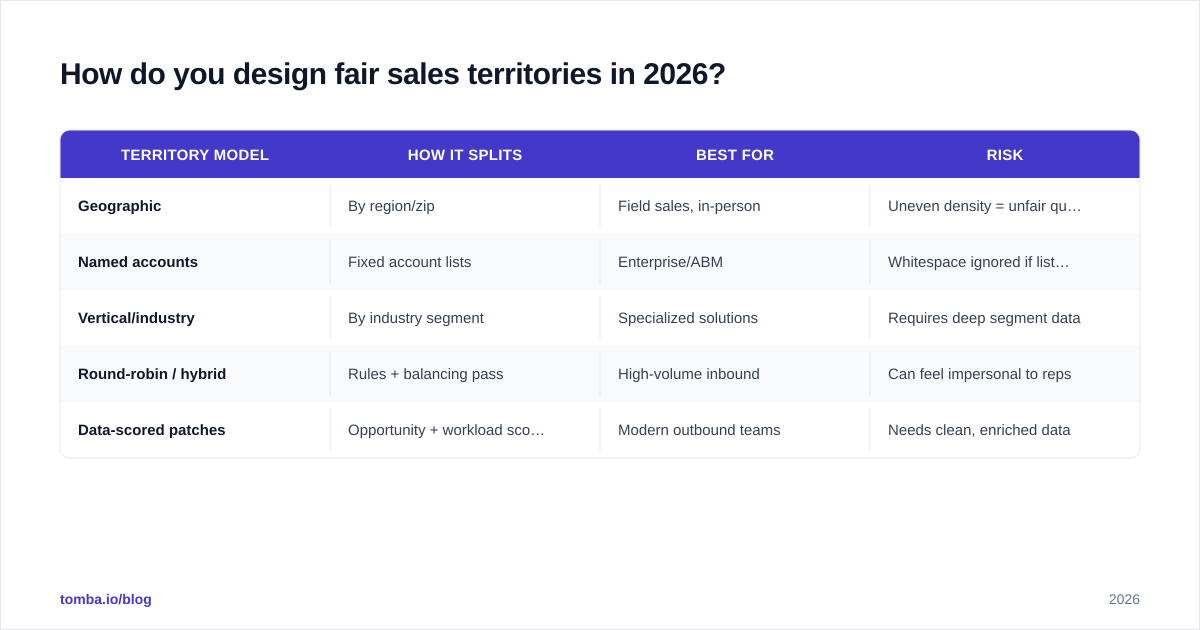
| Territory model | How it splits | Best for | Risk |
|---|---|---|---|
| Geographic | By region/zip | Field sales, in-person | Uneven density = unfair quotas |
| Named accounts | Fixed account lists | Enterprise/ABM | Whitespace ignored if list is stale |
| Vertical/industry | By industry segment | Specialized solutions | Requires deep segment data |
| Round-robin / hybrid | Rules + balancing pass | High-volume inbound | Can feel impersonal to reps |
| Data-scored patches | Opportunity + workload score | Modern outbound teams | Needs clean, enriched data |
The data-scored model wins for most outbound teams, but it has a hard dependency: your account and contact records must be accurate. Territories built on a CRM full of dead companies and bounced emails will always look balanced on the spreadsheet and feel broken in practice. This is where data enrichment earns its keep — before you score and split patches, you refresh firmographics, fill in missing decision-maker contacts, and drop accounts that no longer exist. Splitting a clean list is fair; splitting a rotting one just distributes the rot.
One more rule: publish the math. Reps accept hard territories when they understand how the lines were drawn. They revolt against black-box assignments — even fair ones — because they can't tell whether they were shorted. Transparency is cheaper than turnover.
What separates real sales enablement from onboarding decks?#
Real enablement is continuous and tied to deals in flight; onboarding is a one-time event. The teams that confuse the two run a great first two weeks and then leave reps to figure out months three through twenty-four alone.
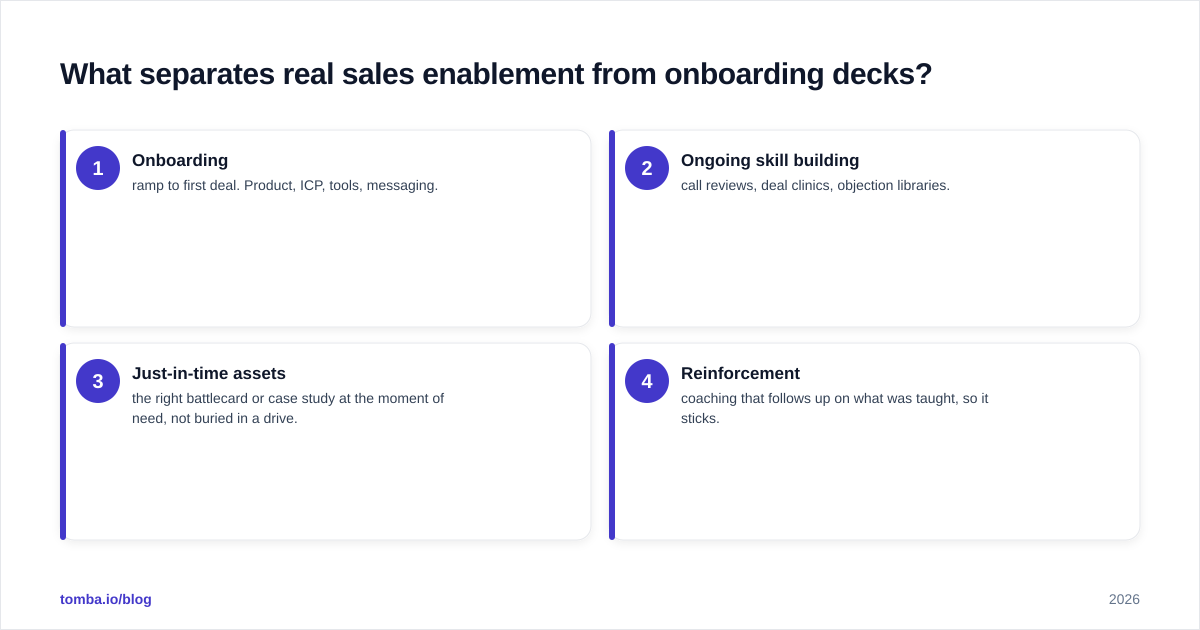
A functional enablement program has four layers:
- Onboarding — ramp to first deal. Product, ICP, tools, messaging.
- Ongoing skill building — call reviews, deal clinics, objection libraries.
- Just-in-time assets — the right battlecard or case study at the moment of need, not buried in a drive.
- Reinforcement — coaching that follows up on what was taught, so it sticks.
The reinforcement layer is where most programs die. HubSpot and Salesforce both publish enablement research showing that skills decay quickly without structured follow-up — training without reinforcement is mostly wasted spend. The cheap fix is a weekly deal clinic where reps bring one live deal and the team pressure-tests it. It costs an hour and reinforces a dozen skills in context.
Enablement also has to cover the top of the funnel, not just closing. If reps can't build a clean prospecting list and reach the right person, downstream coaching is moot. Equip them with a repeatable way to find contacts — whether that's a domain search to map every email at a target company or a quick lookup before a call — so the skill you're coaching actually has at-bats to improve on. The best objection handling in the world is useless against a voicemail for someone who left the company two years ago.
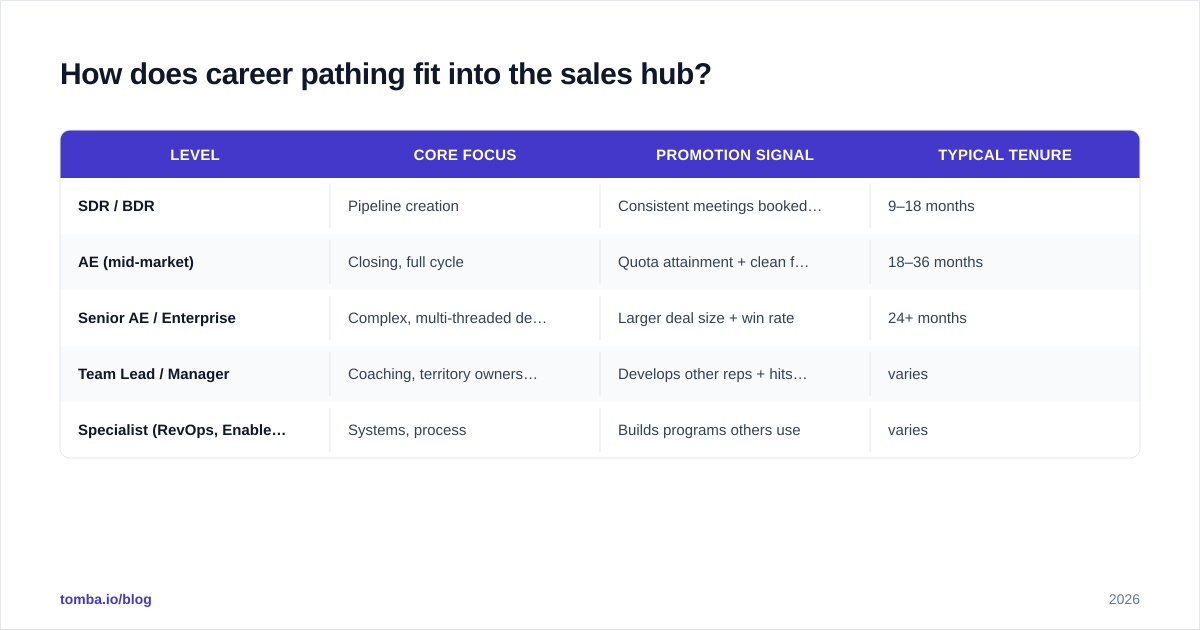
How does career pathing fit into the sales hub?#
Career pathing is the retention layer — and it's the one managers most often improvise. A rep who can't see their next step starts taking recruiter calls, no matter how good their territory or coaching is.
A visible path answers three questions before the rep has to ask: What does the next level look like? What do I have to demonstrate to get there? Roughly how long does it take? When those are written down, the promotion conversation stops being a negotiation and becomes a scorecard review.
| Level | Core focus | Promotion signal | Typical tenure |
|---|---|---|---|
| SDR / BDR | Pipeline creation | Consistent meetings booked + qualified | 9–18 months |
| AE (mid-market) | Closing, full cycle | Quota attainment + clean forecast | 18–36 months |
| Senior AE / Enterprise | Complex, multi-threaded deals | Larger deal size + win rate | 24+ months |
| Team Lead / Manager | Coaching, territory ownership | Develops other reps + hits team number | varies |
| Specialist (RevOps, Enablement) | Systems, process | Builds programs others use | varies |
Notice the last row. Not every strong rep wants to manage people — some are better as specialists in revenue operations or enablement. A career framework that only goes "rep → manager" loses your best individual contributors. Build at least two ladders.
Tie promotion to measurable signals, not tenure or charisma. Win rate, forecast accuracy, and pipeline hygiene are auditable; "seems ready" is not. When the criteria are objective, you also remove the bias that quietly stalls under-networked reps.
What does the quarterly operating cadence look like?#
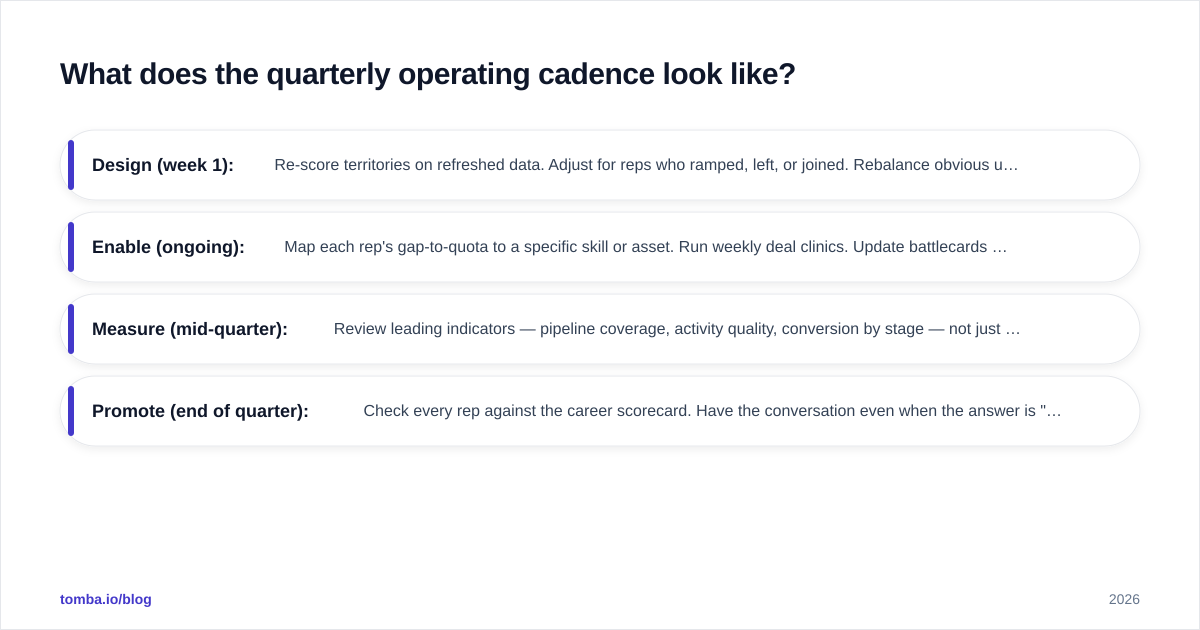
The four pillars only work as a system if you run them on the same clock. Annual planning is too slow for how fast data and intent move in 2026. A quarterly loop keeps everything honest:
- Design (week 1): Re-score territories on refreshed data. Adjust for reps who ramped, left, or joined. Rebalance obvious unfairness.
- Enable (ongoing): Map each rep's gap-to-quota to a specific skill or asset. Run weekly deal clinics. Update battlecards from real lost-deal reasons.
- Measure (mid-quarter): Review leading indicators — pipeline coverage, activity quality, conversion by stage — not just the lagging number.
- Promote (end of quarter): Check every rep against the career scorecard. Have the conversation even when the answer is "not yet, here's the gap."

The discipline here is in the measure step. Most managers stare at quota attainment, which is a lagging indicator — by the time it's red, the quarter is half gone. Watch pipeline coverage and activity quality early, and you can redirect enablement or even adjust a territory before the number is lost.
This is also where bad data quietly sabotages good management. If a rep's pipeline coverage looks thin, is it a skill problem, a territory problem, or a contact-data problem? You can't tell unless the underlying records are trustworthy. Teams that invest in keeping contact data current — valid emails, reachable phone numbers, accurate titles — can actually diagnose the cause instead of guessing. A quick way to keep reps unblocked is giving them direct-dial access through a phone finder so coverage gaps don't turn into coaching mysteries.
How do you tie data quality to all four pillars?#
Data is the floor the whole hub stands on. Here's the concrete dependency in each pillar:
- Management: You manage what you measure. Garbage CRM data means garbage forecasts and misdirected coaching.
- Enablement: Reps can't practice skills against contacts who don't exist. Clean lists create at-bats.
- Territory: Fair splits require accurate firmographics and live account status.
- Career: Promotion signals like win rate are only meaningful if pipeline data is real.
The practical move is to make data hygiene a recurring task, not a heroic one-time cleanup. Verify before you load, enrich on a schedule, and dedupe before territory planning. You can check our notes on data sources and accuracy for how that pipeline works in practice, and validate lists with an email verifier before they ever reach a rep's queue. A territory map built on verified contacts is a plan; one built on a stale export is a liability you've handed your team.
What's the simplest way to start if I run a small team?#
Don't build the whole system at once. Pick the pillar that's bleeding the most and fix it this quarter:
- Reps quitting? Start with career pathing — write the ladder and have one honest conversation per rep.
- Reps missing quota despite effort? Audit territory fairness before you touch coaching.
- New hires ramping slowly? Build the enablement reinforcement loop — weekly deal clinics.
- Forecasts always wrong? Fix data hygiene and your management metrics first.
Then, next quarter, connect the pillar you fixed to the next one. Within a year you have a real hub instead of four disconnected initiatives. The point isn't to copy a giant enterprise program — it's to make sure the four levers you already pull every week are pulling in the same direction.
The bottom line#
Sales management, enablement, territory, and career pathing fail in isolation and compound together. The manager who designs territory and enablement in the same room, measures leading indicators on a quarterly clock, and shows every rep a written path will out-retain and out-perform the one running four disconnected programs — even with the same headcount and budget.
All of it sits on contact data you can trust. Before you score a single territory or coach a single call, make sure your reps can actually reach the right people. Tomba's Email Finder gives your team verified professional emails by name, domain, or company, so the patches you design and the pipeline you coach are built on contacts that are real — not a spreadsheet of bounces. Start on the free tier with 25 searches a month, and scale to a paid plan when your territory planning depends on it.
// get started
Find, verify and enrich your first contacts today
Start on the free plan with 25 searches a month, then scale when your team is ready.
Free plan · No credit card required · GDPR & CCPA
// about the author