Sales Hub Sales Process Pipeline Foundations (2026 Guide)
A practical 2026 framework for building sales process and pipeline foundations in a sales hub — stages, exit criteria, hygiene, and the data that keeps deals moving.
Your pipeline is only as honest as the rules that govern it. Most teams running a "sales hub" — HubSpot Sales Hub, Salesforce, Pipedrive, or any central CRM — have stages with names but no definitions. The result is a forecast nobody trusts and deals that sit untouched for weeks. This guide fixes the foundation.
TL;DR#
- A sales process is the repeatable set of stages a deal moves through; a pipeline is the live view of those deals at each stage. You need both defined, in writing.
- Every stage needs exit criteria — objective, verifiable conditions — not vibes. "Demo done" is not exit criteria; "decision-maker confirmed budget and timeline" is.
- Pipeline hygiene (stale-deal rules, mandatory next steps, close-date discipline) matters more than fancy automation.
- Clean contact data feeds the whole system. Garbage leads in means garbage forecasts out — enrichment and verification are foundation work, not nice-to-haves.
- Measure conversion rate by stage, sales velocity, and stage aging. These three tell you where the process actually breaks.
What are sales process and pipeline foundations?#
The conclusion first: your sales process is the recipe, and your pipeline is the kitchen at any given moment. The recipe tells every cook the same steps in the same order; the kitchen view shows you what's on each burner right now. A sales hub without a written recipe is just a list of names cooking at random temperatures.
A sales process is the standardized sequence of stages a deal passes through from first touch to closed-won or closed-lost. A pipeline is the visualization of all open deals distributed across those stages at this moment. Foundations are the rules that connect the two: what each stage means, what must be true to advance, and what data has to be present.
Teams skip this because naming stages feels like doing the work. It isn't. The stage label "Negotiation" means five different things to five reps unless you define it. Foundations turn a subjective judgment ("I think this one's close") into a shared standard ("this deal meets the four conditions for Stage 4").
Why does pipeline hygiene matter more than tooling?#
Because a clean process in a basic CRM beats a messy process in an expensive one every time. According to HubSpot's sales research, the highest-performing teams are not the ones with the most tools — they are the ones with the most consistent behavior. Tools amplify whatever process you already have. Amplifying chaos just gives you faster chaos.
Pipeline hygiene is the set of ongoing habits that keep your data trustworthy:
- Every open deal has a next step with a date. No exceptions.
- Deals that pass their close date get reviewed, not silently rolled forward.
- Stale deals (no activity in X days) get flagged and either re-engaged or closed-lost.
- Stage changes require the exit criteria to be met — enforced by required fields where possible.

Without hygiene, your pipeline inflates. Reps leave dead deals open because closing them as lost feels like admitting failure. Forecasts balloon, leadership plans against fantasy revenue, and the whole system loses credibility. The fix is cultural and structural, not a software purchase.
How do you define stages and exit criteria?#
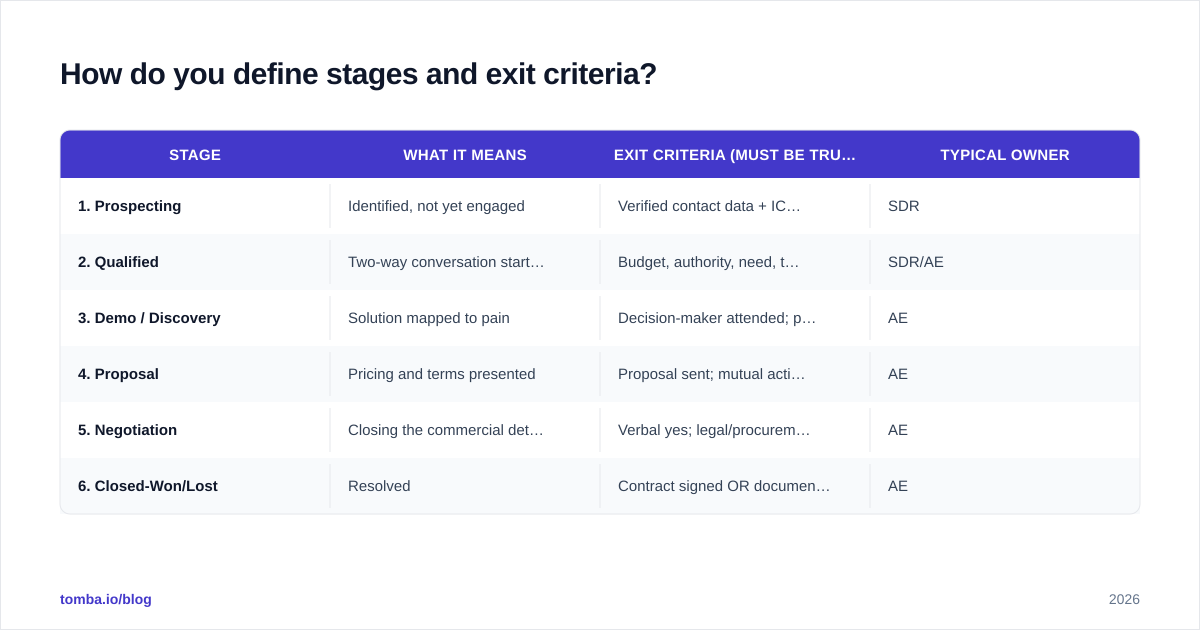
Start with the buyer's journey, not your internal steps. A common B2B foundation looks like this, and each stage earns its place only if it has objective exit criteria.
| Stage | What it means | Exit criteria (must be true to advance) | Typical owner |
|---|---|---|---|
| 1. Prospecting | Identified, not yet engaged | Verified contact data + ICP fit confirmed | SDR |
| 2. Qualified | Two-way conversation started | Budget, authority, need, timeline acknowledged | SDR/AE |
| 3. Demo / Discovery | Solution mapped to pain | Decision-maker attended; pain quantified | AE |
| 4. Proposal | Pricing and terms presented | Proposal sent; mutual action plan agreed | AE |
| 5. Negotiation | Closing the commercial details | Verbal yes; legal/procurement engaged | AE |
| 6. Closed-Won/Lost | Resolved | Contract signed OR documented loss reason | AE |
The single most important column is exit criteria. Notice they are verifiable. "Decision-maker attended" is a yes/no fact. "Felt good about the demo" is not. When you can audit a stage by checking facts, your pipeline stops being a popularity contest.
A few rules that keep stages clean:
- Stages are buyer-verified, not seller-hoped. A deal advances when the buyer does something, not when the rep wishes they would.
- No skipping. If a deal jumps from Qualified to Negotiation, something is undocumented. Backfill it.
- Closed-lost needs a reason code. "No reason" is how you lose the chance to learn.
For a deeper grounding in the vocabulary here, Tomba's B2B glossary defines terms like marketing qualified lead and win rate that you'll reference constantly when writing stage definitions.
What data has to sit underneath the pipeline?#
Clean contact data is the foundation under the foundation. Here's the analogy: your pipeline is a building, and contact data is the soil it sits on. You can engineer the structure perfectly, but if the soil shifts, the whole thing cracks.
Three data problems quietly destroy pipelines:
- Bad email addresses mean your outreach never lands, so Stage 1 conversion looks broken when the real issue is deliverability.
- Missing decision-maker info means reps advance deals without confirming authority, inflating Stage 3 and 4.
- Stale records mean you're forecasting against companies that reorganized or contacts who left.
This is where front-of-pipeline tooling earns its keep. Using an email finder to source verified decision-maker addresses, an email verifier to confirm they're deliverable before they enter the CRM, and data enrichment to fill in title, company size, and role means your Stage 1 entries are real from the start. Garbage that never enters the pipeline never has to be cleaned out later.
A practical rule: no contact enters the pipeline unverified. Verification is a gate, not an afterthought. Run lists through a check before import, and your prospecting stage stops lying to you.
How do you measure whether the foundation works?#
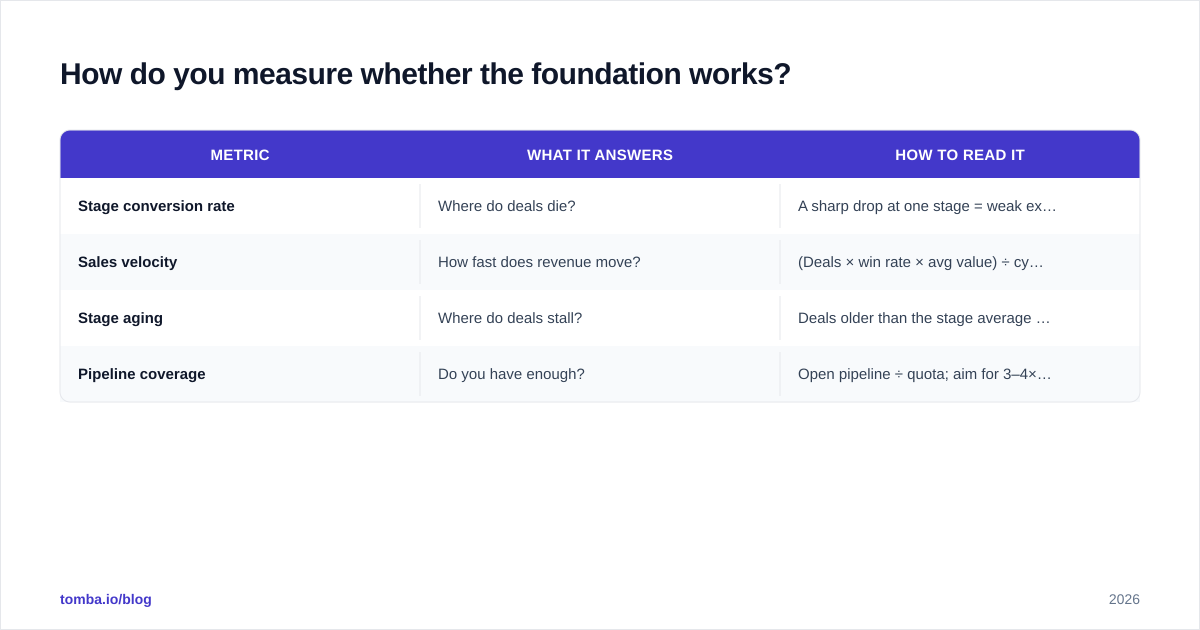
Three metrics tell you almost everything. Track these and you'll find the broken stage fast.
| Metric | What it answers | How to read it |
|---|---|---|
| Stage conversion rate | Where do deals die? | A sharp drop at one stage = weak exit criteria or wrong audience |
| Sales velocity | How fast does revenue move? | (Deals × win rate × avg value) ÷ cycle length |
| Stage aging | Where do deals stall? | Deals older than the stage average need review |
| Pipeline coverage | Do you have enough? | Open pipeline ÷ quota; aim for 3–4× depending on win rate |
Stage conversion rate is your diagnostic tool. If 60% of deals die between Demo and Proposal, your discovery isn't qualifying hard enough — you're demoing to people who can't buy. Fix the exit criteria on the earlier stage, not the proposal template.
Sales velocity is your speedometer. It combines four levers (deal count, win rate, deal size, cycle time) so you can see which one to pull. Shortening cycle time often beats chasing more leads.
Stage aging catches the silent killer: deals that technically sit in "Negotiation" but haven't moved in 45 days. They're dead; they just haven't been buried. Aging reports force the conversation.
For benchmarks on what good looks like, G2's CRM category and analyst notes from Gartner are useful neutral references when you're calibrating targets against peers.
What's the difference between a process and a methodology?#
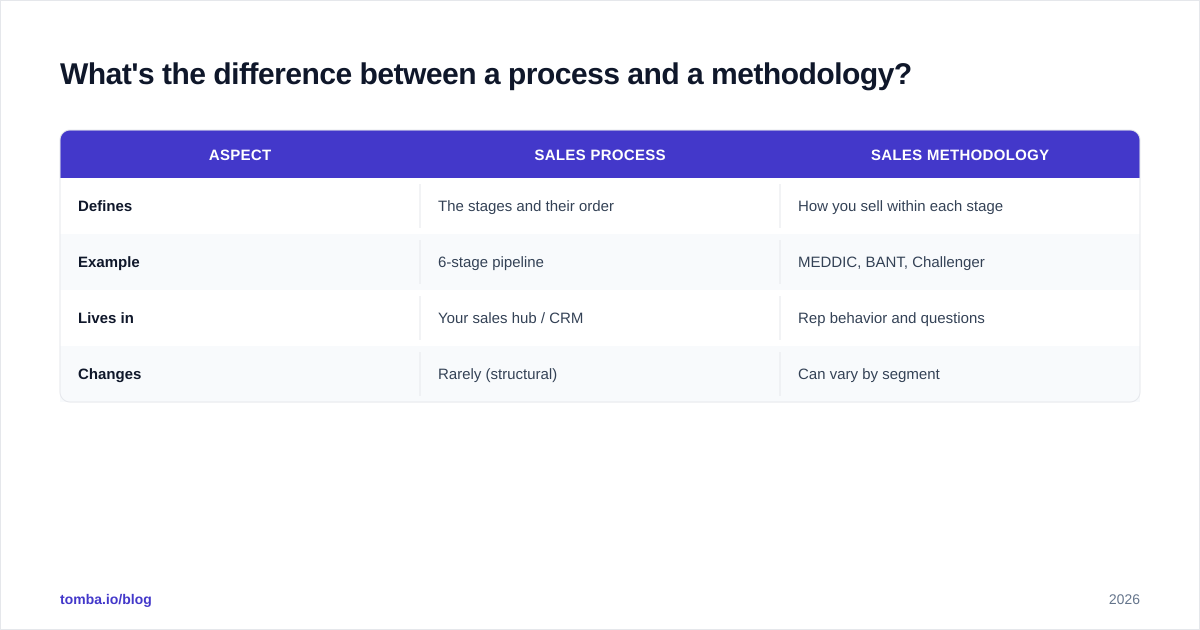
Quick clarification, because teams conflate these. Your process is the stages (Prospecting → Closed). A methodology (MEDDIC, BANT, Challenger, SPIN) is the philosophy you use inside the stages to qualify and advance.
| Aspect | Sales process | Sales methodology |
|---|---|---|
| Defines | The stages and their order | How you sell within each stage |
| Example | 6-stage pipeline | MEDDIC, BANT, Challenger |
| Lives in | Your sales hub / CRM | Rep behavior and questions |
| Changes | Rarely (structural) | Can vary by segment |
You need both, but get the process right first. A brilliant methodology applied to undefined stages still produces an untrustworthy pipeline. The process is the skeleton; the methodology is the muscle. No skeleton, nothing to attach the muscle to.
When you're ready to layer in automation — routing, reminders, sequence triggers — connect your hub through integrations like HubSpot, Salesforce, or Pipedrive so verified data flows in automatically rather than through manual paste-ins.
How do you roll this out without breaking the team?#
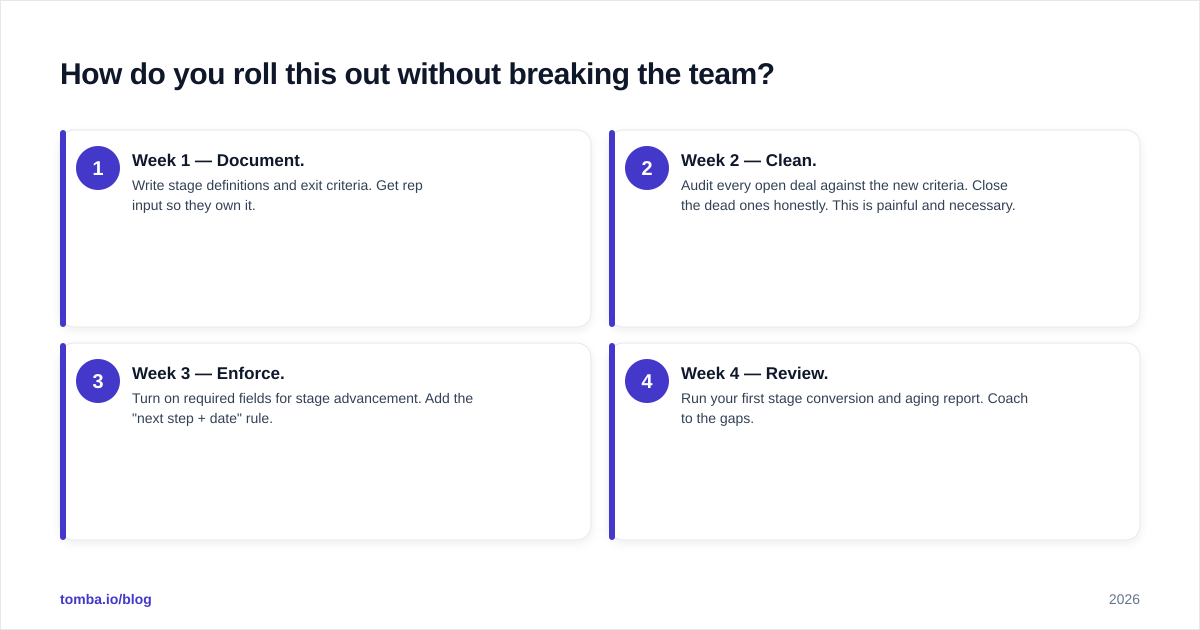
Conclusion first: change the rules in one stage at a time, and audit weekly. Big-bang process overhauls fail because reps revert under quota pressure.
A 30-day rollout that actually sticks:
- Week 1 — Document. Write stage definitions and exit criteria. Get rep input so they own it.
- Week 2 — Clean. Audit every open deal against the new criteria. Close the dead ones honestly. This is painful and necessary.
- Week 3 — Enforce. Turn on required fields for stage advancement. Add the "next step + date" rule.
- Week 4 — Review. Run your first stage conversion and aging report. Coach to the gaps.
The hardest part is Week 2. A pipeline that drops 30% after cleanup wasn't shrinking — it was finally telling the truth. Leadership has to expect and welcome that number.
The bottom line#
Sales process and pipeline foundations come down to three things: defined stages with verifiable exit criteria, ongoing hygiene that keeps the data honest, and clean contact records feeding the front of the funnel. Get those right in whatever sales hub you run, and the fancy automation you add later will actually have something solid to amplify.
The cheapest, highest-leverage fix is at the very top: stop letting unverified contacts into your pipeline. Tomba's Email Finder sources verified, deliverable decision-maker emails by name, domain, or company — so Stage 1 starts with real prospects instead of bounces. Pair it with the email verifier as an import gate and your foundation holds. Start free with 25 searches a month, or see Tomba pricing for the Starter plan at $49/mo when you're ready to scale prospecting volume.
// get started
Find, verify and enrich your first contacts today
Start on the free plan with 25 searches a month, then scale when your team is ready.
Free plan · No credit card required · GDPR & CCPA
// about the author