Sales Hub Sales Process & Pipeline Methodologies (2026 Guide)
How to build a repeatable sales process and clean pipeline inside HubSpot Sales Hub in 2026 — stages, methodologies, automation, and the data layer most teams forget.
You bought HubSpot Sales Hub to make selling predictable. Then six months later your pipeline is a graveyard of deals stuck in "Qualified," your forecast is a guess, and every rep runs a slightly different playbook in their head. The tool is not the problem. The missing layer is a documented sales process, a pipeline that mirrors it, and a methodology that tells reps what "qualified" actually means.
This guide shows you how to wire all three together inside Sales Hub for 2026 — and where the data underneath quietly decides whether any of it works.
TL;DR#
- A sales process is the repeatable sequence of stages a deal moves through; a pipeline is the visual board in Sales Hub that displays it; a methodology (MEDDIC, BANT, SPICED) is the decision logic reps use to advance deals.
- Most teams skip straight to building pipeline stages without defining exit criteria — that is why deals rot and forecasts lie.
- Pick one methodology and encode it as required deal properties, not as a wiki page nobody reads.
- Sales Hub automation (workflows, deal rotation, sequences) only pays off after the process is documented — automating chaos just produces faster chaos.
- The cheapest forecast killer is dirty contact data. Verified emails and enriched records feed every downstream stage.
What is the difference between a sales process, a pipeline, and a methodology?#
People use these three words interchangeably and then wonder why their team is misaligned. They are different layers.
Think of it like cooking in a busy kitchen. The process is the recipe — the ordered steps from raw ingredients to plated dish. The pipeline is the ticket rail where orders hang so the line cooks can see what stage each dish is at. The methodology is the chef's judgment about whether a dish is actually ready to send out. You need all three; a recipe with no judgment burns food, and judgment with no recipe can't scale past one cook.
In Sales Hub terms:
- Process = your documented stages and the exit criteria for each.
- Pipeline = the deal board with those stages as columns.
- Methodology = the qualification framework, stored as deal and contact properties so it is enforced, not optional.
Get the layering wrong and you build a beautiful pipeline on top of an undefined process. That is the single most common Sales Hub failure mode.

How do you map a sales process to HubSpot pipeline stages?#
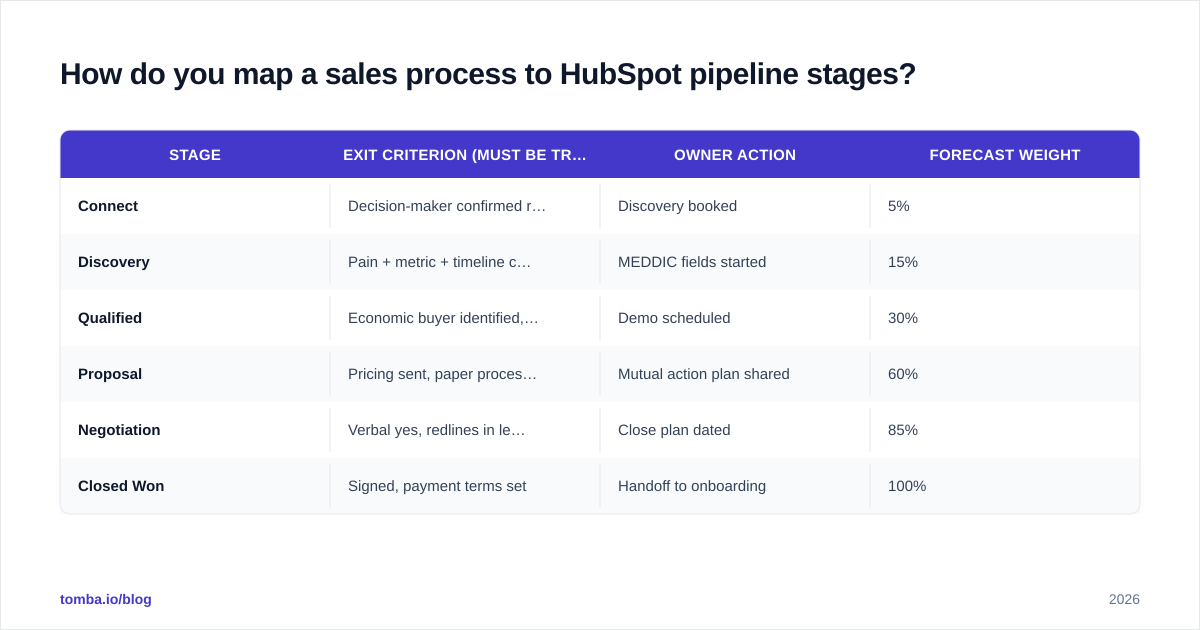
Start with the buyer, not the CRM. Write down the actual decisions your buyer makes between "never heard of you" and "signed." Each buyer decision becomes a stage, and each stage gets an exit criterion — a concrete, observable event that must be true before the deal moves forward.
A workable B2B default looks like this:
| Stage | Exit criterion (must be true to advance) | Owner action | Forecast weight |
|---|---|---|---|
| Connect | Decision-maker confirmed reachable; verified email on record | Discovery booked | 5% |
| Discovery | Pain + metric + timeline captured | MEDDIC fields started | 15% |
| Qualified | Economic buyer identified, budget range known | Demo scheduled | 30% |
| Proposal | Pricing sent, paper process mapped | Mutual action plan shared | 60% |
| Negotiation | Verbal yes, redlines in legal | Close plan dated | 85% |
| Closed Won | Signed, payment terms set | Handoff to onboarding | 100% |
Notice the weights are tied to exit criteria, not to rep optimism. In Sales Hub you set these as deal stage probabilities, and your weighted forecast inherits them automatically. If a rep wants to call a deal 60%, the deal has to physically sit in Proposal — which means pricing was actually sent. That removes the argument from your forecast review and replaces it with evidence. (For the mechanics of stage probability and rotation, HubSpot's own Sales Hub documentation is the canonical reference.)
Keep stages to six or fewer. Every extra stage is a place for deals to hide. If you can't write a one-sentence exit criterion for a stage, it is not a real stage — it is a status, and statuses belong in a property field, not on your board.
Which sales methodology fits Sales Hub best?#
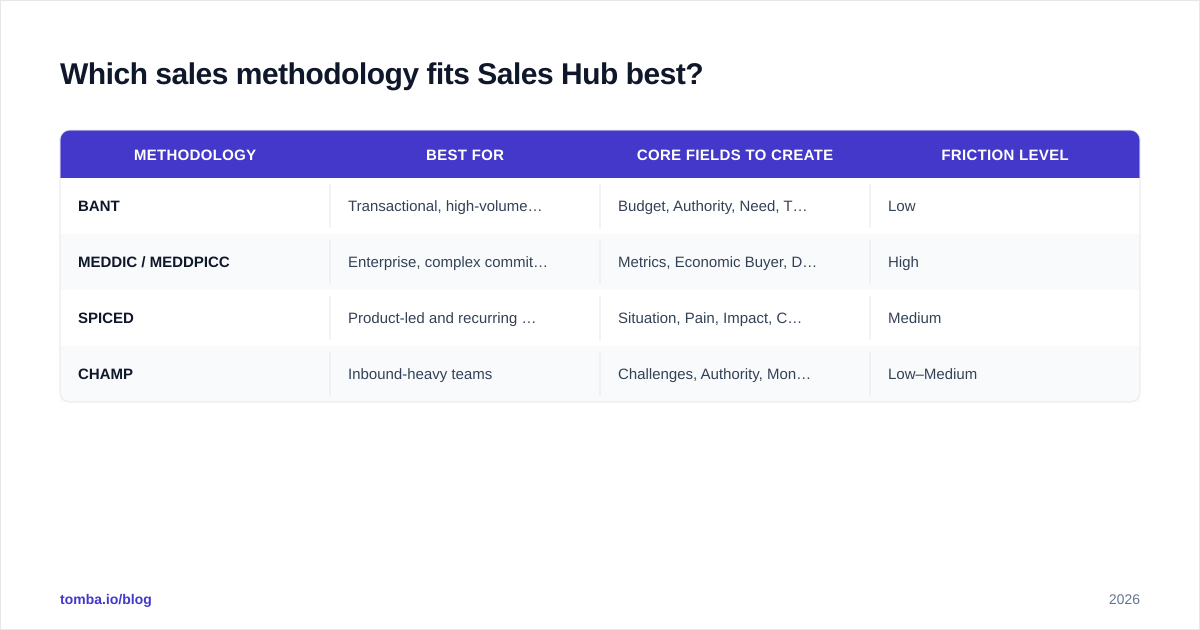
The honest answer: the one your reps will actually fill in. A methodology only works when it is encoded as required fields that gate stage progression. Here is how the common frameworks map onto Sales Hub deal properties.
| Methodology | Best for | Core fields to create | Friction level |
|---|---|---|---|
| BANT | Transactional, high-volume SMB | Budget, Authority, Need, Timeline | Low |
| MEDDIC / MEDDPICC | Enterprise, complex committees | Metrics, Economic Buyer, Decision Criteria, Decision Process, Pain, Champion | High |
| SPICED | Product-led and recurring revenue | Situation, Pain, Impact, Critical Event, Decision | Medium |
| CHAMP | Inbound-heavy teams | Challenges, Authority, Money, Prioritization | Low–Medium |
For most teams running Sales Hub Professional, BANT or SPICED hits the sweet spot: enough rigor to qualify out junk, not so much that reps abandon the form. Reserve MEDDIC for genuinely enterprise motions where a single deal justifies twenty minutes of data entry. Software review sites like G2 are useful for seeing which methodologies the tooling ecosystem actually supports natively.
The implementation move that matters: turn each methodology element into a deal property, then build a required-property rule so a deal cannot move from Discovery to Qualified until the economic buyer field is filled. That is the difference between a methodology and a poster on the wall.

How do you automate the pipeline without breaking it?#
Automate the boring, gate the important, and never automate a step you have not first done manually a hundred times.
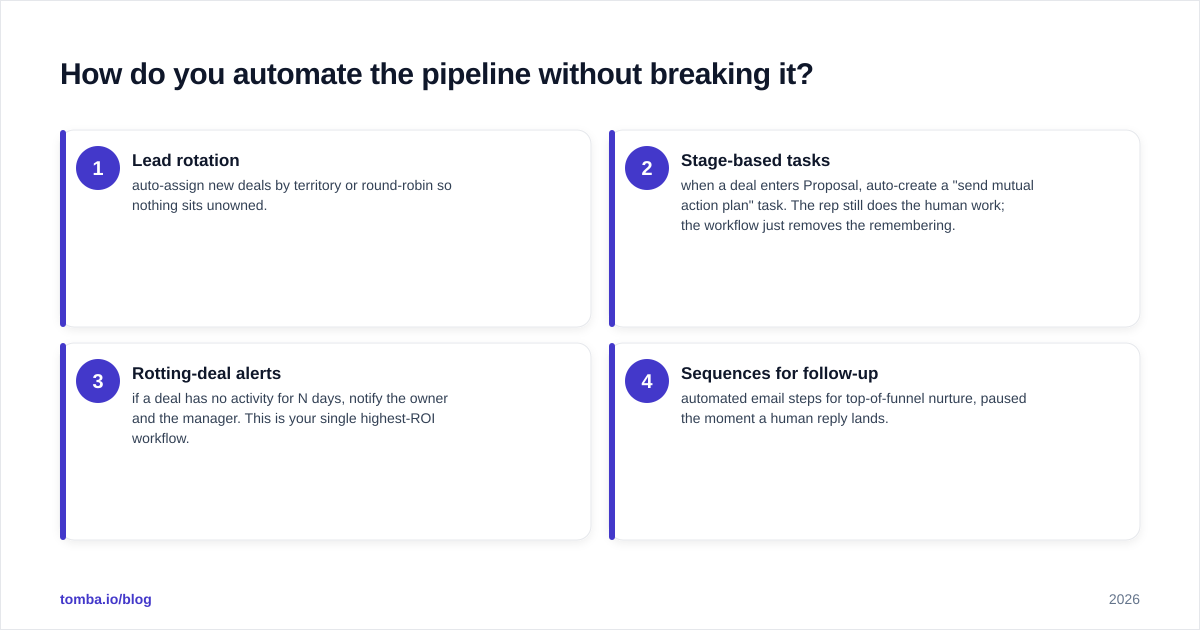
Sequence your build in this order:
- Lead rotation — auto-assign new deals by territory or round-robin so nothing sits unowned.
- Stage-based tasks — when a deal enters Proposal, auto-create a "send mutual action plan" task. The rep still does the human work; the workflow just removes the remembering.
- Rotting-deal alerts — if a deal has no activity for N days, notify the owner and the manager. This is your single highest-ROI workflow.
- Sequences for follow-up — automated email steps for top-of-funnel nurture, paused the moment a human reply lands.
What you should not automate: stage advancement based on email opens, auto-closing deals as lost, or anything that fakes activity. Those inflate vanity metrics and corrode forecast trust. If you want the deeper logic behind triggers and gating, our primer on sales automation breaks down where automation helps versus where it hides problems.
A practical guardrail: every automation should make a true thing visible faster, never make a false thing look true.
Why does pipeline data quality decide whether any of this works?#
Because a methodology runs on inputs, and garbage inputs produce a confident, wrong forecast. The most expensive failures in Sales Hub are not process failures — they are data failures wearing a process costume.
Three data problems quietly break the best pipeline design:
- Unreachable contacts. A deal in "Connect" with a bounced or guessed email is not in your pipeline; it is noise. Reps mark activity, the stage probability counts it, and your forecast inherits a phantom. Running new contacts through an email verifier before they ever hit a stage keeps the top of funnel honest.
- Missing decision-maker info. MEDDIC's "Economic Buyer" field is only as good as your ability to actually find that person. When reps log a deal but can't reach the buyer, the methodology silently degrades. An email finder and data enrichment close that gap by filling verified contact details into the deal record.
- Duplicate and stale records. Two deals for one account double-count your forecast. A clean B2B database and routine dedupe keep weighted pipeline math trustworthy.
Here is the chain reaction: verified data → reliable stage entry → honest exit criteria → trustworthy weighted forecast. Skip the first link and every downstream number is fiction. This is also why teams that obsess over pipeline reporting but ignore contact hygiene keep missing forecast by 30% — the board looks disciplined while the underlying records are guesses.
How do you measure whether the process is working?#
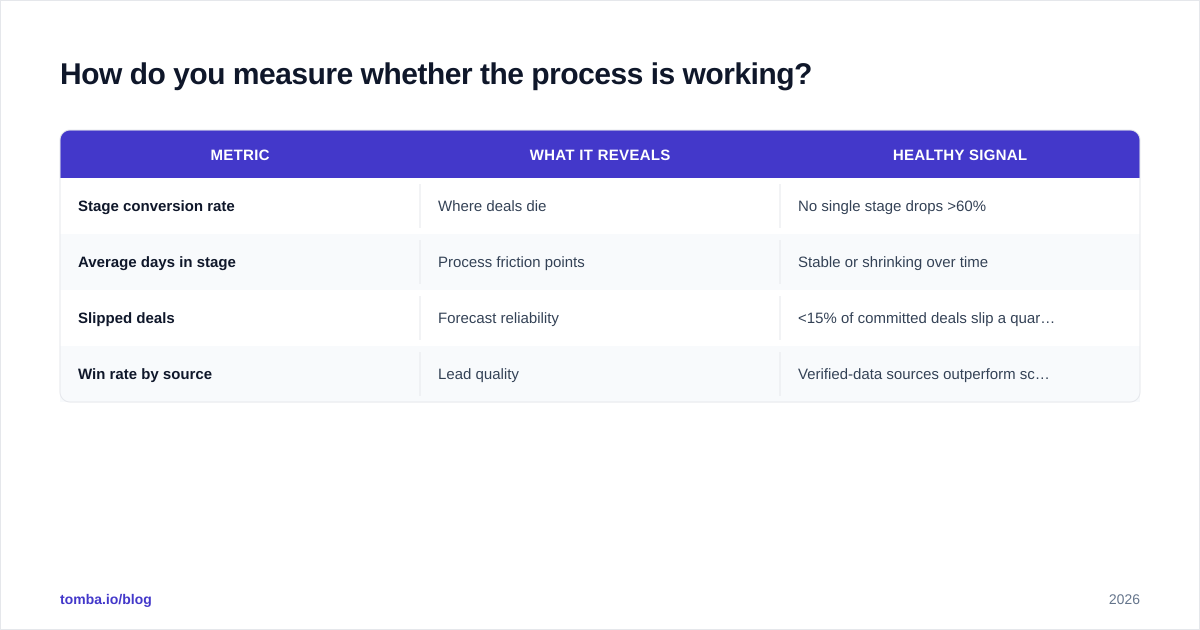
Track movement, not just totals. A growing pipeline is meaningless if nothing converts.
The metrics that tell the truth:
| Metric | What it reveals | Healthy signal |
|---|---|---|
| Stage conversion rate | Where deals die | No single stage drops >60% |
| Average days in stage | Process friction points | Stable or shrinking over time |
| Slipped deals | Forecast reliability | <15% of committed deals slip a quarter |
| Win rate by source | Lead quality | Verified-data sources outperform scraped lists |
Watch stage-to-stage conversion like a doctor watches blood pressure. If 70% of deals die between Discovery and Qualified, your exit criterion for Discovery is too loose — reps are advancing deals that were never real. That is a methodology fix, not a motivation problem. Pair this with a clear definition of your win rate so the whole team measures the same thing.
Review these in your weekly pipeline meeting and let the numbers, not the loudest rep, drive which deals get attention. For a broader benchmark of what good RevOps reporting looks like, analyst resources from Gartner are a solid reality check against your internal assumptions.
What does a 30-day Sales Hub rollout look like?#
You do not boil the ocean. You sequence it.
- Week 1 — Document. Write the stages and exit criteria on one page. Get sales and leadership to sign off before touching the CRM.
- Week 2 — Build. Create the pipeline, deal properties for your chosen methodology, and stage probabilities. No automation yet.
- Week 3 — Clean. Verify and enrich existing contacts, dedupe deals, and backfill methodology fields on open deals.
- Week 4 — Automate and train. Turn on rotation, rotting-deal alerts, and stage tasks. Run reps through the new exit criteria with live deals.
The order is deliberate: document before you build, clean before you automate. Teams that reverse this spend month two untangling automated workflows that fire on dirty data.
Final take and where to start#
A sales hub sales process pipeline methodology stack is three layers — documented process, mirrored pipeline, enforced methodology — sitting on a foundation of clean, verified contact data. Get the layers in order and Sales Hub turns from an expensive contact database into an actual forecasting engine. Skip the data foundation and you have built a precise machine for being confidently wrong.
Start with the cheapest, highest-leverage fix: make sure the contacts entering your pipeline are real. Run your inbound and prospected leads through the Tomba Email Finder to capture verified, decision-maker email addresses before they ever hit a deal stage — so your MEDDIC fields, your stage probabilities, and your weighted forecast are built on people you can actually reach. Pair it with the free tier (25 searches a month) to test it against your messiest pipeline segment, then scale into the Starter plan at $49/mo once the lift in connect rates is obvious. Clean data first; everything else compounds from there.
// get started
Find, verify and enrich your first contacts today
Start on the free plan with 25 searches a month, then scale when your team is ready.
Free plan · No credit card required · GDPR & CCPA
// about the author