HubSpot Sales Hub: From Pipeline to Closing — 2026 Guide
How to run a clean sales process in HubSpot Sales Hub — from pipeline stages to handling objections, negotiating, and closing more deals in 2026.
TL;DR
- A sales process is the repeatable sequence your team runs every deal through; a pipeline is the visual snapshot of where those deals sit right now. Sales Hub turns both into one workspace.
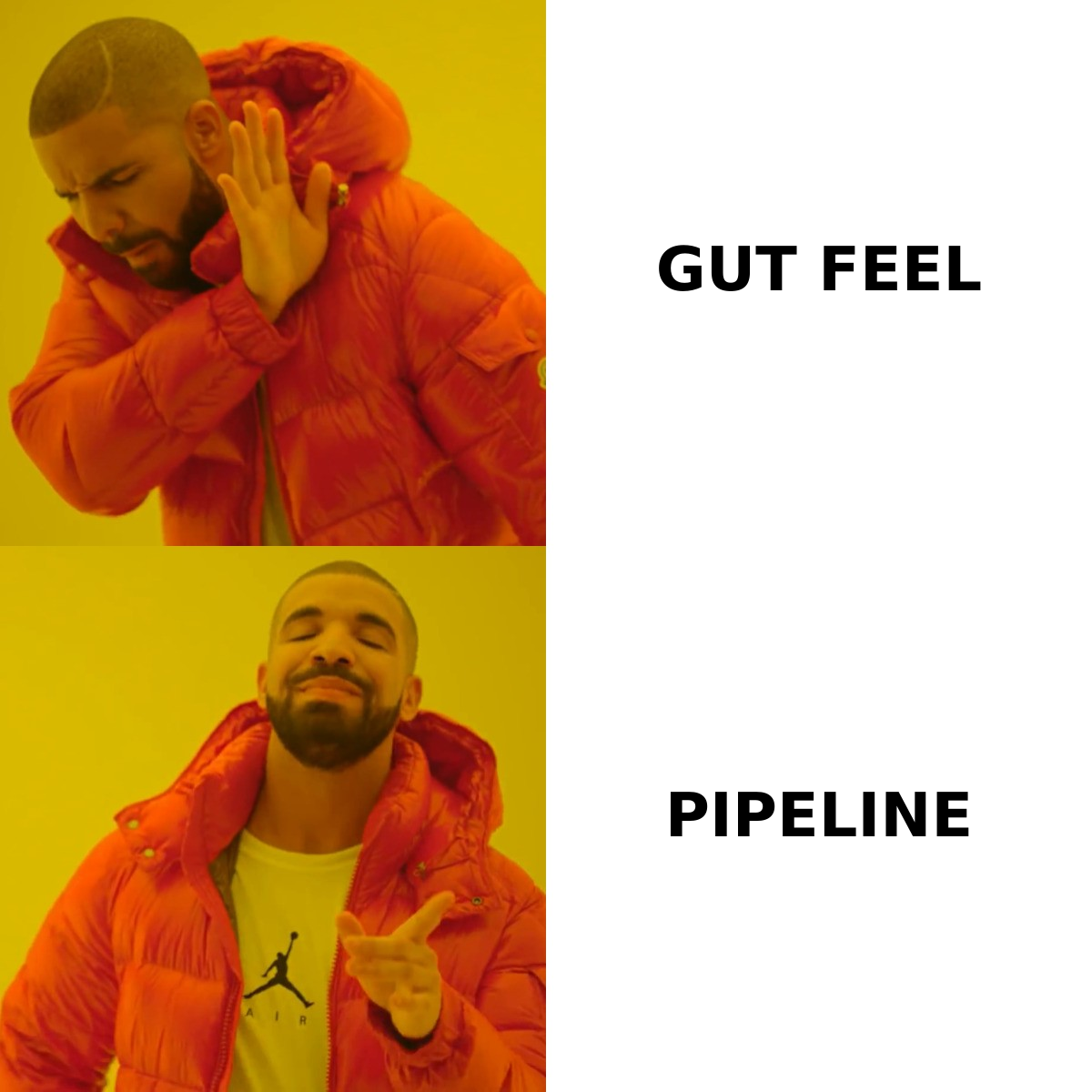
- Pipeline stages should map to buyer actions you can verify — not to your internal feelings about a deal.
- Objections are buying signals, not rejections. Categorize them (budget, authority, need, timing) and you handle 80% with four scripted moves.
- Negotiation starts the moment you give a price. Anchor early, trade concessions, and never discount without getting something back.
- Closing is the natural end of a well-run process, not a magic phrase. If you're "always closing," your stages are broken.
What is the difference between a sales process and a pipeline?#
Your sales process is the recipe; your pipeline is the photo of what's currently cooking. The process is the fixed sequence of steps every opportunity moves through — connect, qualify, demo, propose, negotiate, close. The pipeline is the live view inside your CRM showing which deals are at which step and how much revenue each represents.
People conflate the two because tools like HubSpot Sales Hub render them in the same board. But they answer different questions. The process answers "what should happen next on this deal?" The pipeline answers "are we going to hit the number this quarter?" You need both, and they have to agree with each other. When reps invent their own steps, the pipeline becomes fiction and forecasting collapses.
The fix is to define a small number of stages — usually five to seven — where each stage represents a buyer commitment you can observe, not a seller hope. "Demo scheduled" is observable. "Customer is interested" is not.
How should you structure pipeline stages in Sales Hub?#
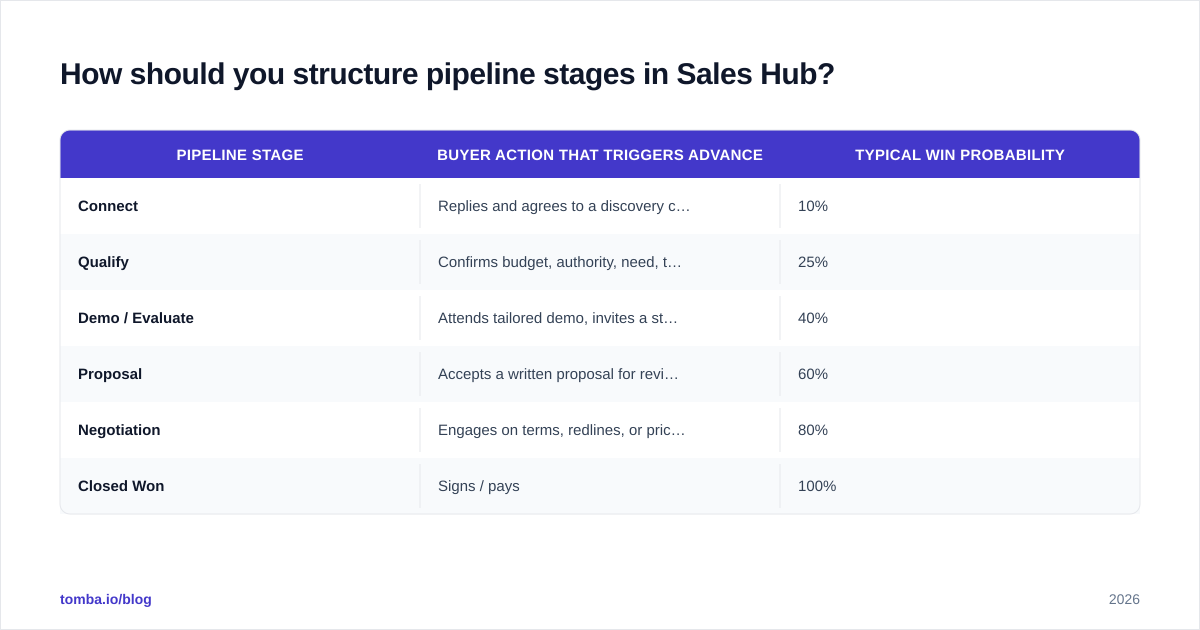
Anchor every stage to an exit criterion the buyer controls. Below is a stage model that works for most mid-market B2B teams, with the verifiable action that lets a deal move forward.
| Pipeline stage | Buyer action that triggers advance | Typical win probability |
|---|---|---|
| Connect | Replies and agrees to a discovery call | 10% |
| Qualify | Confirms budget, authority, need, timeline | 25% |
| Demo / Evaluate | Attends tailored demo, invites a stakeholder | 40% |
| Proposal | Accepts a written proposal for review | 60% |
| Negotiation | Engages on terms, redlines, or pricing | 80% |
| Closed Won | Signs / pays | 100% |
Two rules keep this honest. First, a deal can only sit in a stage if the buyer action has actually occurred — no "I think they'll sign." Second, probabilities are not vibes; they're derived from your historical conversion between stages. HubSpot's deal stage probabilities and weighted-pipeline reporting let you back these numbers with data instead of optimism. If you want a primer on the metrics that feed this, the sales win rate definition is a useful reference.
A clean pipeline also depends on clean data going in. Reps waste hours chasing contacts who bounced or never existed. Feeding verified contact data into your CRM at the top — using an email verifier before a record ever becomes a deal — keeps the early stages from clogging with dead leads.
How do you qualify deals so the pipeline stays accurate?#
Qualify against a framework, then enforce it as a stage gate. BANT (Budget, Authority, Need, Timeline) is the simplest; MEDDIC and SPICED go deeper for complex enterprise motions. The framework matters less than the discipline of applying the same one every time.
The practical move: make "Qualify" a stage a deal cannot leave until all four BANT fields are filled in the deal record. In Sales Hub you can enforce this with required properties and stage-based automation that flags or blocks an advance if fields are empty. This single rule eliminates most "happy ears" deals that inflate the forecast and then vanish.
Qualification also depends on reaching the right person. A deal stalls when you've been talking to a champion with no budget authority. Enriching the account with verified decision-maker contacts — pulling the buying committee with a domain search — lets you confirm authority instead of assuming it.
How do you handle objections during the sales process?#
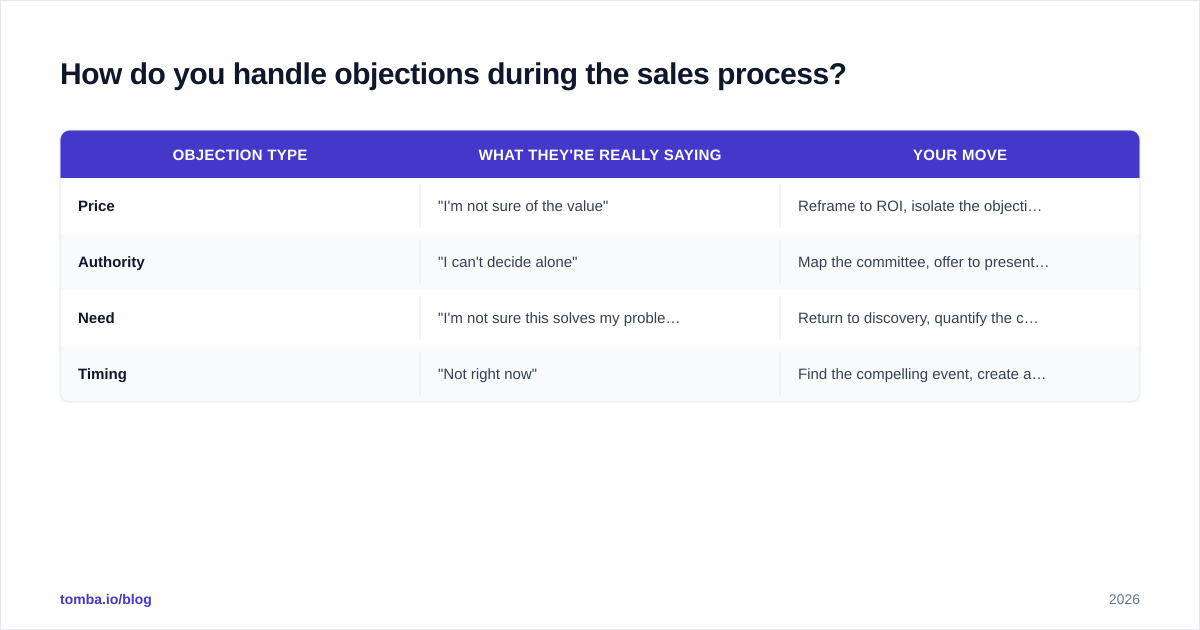
Treat objections as requests for information, then route each to a category with a prepared response. Most objections fall into four buckets, and you can prepare two or three moves for each.
| Objection type | What they're really saying | Your move |
|---|---|---|
| Price | "I'm not sure of the value" | Reframe to ROI, isolate the objection, defer discount |
| Authority | "I can't decide alone" | Map the committee, offer to present to the decider |
| Need | "I'm not sure this solves my problem" | Return to discovery, quantify the cost of inaction |
| Timing | "Not right now" | Find the compelling event, create a small next step |
The universal structure underneath all four is the same: acknowledge, clarify, respond, confirm. Acknowledge so the buyer feels heard ("That's a fair concern"). Clarify so you solve the real issue, not the surface one ("When you say it's expensive, compared to what?"). Respond with evidence. Then confirm you've resolved it before moving on ("Does that address it?").
The most expensive mistake is answering an objection that wasn't asked. When a buyer says "it's too expensive," that can mean the budget is real, the value is unclear, or they're testing for a discount. Clarify first. HubSpot's own sales objection-handling guidance is a solid library of category-specific scripts if you want to build a team playbook.
How do you negotiate without just discounting?#
Negotiate by trading, never by giving. The moment you discount unilaterally, you've taught the buyer that your price is fake and your first number was a lie. Every concession should buy you something — a faster close, a longer term, a case study, a multi-year commitment, removal of a custom requirement that inflates your cost.
Three principles carry most B2B negotiations:
Anchor first and high. The first number framed becomes the reference point for everything after. If you let the buyer anchor with "we have $10k," you'll negotiate down from their number, not yours.
Isolate the objection before conceding. Ask "if we solve the price, is there anything else between us and signing?" This surfaces hidden blockers so you don't discount your way past one obstacle into another.
Trade in their currency. A startup values cash flow, so offer quarterly billing instead of a lower price. An enterprise values risk reduction, so offer a pilot or an SLA. You preserve margin by giving what's cheap to you but valuable to them.
For a deeper academic grounding, the negotiation literature on distributive vs. integrative bargaining explains why "growing the pie" beats splitting it — integrative deals close faster and renew better.
What actually closes a deal in 2026?#
Closing is the result of a process run correctly, not a clever line at the end. If your discovery was thorough, your demo was tailored, your objections were handled, and your negotiation traded fairly, the close is administrative. The buyer expects it.
That said, a few closing techniques still earn their place when used honestly:
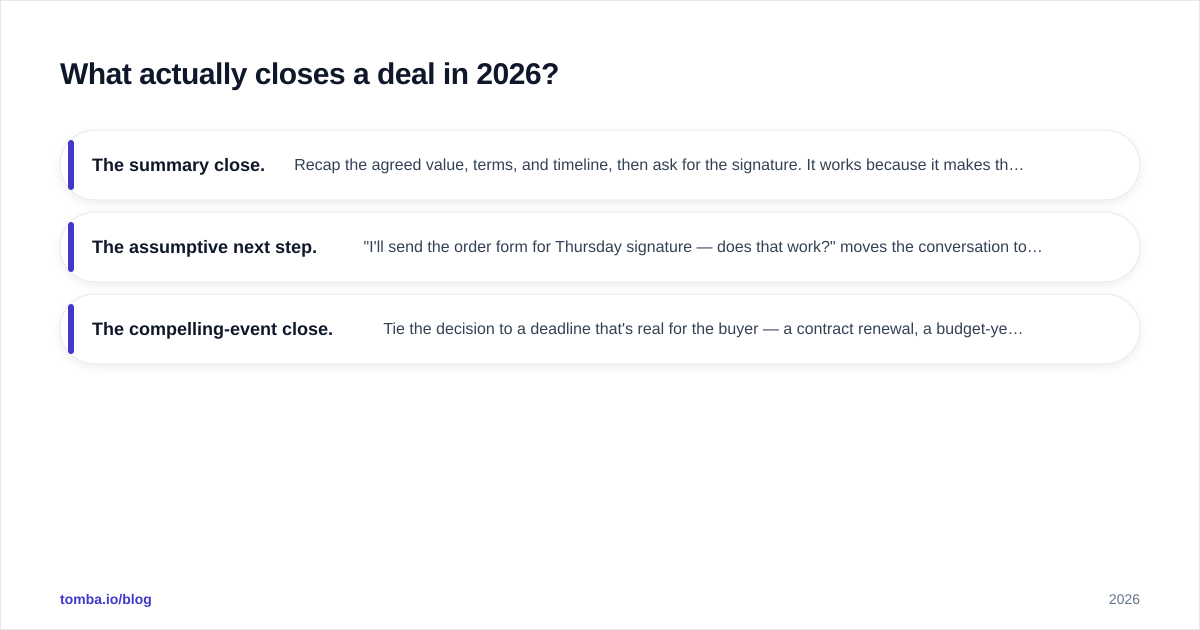
- The summary close. Recap the agreed value, terms, and timeline, then ask for the signature. It works because it makes the decision feel like a confirmation of choices already made.
- The assumptive next step. "I'll send the order form for Thursday signature — does that work?" moves the conversation to logistics.
- The compelling-event close. Tie the decision to a deadline that's real for the buyer — a contract renewal, a budget-year cutoff, a launch date.
What does not work in 2026: pressure tactics, fake scarcity, and the manipulative one-liners that fill old sales books. Modern B2B buyers research independently, talk to peers, and check G2 reviews before they ever reply to you. A pushy close on a well-informed buyer ends the deal. Your leverage is competence, not pressure.
The other quiet killer of closes is a broken handoff between marketing and sales. When the lead's response rate data and contact details are wrong, reps burn cycles re-qualifying instead of advancing. Accurate contact and account data — captured once and enriched — keeps momentum through the final stages.
How do you measure whether your sales process is working?#
Track conversion between stages, not just the final win rate. A single win-rate number hides where deals actually die. If 70% of deals stall between Proposal and Negotiation, your pricing or your stakeholder mapping is the problem — and no amount of "closing harder" fixes it.
The four metrics that tell the real story:
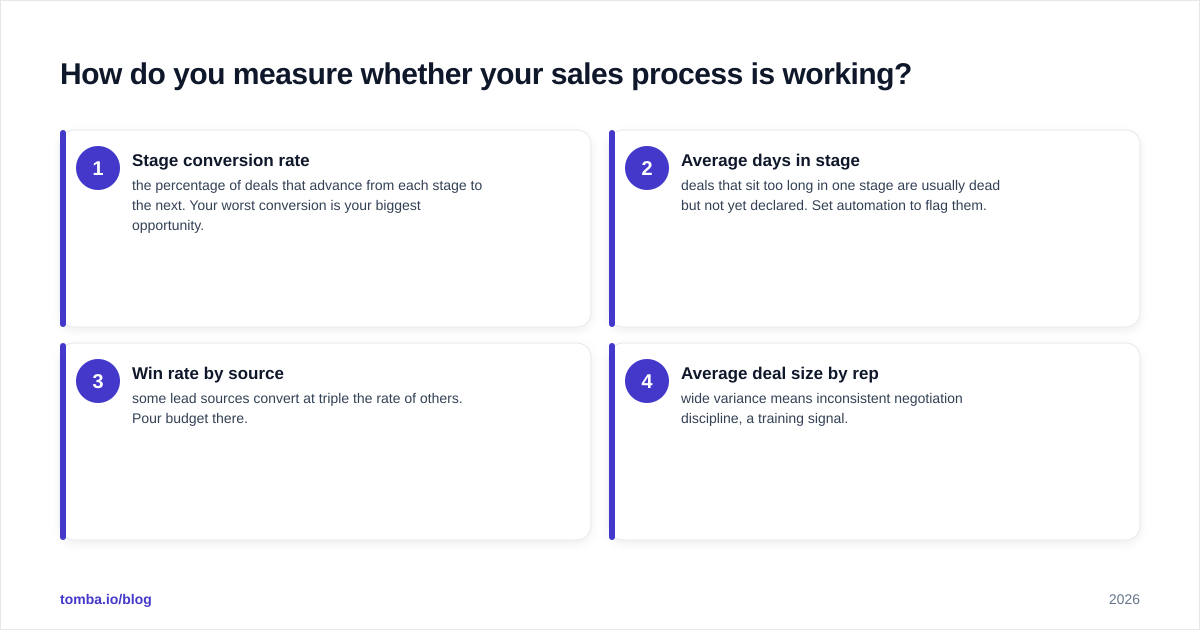
- Stage conversion rate — the percentage of deals that advance from each stage to the next. Your worst conversion is your biggest opportunity.
- Average days in stage — deals that sit too long in one stage are usually dead but not yet declared. Set automation to flag them.
- Win rate by source — some lead sources convert at triple the rate of others. Pour budget there.
- Average deal size by rep — wide variance means inconsistent negotiation discipline, a training signal.
Review these weekly in a pipeline meeting that interrogates specific deals, not vague status. "What's the verifiable next buyer action?" is the only question that matters per deal. If a rep can't name one, the deal isn't real, and it should be pushed or closed-lost so the forecast stays honest.
Putting it together: a repeatable Sales Hub motion#
The teams that consistently hit quota aren't the ones with the smoothest talkers. They're the ones with a process so clear that an average rep produces above-average results. Define your stages around buyer actions. Gate qualification with required fields. Script your objection categories. Negotiate by trading. Let the close be the easy part.
Every one of those steps depends on one unglamorous input: accurate contact data at the top of the funnel. A pipeline built on bounced emails and wrong-number contacts produces a beautiful board that forecasts nothing. Get the data right and the rest of the process compounds.
That's where Tomba fits. Before a lead ever becomes a deal in your pipeline, use the Tomba Email Finder to source verified, professional email addresses by name, company, or domain — so your reps spend their time advancing real deals instead of chasing ghosts. Pair it with the email verifier to keep your Sales Hub clean, and check Tomba pricing to start on the free tier (25 searches/month) before scaling to Starter at $49/mo. A clean process deserves clean data feeding it.
// get started
Find, verify and enrich your first contacts today
Start on the free plan with 25 searches a month, then scale when your team is ready.
Free plan · No credit card required · GDPR & CCPA
// about the author