Sales Hub Pipeline Management: A 2026 Sales Process Playbook
Your CRM is only as good as the process behind it. Here's how to design deal stages, run sales hub pipeline management, and forecast with confidence in 2026.
Pipeline management fails for one reason more than any other: teams buy a sales hub, drag deals across a board, and call it a process. The tool is not the process. The deal stages, exit criteria, and forecasting discipline you build inside that tool are the process — and that is where most revenue leaks happen.
This playbook walks through how to run sales hub pipeline management as a system: how to design stages that mean something, how to keep the board clean, how to forecast from it, and how to keep the top of the funnel full so the whole machine has something to work on.
TL;DR#
- A sales hub (HubSpot Sales Hub, Salesforce, Pipedrive, etc.) is the system of record; your sales process is the set of rules that govern it, and pipeline management is the day-to-day discipline of keeping deals moving through it.
- Good deal stages are defined by buyer actions and exit criteria, not vague rep feelings like "interested" or "hot."
- Forecasting only works when stage probabilities are calibrated against real historical win rates — not optimistic guesses.
- A pipeline is a leaky bucket: you must measure stage-to-stage conversion and time-in-stage to find the leaks.
- None of it matters if the top of the funnel is empty. Accurate contact data feeding the first stage is the unglamorous prerequisite to everything downstream.
What is the difference between a sales hub, a sales process, and pipeline management?#
People use these three terms interchangeably, and that confusion is expensive. Think of it like a kitchen.
The sales hub is the kitchen itself — the counters, the stove, the storage. It's the software where contacts, companies, and deals live. HubSpot Sales Hub and Salesforce are the obvious examples, but the category includes Pipedrive, Close, and dozens more.
The sales process is the recipe — the ordered steps that turn a raw lead into a closed customer. It exists whether or not you write it down. The question is only whether it's intentional or accidental.
Pipeline management is the cooking: the daily act of moving deals through the stages, removing the ones that have gone cold, and making sure nothing burns while you're distracted by something newer and shinier.
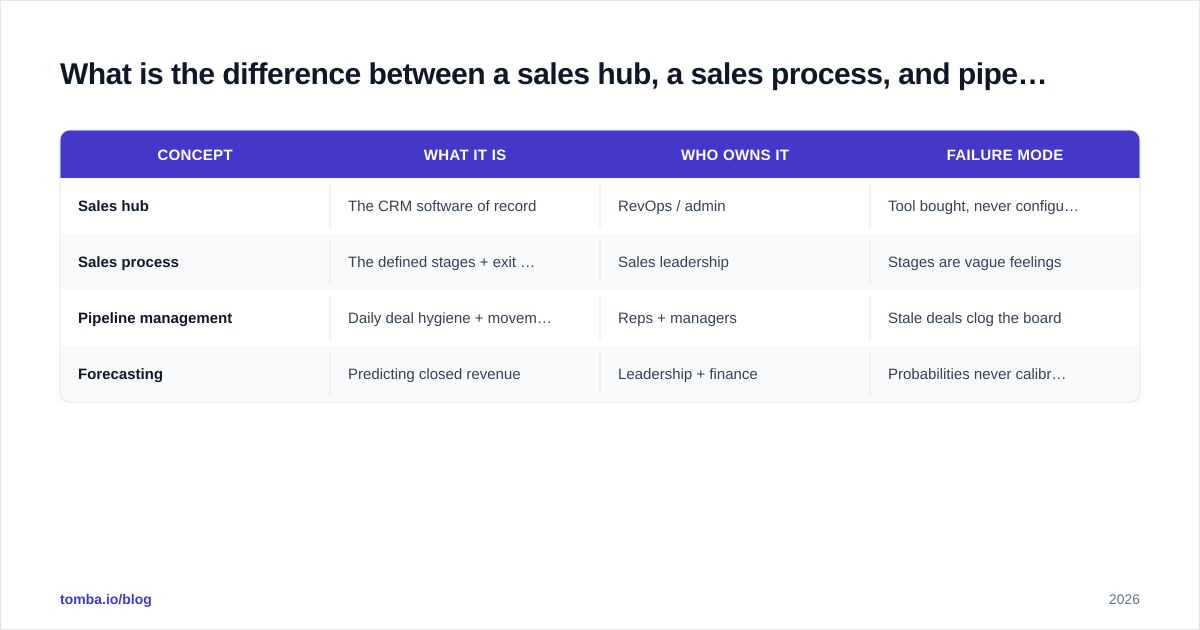
| Concept | What it is | Who owns it | Failure mode |
|---|---|---|---|
| Sales hub | The CRM software of record | RevOps / admin | Tool bought, never configured |
| Sales process | The defined stages + exit criteria | Sales leadership | Stages are vague feelings |
| Pipeline management | Daily deal hygiene + movement | Reps + managers | Stale deals clog the board |
| Forecasting | Predicting closed revenue | Leadership + finance | Probabilities never calibrated |
When a deal review goes sideways, it's almost always because one of these layers is broken while everyone argues about a different one. You can't fix a vague process by buying a better hub.
How do you design sales pipeline stages that actually mean something?#
The single biggest mistake in pipeline management is naming stages after rep emotions. "Qualified," "Interested," "Hot," "Negotiation" — these describe how the rep feels, not what the buyer has done. Two reps will stage the same deal three different ways, and your forecast becomes fiction.
Fix it by defining every stage with an exit criterion: a verifiable, buyer-side action that must be true before the deal advances. The rep doesn't decide a deal is "qualified" — the deal is qualified when a specific, observable thing has happened.
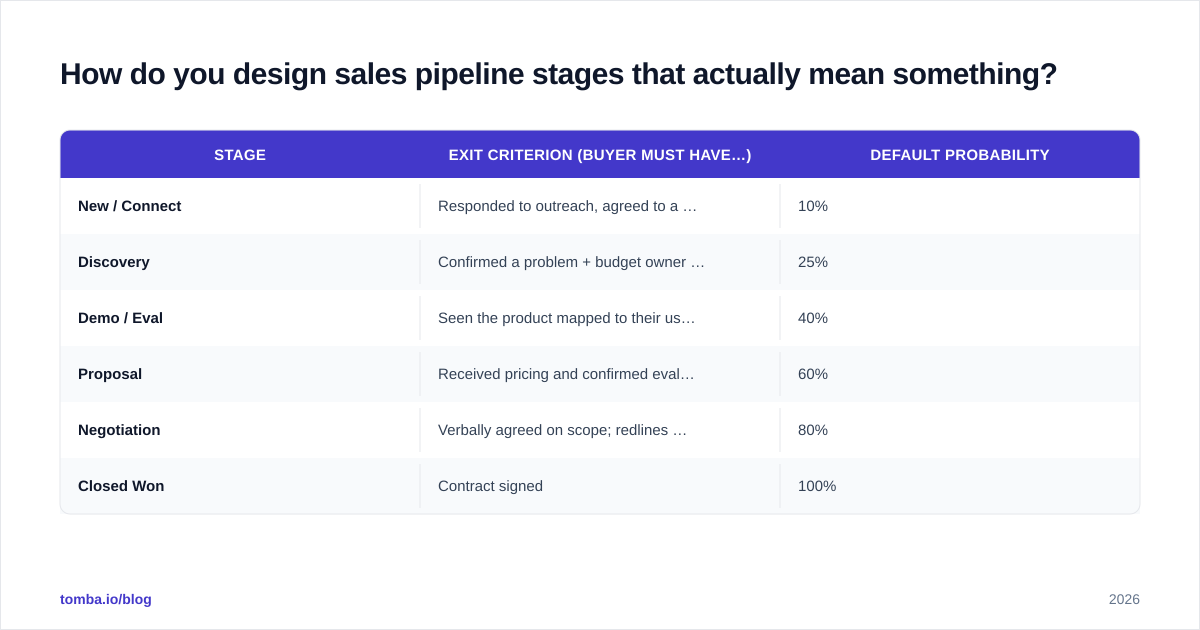
A clean B2B pipeline often looks like this:
| Stage | Exit criterion (buyer must have…) | Default probability |
|---|---|---|
| New / Connect | Responded to outreach, agreed to a call | 10% |
| Discovery | Confirmed a problem + budget owner identified | 25% |
| Demo / Eval | Seen the product mapped to their use case | 40% |
| Proposal | Received pricing and confirmed evaluation criteria | 60% |
| Negotiation | Verbally agreed on scope; redlines in progress | 80% |
| Closed Won | Contract signed | 100% |
Notice that each criterion is something you could prove in a deal review. "Has the buyer confirmed a budget owner? Show me the email." That accountability is what makes the rest of pipeline management possible. If you want a shared vocabulary for these concepts across the team, a simple internal B2B glossary keeps everyone defining "qualified" the same way.
Keep the stage count low. Five to seven stages is plenty for most B2B motions. Every extra stage is another place a deal can stall and another judgment call a rep has to make.
How do you set up pipeline management inside a sales hub?#
Once the stages are defined, you configure them in the hub. The mechanics differ slightly between platforms, but the principles are identical.
1. Mirror your stages exactly. Don't use the default stages the tool ships with. Delete them and rebuild to match your process. The defaults are generic and will quietly push your team back toward feeling-based staging.
2. Make required fields enforce the exit criteria. If a deal can't move to "Proposal" without a "pricing sent" date filled in, your data stays honest. Most sales hubs support stage-gating fields; use them.
3. Automate the busywork, not the judgment. Task creation, follow-up reminders, and stage-based email sequences are great candidates for sales automation. Deal advancement is not — a human should always confirm an exit criterion is genuinely met.
4. Connect your data sources. Your hub is only as accurate as the contact records flowing into it. If you're running HubSpot, a direct HubSpot integration that pushes verified contact data into deal records saves hours of manual entry and prevents the dreaded "email bounced, wrong contact" stall in stage one.
This is also where most teams get distracted. A new tool launches, it has a slicker board, and suddenly everyone wants to migrate instead of fixing the process they already have.
The board doesn't close deals. Discipline does.
How do you forecast accurately from your pipeline?#
A forecast is just your pipeline multiplied by the probability each deal closes. The math is trivial; the inputs are where it breaks.
The naive approach uses the default stage probabilities the hub gives you. The disciplined approach calibrates probabilities against your own historical win rate. If deals that reach "Proposal" actually close 45% of the time over the last 12 months — not the 60% the tool assumes — then your forecast must use 45%, or you'll perpetually miss.
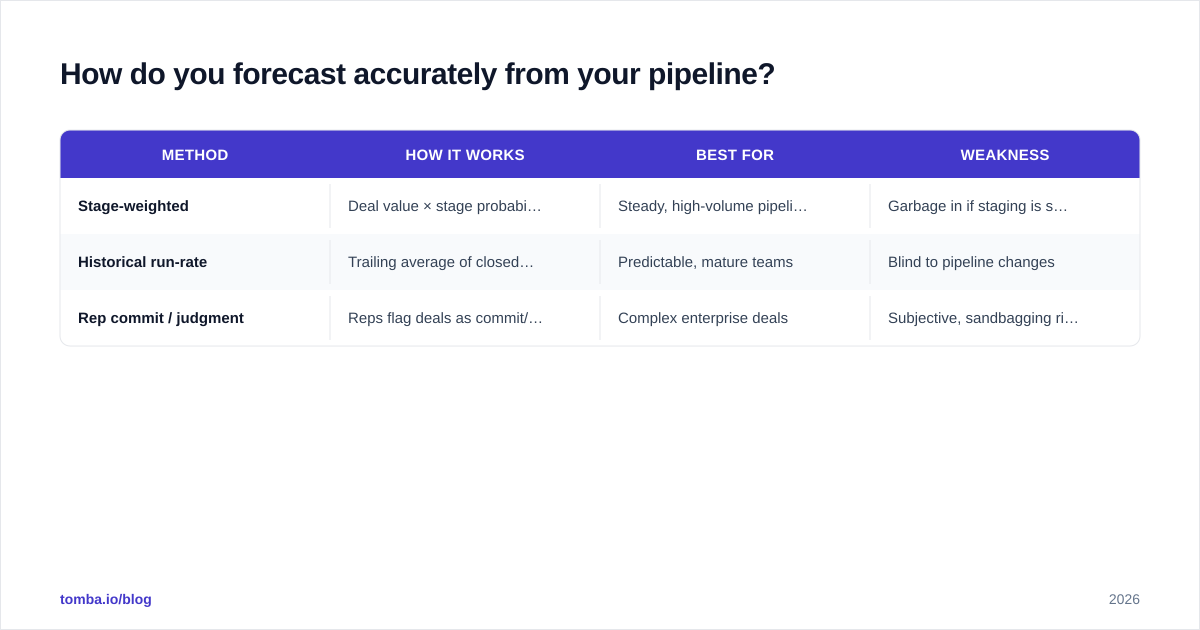
There are three common forecasting methods, and mature teams use more than one as a cross-check:
| Method | How it works | Best for | Weakness |
|---|---|---|---|
| Stage-weighted | Deal value × stage probability | Steady, high-volume pipelines | Garbage in if staging is sloppy |
| Historical run-rate | Trailing average of closed revenue | Predictable, mature teams | Blind to pipeline changes |
| Rep commit / judgment | Reps flag deals as commit/best-case | Complex enterprise deals | Subjective, sandbagging risk |
The metric that ties forecasting together is your win rate — and you can only trust it if your historical data is clean. This is the payoff for all that exit-criteria discipline: a forecast you'd stake your quarter on.
According to industry analysts like Gartner, forecast accuracy is consistently ranked among the top concerns of sales leaders — and the root cause is almost always pipeline data quality, not the forecasting formula itself.
How do you find and fix leaks in the pipeline?#
A pipeline is a leaky bucket. Your job in pipeline management is to find the holes. Two metrics do most of the work.
Stage-to-stage conversion rate. What percentage of deals move from each stage to the next? If 70% of deals move from Discovery to Demo but only 20% move from Demo to Proposal, your demo isn't landing — that's where to coach.
Time-in-stage. How long do deals sit in each stage before advancing? A deal that's been in "Negotiation" for 60 days isn't negotiating; it's dying. Set a maximum age per stage and flag anything that exceeds it.
Here's a simple framework for working the pipeline every week:
- Sort by time-in-stage, descending. The oldest deals get attention first.
- Apply the "next step" test. Every open deal must have a scheduled next action with a date. No next step = the deal isn't real.
- Kill zombies honestly. A deal with no buyer response in 30 days goes to Closed Lost, not "Stalled." Inflated pipelines lie to everyone.
- Inspect the conversion cliffs. Wherever stage-to-stage conversion drops hardest, that's your coaching priority for the week.
This weekly hygiene is the difference between a pipeline you manage and a pipeline that manages you. It's also why bulk data tools matter: when you need to refresh a list of stalled accounts with current contacts, a bulk lead generation workflow beats hand-checking records one at a time.
How does pipeline management connect to the top of the funnel?#
Everything above assumes deals are entering the pipeline. The most beautifully managed pipeline in the world is worthless if stage one is empty.
This is the part teams love to ignore because it's the least glamorous. Forecasting dashboards are fun. Cold prospecting and data hygiene are not. But the math is brutal: if your overall win rate is 20% and you need 10 new customers this quarter, you need 50 real opportunities — which might mean 500 qualified contacts at the top.
Those contacts have to be real. A pipeline stuffed with bounced emails and disconnected phone numbers produces a forecast built on sand. Before a lead ever earns a deal stage, two things must be true:
- The contact information is verified — the email deliverable, the role current.
- The record is enriched with enough context (company size, role, intent signals) to qualify it quickly.
That's why the boring infrastructure — finding and verifying contacts — is the foundation the entire pipeline sits on. Tools that handle data enrichment at the point of entry keep your stage-one data clean so the rest of your process isn't compounding errors. Compare your stack against alternatives on a marketplace like G2 before committing, and prioritize data accuracy over feature count.
What does a healthy pipeline management system look like in practice?#
Pull it together and a mature setup has these traits:
- Stages defined by exit criteria, configured into the sales hub with gating fields.
- A weekly review cadence that sorts by time-in-stage and kills zombie deals.
- Calibrated forecast probabilities based on trailing win rates, cross-checked with at least two methods.
- Conversion and time-in-stage dashboards that surface leaks automatically.
- A clean, verified, continuously refreshed top of funnel so the machine never starves.
| Symptom | Likely broken layer | Fix |
|---|---|---|
| Forecast always misses high | Uncalibrated probabilities | Reset to trailing win rate |
| Deals pile up in one stage | Conversion leak / coaching gap | Inspect that stage's demo or proposal |
| Board looks full but revenue flat | Zombie deals inflating pipeline | Enforce next-step test, close lost |
| Stage-one bounces, wrong contacts | Dirty top-of-funnel data | Verify + enrich at entry |
| Reps stage the same deal differently | Vague process, not tool | Rewrite exit criteria |
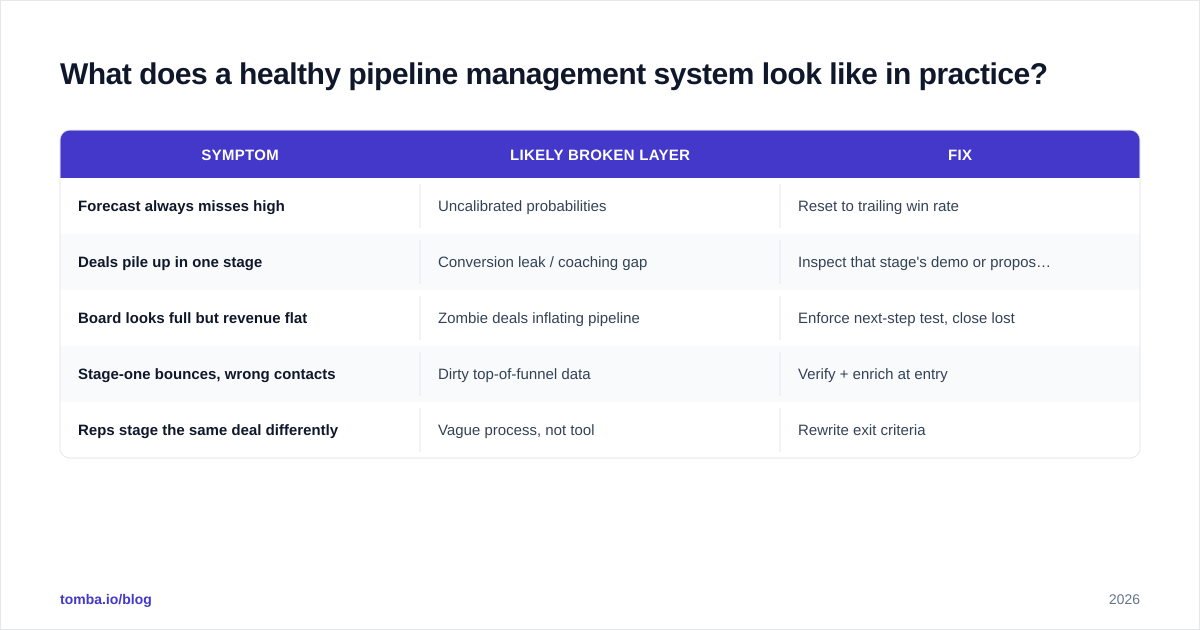
The pattern is clear: most "pipeline problems" are actually process problems or data problems wearing a pipeline costume. The hub is rarely the bottleneck.
Frequently asked questions#
Do I need a sales hub like HubSpot or Salesforce, or is a spreadsheet enough? A spreadsheet works until you have more than one rep or more than a few dozen open deals. Past that, you lose the automation, reporting, and audit trail that make pipeline management scalable. Start in a sales hub early — migrating a messy spreadsheet later is painful.
How many pipeline stages should I have? Five to seven for most B2B motions. Fewer and you can't diagnose where deals stall; more and you create unnecessary judgment calls and stall points. Each stage must earn its place with a distinct exit criterion.
How often should I review my pipeline? Reps should touch their deals daily; managers should run a structured pipeline review weekly. Forecast roll-ups happen weekly or bi-weekly. Monthly is too slow to catch a stalling quarter while you can still fix it.
What's the fastest way to improve forecast accuracy? Calibrate your stage probabilities against your real trailing-12-month win rate, then enforce exit criteria so deals are staged honestly. Most forecast misses come from optimistic staging, not bad math.
Keep your pipeline fed with accurate contacts#
You can perfect every stage, calibrate every probability, and run a flawless weekly review — but if stage one is starving, none of it produces revenue. The unglamorous prerequisite to great pipeline management is a steady flow of real, verified contacts entering the funnel.
That's exactly what Tomba's Email Finder is built for: find professional email addresses by name, company, or domain, verify they're deliverable before they ever hit your CRM, and push clean records straight into your sales hub. Plans start free with 25 searches a month, and paid tiers begin at $49/mo on the Starter plan — see the full Tomba pricing for Growth, Pro, and Enterprise options. Fix the top of the funnel, and the rest of your pipeline finally has something worth managing.
// get started
Find, verify and enrich your first contacts today
Start on the free plan with 25 searches a month, then scale when your team is ready.
Free plan · No credit card required · GDPR & CCPA
// about the author