Sales Hub: Build a Sales Process, Pipeline & Business Case 2026
A practical playbook for turning a messy sales hub into a stage-gated pipeline, repeatable proposals, and a business case buyers actually sign off on.
TL;DR
- A sales hub is only as good as the process behind it — without stage gates, your pipeline is a list of hopes, not a forecast.
- Map your pipeline to how buyers actually decide, then attach an exit criterion to every stage so deals can't drift.
- Proposals should be assembled from a tested template library, not written from scratch each time — speed and consistency lift win rates.
- A business case is the document that survives the meeting you're not in. Quantify the cost of inaction, not just your features.
- Clean contact and account data is the fuel for all of it; bad data quietly breaks every stage downstream.
What is a sales hub sales process and why does it fail without one?#
A sales hub is the central place your team works deals — CRM records, pipeline stages, proposals, and the reporting that ties them together. The hub is the furniture. The sales process is the discipline that decides how a deal moves from one room to the next.
Most teams buy the furniture and skip the discipline. They stand up Salesforce or HubSpot, create five pipeline stages with names like "Working" and "Negotiation," and assume structure will emerge. It doesn't. Reps interpret "Negotiation" five different ways, the forecast becomes fiction, and every QBR turns into archaeology.
Think of it like a kitchen. A beautiful kitchen doesn't make you a chef. A repeatable recipe — measured, sequenced, testable — does. Your sales hub is the kitchen; your process, pipeline definitions, proposal templates, and business case are the recipe. This guide builds that recipe.
How do you design a pipeline that maps to how buyers actually buy?#
Start from the buyer, not your internal milestones. The fastest way to a useless pipeline is naming stages after what you do ("Demo Given") instead of what the buyer has committed to ("Demo Confirmed Fit With Stakeholders"). A stage should represent a verifiable change in the buyer's state, not an activity your rep performed.
Every stage needs three things:
- Entry criteria — what must be true for a deal to land here.
- Exit criteria — the single, checkable thing that lets it advance.
- A default action — what the rep does next, so no deal sits idle.
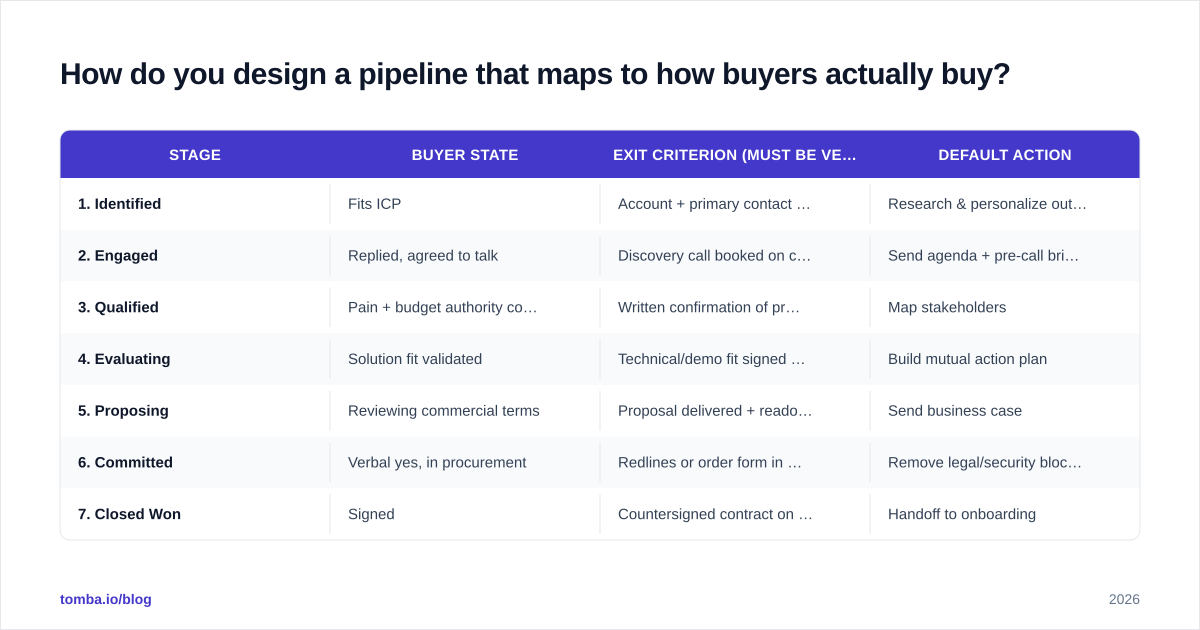
Here's a reference seven-stage pipeline with buyer-anchored exit criteria:
| Stage | Buyer state | Exit criterion (must be verifiable) | Default action |
|---|---|---|---|
| 1. Identified | Fits ICP | Account + primary contact confirmed in CRM | Research & personalize outreach |
| 2. Engaged | Replied, agreed to talk | Discovery call booked on calendar | Send agenda + pre-call brief |
| 3. Qualified | Pain + budget authority confirmed | Written confirmation of problem & timeline | Map stakeholders |
| 4. Evaluating | Solution fit validated | Technical/demo fit signed off by champion | Build mutual action plan |
| 5. Proposing | Reviewing commercial terms | Proposal delivered + readout meeting held | Send business case |
| 6. Committed | Verbal yes, in procurement | Redlines or order form in motion | Remove legal/security blockers |
| 7. Closed Won | Signed | Countersigned contract on file | Handoff to onboarding |
The discipline isn't the stage names — it's the refusal to advance a deal until the exit criterion is genuinely met. A deal where the champion "seems excited" is not in Evaluating; it's in Qualified until something is signed off. That single rule is what turns a pipeline into a sales win rate you can trust.
Before any of this works, the records flowing into stage one have to be real. A pipeline built on guessed email addresses and stale titles inherits that rot at every stage. This is where a clean top of funnel matters: use an email finder and data enrichment to make sure the account and contact you're staging are accurate before a rep spends a week on them.
What separates a stage gate from a wish?#
A stage gate is a checkpoint a deal cannot pass without producing evidence. A wish is a stage a rep moves a deal into because the quarter is ending.
The test is simple: could a manager who has never spoken to the buyer verify the exit criterion from the CRM alone? "Champion confirmed budget in writing — see email attached" passes. "I have a good feeling about this one" does not.
Stage gates do three things for your forecast:
- They make slippage visible early. A deal stuck at Qualified for 40 days is a coaching conversation now, not a missed number later.
- They standardize language. When everyone defines "Proposing" identically, your conversion rates between stages become real metrics you can act on.
- They protect rep time. Gates stop reps from pouring effort into deals that haven't earned it.
Industry research backs this up: HubSpot's sales data consistently shows that teams with a defined, enforced process outperform ad-hoc teams on both win rate and forecast accuracy. You can read HubSpot's breakdown of sales pipeline stages for a vendor-neutral primer that complements the buyer-anchored model above.
How should proposals work inside the pipeline?#
Proposals should be assembled, not authored. The single biggest leak in stage 5 is reps writing every proposal from a blank page — slow, inconsistent, and impossible to A/B test.
Build a modular proposal system instead:
- A locked spine: problem statement, scope, pricing, terms, next steps — always in the same order.
- Swappable modules: ROI math, case studies, security/compliance appendix, implementation timeline. Reps pull the modules a given deal needs.
- A tested cover narrative: the two paragraphs that frame why now, refined over time like any high-performing template.
Speed matters because it correlates with momentum. A proposal delivered within 24 hours of the readout meeting lands while the buyer's urgency is intact. To keep the writing tight and on-brand, many teams lean on a starting library of cold email templates and proposal copy, then localize per deal rather than reinventing each time.
The proposal is not the close. It's the artifact that makes the next document — the business case — easy for your champion to forward upward.
What makes a business case your buyer's finance team will actually approve?#
A business case survives the meeting you're not in. Your champion will not be in the room when the CFO scrutinizes the spend. The business case is the only version of you that gets to argue.
That changes how you write it. Features don't travel up the org chart; numbers do. A finance-grade business case has four parts:
- Cost of inaction. Quantify what the status quo costs per month — wasted hours, lost deals, churn, manual data cleanup. This is the number that creates urgency.
- Expected impact. Conservative, defensible projections tied to the buyer's own metrics, not your marketing claims.
- Total cost of ownership. Honest — license, implementation, ramp time. Hiding it destroys credibility in procurement.
- Payback period. The single line a CFO scans for: "this pays for itself in X months."
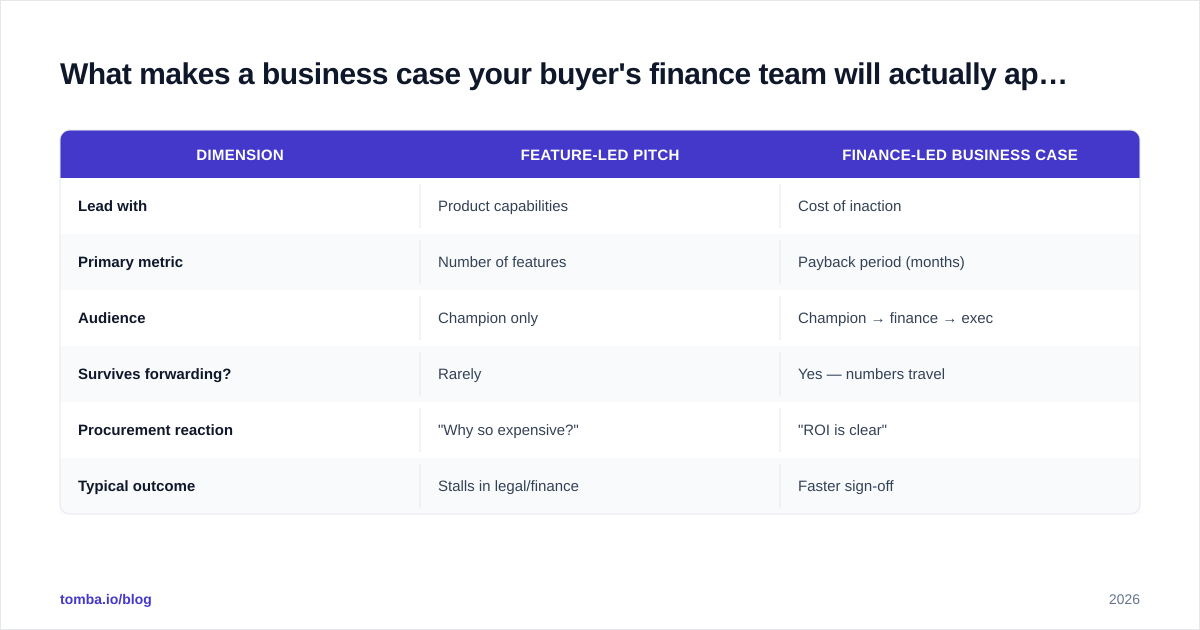
Compare a feature-led pitch with a finance-led business case:
| Dimension | Feature-led pitch | Finance-led business case |
|---|---|---|
| Lead with | Product capabilities | Cost of inaction |
| Primary metric | Number of features | Payback period (months) |
| Audience | Champion only | Champion → finance → exec |
| Survives forwarding? | Rarely | Yes — numbers travel |
| Procurement reaction | "Why so expensive?" | "ROI is clear" |
| Typical outcome | Stalls in legal/finance | Faster sign-off |
A practical tip: anchor the ROI math to data your buyer already trusts. If they can't reproduce your numbers from their own systems, the case reads as a sales artifact and gets discounted. For a rigorous external framework on quantifying value, Gartner's guidance on building a business case is a useful reference for the finance vocabulary buyers expect.
How do data quality and revenue operations tie it all together?#
Process, pipeline, proposals, and business case all run on data — and the data degrades constantly. People change jobs, companies rebrand, emails bounce. A pristine process built on a decaying contact database produces confident, wrong forecasts.
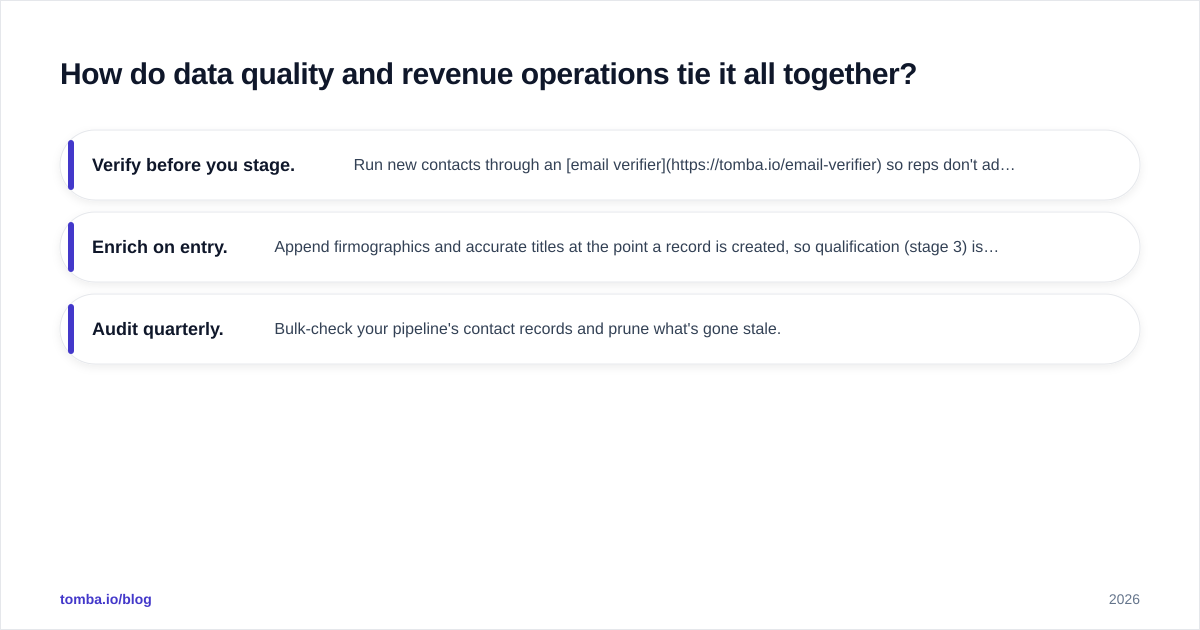
This is the job of revenue operations: keep the fuel clean so the engine runs. Three habits matter most:
- Verify before you stage. Run new contacts through an email verifier so reps don't advance deals built on dead addresses.
- Enrich on entry. Append firmographics and accurate titles at the point a record is created, so qualification (stage 3) isn't guesswork.
- Audit quarterly. Bulk-check your pipeline's contact records and prune what's gone stale.
When data is reliable, every downstream artifact gets sharper: qualification is faster, proposals address the right stakeholders, and your business case cites numbers nobody can wave away. When data is dirty, you're stage-gating fiction. G2's category reviews of sales pipeline tools reinforce the same point from the buyer's side: teams rank data accuracy above nearly every flashy feature.
What's the rollout order — and what should you ignore?#
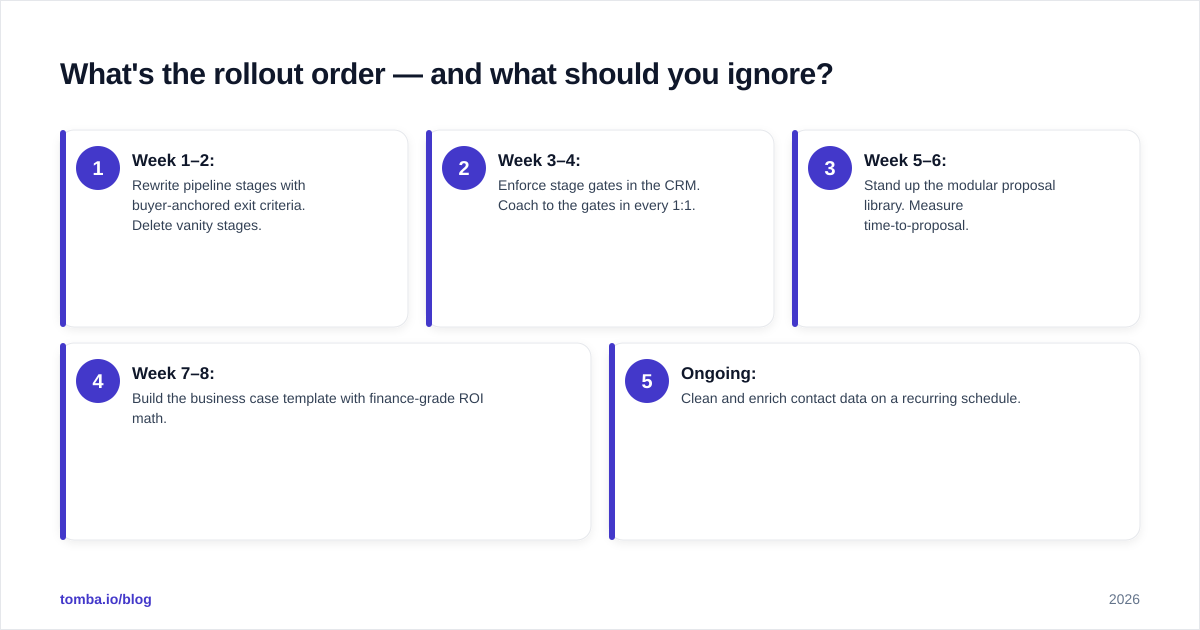
Don't boil the ocean. Sequence the build so each piece reinforces the next:
- Week 1–2: Rewrite pipeline stages with buyer-anchored exit criteria. Delete vanity stages.
- Week 3–4: Enforce stage gates in the CRM. Coach to the gates in every 1:1.
- Week 5–6: Stand up the modular proposal library. Measure time-to-proposal.
- Week 7–8: Build the business case template with finance-grade ROI math.
- Ongoing: Clean and enrich contact data on a recurring schedule.
Ignore, for now, exotic forecasting AI and elaborate scoring models. They're amplifiers — they make a good process better and a broken process more confidently broken. Get the gates and the data right first. For the deeper mechanics of automating the repetitive parts once the foundation holds, see how teams approach sales automation without sacrificing the discipline above.
Bringing it together#
A sales hub doesn't close deals; a process does. Define your pipeline around the buyer's verifiable commitments, gate every stage with evidence, assemble proposals from a tested library, and arm your champion with a business case written in the language of finance. Underneath all of it, keep your contact and account data clean — because every stage you build inherits the quality of the records flowing into stage one.
Start at the foundation. If your pipeline is staging deals on guessed or stale contact data, fix that first: use the Tomba Email Finder to source accurate, verified professional emails by name, company, or domain, then enrich and verify before a rep ever advances the deal. Clean inputs are the cheapest forecast accuracy you'll ever buy — check the Tomba pricing tiers (a free plan covers 25 searches a month, Starter is $49/mo) and build your process on data you can trust.
// get started
Find, verify and enrich your first contacts today
Start on the free plan with 25 searches a month, then scale when your team is ready.
Free plan · No credit card required · GDPR & CCPA
// about the author