6sense vs Terminus 2026: Which ABM Platform Wins?
6sense vs Terminus in 2026: which ABM platform delivers better intent data, ad targeting, and pipeline ROI? A neutral breakdown of pricing, accuracy, and fit.
The ABM platform market has reshuffled. 6sense and Terminus once shared the same shortlist, but the two products have drifted in opposite directions — one leaning hard into predictive AI and intent, the other into multi-channel ad orchestration and account-based experience. If you are scoping an ABM stack in 2026, the right pick depends less on logos and more on which of those bets fits your go-to-market motion.
This is a neutral, head-to-head breakdown. No "every tool is great." Real trade-offs, real numbers, and where each platform actually loses.
TL;DR#
- 6sense wins on intent data and AI scoring. Its predictive models and proprietary intent network are the deepest in the category for surfacing in-market accounts.
- Terminus wins on ad orchestration and Chat. Display reach, account-based ads, and the Ramble chat acquisition give Terminus a stronger engagement surface.
- Pricing: both sit in enterprise territory. 6sense starts around $60K/year for production tiers; Terminus starts around $30K/year. Expect 6-figure totals at scale.
- Best fit for 6sense: data-heavy RevOps teams with a mature sales motion that needs to prioritize accounts.
- Best fit for Terminus: marketing-led orgs that want a single console to run ads, chat, email, and web personalization across target accounts.
- Better together with a finder: neither platform reliably gives you verified contact emails at scale — pair with a Tomba Email Finder for execution.
What are 6sense and Terminus, really?#
Both are account-based marketing platforms, but they solve different halves of the ABM problem.
6sense is an account intelligence platform first. It ingests first-party signals (web, CRM, MAP), third-party intent (its proprietary B2B network plus Bombora), and technographics, then runs predictive models to score accounts on buying stage — Target, Awareness, Consideration, Decision, Purchase. The advertising and orchestration layer sits on top of that intelligence.
Terminus is an account-based experience platform first. It started as an ad network for B2B (one of the few non-LinkedIn options that could actually target by account at scale), then layered on email signatures, web personalization, chat (Ramble), and intent (Terminus + FollowUze acquisitions). The intelligence layer exists, but it is not the leading edge.
That ordering matters. If you ask 6sense and Terminus the same question — "which accounts should I focus on this quarter?" — 6sense will give a more confident answer. If you ask "how do I run 4 coordinated touches against my top 200 accounts this month?", Terminus will give a smoother answer.

What does the head-to-head feature comparison look like?#
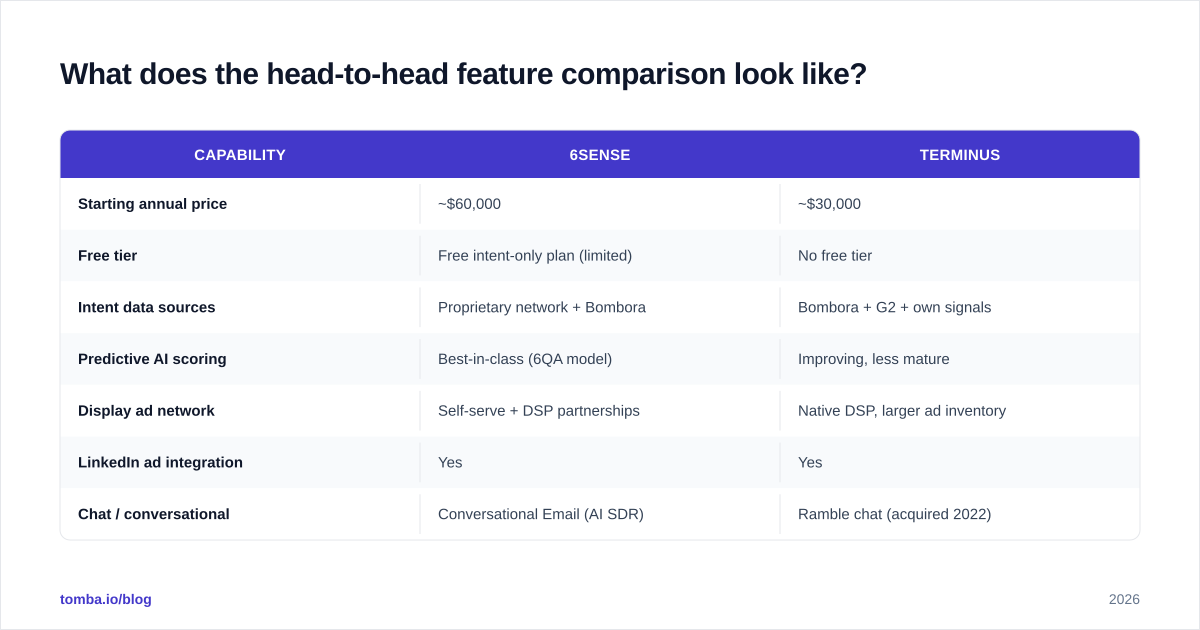
Here is the honest grid. Pricing is approximate based on public RFP data, G2 reviewer disclosures, and partner channel intel — both vendors negotiate aggressively, so your mileage will vary.
| Capability | 6sense | Terminus |
|---|---|---|
| Starting annual price | ~$60,000 | ~$30,000 |
| Free tier | Free intent-only plan (limited) | No free tier |
| Intent data sources | Proprietary network + Bombora | Bombora + G2 + own signals |
| Predictive AI scoring | Best-in-class (6QA model) | Improving, less mature |
| Display ad network | Self-serve + DSP partnerships | Native DSP, larger ad inventory |
| LinkedIn ad integration | Yes | Yes |
| Chat / conversational | Conversational Email (AI SDR) | Ramble chat (acquired 2022) |
| Web personalization | Limited | Strong (native) |
| CRM integrations | Salesforce, HubSpot, MS Dynamics | Salesforce, HubSpot, Marketo |
| Time to first value | 60–90 days | 30–60 days |
| Best-suited team size | 200+ employees | 50–500 employees |
| Reporting depth | Deep (account journey analytics) | Moderate |
The standout numbers: Terminus is roughly half the entry cost, and faster to deploy. 6sense is the heavier lift but pays back with sharper account prioritization once the model is trained on your data.
Is 6sense better than Terminus for intent data?#
Short answer: yes, by a clear margin in 2026.
6sense operates its own intent network, which it built by acquiring sites and partnering with publishers over the past decade. That network produces co-occurrence intent signals that the platform deduplicates against Bombora's data and surfaces as a per-account intent score. The 6QA (6sense Qualified Account) score is the closest the category has to a credible "in-market right now" indicator.
Terminus relies more heavily on third-party intent — primarily Bombora and G2 — supplemented by its own ad-impression and engagement data. The picture is good. It is not as predictive as 6sense's stack.
What this means practically:
- If your sales team complains about "spray and pray" lead lists, 6sense's prioritization will be felt within a quarter.
- If your marketing team already has a target account list and just needs to reach those accounts, Terminus's intent is sufficient.
For teams that want to test intent before committing six figures, a smaller starting point is a B2B database layered with data enrichment — you get firmographic and contact data without the ABM platform overhead, and you can graduate to 6sense or Terminus once the motion proves out.
Is Terminus better than 6sense for advertising and engagement?#
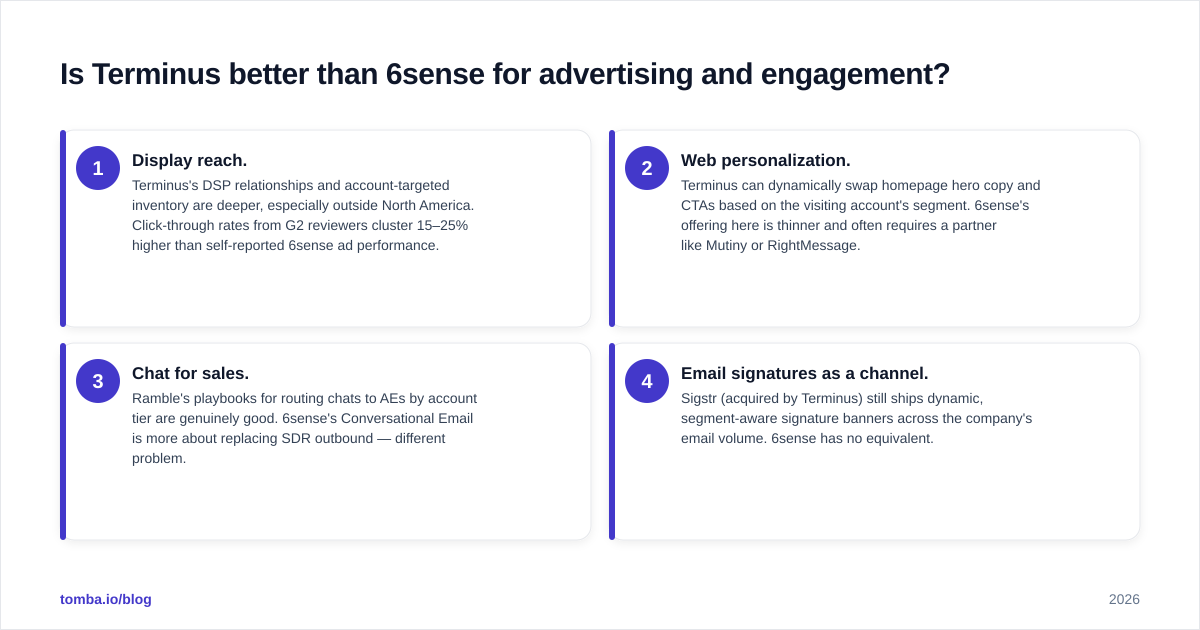
Yes — Terminus's ad network and account-based display capability is more mature than 6sense's, and the Ramble chat addition gives it a real-time engagement surface that 6sense lacks natively.
Where Terminus pulls ahead:
- Display reach. Terminus's DSP relationships and account-targeted inventory are deeper, especially outside North America. Click-through rates from G2 reviewers cluster 15–25% higher than self-reported 6sense ad performance.
- Web personalization. Terminus can dynamically swap homepage hero copy and CTAs based on the visiting account's segment. 6sense's offering here is thinner and often requires a partner like Mutiny or RightMessage.
- Chat for sales. Ramble's playbooks for routing chats to AEs by account tier are genuinely good. 6sense's Conversational Email is more about replacing SDR outbound — different problem.
- Email signatures as a channel. Sigstr (acquired by Terminus) still ships dynamic, segment-aware signature banners across the company's email volume. 6sense has no equivalent.
If your ABM thesis is "surround the buying committee on every channel we touch," Terminus delivers that surround sound better than 6sense.
How do they compare on pricing and ROI?#
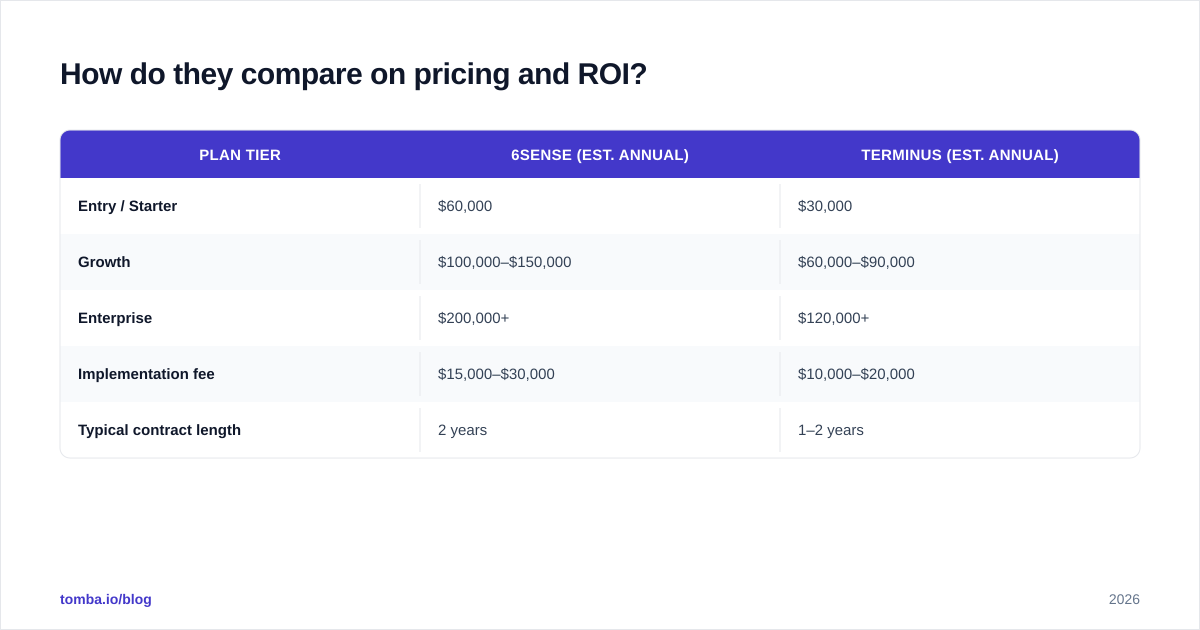
Neither platform is cheap. Both will quote you on contract value, expected pipeline lift, and predicted CAC reduction — every claim should be discounted by 30% for negotiation theater.
| Plan tier | 6sense (est. annual) | Terminus (est. annual) |
|---|---|---|
| Entry / Starter | $60,000 | $30,000 |
| Growth | $100,000–$150,000 | $60,000–$90,000 |
| Enterprise | $200,000+ | $120,000+ |
| Implementation fee | $15,000–$30,000 | $10,000–$20,000 |
| Typical contract length | 2 years | 1–2 years |
Where ROI actually shows up:
- 6sense ROI lands in pipeline efficiency: SDR conversion rates climb because reps work pre-scored accounts. Companies report 20–35% lift in opportunity rates among 6QA-flagged accounts in year two.
- Terminus ROI lands in engagement metrics: ad-influenced pipeline grows fastest in months 1–6 because the ad network can ramp immediately. Long-term lift on win rate is more modest unless paired with strong intent.
A common pattern in 2026: companies start with Terminus for the faster ramp, then migrate to or add 6sense once their data infrastructure can support the heavier integration. The opposite path (6sense first, Terminus added) also exists but is rarer.
What do real users say about each platform?#
Synthesizing recent reviews from G2 and Gartner:
6sense — what reviewers praise
- Predictive scoring is "scary accurate" once trained
- Sales gets a single account-priority feed that survives the SDR-AE handoff
- Anonymous visitor de-anonymization is best in class
6sense — what reviewers criticize
- Implementation drags past 90 days more often than not
- Reporting is powerful but steep — most teams under-use it
- Pricing renews aggressively
Terminus — what reviewers praise
- Ad campaigns can be live in a week, not a quarter
- Single console reduces "where do I run this?" decisions for marketers
- Customer success is more hands-on than at 6sense
Terminus — what reviewers criticize
- Intent data feels noisier than 6sense
- Reporting on multi-touch attribution still requires spreadsheets
- Product roadmap stalled briefly during 2023 ownership changes; momentum returned but trust took a hit
What about the alternatives?#
If neither 6sense nor Terminus fits, the competitive set in 2026 includes:
- Demandbase One — closest direct competitor to 6sense. Strong identity graph, similar pricing.
- RollWorks — solid mid-market ABM at lower price points; weaker on predictive AI.
- Mutiny + Clay + Apollo — the "unbundle ABM" stack. More work to wire up, more flexible.
For a deeper look at the unbundled approach, see our Apollo alternative and 6sense alternative breakdowns.
How do you decide between 6sense and Terminus?#
Run this four-question filter. Whichever answer wins three out of four is your platform.
- Is your bottleneck "which accounts" or "how to reach them"?
- Which accounts → 6sense
- How to reach them → Terminus
- Is your team marketing-led or RevOps-led?
- Marketing-led → Terminus
- RevOps/sales-led → 6sense
- How patient is leadership?
- 90+ days to value acceptable → 6sense
- Need wins in Q1 → Terminus
- What is your annual budget for ABM tooling?
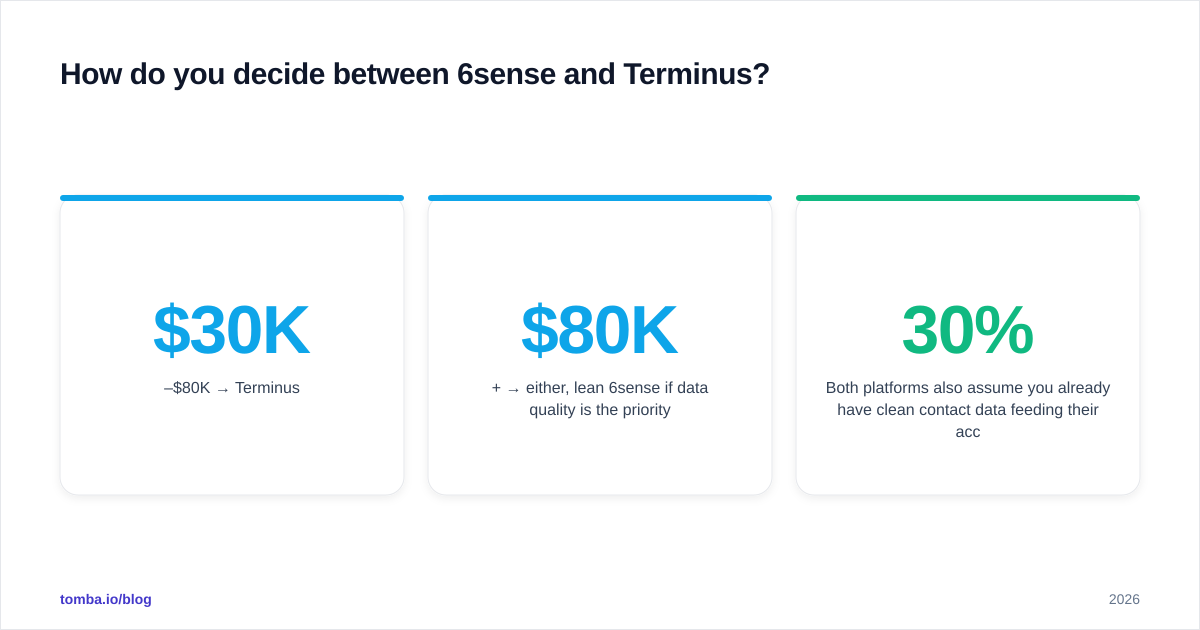
- $30K–$80K → Terminus
- $80K+ → either, lean 6sense if data quality is the priority
Both platforms also assume you already have clean contact data feeding their account models. If your CRM has 30% missing emails on target-account contacts, neither platform will save you — the prioritized accounts won't be reachable. Fix the contact layer first with a domain search or bulk email finder workflow before you bolt on ABM intelligence.
What integrations should you check before buying?#
For both 6sense and Terminus, audit these before signing:
- CRM: Salesforce is fully supported by both. HubSpot is supported but Terminus's HubSpot depth is slightly better in 2026. MS Dynamics is supported by both but reviewer satisfaction is lower.
- MAP: Marketo, HubSpot Marketing Hub, and Pardot all integrate. Eloqua works with 6sense and is in beta with Terminus.
- Sales engagement: Outreach, Salesloft, and Apollo all push 6sense and Terminus signals into cadences. Native support is generally cleaner with 6sense.
- BI/warehouse: 6sense exports to Snowflake, BigQuery, and Redshift natively. Terminus relies on partner ETL.
- Contact enrichment: neither platform reliably provides verified work emails at scale. Plug in a dedicated finder via the Tomba API or HubSpot integration so your SDRs aren't stuck with account names and no inboxes.
Final verdict: which one should you pick?#
Pick 6sense if your bottleneck is account selection, your team can absorb a 90-day onboarding, and you have the budget to grow into the enterprise tier. The data advantage compounds.
Pick Terminus if you need to run multi-channel ABM campaigns this quarter, your marketing team owns the budget, and you value time-to-value over predictive depth.
Pick neither if you are under 50 employees or your ABM hypothesis is unproven — start by tightening your target account list, running manual outreach with verified contact data, and proving lift before you sign a six-figure contract.
When you are ready to operationalize either platform, the unglamorous prerequisite is contact data your sales team will actually use. The Tomba Email Finder ships verified work emails at $49/month starter pricing, with Tomba pricing scaling into bulk and API tiers for ABM teams running thousands of target accounts. Pair it with 6sense or Terminus and your reps stop hunting for inboxes and start working the accounts the platform flags.
// get started
Find, verify and enrich your first contacts today
Start on the free plan with 25 searches a month, then scale when your team is ready.
Free plan · No credit card required · GDPR & CCPA
// about the author