ABM in 2026: The Complete Account-Based Marketing Playbook
Account-based marketing has eaten the B2B playbook. Here's how ABM actually works in 2026 — the tiers, the tech stack, the metrics, and where it breaks.
ABM in 2026: The Complete Account-Based Marketing Playbook
TL;DR
- ABM is no longer a campaign type — in 2026 it's the default operating model for B2B teams selling deals above $25k ACV.
- The winning programs run three tiers (1:1, 1:few, 1:many) and let intent signals decide which accounts move between them.
- The 2026 stack collapses around four jobs: account selection, signal detection, contact data, and orchestration.
- Pipeline-sourced and pipeline-influenced are the two numbers that matter. Everything else is theater.
- ABM fails when sales and marketing share a slide but not a list. Fix the list first.
Account-based marketing has been called the future of B2B for a decade. In 2026 it stopped being the future and became the floor. If your average contract value is north of $25,000 and your buying committee has more than three people, lead-gen-by-volume is now a structurally worse use of budget than running a tight ABM program.
This guide walks through what ABM actually is in 2026, how the modern stack fits together, what the tiers look like in practice, and where most programs quietly fail. No vendor cheerleading — just the playbook the better operators are running.
What is ABM in 2026?#
Account-based marketing treats a defined list of companies as the unit of work instead of treating individual leads as the unit of work. You pick the accounts that look like your best customers, you map the buying committee inside each one, and you coordinate marketing and sales touches against that committee until a deal materializes.
The 2026 version differs from the 2018 version in three ways:
- Intent and signals decide priority, not gut feel. Buying-intent data, hiring signals, technographic changes, funding events, and product-usage telemetry all feed an account score that's recomputed daily.
- The contact layer is dynamic, not a static list pulled once a quarter. Buying committees churn at 25–30% per year, and good programs re-enrich every 30 days using a B2B database plumbed into the CRM.
- AI handles the long tail of personalization that humans used to skip. Tier-3 1:many emails now reference the prospect's actual stack and last earnings call, generated at send time.
If you want the textbook definition, Gartner calls ABM "a B2B strategy that focuses sales and marketing resources on a defined set of target accounts within a market." That's accurate but unhelpfully bloodless. The operational definition is simpler: a named list, a shared score, and one pipeline number both teams own.
What are the three tiers of ABM?#
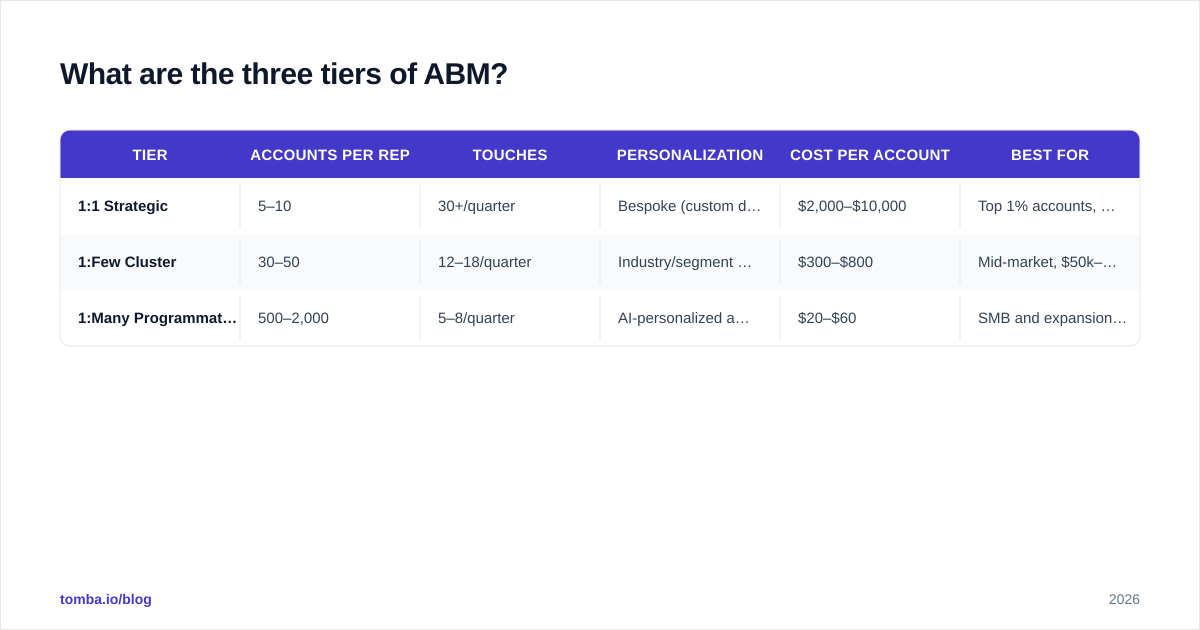
Every credible ABM program in 2026 runs three tiers in parallel. The tiers differ by economic logic, not by enthusiasm.
| Tier | Accounts per rep | Touches | Personalization | Cost per account | Best for |
|---|---|---|---|---|---|
| 1:1 Strategic | 5–10 | 30+/quarter | Bespoke (custom decks, micro-sites, exec gifting) | $2,000–$10,000 | Top 1% accounts, $250k+ ACV |
| 1:Few Cluster | 30–50 | 12–18/quarter | Industry/segment specific | $300–$800 | Mid-market, $50k–$250k ACV |
| 1:Many Programmatic | 500–2,000 | 5–8/quarter | AI-personalized at send time | $20–$60 | SMB and expansion, $10k–$50k ACV |
The mistake most teams make is running only the middle tier and calling it ABM. A program with no 1:1 lane has no anchor accounts, and a program with no 1:many lane has no top-of-funnel pressure feeding the cluster.
The accounts inside each tier should not be static. A Tier-3 account that fires a "decision-maker just joined" signal and starts pricing-page binge sessions should auto-promote to Tier 2 the same week. The 2026 difference is that this promotion happens via workflow, not via a quarterly account-review meeting.
How do you pick the right target accounts?#
Account selection is where ABM programs win or lose. There are four inputs that matter:
- Firmographics — industry, size, geography, revenue band. The boring baseline.
- Technographics — what's already in their stack. A company running Salesforce + Outreach is a wildly different prospect than one running HubSpot + Apollo.
- Behavioral signals — research intent (Bombora, G2, 6sense), hiring intent (job posts for roles your product enables), and product usage if you have a PLG motion.
- Fit math — a logistic regression or gradient-boosted model trained on closed-won vs closed-lost from the last 24 months.
The sequence matters. Build the firmographic universe first, layer technographics to cut the noise, then rank inside that subset by behavioral signal density. Don't rank by signal density across the whole TAM — you'll end up chasing companies that browse a lot but never buy.
Once the list exists, every account needs at least four mapped contacts: an economic buyer, a technical evaluator, a champion candidate, and a user. Fewer than four and you're betting the deal on one human. Tools like a LinkedIn finder or a domain search close the gap between a target account list and an actually-actionable contact list.
What does the 2026 ABM tech stack look like?#
The stack has consolidated. Where 2020 ABM required eight tools, 2026 ABM requires four jobs to be done, and most teams hit them with three or four vendors.
| Job | What it does | Representative tools | Typical spend |
|---|---|---|---|
| Account selection & scoring | Builds the named list, ranks by fit + intent | 6sense, Demandbase, Clearbit | $40k–$150k/yr |
| Contact discovery & enrichment | Adds the humans to the accounts, keeps data fresh | Tomba, Apollo,ZoomInfo | $5k–$60k/yr |
| Orchestration | Routes accounts to plays, fires touches across channels | HubSpot, Outreach, Salesloft | $20k–$80k/yr |
| Display & retargeting | Ad coverage on named accounts | LinkedIn ABM, RollWorks, Metadata | $30k–$200k/yr |
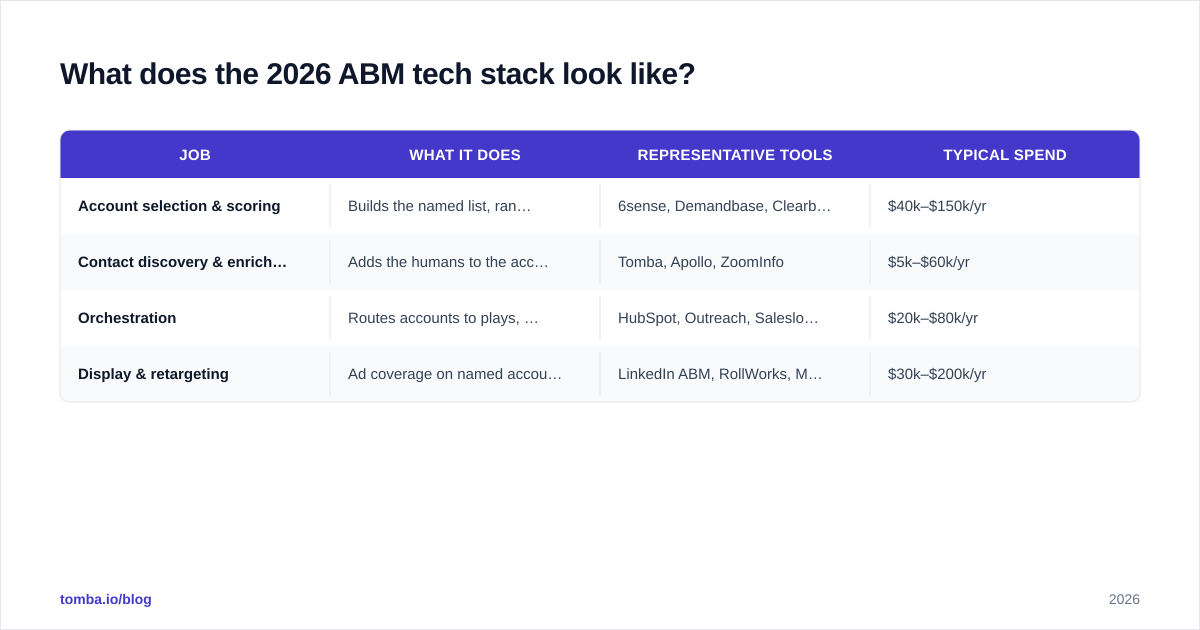
Two notes on this stack:
- Don't buy display before you can prove the named list is correct. Spending $100k on LinkedIn ABM against a list with 30% bad fit is just a tax on a bad list.
- Contact data is the layer most teams under-budget. A perfect account list with stale contacts is a list of company logos, not a pipeline engine. Whatever you pick — Apollo alternative, ZoomInfo, or a focused email finder — budget for monthly re-enrichment, not annual.
Is ABM better than lead generation?#
Yes and no. ABM is better when three conditions are true: deals are large enough to justify per-account cost, buying committees are big enough that one-to-one is impossible, and the total addressable market is small enough to list out. Below roughly $15k ACV or above roughly 50,000 fitting accounts, traditional inbound and volume outbound are still more efficient.
The actual answer most companies arrive at is "both, with different metrics." Inbound and broad outbound fill the top of the funnel and produce MQLs. ABM is what you do once an account from any source shows fit + intent. It's a layer over the funnel, not a replacement for it.
The argument that gets made on LinkedIn — "ABM killed lead gen" — is mostly noise. What actually died is treating an unranked MQL list as a sales handoff. The MQL didn't die; the unfiltered one did.
What metrics actually measure ABM success?#
Most ABM dashboards measure activity. The two numbers that measure outcomes:
- Pipeline sourced from named accounts — dollars of qualified opportunity created from accounts on the target list, attributed by first touch inside the program window.
- Pipeline influenced from named accounts — dollars where the account received ≥3 ABM touches in the 90 days before opportunity creation.
Everything else is supporting cast. Engagement scores, account reach, page views per account — useful for tuning, not for proving the program works.
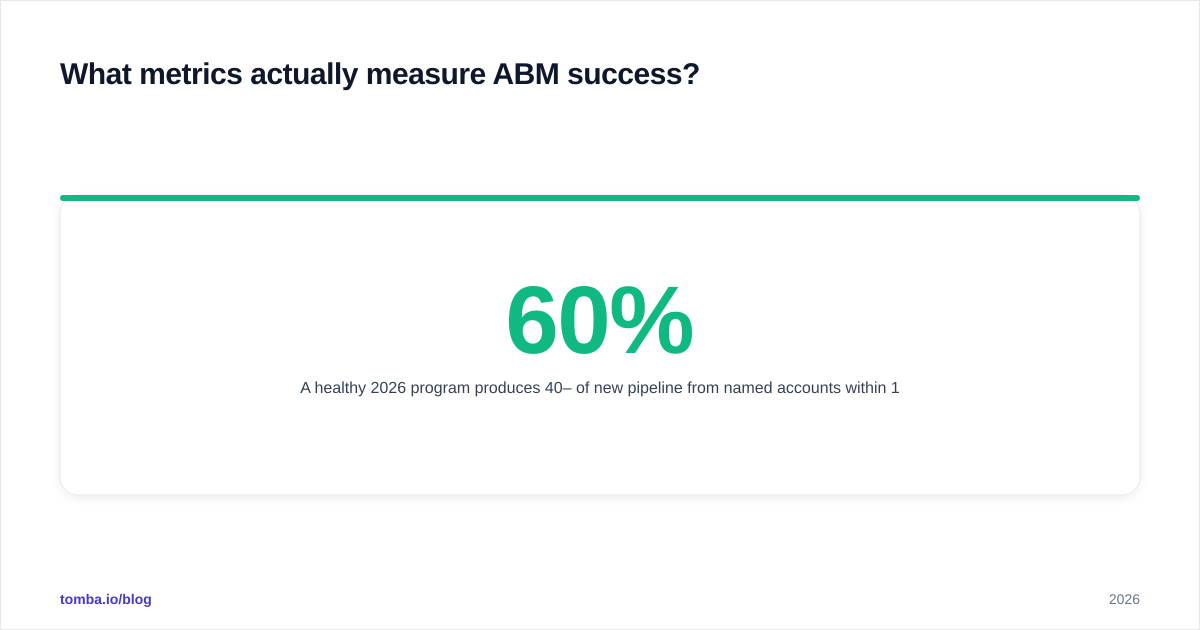
A healthy 2026 program produces 40–60% of new pipeline from named accounts within 18 months of launch, against 25–35% of marketing spend allocated to the program. If you're past month 18 and below 30% sourced, your account list is wrong, your contact data is stale, or your sales team isn't actually working the list.
For a deeper dive on the metrics side, Forrester's B2B Summit research tracks ABM-program maturity benchmarks every year — worth reading if your CFO wants comparables.
How do you operationalize ABM week to week?#
The cadence that works in practice:
Daily
- Score refresh runs overnight. Accounts that crossed a tier threshold land in a Slack channel by 8 AM.
- Reps work their top 10 accounts. Marketing does not touch the rep's top 10 without permission — those are reserved for direct human follow-up.
Weekly
- 30-minute sales+marketing standup on tier-1 accounts only. Status, next touch, blockers.
- Marketing reviews the 1:few cluster: which segments are converting, which are dead, what to kill.
Monthly
- Contact re-enrichment job runs against the named list — new joiners, departures, role changes. Bad contacts get verified and replaced.
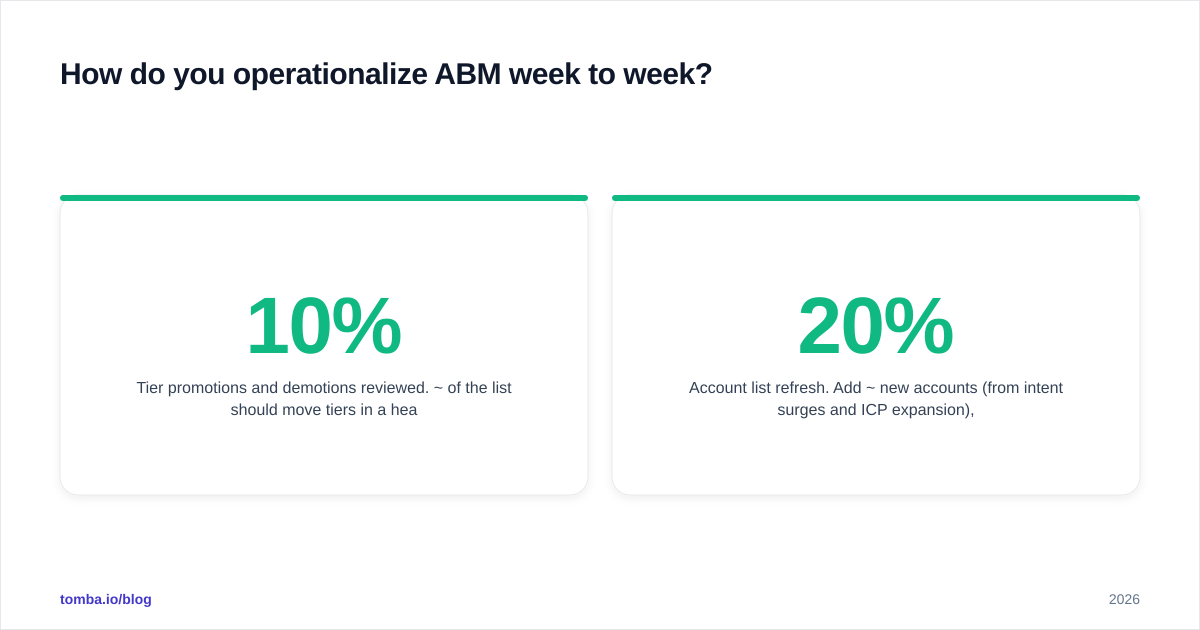
- Tier promotions and demotions reviewed. ~10% of the list should move tiers per month in a healthy program.
Quarterly
- Account list refresh. Add ~20% new accounts (from intent surges and ICP expansion), retire ~20% (no engagement, no fit signal, no closed-won path).
- Tech stack review — what's earning its line item.
The orchestration layer (HubSpot, Outreach, Salesloft, or any modern sales automation platform) should drive this cadence with workflows, not spreadsheets. If your ABM program lives in a quarterly slide deck, it isn't running.
Where do ABM programs actually fail?#
Five failure modes account for almost every dead ABM program:
- Two lists, one slide. Marketing has a target list, sales has a different one, the leadership deck pretends they're the same. Fix: one list, one source of truth, in the CRM, with a shared score field.
- Stale contact data. The list is right, but 30% of the contacts left, switched roles, or never existed. Fix: monthly enrichment via a data enrichment pipeline, not annual.
- No clear tier economics. The same touch budget gets spread across 1:1 and 1:many because nobody did the per-account math. Fix: cost per account by tier, reviewed quarterly.
- Sales never works the list. The CMO buys the platform, the CRO doesn't change rep comp. Reps keep working inbound MQLs because that's what compensation rewards. Fix: SDR/AE quotas tied to named-account pipeline, not generic activity.
- Display-first programs. $200k goes to LinkedIn ABM before the list is validated or the contact layer works. Result: pretty dashboards, zero pipeline. Fix: don't turn on paid until 1:1 and 1:few have produced demonstrable pipeline.
The pattern across all five: ABM gets sold as a marketing program, but it lives or dies on cross-functional ops. The marketing team can't fix a comp plan; the sales team can't fix a scoring model. Whoever owns revenue operations has to own the program, with both VPs reporting in.
What's changing in ABM in 2026?#
Three shifts to watch:
- Signal-rich, contact-poor is now the default problem. Intent providers got commoditized. Knowing that ACME is researching "data warehouses" is table stakes. Knowing the three people at ACME who run data infrastructure, with verified emails and direct dials, is the actual edge. The market is rebalancing budget from intent toward contact data.
- AI personalization at scale is real and unevenly distributed. The teams running it well are producing tier-2-quality outbound at tier-3 cost. The teams running it badly are producing the same template with a hallucinated company description in the first line. The difference is the input data quality, not the model.
- Buying committees keep growing. Gartner's average B2B buying-committee size is now 11 people. Mapping all 11 with a phone finder, email, and LinkedIn on file is no longer optional for tier-1 accounts.
Bottom line#
ABM in 2026 isn't a campaign — it's a pipeline operating system. The teams winning with it have a tight named list, fresh contacts on every account, a tiered budget that matches per-account economics, and a comp plan that pulls sales into the same boat as marketing. The teams losing with it bought the platform first and never fixed the underlying ops.
If you're starting an ABM program or rebooting one that stalled, the single highest-leverage step is fixing the contact layer. A perfect account list is worthless if you can't reach the buying committee. Tomba's email finder and data enrichment tools were built for exactly this layer — finding and verifying the humans behind your named accounts, on demand, at the volume an ABM program actually needs. Start with the Tomba pricing free tier (25 searches), wire it into your CRM, and let your strategy team focus on the part of ABM that actually matters: deciding which accounts get the bespoke treatment, and proving it produced pipeline.
Ready to find emails that actually work?
Join 150,000+ professionals who stopped guessing and started sending. Free credits on signup — no credit card required.
Get the Tomba newsletter
Practical outbound tactics and product updates — once every two weeks.
About the author