ABM for SaaS in 2026: The Complete Playbook for Revenue Teams
ABM for SaaS is no longer optional for teams selling to mid-market and enterprise. Here is the 2026 playbook covering tiering, plays, tooling, and the metrics that actually predict pipeline.
TL;DR#
- ABM for SaaS in 2026 means tight integration between RevOps, marketing, and sales — not a campaign tactic bolted onto demand gen.
- Tier your accounts (1:1, 1:few, 1:many) before you touch a single tool — most failures start with a sloppy ICP, not bad software.
- The winning stack pairs intent data, enrichment, multi-channel orchestration, and a CRM that can actually score account-level signals.
- Measure pipeline created per account, multi-thread coverage, and meeting-to-opportunity rate. Vanity MQLs will lie to you.
- Budget reality: a serious 1:few program runs $80k–$250k/year before headcount. If you can't fund it, run 1:many with focused enrichment first.
What is ABM for SaaS and why does it look different in 2026?#
Account-based marketing for SaaS is the practice of treating named accounts — not anonymous leads — as the unit of revenue. You define a small list of companies that match your ideal customer profile, then coordinate marketing, sales, and product touches against the buying committee inside each one.
That definition has been stable for a decade. What changed in 2026 is the operating model:
- Buying committees got larger. Gartner's latest B2B buying research puts the average enterprise SaaS purchase at 11+ stakeholders. Single-threaded selling is dead.
- Inbound MQL volume collapsed. Generative search cut top-of-funnel form fills by 30–50% across most SaaS verticals. Outbound and ABM are picking up the slack.
- AI agents handle the busywork. Drafting first-touch emails, enriching contact records, summarizing 10-Ks — all automated. Reps spend more time on multi-threaded narratives, less on data entry.
- Signal quality is the moat. Everyone has intent data now. Whoever combines first-party product signals with third-party intent wins.
If your "ABM program" is still a quarterly ad campaign against a static list, you don't have ABM — you have a display retargeting flight with extra steps.
How is ABM different from traditional SaaS demand generation?#
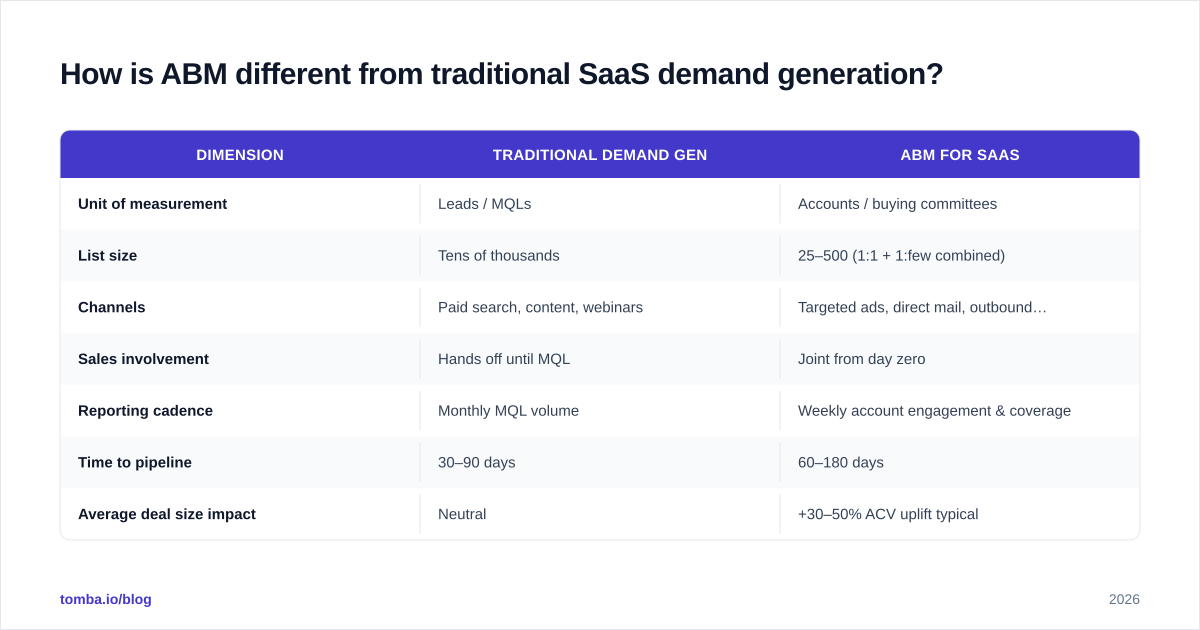
The shorthand: demand gen optimizes for lead volume, ABM optimizes for account penetration. Here is the practical breakdown.
| Dimension | Traditional Demand Gen | ABM for SaaS |
|---|---|---|
| Unit of measurement | Leads / MQLs | Accounts / buying committees |
| List size | Tens of thousands | 25–500 (1:1 + 1:few combined) |
| Channels | Paid search, content, webinars | Targeted ads, direct mail, outbound, exec sponsorship |
| Sales involvement | Hands off until MQL | Joint from day zero |
| Reporting cadence | Monthly MQL volume | Weekly account engagement & coverage |
| Time to pipeline | 30–90 days | 60–180 days |
| Average deal size impact | Neutral | +30–50% ACV uplift typical |
Note the deal-size column. Forrester and TOPO research has shown for years that companies running disciplined ABM see higher ACVs because they're courting bigger logos and selling to more stakeholders inside each one. The trade-off is patience: ABM compounds, it doesn't spike.
Who should run ABM for SaaS — and who shouldn't?#
ABM is not a universal best practice. It pays off when three conditions hold:
- ACV ≥ $15k/year. Below that, the cost of a 1:few play eats the LTV.
- Identifiable ICP. You can name the 500–5,000 companies that should buy.
- Multi-stakeholder sales. Champions, economic buyers, IT review, procurement.
If you sell a $39/month PLG tool to designers, skip ABM and double down on product-led growth. If you sell a $90k/year compliance platform to FinServ CISOs, ABM is your highest-leverage motion.
A useful self-test: pull your last 50 closed-won deals. If 80% came from fewer than 200 source companies, you're already running de facto ABM — you just haven't operationalized it.
How do you tier accounts for a SaaS ABM program?#
Tiering is where most programs live or die. The standard framework is three tiers:
Tier 1 — 1:1 (5–25 accounts per rep) Custom microsites, executive sponsorship, bespoke research, dedicated AE+SDR+marketer pod. Reserved for accounts where a closed-won would materially move the quarter.
Tier 2 — 1:few (50–200 accounts) Cohorts of 10–30 accounts grouped by vertical, persona, or trigger event. Shared content templates, customized intros, multi-channel sequences. Most SaaS programs spend 70% of their budget here.
Tier 3 — 1:many (500–5,000 accounts) Programmatic. Reverse-IP targeting, account-list display, retargeting, intent-triggered outbound. This is where you find new Tier 2 candidates.
The fastest way to build the actual list is to pull a clean firmographic slice from your CRM, then layer enrichment and intent. A solid B2B database plus data enrichment on the gaps lets you stand up a workable Tier 2 list in a sprint instead of a quarter.
What does the 2026 ABM tech stack look like?#
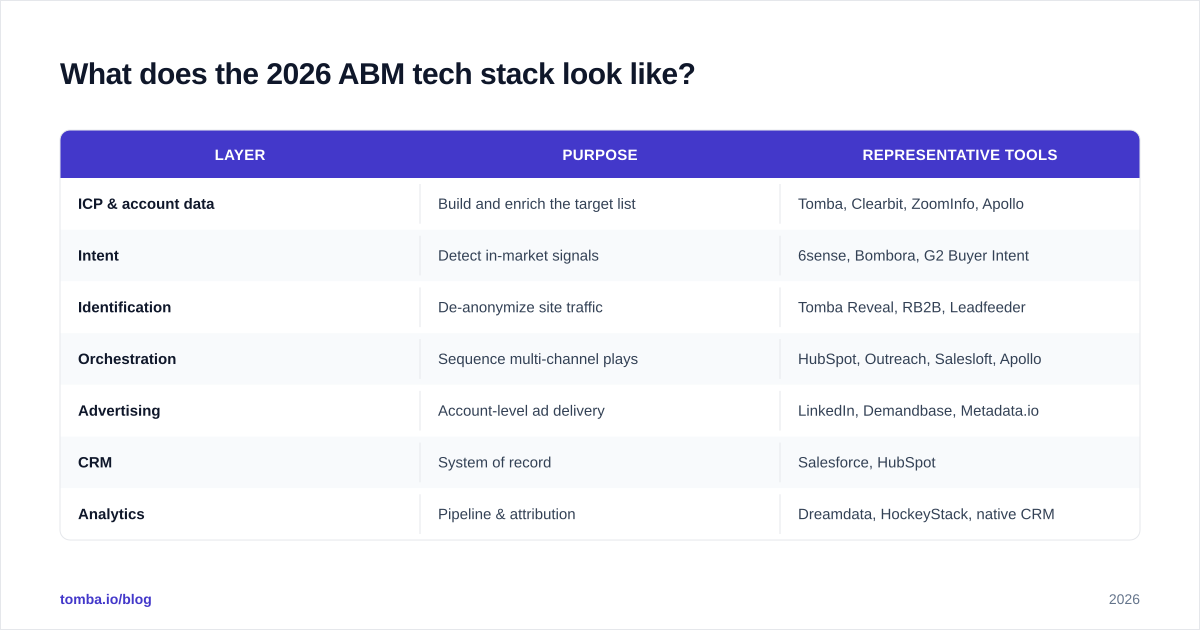
You don't need every category — but you need something in each lane. Here's a reference stack:
| Layer | Purpose | Representative tools |
|---|---|---|
| ICP & account data | Build and enrich the target list | Tomba, Clearbit,ZoomInfo, Apollo |
| Intent | Detect in-market signals | 6sense, Bombora, G2 Buyer Intent |
| Identification | De-anonymize site traffic | Tomba Reveal, RB2B, Leadfeeder |
| Orchestration | Sequence multi-channel plays | HubSpot, Outreach, Salesloft, Apollo |
| Advertising | Account-level ad delivery | LinkedIn, Demandbase, Metadata.io |
| CRM | System of record | Salesforce, HubSpot |
| Analytics | Pipeline & attribution | Dreamdata, HockeyStack, native CRM |
A common 2026 pattern: use a focused finder/verifier like Tomba's email finder and email verifier for contact discovery and hygiene, then push clean records into HubSpot or Salesforce via native integrations. That keeps your CRM the system of record without forcing you onto a $100k all-in-one suite before you've proven the motion.
For competitive context: Apollo alternatives and Clearbit alternatives are worth a look if your current vendor's pricing has crept past what your program ROI justifies.
What plays actually work? Five proven 2026 ABM motions#
These are the plays I've seen run repeatedly with measurable results.
1. The trigger-event play (1:few) A funding round, a key exec hire, or a tech-stack change drops the account into a 6-week sequence. Outbound emails reference the trigger by name. Conversion to meeting averages 8–12% vs. 1–2% for untriggered cold.
2. The champion-multiplier play (1:1) You have one user inside a target account. The marketer builds a personalized landing page, the AE runs a "land and expand" narrative, and you treat the existing user as the entry vector to the buying committee.
3. The vertical surround (1:few) Pick a vertical with 50 logo targets. Run a vertical webinar, a custom report, and a coordinated LinkedIn ad flight. SDRs follow up only on engaged accounts. Better economics than spray-and-pray outbound.
4. The displacement play (1:1) You know the account uses a competitor. Build a tailored migration story, a TCO calculator, and a customer reference from a similar switch. This is where C-level air cover earns its keep.
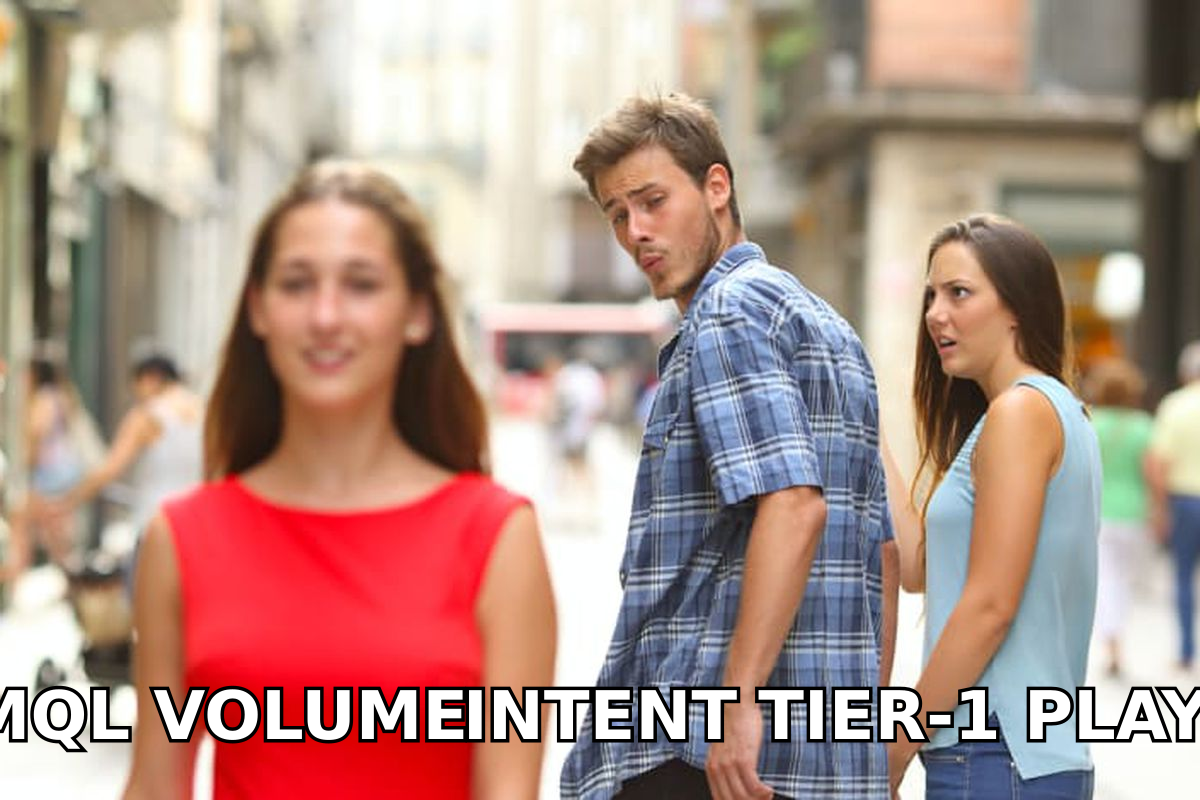
5. The intent-spike play (1:many → 1:few) 6sense or Bombora flags a research surge. The account auto-promotes from Tier 3 to Tier 2 and triggers a 14-day sequence. Speed-to-touch is the entire game here — under 48 hours from spike to first outreach.
How do you build the contact list for an ABM program?#
You have your account list. Now you need the humans. The 2026 workflow looks like this:
- Map the buying committee for each persona. For a mid-market SaaS deal, that's usually 5–9 roles: economic buyer, champion, end user, IT/security, finance.
- Source contacts via LinkedIn finder, domain search, and your contract data provider.
- Verify every email before it touches a sequence. Bounce rates above 3% will tank your sender reputation.
- Enrich with role, seniority, tech stack, and recent activity.
- Push into CRM with the account-tier tag so reporting works.
For multi-account contact discovery at scale, a bulk email finder saves hours vs. one-by-one lookups. For ongoing pipeline hygiene, a catch-all verifier is non-negotiable — catch-all domains are the #1 silent killer of cold campaign deliverability.
If you need to validate the company email pattern before running a full sequence, do that first. Five minutes of pattern validation saves a week of bounces.
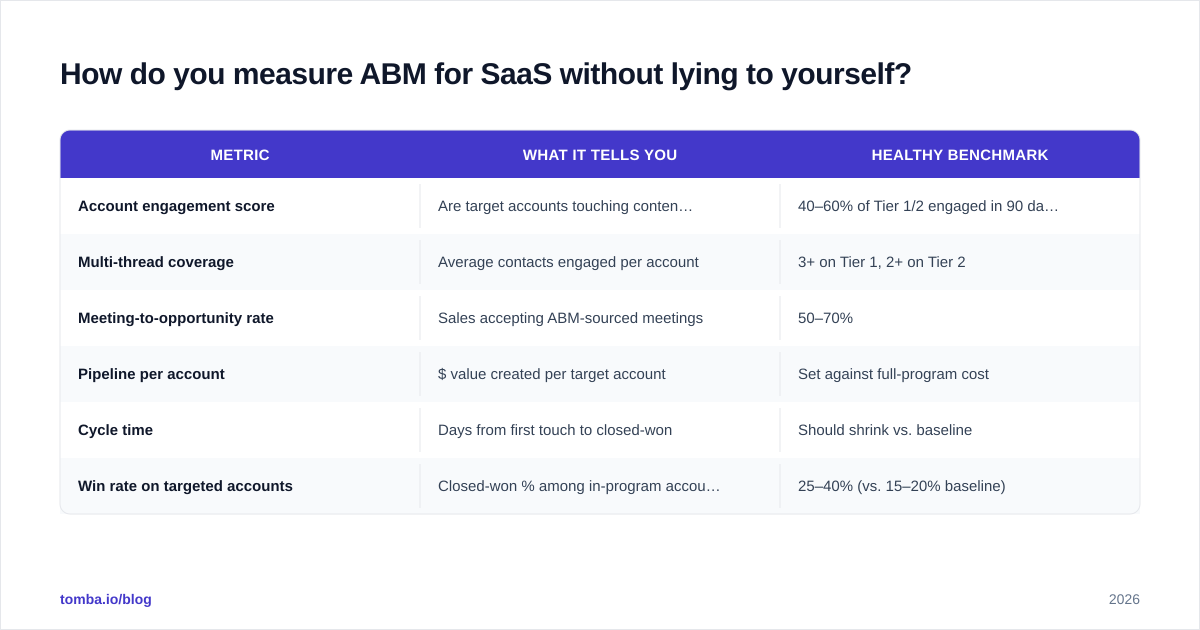
How do you measure ABM for SaaS without lying to yourself?#
The classic mistake: importing demand-gen metrics into an ABM program. MQL counts will make a 1:few program look like a failure even when it's printing pipeline.
Use these metrics instead:
| Metric | What it tells you | Healthy benchmark |
|---|---|---|
| Account engagement score | Are target accounts touching content? | 40–60% of Tier 1/2 engaged in 90 days |
| Multi-thread coverage | Average contacts engaged per account | 3+ on Tier 1, 2+ on Tier 2 |
| Meeting-to-opportunity rate | Sales accepting ABM-sourced meetings | 50–70% |
| Pipeline per account | $ value created per target account | Set against full-program cost |
| Cycle time | Days from first touch to closed-won | Should shrink vs. baseline |
| Win rate on targeted accounts | Closed-won % among in-program accounts | 25–40% (vs. 15–20% baseline) |
Track these weekly with marketing and sales in the same room. The moment ABM becomes a marketing-only standup, the program drifts back into campaign theater.
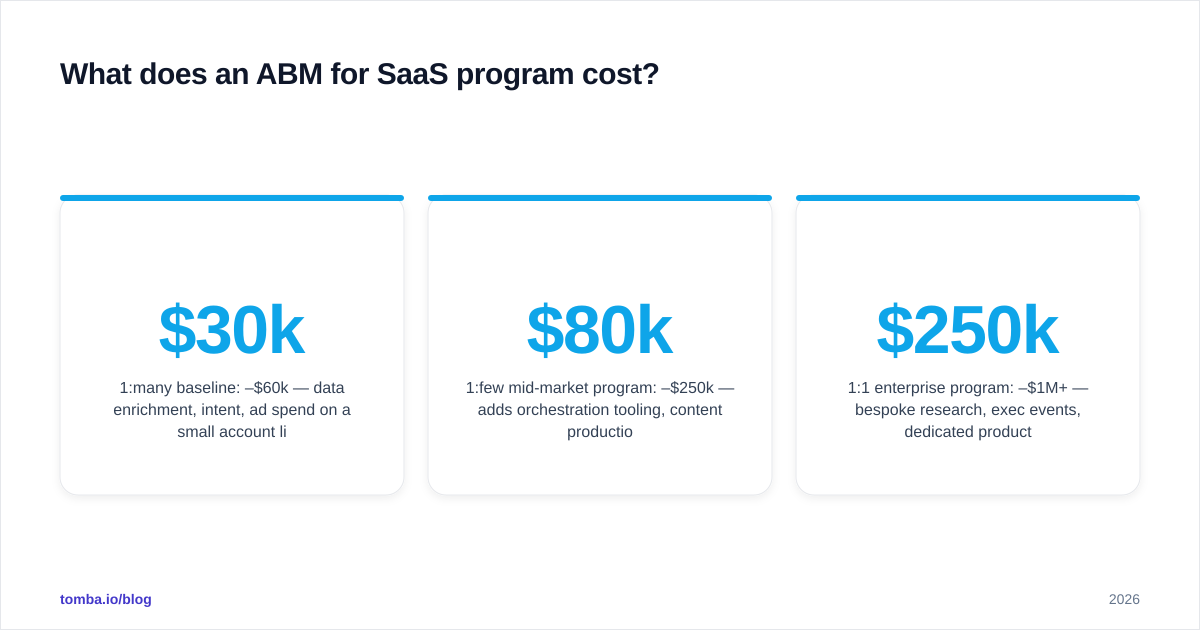
What does an ABM for SaaS program cost?#
Real numbers from programs I've seen in 2026, excluding headcount:
- 1:many baseline: $30k–$60k/year — data enrichment, intent, ad spend on a small account list.
- 1:few mid-market program: $80k–$250k/year — adds orchestration tooling, content production, customized direct mail or gifting.
- 1:1 enterprise program: $250k–$1M+/year — bespoke research, exec events, dedicated production budget per account.
Headcount typically doubles those numbers. A working 1:few program needs one ABM marketer, one SDR pod (3–5 reps), and meaningful AE time. RevOps support is mandatory, not optional. See revenue operations for context on what that function should own.
Common mistakes that kill SaaS ABM programs#
- Starting with tools instead of strategy. No amount of 6sense fixes a fuzzy ICP.
- Sales and marketing in separate Slack channels. Daily standups beat quarterly QBRs.
- Treating every Tier 2 account like Tier 1. Budget evaporates, no logo gets the white-glove treatment.
- Measuring monthly. ABM compounds over quarters. Monthly dashboards trigger panic pivots.
- Skipping verification. Bouncing 8% of your outreach on a 200-account program is a 16-account own-goal.
- No exit criteria. Accounts sit in nurture forever. Set a "demote or exit" rule at 90 days of no engagement.
How does ABM fit alongside PLG and inbound?#
A false dichotomy that wastes a lot of strategy meetings. The right model in 2026 is layered:
- PLG handles self-serve and bottom-up champions.
- Inbound captures in-market demand from organic, paid, and community.
- ABM drives top-down expansion into named accounts and proactively works the logos that don't raise their hand.
Healthy SaaS revenue orgs run all three. The mix shifts with stage: early-stage leans PLG + inbound, growth-stage adds ABM for enterprise expansion, late-stage often makes ABM the dominant motion for $100k+ deals.
For the inbound side, your response rate on follow-ups still matters — ABM accounts research you long before they raise a hand.
Where to start if you're building ABM from scratch#
A 90-day starter plan:
- Days 1–14: Lock the ICP. Pull closed-won data, define firmographic + technographic filters, agree the list with sales.
- Days 15–30: Build the target list (start with 100–200 Tier 2 accounts), enrich contacts, layer intent data.
- Days 31–60: Run two plays — one trigger-event sequence, one vertical surround. Instrument metrics from day one.
- Days 61–90: Review. Promote/demote accounts. Double the budget on what worked, kill what didn't.
Resist the urge to launch six plays simultaneously. Two plays run well beat six run poorly.
Closing thought + where Tomba fits#
ABM for SaaS in 2026 rewards discipline over volume. The teams winning aren't the ones with the biggest tech stack — they're the ones with the cleanest account list, the tightest sales-marketing loop, and the most reliable data layer underneath the whole thing.
If you're standing up an ABM program and need contact discovery, verification, and enrichment that won't break your budget, start with Tomba Email Finder. It plugs into your existing CRM and outreach stack, supports bulk workflows for Tier 2 lists, and pairs with the Tomba API if you want to wire account-tier-aware enrichment directly into your orchestration. Free tier covers 25 searches/mo to test the workflow; paid plans start at $49/mo on Tomba's pricing page. Build the program, prove the pipeline, then scale the stack — not the other way around.
// get started
Find, verify and enrich your first contacts today
Start on the free plan with 25 searches a month, then scale when your team is ready.
Free plan · No credit card required · GDPR & CCPA
// about the author