Account Based Selling Tools: The 2026 Stack That Wins
Account based selling tools turn a target account list into booked meetings. Here's the 2026 stack — by layer, by budget, and what to skip.
Account based selling treats a short list of high-value accounts like a market of one. Instead of blasting 10,000 contacts and hoping, your team picks the 50–200 companies that actually fit, maps the buying committee inside each, and runs coordinated, multi-threaded plays until a deal opens. The tooling exists to make that coordination repeatable — and in 2026 the category has fragmented into five distinct layers that most "all-in-one" pitches blur together.
This guide breaks the stack down by layer, shows you what each layer actually does, and gives concrete pricing so you can build a stack that fits your budget instead of buying a logo.
TL;DR#
- Account based selling tools cluster into five layers: target-account data, contact data and enrichment, intent and signals, orchestration and sequencing, and measurement. You rarely need one vendor for all five.
- Data quality is the foundation. A beautiful orchestration tool firing emails at stale contacts just automates failure faster. Fix data first.
- You can build a credible ABS stack for under $300/month by pairing a precise contact-data source like Tomba's email finder with a CRM you already own and a lightweight sequencer.
- Enterprise ABM platforms (6sense, Demandbase) earn their price only when you have the volume and analyst headcount to act on intent data. Below ~20 reps, they're overkill.
- The 2026 shift is toward signal-driven, multi-threaded outreach — tools that tell you which account is in-market this week and who to reach, not just bigger contact lists.
What is account based selling, and why does the tooling matter?#
Account based selling (ABS) is the rep-led cousin of account based marketing (ABM). Where ABM runs ads and campaigns at target accounts, ABS is what your sales reps do account-by-account: research the org, identify the 5–8 people on the buying committee, and run coordinated outreach across email, phone, and social until you earn a meeting.
Think of it like a heist movie versus a lottery. Spray-and-pray outbound is buying a thousand lottery tickets. Account based selling is casing one building, learning the schedule of every guard, and walking in with a plan. The tooling is the planning room — the floor plans, the comms, the timing.
The reason tooling matters: a single rep can hold maybe 30–50 accounts in their head. The moment you ask them to multi-thread across a committee, track which contacts have been touched, and react to buying signals, manual tracking collapses. That's the job ABS tools do.
What are the layers of an account based selling stack?#
Most buyers get burned because they treat "account based selling tools" as one purchase. It isn't. Here are the five layers, what each does, and where the money goes.
1. Target-account data. Firmographics, technographics, and company lists. This is how you build and refine the account list itself — revenue, headcount, tech stack, funding. Tools: Clearbit, ZoomInfo, Vainu.
2. Contact data and enrichment. Once you know the account, you need the humans: names, titles, verified emails, direct dials. This is the layer where accuracy makes or breaks the campaign, and where a focused email finder plus data enrichment does the heavy lifting.
3. Intent and signals. Who's researching your category right now? Third-party intent (G2, Bombora), website de-anonymization, and engagement signals tell you which accounts to prioritize this week.
4. Orchestration and sequencing. The execution layer: multi-step, multi-channel plays across email, LinkedIn, and phone, coordinated across the whole buying committee. Tools: Outreach, Salesloft, Apollo sequences.
5. Measurement and attribution. Pipeline influenced, account engagement scoring, and deal velocity by segment — so you know which plays to double down on.
The mistake is buying a Layer-4 orchestration platform and assuming it solves Layer 2. It doesn't. Garbage contacts in, garbage meetings out.
Which account based selling tools should you actually compare?#
Here's a concrete comparison across the layers, with representative pricing as of 2026. Prices move, so treat these as orientation, not quotes — verify on each vendor's own pricing page before you buy.
| Tool | Primary layer | Best for | Entry price | Free tier |
|---|---|---|---|---|
| Tomba | Contact data + enrichment | Verified emails by domain/name at low cost | $49/mo (Starter) | 25 searches/mo |
| Apollo.io | Contact data + sequencing | All-in-one for SMB outbound teams | ~$49/seat/mo | Limited |
| ZoomInfo | Target-account + contact data | Enterprise data depth + direct dials | Custom (high 4–5 figures/yr) | No |
| 6sense | Intent + orchestration | Predictive intent at scale | Custom (5-figure/yr) | Limited |
| Demandbase | Intent + ABM advertising | Account-based advertising + intent | Custom | No |
| Salesloft | Orchestration + sequencing | Multi-channel cadence execution | Custom (per seat) | No |
| Clearbit (Breeze) | Target-account enrichment | Real-time web enrichment in HubSpot | Bundled with HubSpot | Limited |
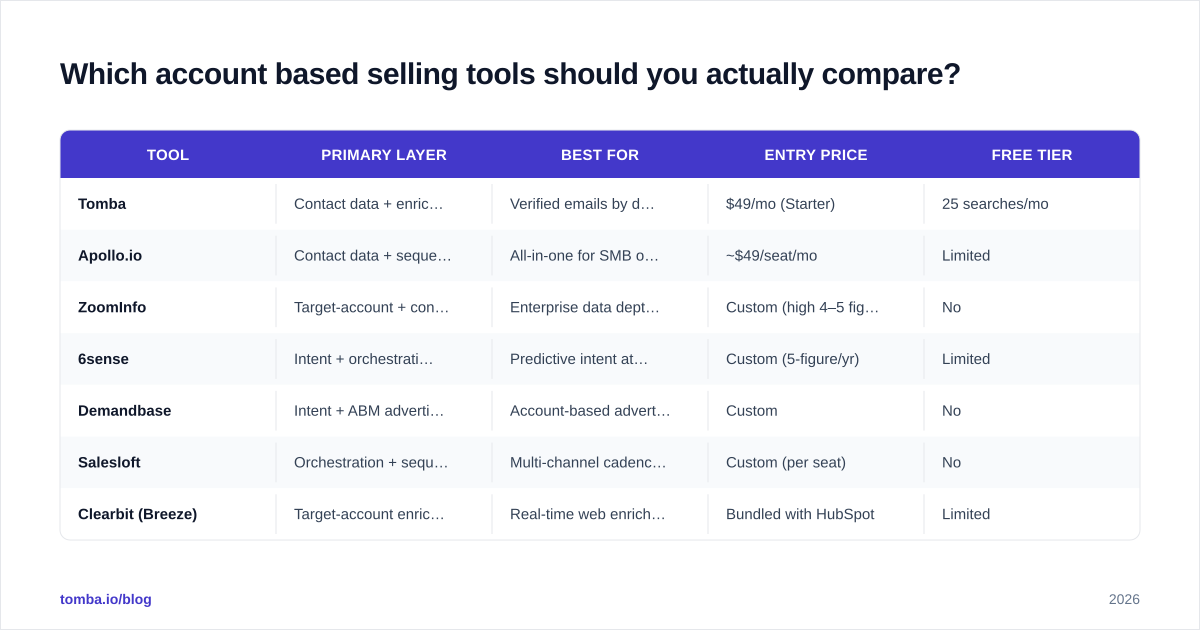
A few honest reads on this table:
- ZoomInfo and 6sense are powerful and expensive. They make sense when you have the headcount to operationalize them. If a $30k+/year contract would be more than 10% of your total sales-tech budget, you're probably too early.
- Apollo is the popular "do everything" pick for SMB — but teams routinely report that its contact data accuracy lags dedicated finders, so many pair it with a verification source. See the Apollo alternative breakdown for the trade-offs.
- Tomba sits squarely in Layer 2 and is built to be the accuracy backbone other layers depend on, with transparent Tomba pricing rather than "call us."
How accurate does your contact data need to be?#
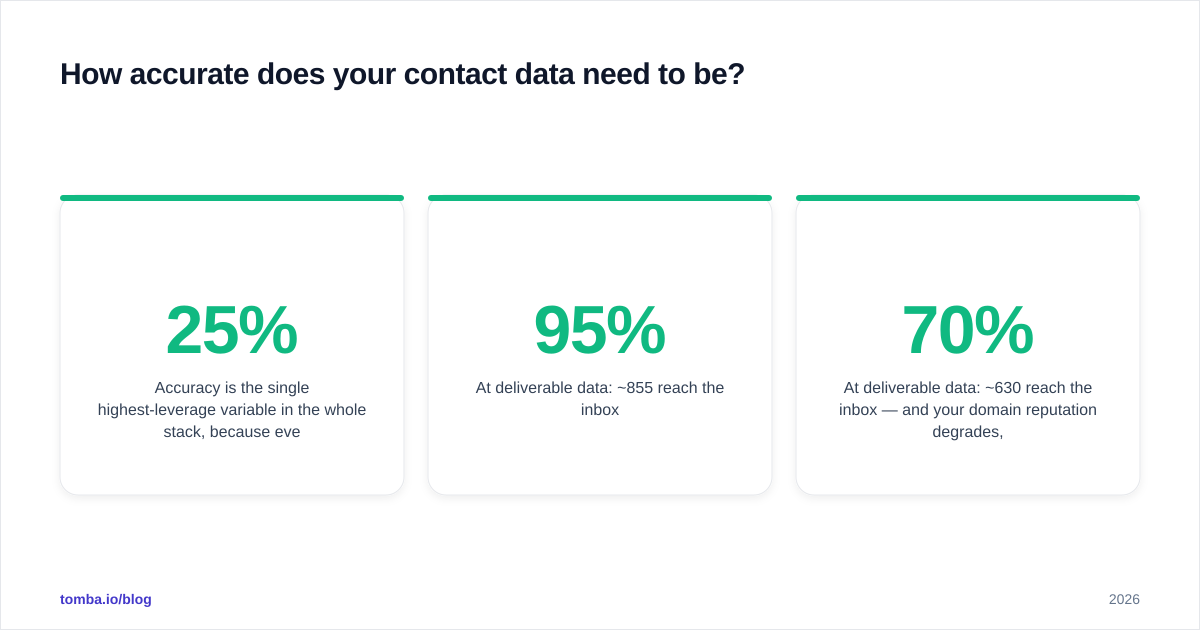
Accuracy is the single highest-leverage variable in the whole stack, because every other layer multiplies it. A 25% bounce rate doesn't just waste 25% of your sends — it tanks your sender reputation, which then suppresses deliverability for the good 75%.
Run the math on a typical ABS campaign:
- 150 target accounts × 6 contacts each = 900 contacts
- At 95% deliverable data: ~855 reach the inbox
- At 70% deliverable data: ~630 reach the inbox — and your domain reputation degrades, dragging future sends down further
That 25-point accuracy gap isn't a rounding error. It's the difference between a campaign that compounds and one that quietly poisons your domain. This is why a dedicated email verifier belongs in the pipeline before the orchestration layer ever fires, and why catch-all verification matters for the many enterprise domains that accept-all by default.
For sourcing contacts at the account level, domain search lets you pull every known email pattern at a target company in one pass — useful when you're mapping a buying committee and need the CFO, the VP Eng, and the procurement lead at the same firm.
Do you need an enterprise ABM platform or a lean stack?#
Conclusion first: most teams under ~20 reps should run a lean stack and graduate to an enterprise platform only when intent data volume justifies a dedicated analyst.
The enterprise platforms (6sense, Demandbase) shine at predictive intent — telling you that Account X is in-market before they fill out a form. That's genuinely valuable. But the value only materializes if someone acts on the signal within days. Buy the Ferrari, then staff the pit crew, or it sits in the garage.
Here's the decision framework:
| Situation | Recommended approach |
|---|---|
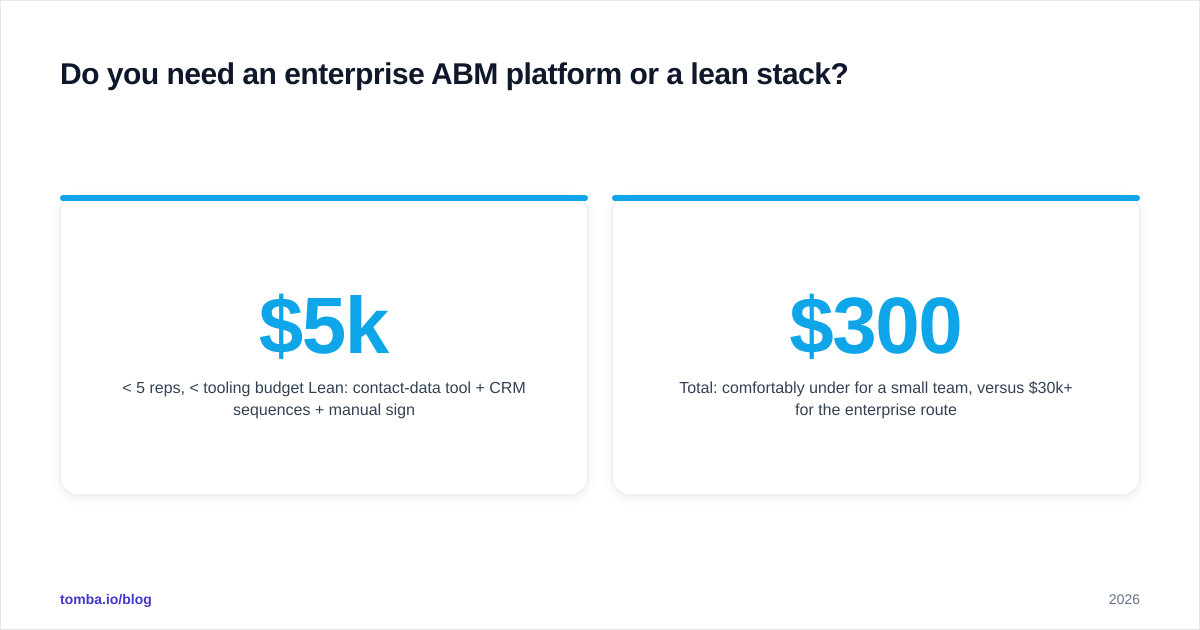
| < 5 reps, < $5k/mo tooling budget | Lean: contact-data tool + CRM sequences + manual signal checks |
| 5–20 reps, repeatable ICP | Mid: dedicated data source + orchestration tool (Salesloft/Apollo) + G2 intent |
| 20+ reps, multi-segment GTM | Enterprise: 6sense/Demandbase +ZoomInfo + full revenue operations function |
| PLG motion with web traffic | Add website de-anonymization to identify accounts already visiting |
A lean 2026 stack that actually works:
- Data + enrichment: Tomba for verified emails and contact enrichment
- CRM: Whatever you already run — push contacts straight in via the Salesforce integration or HubSpot
- Sequencing: Your CRM's native cadences, or a low-cost sequencer
- Signals: Free G2 buyer-intent alerts plus manual LinkedIn monitoring of target accounts
Total: comfortably under $300/month for a small team, versus $30k+/year for the enterprise route.
How do you build the buying-committee map?#
Multi-threading is the whole point of ABS, and it's where tooling earns its keep. A modern B2B deal involves 6–10 stakeholders, according to Gartner's buying-group research. Single-threading — relying on one champion — is how deals die when that champion changes jobs.
Build the map in three passes:
- Identify roles, not just names. For each account, list the economic buyer, the champion, the technical evaluator, the end users, and the blocker (often procurement or security). Use domain search to surface everyone at the company, then filter by title.
- Verify and enrich. Confirm each contact is real and current before outreach. People change jobs constantly; a six-month-old list is already 15–20% wrong.
- Sequence per persona. The CFO and the end-user engineer should not get the same email. Coordinate timing so the committee hears a consistent story from multiple angles in the same window.
For the technical and content-led members of a committee, an author finder and LinkedIn finder help you reach people who publish or are active on social before they ever hit a form.
What does a coordinated ABS play look like in practice?#
A worked example beats abstraction. Say you sell observability software and your target is a 2,000-person fintech.
- Week 1 — Map. Pull the engineering org from domain search: VP Eng, two Directors, SRE lead, plus the CFO for budget. Verify all six emails.
- Week 1 — Signal check. G2 shows the account viewed three competitor pages last week. That's your timing trigger.
- Week 2 — Multi-thread. SRE lead gets a technical email referencing a specific incident-response pain. VP Eng gets a peer-benchmark angle. CFO gets a cost-of-downtime framing. All within 48 hours.
- Week 3 — Channel mix. LinkedIn touches on the technical contacts, a call to the SRE lead, a value-prop one-pager to the VP.
- Week 4 — Measure. Three of six engaged; the account moves from "target" to "engaged" in your scoring model. Double down.
None of this is possible at scale without the data layer feeding accurate contacts into the orchestration layer. The play is only as good as the emails behind it.
What mistakes kill account based selling programs?#
The patterns repeat across every failed program:
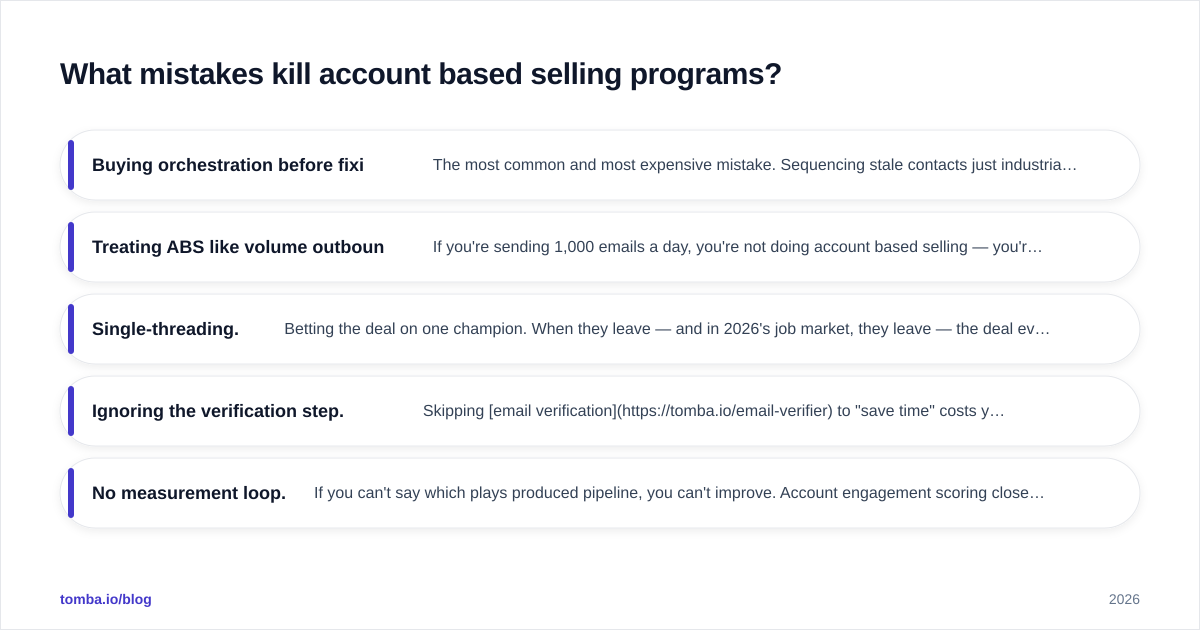
- Buying orchestration before fixing data. The most common and most expensive mistake. Sequencing stale contacts just industrializes the bounce.
- Treating ABS like volume outbound. If you're sending 1,000 emails a day, you're not doing account based selling — you're doing spray-and-pray with extra steps. ABS is depth, not breadth.
- Single-threading. Betting the deal on one champion. When they leave — and in 2026's job market, they leave — the deal evaporates.
- Ignoring the verification step. Skipping email verification to "save time" costs you far more in deliverability damage than it saves.
- No measurement loop. If you can't say which plays produced pipeline, you can't improve. Account engagement scoring closes the loop.
You can validate any vendor's real-world reputation on independent review sites like G2 before committing — analyst marketing and verified-buyer reviews often tell different stories.
How do these tools connect to your existing workflow?#
The best account based selling tools disappear into the tools your reps already live in. Look for:
- Native CRM sync so contacts flow into Salesforce or HubSpot without CSV gymnastics
- Bulk processing for enriching a whole account list at once via a bulk email finder
- API access so you can wire enrichment into your own RevOps automations through the Tomba API
- Spreadsheet and browser tools — a Chrome extension or Google Sheets add-on for reps who work where they research
HubSpot's own account-based marketing playbook is a solid free primer on aligning sales and marketing around the same target list — worth reading before you finalize your stack, because tooling decisions follow process decisions, not the other way around.
Building your account based selling stack: where to start#
Start with the layer that multiplies everything else: contact data and verification. You can swap orchestration tools later with minimal pain, but bad data contaminates every downstream layer and damages your domain in ways that take months to recover from.
Tomba's Email Finder is built to be that accuracy backbone — find verified professional emails by domain, name, or company, map an entire buying committee in one domain search, and enrich contacts before they ever enter your sequences. The free tier gives you 25 searches a month to test it against your own target accounts, and paid plans start at $49/month with transparent pricing — no "contact sales" wall. Pull your real target-account list, run it through, and check the deliverability for yourself. That single test will tell you more than any vendor demo. Build the data layer right, and the rest of your account based selling stack finally has something solid to stand on.
// get started
Find, verify and enrich your first contacts today
Start on the free plan with 25 searches a month, then scale when your team is ready.
Free plan · No credit card required · GDPR & CCPA
// about the author