Account Management Best Practices: The 2026 Playbook
A practical, no-fluff guide to the account management best practices that actually grow revenue: health scores, QBRs, joint success plans, and the metrics that prove expansion.
Account management is where revenue quietly compounds or quietly leaks. The deal that took six months to close can churn in six weeks if nobody owns the relationship after the contract is signed. This guide lays out the account management best practices that separate teams who renew and expand from teams who scramble at renewal time.
TL;DR#
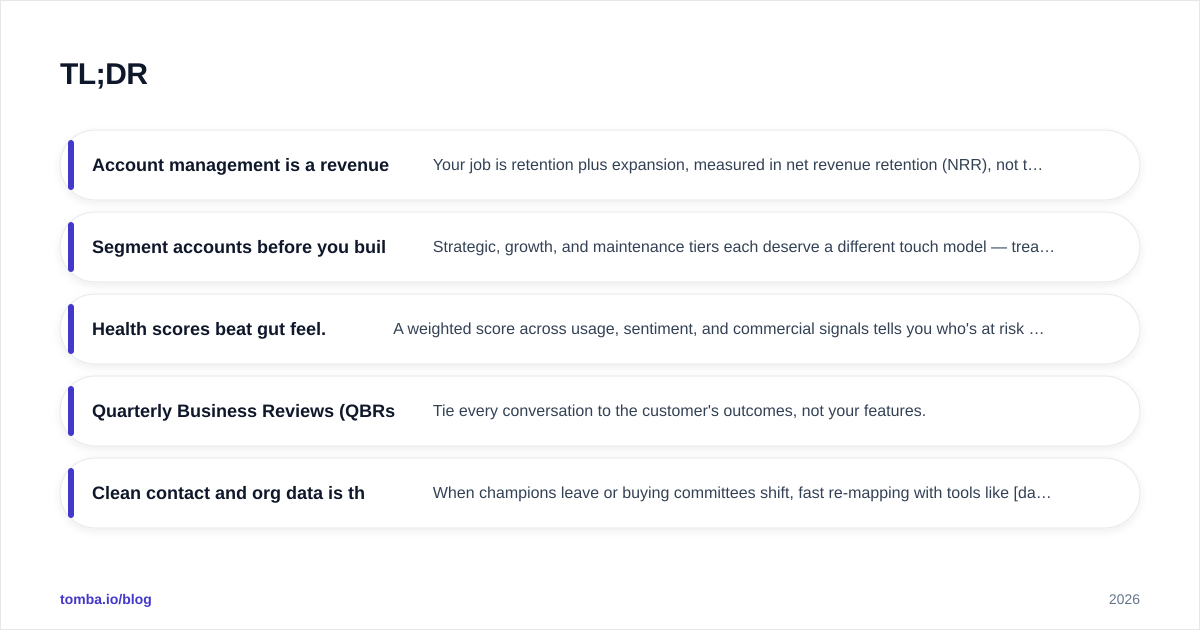
- Account management is a revenue function, not a support function. Your job is retention plus expansion, measured in net revenue retention (NRR), not ticket closure speed.
- Segment accounts before you build a cadence. Strategic, growth, and maintenance tiers each deserve a different touch model — treating every account the same wastes your best people.
- Health scores beat gut feel. A weighted score across usage, sentiment, and commercial signals tells you who's at risk weeks before they tell you.
- Quarterly Business Reviews (QBRs) and joint success plans turn vendors into partners. Tie every conversation to the customer's outcomes, not your features.
- Clean contact and org data is the foundation. When champions leave or buying committees shift, fast re-mapping with tools like data enrichment keeps you from going dark on an account.
What is account management, really?#
Account management is the discipline of growing the value of existing customer relationships after the initial sale. Think of it like tending an orchard rather than hunting: new-business sales plants the trees, account management makes sure they keep bearing fruit — and plants a few more rows while it's at it.
That framing matters because it changes what "good" looks like. A great account manager (AM) is not the person who responds to tickets fastest. It's the person who understands the customer's business goals well enough to spot the next problem your product can solve, and who has the trust to bring it up before procurement does.
The financial stakes are well documented. Acquiring a new customer costs far more than retaining one, and existing customers convert on upsells at much higher rates than cold prospects. According to Gartner research on B2B buying, expansion revenue from current accounts is the most efficient growth lever most companies are underusing.
Why do most account management programs underperform?#
The common failure isn't laziness — it's structure. Three patterns show up again and again:
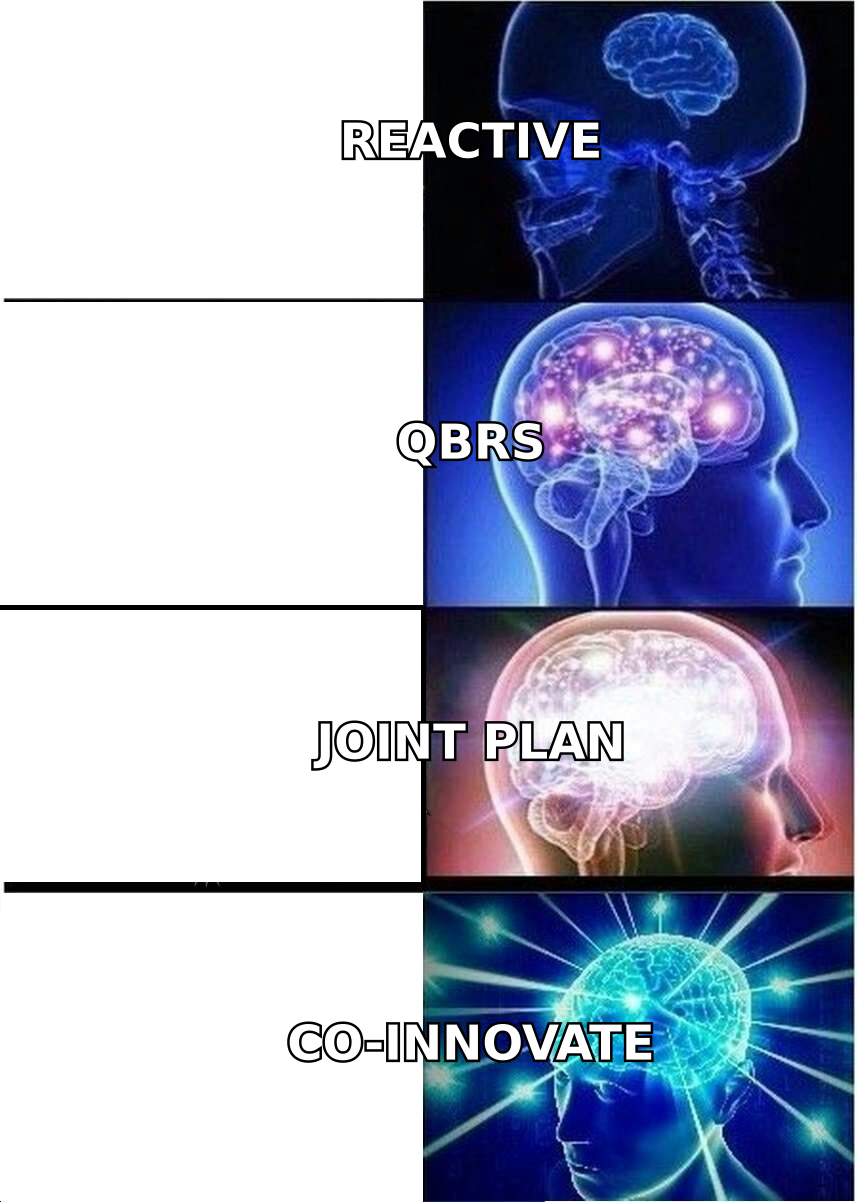
- Reactive servicing. The AM only appears when something breaks or a renewal is 30 days out. By then the relationship has no momentum and no goodwill bank to draw on.
- No account segmentation. Every account gets the same generic check-in, so strategic accounts get under-served and tiny accounts get over-served.
- Data rot. The champion who signed the deal changed jobs, the buying committee reshuffled, and the CRM still lists a contact who left eight months ago.
Each of these is fixable with a deliberate operating model. The rest of this guide is that model.
What are the core account management best practices?#
Here's the short version, expanded in the sections below: segment your book, score account health, run structured QBRs, build joint success plans, keep your contact data current, and measure the right outcomes. Do these six consistently and you'll outperform teams running on charisma alone.
How should you segment your accounts?#
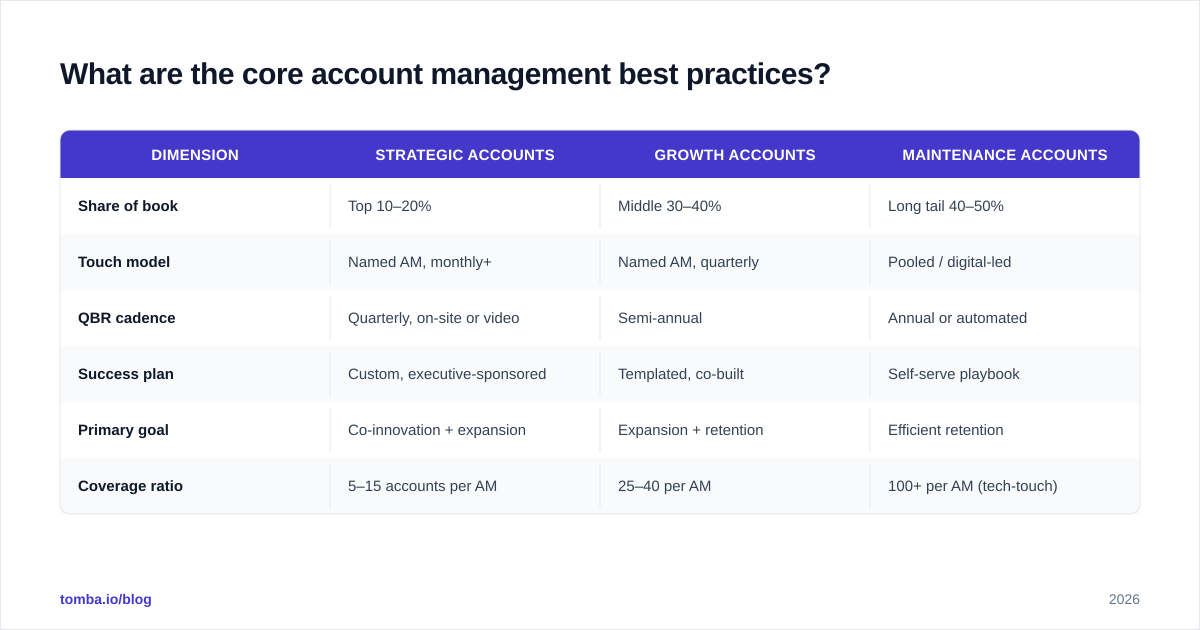
Not all accounts deserve equal effort. Segment by a blend of current revenue, growth potential, and strategic value (logo, referenceability, market influence). A simple three-tier model works for most teams:
| Dimension | Strategic accounts | Growth accounts | Maintenance accounts |
|---|---|---|---|
| Share of book | Top 10–20% | Middle 30–40% | Long tail 40–50% |
| Touch model | Named AM, monthly+ | Named AM, quarterly | Pooled / digital-led |
| QBR cadence | Quarterly, on-site or video | Semi-annual | Annual or automated |
| Success plan | Custom, executive-sponsored | Templated, co-built | Self-serve playbook |
| Primary goal | Co-innovation + expansion | Expansion + retention | Efficient retention |
| Coverage ratio | 5–15 accounts per AM | 25–40 per AM | 100+ per AM (tech-touch) |
The point isn't the exact numbers — it's that you consciously decide where your senior people spend their hours. A common mistake is letting the loudest account, not the most valuable one, set the agenda.
How do you build an account health score?#
A health score is an early-warning system. Like a car dashboard, it doesn't drive for you, but it tells you the engine's overheating before you're stranded. Build it from three signal categories:
- Product signals (40–50%): login frequency, feature adoption breadth, active seats vs. licensed seats, API/usage trends.
- Relationship signals (25–35%): number of engaged stakeholders, executive sponsor present, sentiment from QBRs and support interactions, champion stability.
- Commercial signals (20–30%): invoice timeliness, support escalations, contract value trend, time to renewal.
Weight each input, normalize to a 0–100 score, and bucket into green / amber / red. The discipline is acting on amber — that's where intervention is cheap and effective. Waiting until red usually means waiting until the renewal call where the customer has already decided.
A note on data: your health score is only as good as the records feeding it. If your CRM shows a single contact for a company that actually has a seven-person buying committee, your relationship signal is fiction. This is where org mapping and contact enrichment earn their keep — they keep the people side of the score honest.
What makes a Quarterly Business Review actually useful?#
A QBR is not a feature demo and not a status update. It's a strategic conversation about whether the customer is getting the business outcome they bought, and what comes next. The best QBRs follow a tight arc:
- Recap the customer's goals — in their words, from the last review.
- Show measurable progress against those goals, using their data where possible.
- Surface risks and gaps honestly, including where your product fell short.
- Align on the next quarter's priorities, with named owners on both sides.
- Tee up expansion only when it maps to a goal — never as a bolt-on pitch.
Bring the right people. A QBR with only the day-to-day user and no economic buyer is a missed chance to reinforce value with the person who signs the renewal. If you've lost touch with the executive sponsor because they changed roles, re-establishing that line is your highest-leverage pre-QBR task.
What is a joint success plan and why does it matter?#
A joint success plan is a shared, written document that states the customer's desired outcomes, the milestones to get there, and who owns what — on both sides. It converts a vendor relationship into a partnership because both parties are now accountable to the same scoreboard.
Good joint success plans are specific and time-bound: "Reduce onboarding time for new reps from 21 days to 10 by Q3, measured in your LMS, with our team delivering the certification module by week 4." Vague plans ("improve efficiency") give you nothing to review against and nothing to expand from.
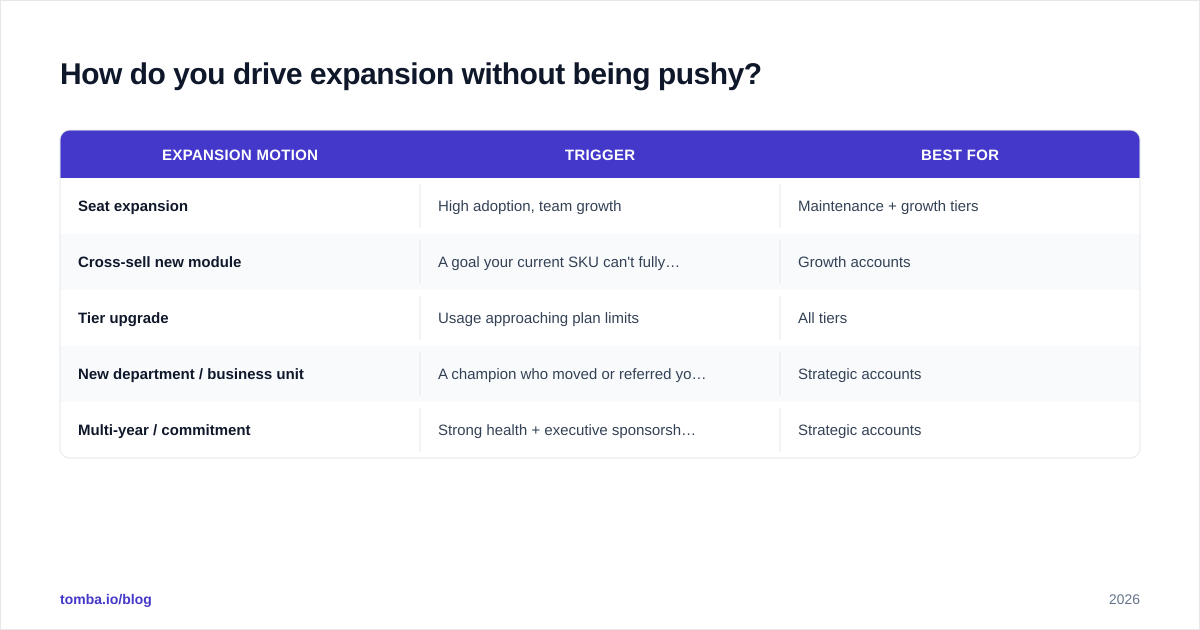
How do you drive expansion without being pushy?#
Expansion follows trust, and trust follows delivered value. The sequence almost always runs: prove value on the current footprint → identify an adjacent problem the customer already feels → connect your capability to that problem → let the customer pull. Pushing product before value is delivered is the fastest way to poison a renewal.
Practically, expansion plays break into a few repeatable motions:
| Expansion motion | Trigger | Best for |
|---|---|---|
| Seat expansion | High adoption, team growth | Maintenance + growth tiers |
| Cross-sell new module | A goal your current SKU can't fully meet | Growth accounts |
| Tier upgrade | Usage approaching plan limits | All tiers |
| New department / business unit | A champion who moved or referred you internally | Strategic accounts |
| Multi-year / commitment | Strong health + executive sponsorship | Strategic accounts |
The "new department" motion is underrated and data-dependent. When a champion moves internally or you get a warm intro to another business unit, you need to map that new org fast — find the right stakeholders, their roles, and how to reach them. A domain search across the company plus a quick phone finder lookup turns a vague "talk to the ops team" into a named, reachable contact list within minutes.
Which metrics prove account management is working?#
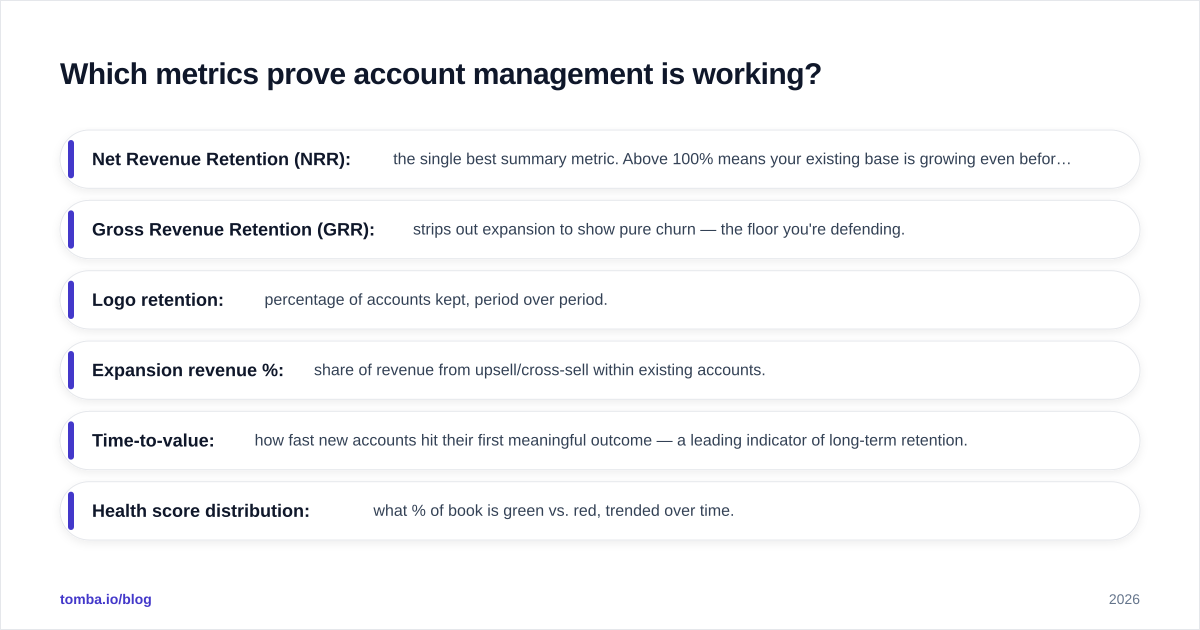
Activity metrics (calls made, QBRs held) tell you the team is busy. Outcome metrics tell you it's working. Anchor your dashboard on these:
- Net Revenue Retention (NRR): the single best summary metric. Above 100% means your existing base is growing even before new logos.
- Gross Revenue Retention (GRR): strips out expansion to show pure churn — the floor you're defending.
- Logo retention: percentage of accounts kept, period over period.
- Expansion revenue %: share of revenue from upsell/cross-sell within existing accounts.
- Time-to-value: how fast new accounts hit their first meaningful outcome — a leading indicator of long-term retention.
- Health score distribution: what % of book is green vs. red, trended over time.
Tie compensation to NRR and GRR, not just gross bookings, and behavior follows. For a deeper look at how downstream sales metrics connect, the concept of win rate applies to renewal and expansion opportunities too — a renewal you assumed was safe and lost still counts against you.

What tools and integrations support good account management?#
Tooling won't fix a broken operating model, but the right stack removes friction. Most mature programs run on a customer relationship platform, a customer success/health platform, and a data layer that keeps contacts and org charts current.
The data layer is the part teams most often neglect. When buying committees shift — and B2B committees now average several stakeholders per deal, per HubSpot and Salesforce research — you need to re-map quickly. Pushing fresh, verified contacts into your CRM through a native Salesforce integration or HubSpot integration means your AMs are never working off a stale org chart. Clean data also keeps your health scores trustworthy and your QBR invite lists complete.
If you're evaluating providers, weigh data freshness, verification accuracy, CRM-native sync, and transparent pricing — not just contact volume. A huge database full of bounced or outdated emails is worse than a smaller one that's verified.
A 90-day account management implementation plan#
If you're standing this up from scratch or fixing a stalled program, sequence it:
- Days 1–30 — Foundation. Segment your book into the three tiers. Clean and enrich contact/org data so every strategic account has a complete stakeholder map. Define your health-score inputs and weights.
- Days 31–60 — Cadence. Stand up QBR scheduling for strategic and growth tiers. Draft joint success plan templates. Launch the health dashboard and start acting on amber accounts.
- Days 61–90 — Expansion + measurement. Identify expansion plays in green accounts. Wire NRR/GRR reporting. Review the first cohort of health interventions and refine the score weights based on what predicted churn.
The goal at day 90 isn't perfection — it's a repeatable rhythm that runs without heroics.
Common questions#
How many accounts can one account manager handle? It depends entirely on tier. A strategic AM might own 5–15 accounts; a tech-touch AM managing the long tail can cover hundreds with automation. Coverage ratios that ignore tier are the root of most burnout and churn.
Is account management the same as customer success? They overlap and the titles blur by company. A useful split: customer success owns adoption and outcomes; account management owns the commercial relationship, retention, and expansion. Small teams combine the roles; larger ones separate them.
How often should I contact an account? Match it to tier and to value delivered, not a calendar quota. A monthly call with nothing to say erodes trust faster than silence. Every touch should advance the joint success plan.
Closing: get the data foundation right first#
Every best practice above — health scoring, QBR invite lists, expansion mapping, re-engaging a champion who switched companies — depends on knowing who's actually in the account and how to reach them. That's the unglamorous foundation under the strategy.
Tomba's Email Finder helps your account managers find and verify the right contacts the moment a buying committee shifts, a champion moves, or you spot an opening in a new department. Start on the free tier (25 searches/month) to map your top accounts, and scale up as your expansion motion proves out. Keep your CRM honest, and your account management best practices will have something solid to stand on.
// get started
Find, verify and enrich your first contacts today
Start on the free plan with 25 searches a month, then scale when your team is ready.
Free plan · No credit card required · GDPR & CCPA
// about the author