Adaptability in Sales: The 2026 Skill That Wins Deals
Buyers change mid-deal, markets shift mid-quarter, and rigid playbooks lose. Here's how adaptability in sales actually works in 2026 — with a framework, a skills matrix, and drills your team can run this week.

TL;DR
- Adaptability in sales is the ability to change your approach mid-conversation, mid-deal, and mid-quarter based on what the buyer and the market are actually telling you — not what your script assumes.
- It is now a measurable, coachable competency, not a vague personality trait. You can break it into four layers: behavioral, situational, strategic, and technological.
- Reps who score high on adaptability close more complex deals because they read signals faster and abandon losing tactics sooner.
- The fastest way to build it: shorten your feedback loop. Smaller bets, faster reads, quicker adjustments.
- Tools matter. Adaptable reps spend less time on manual prospecting busywork and more time reading and responding to buyers — which is where good data and clean contact workflows pay off.
What is adaptability in sales, really?#
Adaptability in sales is the discipline of changing your behavior when the situation changes — quickly, deliberately, and without losing the thread of the deal.
Think of it like driving in a city you don't know. A rigid driver memorizes one route and panics when a road is closed. An adaptive driver keeps the destination fixed but reroutes the moment the GPS reports traffic. The goal never moves; the path constantly does. Great salespeople work the same way — the quota and the customer outcome stay fixed, but the pitch, the channel, the pacing, and the messaging all flex in real time.
That distinction matters because most sales training still optimizes for consistency: same script, same demo, same five-step sequence. Consistency is comfortable and easy to measure, but buyers in 2026 don't behave consistently. They research before they ever reply, they buy in committees of six to ten people, and they switch priorities when their own budgets shift. A rep who can only run one playbook is fragile. A rep who can run the right playbook for the situation in front of them is antifragile.
Research backs this up. Gartner's work on buyer behavior shows the modern B2B purchase is non-linear — buyers loop back through the same stages multiple times rather than marching forward. If your process assumes a straight line, you lose the deal that loops. You can read more in Gartner's research on the B2B buying journey.
Why does adaptability matter more in 2026 than ever?#
Three forces collided, and they all reward flexibility.
First, information symmetry flipped. Buyers now arrive at the first call already knowing your pricing tiers, your competitors, and half your objection-handling script. The rep who recites the standard pitch sounds like a brochure. The rep who asks "what did your research not answer?" and adapts from there earns the conversation.
Second, the channel mix exploded. Email, LinkedIn, phone, video messages, communities, and warm intros all compete for the same buyer. A rigid "email-only" sequence ignores the buyer who only responds on LinkedIn. Adaptability means meeting each prospect on the channel they actually use.
Third, AI raised the floor on tactics. When everyone has access to AI-written sequences and instant research, the differentiator is no longer who has a clever opener — it's who reads the response and adjusts. Tactics commoditize; judgment doesn't.
The result: adaptability has moved from a "nice soft skill" to a core revenue competency. It correlates directly with win rate on complex deals, where the ability to re-sequence stakeholders and re-frame value mid-cycle decides who closes.
What does the adaptability-in-sales framework look like?#
Adaptability isn't one skill — it's four layers stacked on top of each other. Each layer operates on a different timescale, from the seconds inside a live call to the quarters of a shifting market.
Layer 1 — Behavioral (seconds to minutes). Adjusting tone, pace, and language inside a single conversation. The buyer goes quiet — do you fill the silence or hold it? They sound rushed — do you cut to the point or stick to your agenda? This is the most visible layer and the easiest to coach with call recordings.
Layer 2 — Situational (a single deal). Re-sequencing your approach for the specific opportunity. A champion goes dark, a new stakeholder appears, procurement enters early. Situational adaptability means redrawing your deal plan without starting over.
Layer 3 — Strategic (a quarter or territory). Shifting which segments, personas, or messages you prioritize as data comes in. If a vertical stops converting, the strategic-adaptive rep reallocates their pipeline rather than grinding the dead segment.
Layer 4 — Technological (ongoing). Adopting new tools and workflows without friction. Reps who treat every new tool as a threat fall behind; reps who absorb sales automation and AI assistants into their routine free up hours for the human work that actually moves deals.
The layers compound. A rep strong only at Layer 1 is charming but loses complex deals. A rep strong at all four is the one your team studies.
Is adaptability a personality trait or a learnable skill?#
It's overwhelmingly learnable — and treating it as innate is the single biggest coaching mistake managers make.
The myth is that some people are "naturally flexible" and others are rigid by wiring. In practice, adaptability comes down to two trainable mechanics: signal detection (noticing that something changed) and response repertoire (having more than one move available). Both improve with deliberate practice.
Here's the everyday analogy: a new cook follows the recipe exactly because it's the only thing they know. An experienced cook tastes the sauce and adjusts — more acid, less salt — because they've built a repertoire of fixes and they're paying attention to feedback. Nobody is born tasting sauce well. They built it through reps and feedback.
The way you build a response repertoire in sales is by shortening your feedback loop. Make a smaller bet, read the result faster, adjust sooner. A rep who sends one big sequence and waits two weeks learns slowly. A rep who tests two openers on twenty contacts and reads replies in two days learns ten times faster — and that learning rate is adaptability.
How do you compare an adaptive rep to a rigid rep?#
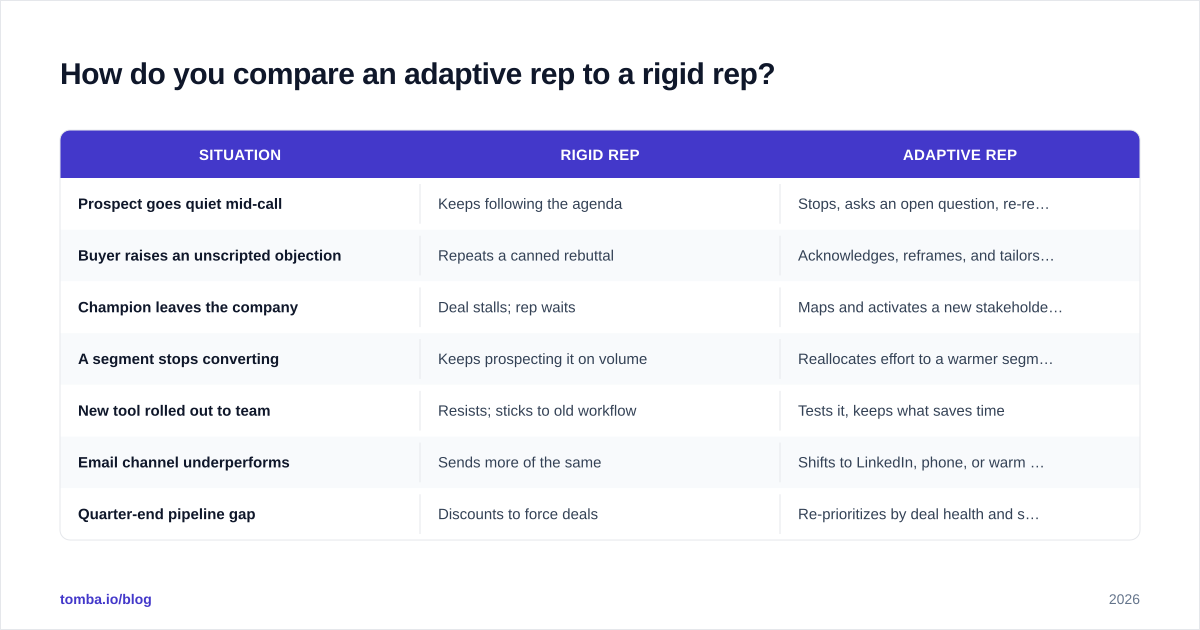
The differences show up in observable behavior, not vibes. Here's how the two profiles diverge across the moments that decide deals.
| Situation | Rigid rep | Adaptive rep |
|---|---|---|
| Prospect goes quiet mid-call | Keeps following the agenda | Stops, asks an open question, re-reads the room |
| Buyer raises an unscripted objection | Repeats a canned rebuttal | Acknowledges, reframes, and tailors the response |
| Champion leaves the company | Deal stalls; rep waits | Maps and activates a new stakeholder within days |
| A segment stops converting | Keeps prospecting it on volume | Reallocates effort to a warmer segment |
| New tool rolled out to team | Resists; sticks to old workflow | Tests it, keeps what saves time |
| Email channel underperforms | Sends more of the same | Shifts to LinkedIn, phone, or warm intro |
| Quarter-end pipeline gap | Discounts to force deals | Re-prioritizes by deal health and stage |
The pattern is clear: the rigid rep responds to change by doing more of the same thing harder. The adaptive rep responds by changing the thing. Same effort, very different outcomes.

What are the core adaptability skills — and how do you build each?#
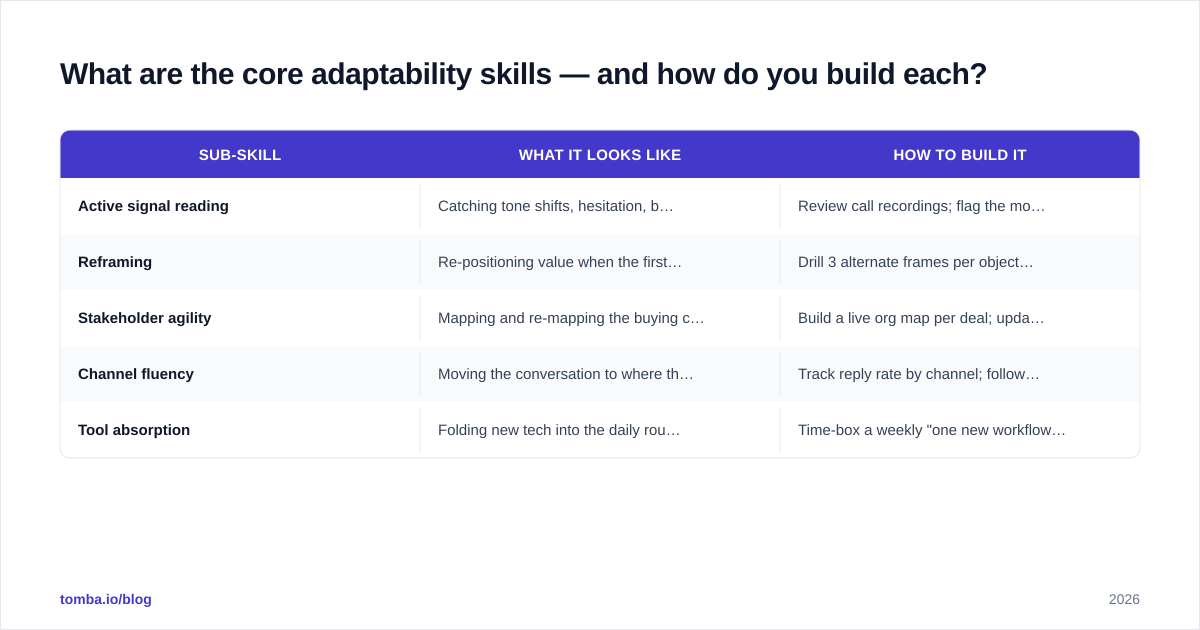
Adaptability decomposes into five trainable sub-skills. Treat this as a competency matrix you can score reps against and coach over a quarter.
| Sub-skill | What it looks like | How to build it |
|---|---|---|
| Active signal reading | Catching tone shifts, hesitation, buying signals | Review call recordings; flag the moment the signal appeared |
| Reframing | Re-positioning value when the first frame misses | Drill 3 alternate frames per objection |
| Stakeholder agility | Mapping and re-mapping the buying committee | Build a live org map per deal; update weekly |
| Channel fluency | Moving the conversation to where the buyer responds | Track reply rate by channel; follow the data |
| Tool absorption | Folding new tech into the daily routine fast | Time-box a weekly "one new workflow" experiment |
A practical coaching cadence: pick one sub-skill per month, score it from call data and CRM hygiene, and run two focused drills a week. Adaptability built this way is durable because it's grounded in repeated, specific reps — not a one-off workshop that fades in a fortnight.
Notice how many of these depend on clean data flowing through your CRM. Stakeholder agility is impossible if your contact records are stale. Channel fluency is impossible if you can't reach the buyer on a second channel. Adaptability and data hygiene are quietly linked.
How does adaptive selling actually work in a live deal?#
The mechanism is a loop, not a line. You sense a signal, interpret it, choose a response from your repertoire, act, and then read the result — which feeds the next loop. The faster you cycle, the more adaptive you appear.
Walk through a real example. You email a VP of Operations with a value-led pitch. No reply in four days (signal). You interpret: either wrong person, wrong channel, or wrong frame. Instead of sending the same message again, you check whether a manager on their team is more reachable, switch to a LinkedIn touch with a different angle, and reference a peer company's result (response). The manager replies and offers an intro upward (result). You just adapted three variables — person, channel, and frame — in one loop, and the deal that would have died on "no reply" is now alive.
Compare that to the rigid path: send follow-up #2, follow-up #3, mark closed-lost. Same starting point, opposite ending.
The unlock for the loop is speed of reaching the right contact when your first attempt stalls. That's where reliable contact data earns its keep — being able to find a different stakeholder's verified email in seconds means you can adapt the deal instead of abandoning it. A clean email finder and data enrichment workflow turns "champion left, deal dead" into "champion left, here's the next contact."
What blocks adaptability — and how do teams fix it?#
Most teams don't lack adaptable people; they have systems that punish adaptability. Three blockers dominate.
Rigid process metrics. When you measure reps only on "activities completed" — calls dialed, emails sent — you reward volume over judgment. A rep who sends 200 identical emails scores well; a rep who sends 40 tailored ones and adapts scores poorly, even if they close more. Fix: measure outcomes and stage progression, not raw activity.
Slow feedback loops. If reps only see results in the monthly review, they can't adjust in time. Fix: surface reply rates, meeting rates, and deal health weekly or daily so reps can read and react inside the same cycle.
Tool friction. When the stack is clunky, reps default to whatever's easiest, not whatever's right. If pulling a verified contact takes ten minutes across three tabs, reps skip it and guess. Fix: invest in tools that make the adaptive move the easy move. The lower the friction on research, enrichment, and outreach, the more cognitive budget reps have left for actually reading the buyer.
This is why technological adaptability (Layer 4) underpins the other three. A team buried in manual busywork has no spare attention for behavioral or situational adaptation. Vendors like HubSpot and Salesforce have built their recent roadmaps around reducing exactly this friction — and peer reviews on G2 consistently rank "time saved on manual work" as a top driver of rep performance.
How do you coach adaptability across a whole team?#
You make it visible, scored, and practiced — the same way you'd coach any skill that matters.
Start by scoring the matrix above for each rep from call recordings and CRM data. Most managers are surprised: their "best" rep on activity metrics is often middling on adaptability, and a quieter rep is quietly excellent at it.
Then run scenario drills. Pick a curveball — "your champion just got promoted out of the buying group" — and have reps talk through their next three moves live. The point isn't a perfect answer; it's expanding the response repertoire so the move exists when it's needed for real.
Finally, reward the adjustment, not just the outcome. When a rep abandons a losing tactic early, call it out as a win even if the deal still slips. You're training the instinct to read and respond, which pays off across hundreds of future deals. For a deeper look at the research linking flexible behavior to revenue, HubSpot's sales blog is a strong, regularly updated source.
Putting it together#
Adaptability in sales is no longer a personality footnote — it's the competency that decides who survives buyers who don't follow your funnel. Break it into four layers, score the five sub-skills, shorten your feedback loops, and remove the tool friction that eats your reps' attention. Do that, and your team stops forcing one playbook onto every deal and starts running the right play for the buyer in front of them.
The lowest-friction place to start is your contact data. Adaptable reps need to reach the right person fast — a new stakeholder, a different channel, a warm path upward — without losing a deal to a dead email. Tomba's Email Finder gives you verified professional emails by name, company, or domain, so when a deal forces you to adapt, you can pivot to the next contact in seconds instead of starting over. Start free with 25 searches a month, and check Tomba pricing when your pipeline outgrows it — the Starter plan is $49/mo. Give your reps fewer reasons to guess, and more room to do the human work adaptability is built on.
// get started
Find, verify and enrich your first contacts today
Start on the free plan with 25 searches a month, then scale when your team is ready.
Free plan · No credit card required · GDPR & CCPA
// about the author