Adaptio Pricing in 2026: Plans, Costs, and Real ROI
Adaptio doesn't publish a public price list, which makes budgeting tricky. Here's how Adaptio pricing actually works in 2026, what drives the quote, and how to judge ROI.
Adaptio sells itself as an AI sales-coaching and enablement layer that sits on top of your reps' real conversations. The product story is clear. The price tag is not. Like most enablement platforms aimed at sales teams, Adaptio runs a quote-based model rather than a public price list, so "how much does Adaptio cost?" rarely has a one-line answer.
This post fixes that. Below is a practical breakdown of how Adaptio pricing works in 2026, what drives the number on your quote, where the hidden costs hide, and how to decide whether the spend is justified against your win rate.
TL;DR#
- Adaptio pricing is custom and quote-based — there is no published per-seat number, so your cost depends on seat count, contract length, and module mix.
- Expect a per-seat annual model typical of sales-enablement tools, often with a platform/onboarding fee layered on top.
- The real cost drivers are number of reps, conversation-intelligence volume, integrations, and the level of AI coaching you turn on.
- Budget for implementation, CRM integration, and admin time — these are easy to forget and can rival the license cost in year one.
- Adaptio competes on coaching depth, not data volume; if your gap is contact data and pipeline top-of-funnel, a finder-and-enrichment stack like Tomba solves a different problem at a fraction of the price.
What is Adaptio and who is it for?#
Adaptio is an AI-driven sales enablement and coaching platform. In plain terms, it listens to your sales calls and meetings, scores how reps perform against a defined methodology, and feeds managers structured coaching prompts so they stop guessing what to fix. Think of it less as a notetaker and more as a flight simulator for your sales floor — it replays what happened, flags the turbulence, and tells the pilot what to do differently next time.
The buyer is usually a VP of Sales, head of enablement, or RevOps leader at a team large enough that manual call review has stopped scaling. If you have five reps, a manager can listen to calls personally. At fifty reps, that's impossible, and the cost of inconsistent coaching shows up directly in your sales win rate.
That context matters because it shapes pricing. Adaptio is priced like a platform that replaces a slow human process, not like a utility you meter by the lookup.
How does Adaptio pricing actually work in 2026?#
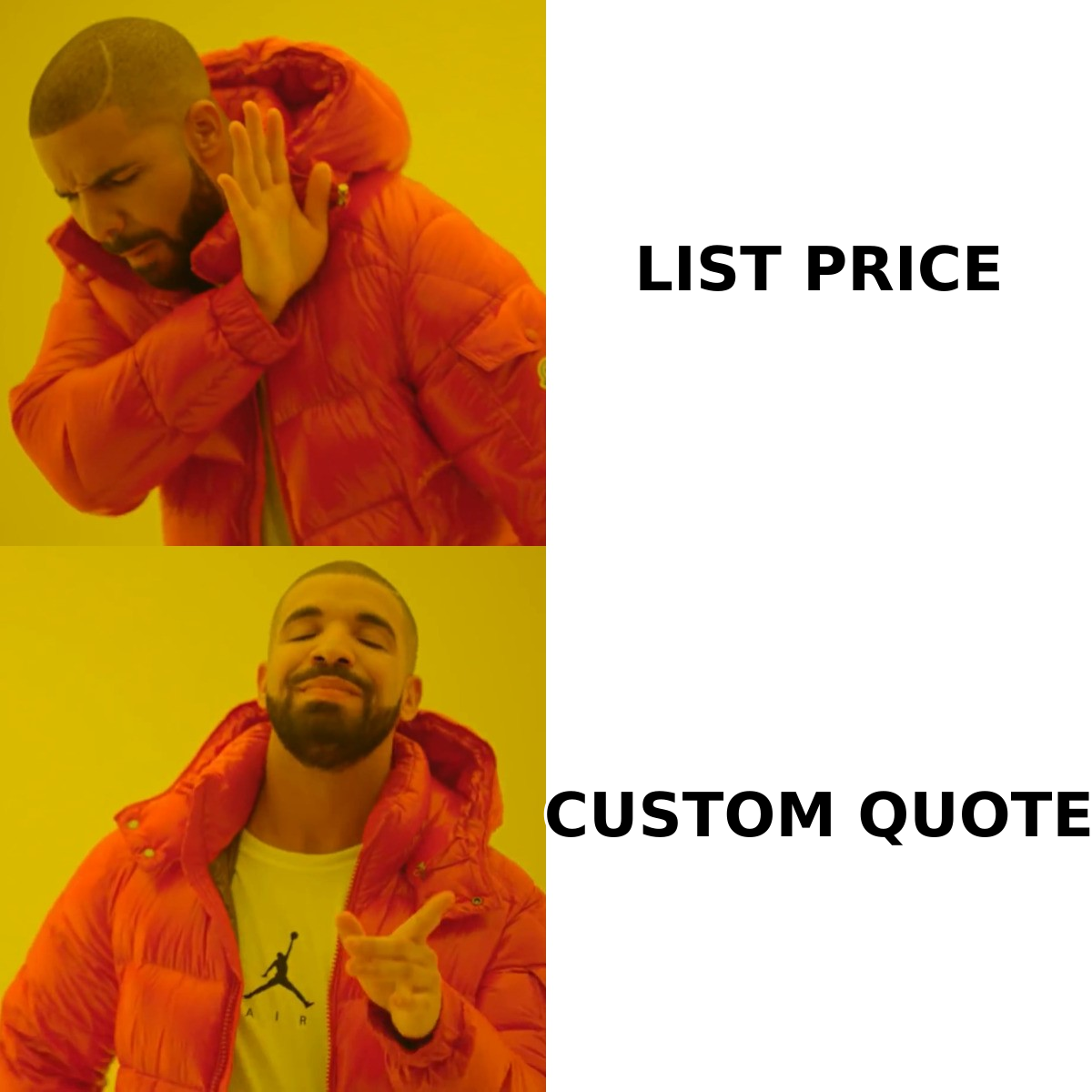
Conclusion first: Adaptio uses a custom, per-seat annual contract, and you get the real number only after a sales conversation. There is no self-serve checkout and no public price page, which is standard for conversation-intelligence and coaching tools at this tier.
Based on how comparable enablement platforms structure deals, an Adaptio quote is typically assembled from four building blocks:
- Per-seat license — billed per rep (and sometimes per manager seat), almost always annual rather than monthly.
- Platform / base fee — a fixed amount that covers the core product regardless of seat count.
- Module or tier upgrades — advanced AI coaching, custom scorecards, deeper analytics, or methodology packs that aren't in the entry tier.
- Onboarding & implementation — a one-time setup fee for configuration, CRM integration, and training.
You should treat any "X per user per month" figure you see floating around third-party sites as an estimate, not a contract. Vendors in this category routinely flex pricing by 30–50% depending on volume and term length.
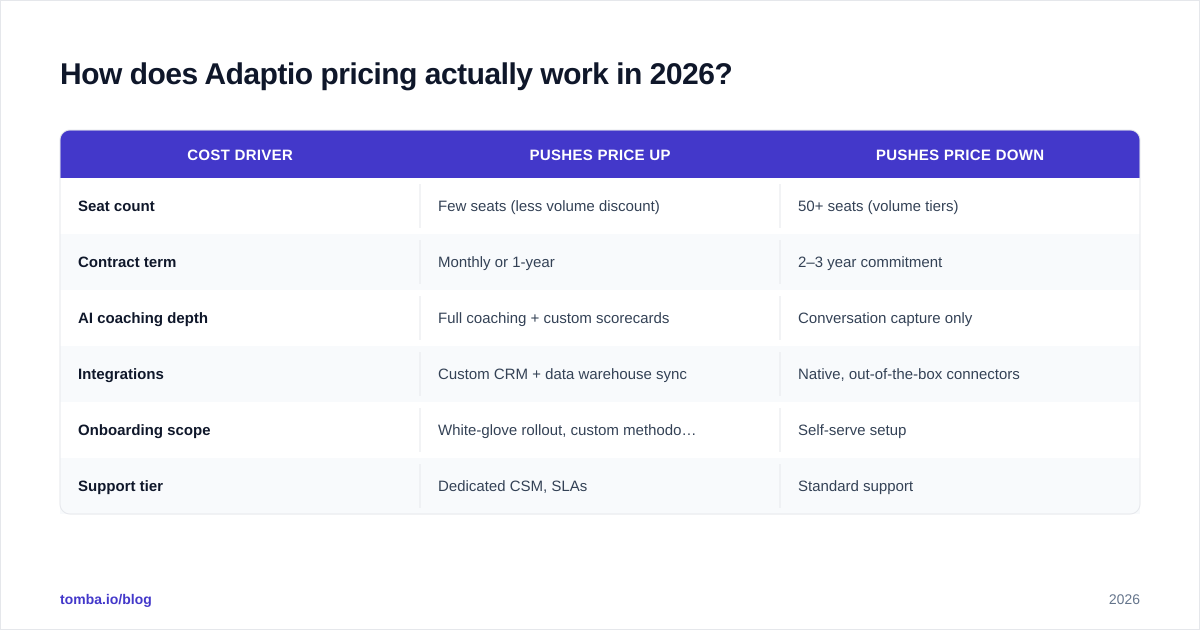
What drives your Adaptio quote up or down#
| Cost driver | Pushes price up | Pushes price down |
|---|---|---|
| Seat count | Few seats (less volume discount) | 50+ seats (volume tiers) |
| Contract term | Monthly or 1-year | 2–3 year commitment |
| AI coaching depth | Full coaching + custom scorecards | Conversation capture only |
| Integrations | Custom CRM + data warehouse sync | Native, out-of-the-box connectors |
| Onboarding scope | White-glove rollout, custom methodology | Self-serve setup |
| Support tier | Dedicated CSM, SLAs | Standard support |
The pattern is consistent across the category: the published "starting" price assumes a happy-path setup, and the real invoice grows with every customization you request.
What are the likely Adaptio pricing tiers?#
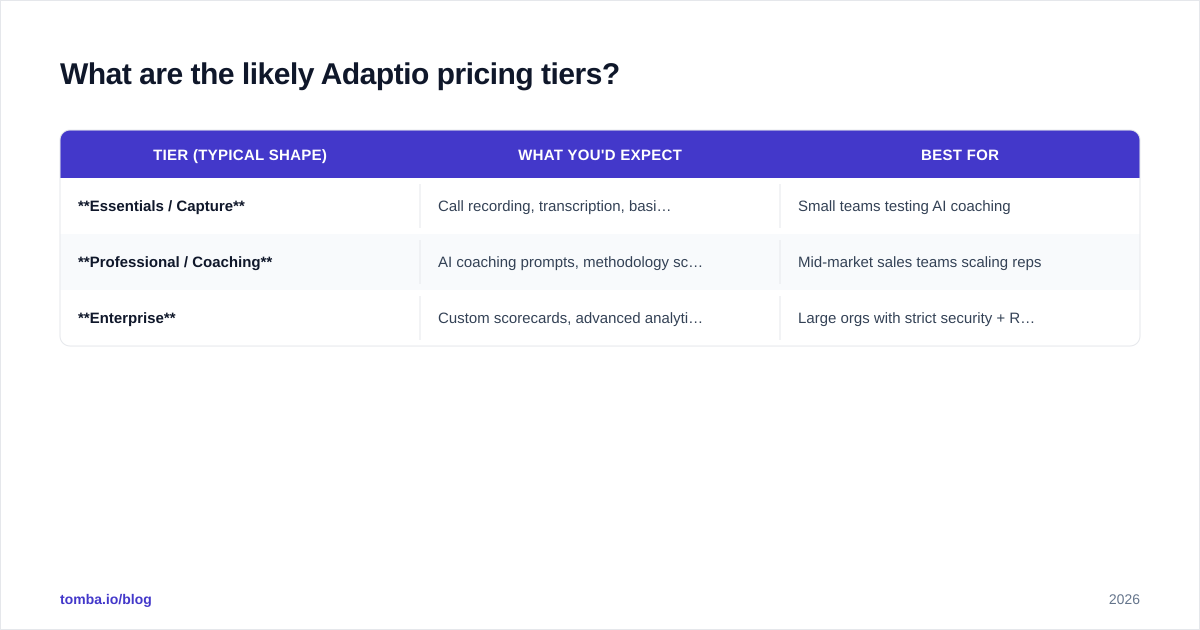
Because Adaptio doesn't post numbers, the honest framing is tiers by capability, not exact dollars. Most enablement platforms structure their lineup roughly like this, and Adaptio's product surface maps cleanly onto it:
| Tier (typical shape) | What you'd expect | Best for |
|---|---|---|
| Essentials / Capture | Call recording, transcription, basic scorecards | Small teams testing AI coaching |
| Professional / Coaching | AI coaching prompts, methodology scoring, manager dashboards | Mid-market sales teams scaling reps |
| Enterprise | Custom scorecards, advanced analytics, SSO, dedicated CSM, API access | Large orgs with strict security + RevOps needs |
If you want a reliable apples-to-apples reference for how the category prices itself, the verified buyer reviews on G2 and Capterra are the best public sources — they often surface real contract sizes in the review text even when the vendor stays quiet. Analyst coverage from Gartner on revenue-enablement platforms is also useful for sizing the market range.
Is Adaptio worth the price?#
The answer hinges on a single number: how much a one-point lift in win rate is worth to you. That reframes the entire pricing debate away from "is the seat cost fair?" toward "does better coaching pay for itself?"
Run the math before the demo, not after. A simple model:
- Take your average deal size and current win rate.
- Estimate a realistic coaching-driven lift — even 2–3 points is meaningful at scale.
- Multiply the incremental won revenue across your rep count and pipeline.
If a team of 30 reps each runs 40 opportunities a year at a $15,000 average deal, a 2-point win-rate improvement is roughly $360,000 in new revenue. Against that, even a five- or six-figure annual Adaptio contract can look cheap — if the coaching actually moves the number. The risk is paying enterprise prices and never operationalizing the insights, which is the most common way these tools become shelfware.
This is why the procurement conversation should center on adoption guarantees, not feature checklists. A platform you don't use is infinitely expensive per outcome.
What hidden costs should you budget for?#
The license is the headline. These line items are the surprise:
- Implementation and CRM integration. Connecting Adaptio to Salesforce, HubSpot, or your data warehouse takes engineering or admin time. If you're already maintaining a HubSpot integration stack, factor in the overlap.
- Admin and enablement ownership. Someone has to build scorecards, maintain the methodology, and review flagged calls. That's a partial FTE you're funding internally.
- Training and change management. Reps resist being recorded and scored. Adoption programs cost time and political capital.
- Annual uplift. Multi-year contracts frequently include a 5–10% yearly price increase. Read the renewal clause.
- Overage or volume fees. High call volume can push you into a higher tier mid-contract.
A reasonable rule of thumb: plan for year-one total cost to run 1.3–1.6x the quoted license once implementation and internal time are counted.
How does Adaptio fit alongside the rest of your sales stack?#
Here's the part vendors won't tell you: Adaptio is a bottom-of-funnel tool. It makes the conversations you're already having better. It does nothing to create more conversations in the first place.
That distinction matters for budget allocation. If your reps are coached beautifully but starved of qualified pipeline, you've optimized the wrong constraint. Coaching a rep with no meetings booked is like tuning a race car with an empty fuel tank.
Most healthy go-to-market stacks split spend across three layers:
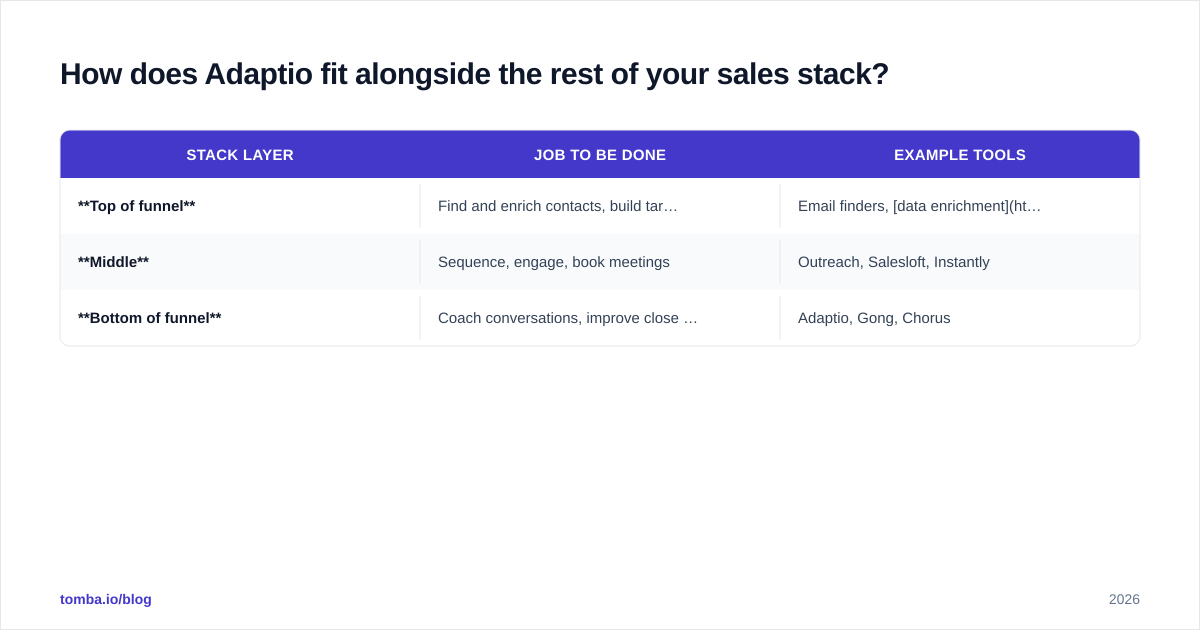
| Stack layer | Job to be done | Example tools |
|---|---|---|
| Top of funnel | Find and enrich contacts, build target lists | Email finders, data enrichment |
| Middle | Sequence, engage, book meetings | Outreach, Salesloft, Instantly |
| Bottom of funnel | Coach conversations, improve close rate | Adaptio, Gong, Chorus |
Adaptio plays in that third row. Before you commit a large coaching budget, make sure rows one and two aren't your actual bottleneck — because they're usually far cheaper to fix. A well-run sales pipeline needs all three layers funded in proportion, not one layer gold-plated.
Adaptio pricing vs. building the top of your funnel first#
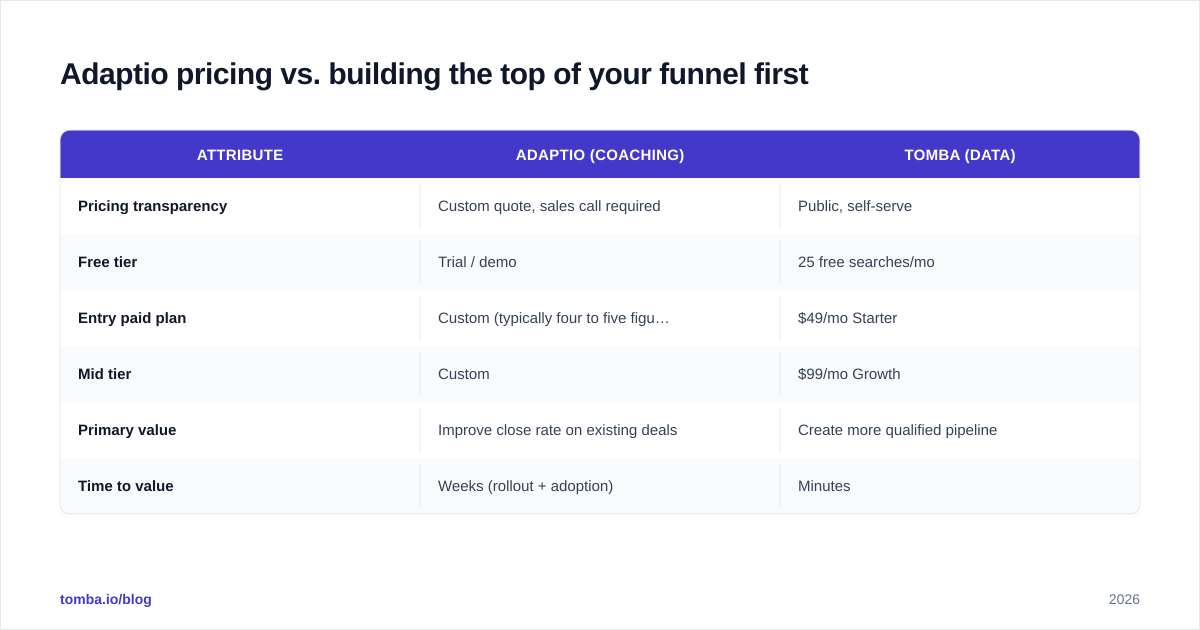
If you map your spend and discover the gap is not enough qualified contacts, the cost calculus changes completely. Data tooling is priced an order of magnitude below enablement platforms, and the impact is immediate — more accurate contacts mean more conversations, which is the raw material Adaptio's coaching depends on.
For comparison, here's how transparent, self-serve data pricing looks against a typical opaque enablement quote:
| Attribute | Adaptio (coaching) | Tomba (data) |
|---|---|---|
| Pricing transparency | Custom quote, sales call required | Public, self-serve |
| Free tier | Trial / demo | 25 free searches/mo |
| Entry paid plan | Custom (typically four to five figures/yr) | $49/mo Starter |
| Mid tier | Custom | $99/mo Growth |
| Primary value | Improve close rate on existing deals | Create more qualified pipeline |
| Time to value | Weeks (rollout + adoption) | Minutes |
Tomba's published Tomba plans run Free (25 searches/mo), Starter at $49/mo, Growth at $99/mo, Pro at $249/mo, and Enterprise custom. You can find verified work emails, verify emails before you send, and run bulk lead generation without ever talking to a sales rep. The two tools aren't really competitors — but they do compete for the same budget line, and knowing which constraint is actually hurting you is the difference between spend and waste.
How should you negotiate an Adaptio contract?#
Five practical levers, in rough order of impact:
- Commit to term for a discount. A 2–3 year deal is the single biggest lever on per-seat price — but only sign long if you've validated adoption in a pilot.
- Buy seats in tiers. Volume thresholds unlock real discounts; ask exactly where the breakpoints sit.
- Pilot first. Negotiate a paid pilot with a clawback or conversion credit rather than committing the whole org on day one.
- Cap the annual uplift. Push to cap renewal increases at a fixed percentage in writing.
- Bundle implementation. Ask for onboarding fees to be waived or folded into the license rather than billed separately.
End every pricing conversation by tying the contract to an outcome metric you both agree on. If the platform improves win rate, you'll happily renew. If it doesn't, you want the exit ramp built in from the start.
The bottom line on Adaptio pricing#
Adaptio is priced like what it is: a premium, quote-based sales-coaching platform aimed at teams big enough that manual call review has broken down. There's no public number because the number genuinely varies — by seats, term, modules, and how much white-glove rollout you need. Expect a per-seat annual model with a platform fee and one-time onboarding, and budget 1.3–1.6x the headline quote for true year-one cost.
Most importantly, diagnose your real constraint first. If reps are closing poorly on good pipeline, Adaptio's coaching may pay for itself many times over. If reps simply don't have enough qualified conversations, no coaching tool will fix that — you need contacts at the top of the funnel before coaching at the bottom can matter.
If pipeline volume is your gap, start where it's cheapest and fastest to move the needle. Use the Tomba Email Finder to find accurate, verified professional emails by name, company, or domain search — 25 free searches to test, transparent pricing from $49/mo, and no sales call required. Feed your reps more real conversations, then decide whether a coaching platform like Adaptio earns its quote.
// get started
Find, verify and enrich your first contacts today
Start on the free plan with 25 searches a month, then scale when your team is ready.
Free plan · No credit card required · GDPR & CCPA
// about the author