AI Cold Email Campaigns in 2026: The Full Playbook
AI cold email campaigns promise hyper-personalization at scale — but most teams automate the wrong half. Here's what actually moves reply rates in 2026.
TL;DR
- AI cold email campaigns win on research and timing, not on generating more copy. The biggest lift comes from feeding the model accurate, enriched data before it writes a word.
- Personalization at scale fails when the data layer is weak. Garbage contact data in, generic-sounding "personalized" email out.
- Deliverability is the silent killer: AI lets you send more, which means more bounces, spam complaints, and burned domains if you skip verification and warmup.
- A repeatable framework — research → segment → draft → verify → send → learn — beats any single clever prompt.
- The right stack pairs a clean data source (finder + verifier) with a sending tool and an AI layer. No single tool does all three well.
What is an AI cold email campaign?#
An AI cold email campaign is outbound email where machine learning handles one or more steps that used to be fully manual: prospect research, copy drafting, send-time optimization, reply classification, and follow-up sequencing. Think of it like a sous-chef in a busy kitchen. The chef (you) still decides the menu and plates the dish, but the sous-chef preps ingredients, times the burners, and keeps the line moving so you can cook ten covers instead of two.
The mistake most teams make is handing the AI the wrong job. They use it to write more emails faster — which is the easy part — and ignore the hard part: knowing who to email, why now, and whether the address even resolves. A model that writes 5,000 variations of "I came across your company" is not a campaign. It's spam with better grammar.
Done properly, AI compresses the research-to-send cycle. Instead of an SDR spending 12 minutes per prospect reading a LinkedIn profile, an enrichment layer pulls firmographics, recent triggers, and tech-stack signals, and the model drafts a first line grounded in real facts. The human reviews, trims, and approves.
How do AI cold email campaigns actually work?#
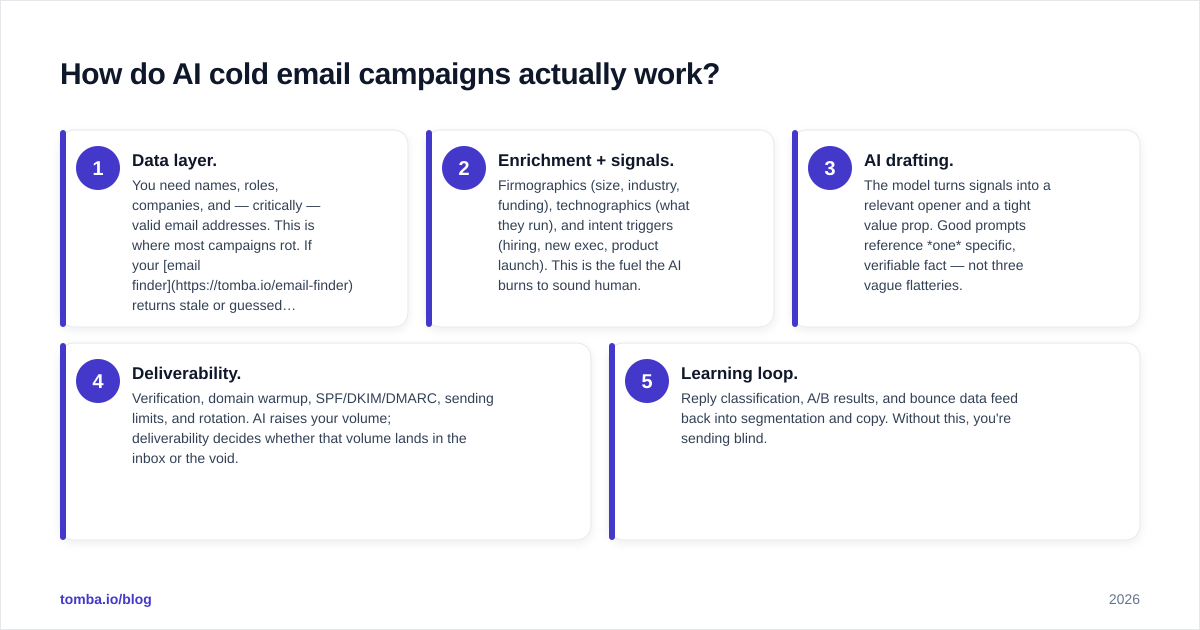
There are five layers, and each one fails independently. Treat them as a pipeline, not a feature list.
- Data layer. You need names, roles, companies, and — critically — valid email addresses. This is where most campaigns rot. If your email finder returns stale or guessed addresses, every downstream step inherits the error.
- Enrichment + signals. Firmographics (size, industry, funding), technographics (what they run), and intent triggers (hiring, new exec, product launch). This is the fuel the AI burns to sound human.
- AI drafting. The model turns signals into a relevant opener and a tight value prop. Good prompts reference one specific, verifiable fact — not three vague flatteries.
- Deliverability. Verification, domain warmup, SPF/DKIM/DMARC, sending limits, and rotation. AI raises your volume; deliverability decides whether that volume lands in the inbox or the void.
- Learning loop. Reply classification, A/B results, and bounce data feed back into segmentation and copy. Without this, you're sending blind.
Here's the uncomfortable truth: layers 1, 2, and 4 determine 80% of your results, and they're the least glamorous. Everyone wants to tune prompts. Almost nobody wants to verify a list.
Sorry — that image alt got mangled; here it is properly:

Is AI personalization better than mass blasting?#
Yes — but only when the personalization is anchored to real data. A "personalized" line built on a hallucinated detail is worse than no personalization, because it signals automation and carelessness at once.
The dividing line is whether your first sentence could be true for any other prospect. "Loved your recent post on X" where X is a real, specific post? That earns a read. "I noticed your company is growing fast"? That's a mass blast wearing a costume. According to HubSpot's sales research, personalized, relevant outreach consistently outperforms generic volume on reply rate — the catch is that relevance has to be verifiable, not generated from thin air.
This is why the data layer matters more than the model. The best AI cold email campaigns spend their compute budget on retrieving and verifying facts, then use a relatively simple prompt to assemble them. The worst ones use an expensive model to invent personality where there's no underlying data.
What does an AI cold email campaign tech stack look like?#
No single tool does data, sending, and AI equally well. You assemble a stack. Here's how the common categories compare on the dimensions that actually affect outcomes.
| Layer | What it does | Example tools | What to watch for |
|---|---|---|---|
| Data / finder | Find + verify addresses by name or domain | Tomba, Apollo, Findymail | Accuracy %, catch-all handling, credit cost |
| Enrichment | Add firmographics + signals | Tomba enrichment, Clearbit | Coverage, freshness, B2B vs consumer bias |
| AI drafting | Generate openers + sequences | Tomba Cold Email AI, Instantly AI, native LLM | Hallucination control, tone match |
| Sending | Deliver + sequence + warm up | Instantly, Smartlead, Saleshandy | Inbox rotation, warmup quality, throttling |
| Verification | Pre-send bounce check | Tomba verifier, |
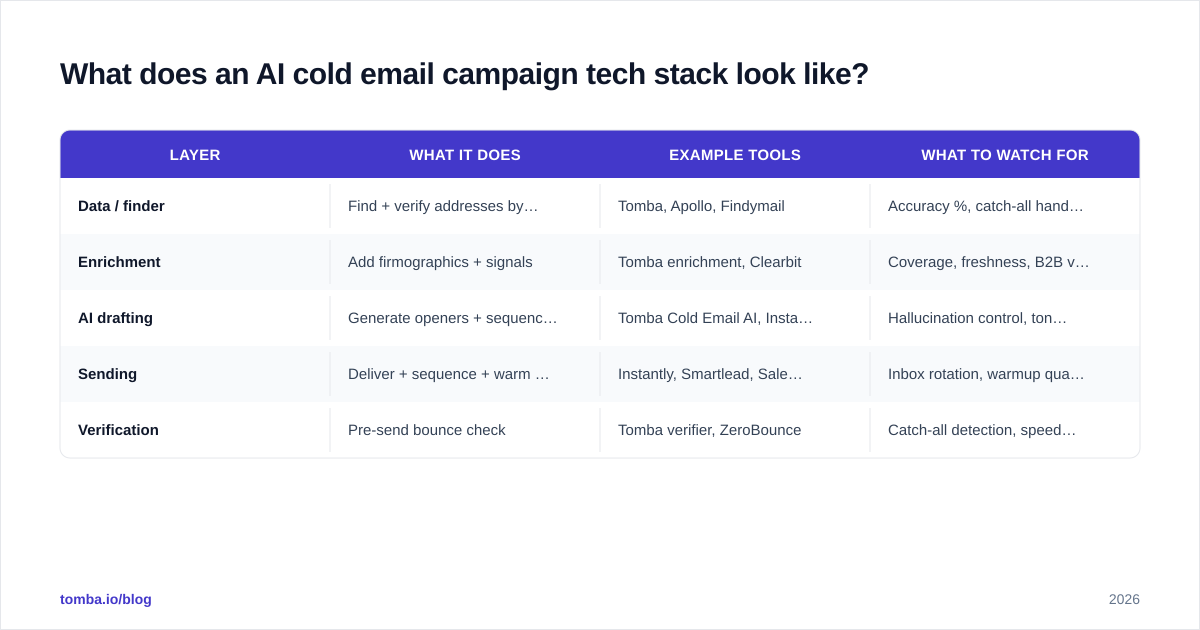
ZeroBounce | Catch-all detection, speed at bulk |
Notice that the data and verification layers anchor the whole table. You can swap sending tools or AI models without much pain. Swap in a bad data source and the entire campaign degrades, no matter how good everything downstream is. That's why teams often start with a strong email verifier and finder, then layer AI on top, rather than the reverse.
For pricing-conscious teams, Tomba's pricing starts with a free tier (25 searches/mo), then Starter at $49/mo, Growth at $99/mo, and Pro at $249/mo — which keeps the data layer affordable while you spend your sending budget elsewhere.
How do you build an AI cold email campaign step by step?#
Here's the framework that survives contact with reality. Each step has a clear exit condition before you move on.
Step 1 — Define the segment. Pick one tight ICP. "VP Eng at Series B SaaS, 50–200 employees, US." Tight beats broad because the AI has more shared context to lean on, and your copy can be sharper. Exit condition: you can name the trigger that makes this segment relevant this month.
Step 2 — Build and verify the list. Use domain search to pull contacts by company, then verify every address before it touches a sequence. A 5% bounce rate will throttle your domain reputation fast. Verify first, send second. Exit condition: bounce-risk addresses removed, catch-alls flagged.
Step 3 — Enrich for signals. Attach the one fact your opener will reference: a funding round, a job posting, a tech-stack change, a published article. If you can't find a signal, the prospect drops to a lower-touch track. Exit condition: every "high-touch" contact has at least one verifiable signal.
Step 4 — Draft with AI, edit as a human. Prompt the model to write a 3-sentence email: one signal-based opener, one value prop, one soft CTA. Then cut it by a third. AI over-writes; your job is subtraction. Exit condition: the email reads like one busy person wrote it to another.
Step 5 — Warm up and send within limits. New domains and mailboxes need email warmup before volume. Stay under your daily caps, rotate inboxes, and authenticate with SPF/DKIM/DMARC. Exit condition: warmup complete, authentication green.
Step 6 — Classify replies and learn. Use AI to bucket replies (interested / not now / wrong person / unsubscribe) and route them. Feed bounce and reply data back into Step 1. Exit condition: next campaign starts with cleaner segmentation than this one did.
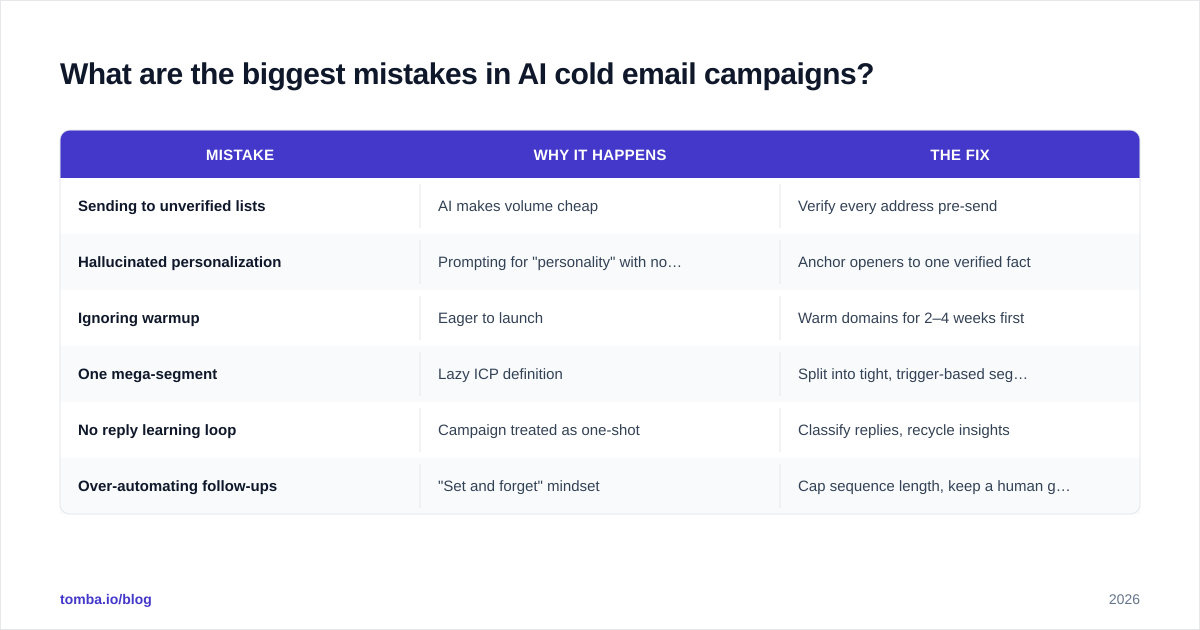
What are the biggest mistakes in AI cold email campaigns?#
The failures cluster into a few predictable buckets. Avoiding these puts you ahead of most senders.
| Mistake | Why it happens | The fix |
|---|---|---|
| Sending to unverified lists | AI makes volume cheap | Verify every address pre-send |
| Hallucinated personalization | Prompting for "personality" with no data | Anchor openers to one verified fact |
| Ignoring warmup | Eager to launch | Warm domains for 2–4 weeks first |
| One mega-segment | Lazy ICP definition | Split into tight, trigger-based segments |
| No reply learning loop | Campaign treated as one-shot | Classify replies, recycle insights |
| Over-automating follow-ups | "Set and forget" mindset | Cap sequence length, keep a human gate |
The throughline: AI amplifies whatever discipline (or sloppiness) you already have. If your data is clean and your process is tight, AI multiplies good outcomes. If you're guessing at addresses and blasting, AI just helps you fail faster and at greater scale.
One more under-discussed risk: deliverability compounding. A single bad campaign — high bounces, spam complaints — damages your domain reputation for weeks, dragging down even your good campaigns. The G2 grid for email deliverability tools is full of vendors precisely because senders keep learning this the hard way. Protect the domain like it's your credit score, because functionally it is.
How do you measure an AI cold email campaign?#
Track four numbers, in order of leading-to-lagging. Reply rate is the one that matters; everything above it is diagnostic.
- Bounce rate (leading, deliverability): under 2% is healthy. Above 5% means your data layer is broken — fix verification before anything else.
- Open rate (diagnostic, with caveats): increasingly unreliable due to privacy features, but a sudden drop still signals deliverability trouble.
- Reply rate (the real KPI): positive + neutral replies divided by delivered. For tight B2B segments with verified data and genuine signals, healthy campaigns clear low-single-digit to high-single-digit percentages depending on niche.
- Positive reply rate (lagging, revenue-linked): the only metric that correlates with pipeline. Optimize for this, not for opens.
If reply rate is low but bounce rate is also low, your problem is copy or targeting, not deliverability — tighten the segment and the opener. If bounce rate is high, stop everything and fix the list. Diagnosing in this order saves weeks of tuning the wrong layer.
Closing: start with the data layer#
The highest-leverage move in any AI cold email campaign isn't a better prompt — it's a better list. Models can polish, summarize, and personalize, but they can't email an address that doesn't exist or invent a trigger that isn't real. Get the data right and even a mediocre prompt outperforms a brilliant one running on garbage.
That's where Tomba Email Finder fits. Find verified professional emails by name, domain, or company, push them through the built-in verifier, and feed your AI layer addresses that actually resolve. Start free with 25 searches a month, scale to Starter at $49/mo when your campaigns prove out, and let the sending tools and the AI compete for the easy 20% — while you've already won the hard 80%.
Build the data layer first. Everything else is amplification.
// get started
Find, verify and enrich your first contacts today
Start on the free plan with 25 searches a month, then scale when your team is ready.
Free plan · No credit card required · GDPR & CCPA
Get the Tomba newsletter
Product and data updates
// about the author