AI Cold Outreach in 2026: Scale Personalization That Replies
AI cold outreach promises personalization at scale — but most teams just automate spam faster. Here's the 2026 playbook for messages that actually get replies.
Cold outreach has a new engine, and most teams are using it to drive off a cliff faster. AI can write a thousand "personalized" first lines before lunch — but volume was never the bottleneck. Relevance was. This guide is about using AI cold outreach to fix relevance, not to scale noise.
TL;DR#
- AI cold outreach means using large language models and enrichment data to research, write, and sequence cold messages at scale — not just spinning templates faster.
- The teams winning in 2026 use AI for the research and targeting layer, then keep messages short and human. The losers automate generic blasts and watch reply rates fall below 1%.
- Garbage in, garbage out: AI personalization is only as good as your contact data. Verified emails and accurate firmographics matter more than clever prompts.
- A practical stack: a data source (email finder + enrichment), an AI writing layer, a sending tool with warmup, and a verification step that protects deliverability.
- Skip the gimmicks — "I saw you went to State, go Cardinals!" lines die in 2026. Buyers can smell AI filler. Lead with a real, specific reason you're reaching out.
What Is AI Cold Outreach?#
AI cold outreach is the use of machine learning — mostly generative LLMs paired with enriched B2B data — to plan, personalize, and automate first-touch messages to people who have never heard from you.
Think of it like the difference between a mailroom clerk and a research assistant. The clerk stuffs the same flyer into 10,000 envelopes (old-school mail merge). The research assistant reads each recipient's company news, role, and recent activity, then drafts a note that sounds like you actually looked. AI lets one rep operate like a room full of research assistants — if you point it at good data.
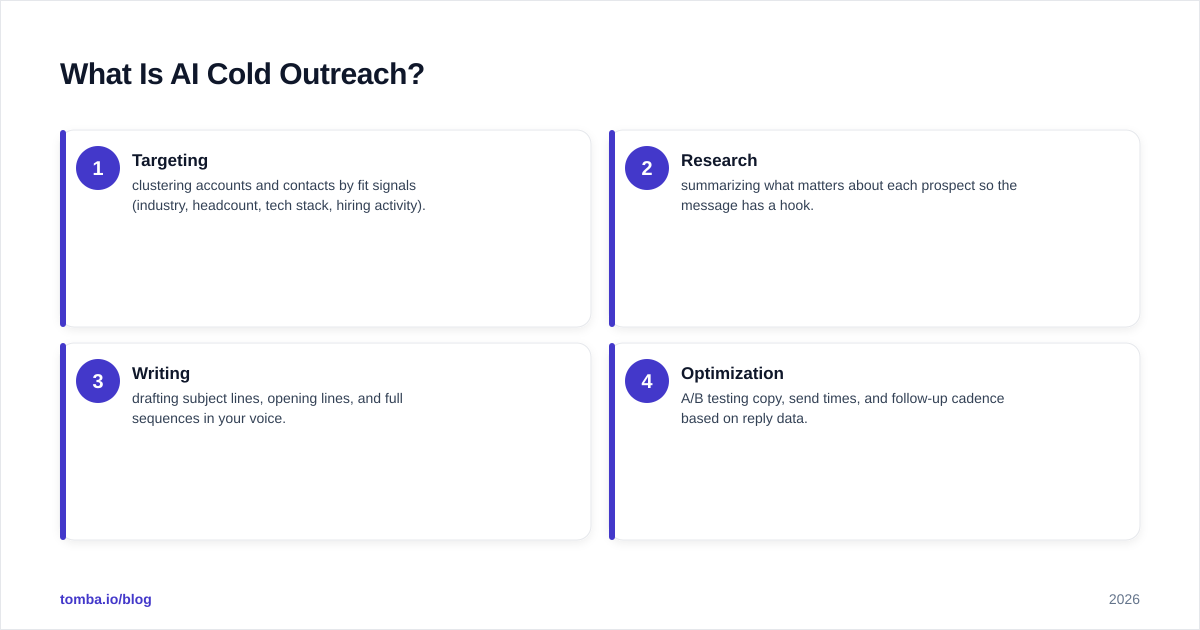
In practice, "AI cold outreach" covers four jobs:
- Targeting — clustering accounts and contacts by fit signals (industry, headcount, tech stack, hiring activity).
- Research — summarizing what matters about each prospect so the message has a hook.
- Writing — drafting subject lines, opening lines, and full sequences in your voice.
- Optimization — A/B testing copy, send times, and follow-up cadence based on reply data.
The mistake almost everyone makes is treating AI as a writing tool only. Writing is the cheapest part of cold outreach. The expensive part — knowing who to contact and why — is where AI actually earns its keep.
Why Does Most AI Cold Outreach Fail?#
Because it scales the wrong thing. When you give a team a tool that writes 500 emails an hour, the natural instinct is to send 500 emails an hour. That's how you torch a domain.
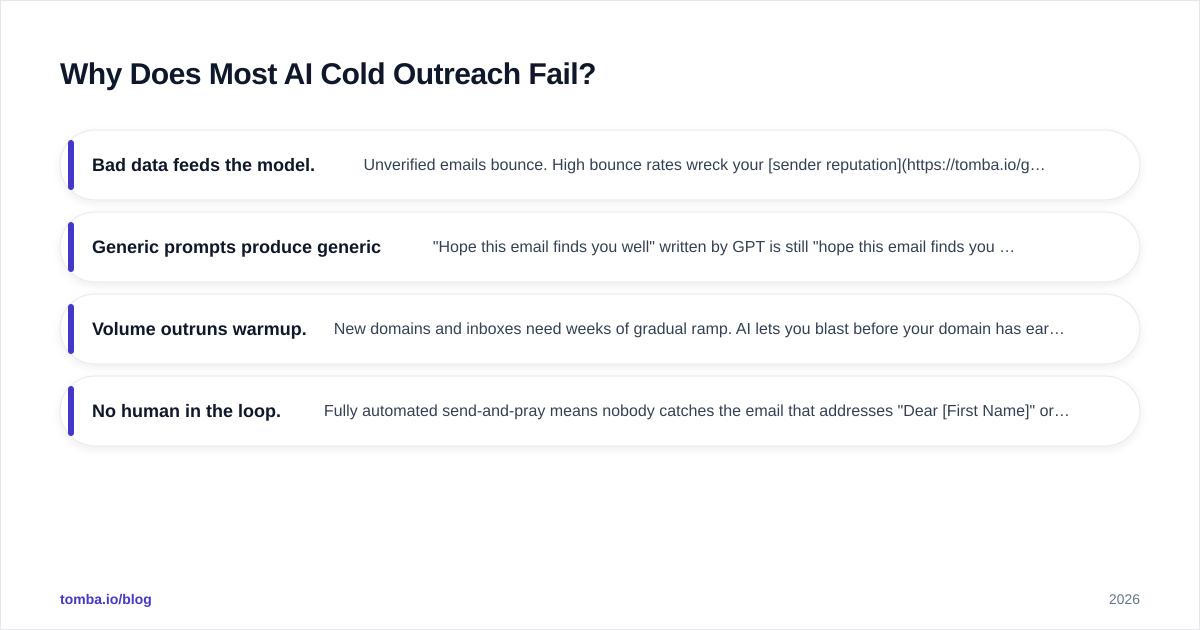
Here's the chain reaction that kills most AI-driven campaigns:
- Bad data feeds the model. Unverified emails bounce. High bounce rates wreck your sender reputation, and mailbox providers start routing you to spam.
- Generic prompts produce generic mush. "Hope this email finds you well" written by GPT is still "hope this email finds you well." Buyers pattern-match AI filler in seconds.
- Volume outruns warmup. New domains and inboxes need weeks of gradual ramp. AI lets you blast before your domain has earned trust.
- No human in the loop. Fully automated send-and-pray means nobody catches the email that addresses "Dear [First Name]" or pitches a CFO a developer tool.
The fix isn't to abandon AI. It's to put AI where it has leverage — research and targeting — and to gate the output behind verification and human review. A reply rate of 5–8% on 200 well-targeted, verified contacts beats 0.5% on 5,000 sloppy ones every single time. And the small list won't get your domain blacklisted.
How Do You Build an AI Cold Outreach Workflow?#
Start with the data layer and work outward. The sequence below is the one repeatable pattern that survives across tools.
Step 1: Define a tight ICP#
Before any AI touches a keyboard, write down your ideal customer profile in concrete, filterable terms: industry, company size, role/title, region, and at least one trigger (hiring for a role, recent funding, a tech-stack signal). The narrower this is, the better AI personalization performs, because the model has less room to hallucinate relevance.
Step 2: Source and verify contacts#
This is where your campaign lives or dies. You need real, deliverable email addresses tied to the right people. Use an email finder to pull verified contacts by name and company, or run a domain search to map every reachable person at a target account. Then push the list through an email verifier so bounces never reach the send step.
Skipping verification to "save time" is the single most expensive shortcut in cold outreach. A 3% bounce rate is the rough line where providers start penalizing you.
Step 3: Enrich for context#
Layer firmographic and role data onto each contact — company size, funding, tech stack, seniority. Data enrichment turns a bare email into a profile the AI can actually reason about. This is the raw material for genuine personalization.
Step 4: Let AI draft, you direct#
Feed the enriched data into your writing layer with a tight prompt: voice, value proposition, one specific hook per contact, and a hard length limit. Ask for short. The best cold emails in 2026 are 50–90 words. Have AI generate variants, then review — never auto-send first touches without a human skim.
Step 5: Sequence, warm up, and send#
Load the approved copy into a sending platform with built-in warmup and throttling. Stagger sends, rotate inboxes if volume is high, and keep daily per-inbox volume conservative (think dozens, not hundreds). Measure response rate, not just opens — open tracking is increasingly unreliable.
Which Tools Make Up the AI Cold Outreach Stack?#
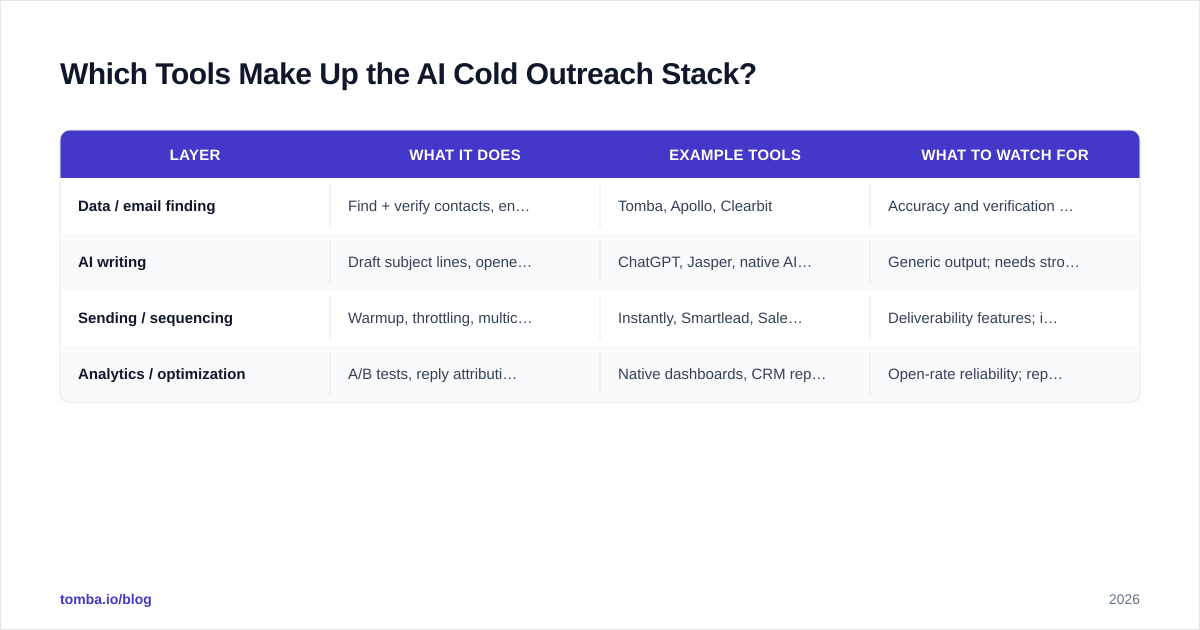
No single tool does all four jobs well. Here's how the categories compare and where each fits.
| Layer | What it does | Example tools | What to watch for |
|---|---|---|---|
| Data / email finding | Find + verify contacts, enrich profiles | Tomba, Apollo, Clearbit | Accuracy and verification quality; bounce protection |
| AI writing | Draft subject lines, openers, sequences | ChatGPT, Jasper, native AI in senders | Generic output; needs strong prompts + review |
| Sending / sequencing | Warmup, throttling, multichannel cadence | Instantly, Smartlead, Saleshandy | Deliverability features; inbox rotation |
| Analytics / optimization | A/B tests, reply attribution, decay tracking | Native dashboards, CRM reports | Open-rate reliability; reply-based metrics |
A lean, effective 2026 stack often looks like: Tomba for finding and verifying contacts, an LLM for drafting, and a dedicated sender for warmup and cadence. You don't need a 12-tool franken-stack. You need clean data, good copy, and protected deliverability.
If you're evaluating all-in-one platforms, compare them honestly against focused alternatives — the Apollo alternative and Instantly alternative breakdowns are useful starting points when you're deciding whether to consolidate or specialize.

Is AI-Written Cold Email Better Than Human-Written?#
Better at drafting volume, worse at judgment — and the winning move is to combine them.
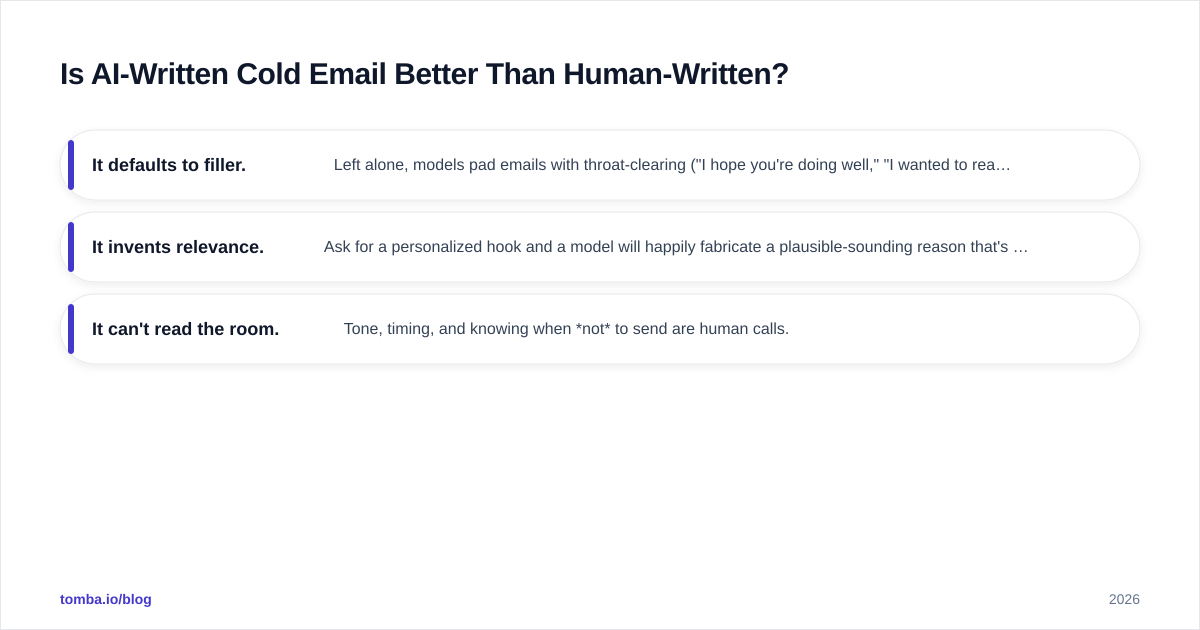
AI excels at the mechanical work: generating ten subject-line variants, rewriting a paragraph to be tighter, adapting a proven template to a new industry. It's tireless and fast. But AI has three weaknesses that still need a human:
- It defaults to filler. Left alone, models pad emails with throat-clearing ("I hope you're doing well," "I wanted to reach out because"). Cut it.
- It invents relevance. Ask for a personalized hook and a model will happily fabricate a plausible-sounding reason that's flat wrong. Verify any factual claim before it sends.
- It can't read the room. Tone, timing, and knowing when not to send are human calls.
The practical division of labor: AI writes the first draft and all the variants; a human owns the value proposition, the hook's accuracy, and the final approval. For repeatable parts — follow-ups, A/B variants — you can lean on tools like a cold email AI writer or a subject line generator and still keep a human gate on the first touch.
One rule that ages well: if a recipient could tell your email was AI-generated, you've already lost. The goal isn't "AI wrote this." It's "a sharp person who clearly understands my world wrote this." AI is the means, not the message.
How Do You Protect Deliverability With AI at Scale?#
Deliverability is the invisible tax on every cold campaign, and AI volume raises the stakes. Three controls keep you out of the spam folder.
1. Verify before you send. Every address goes through verification. Catch-all domains need special handling — use a catch-all verifier rather than guessing, because catch-alls accept everything and then silently bounce or trap you.
2. Authenticate your domain. SPF, DKIM, and DMARC are non-negotiable in 2026. Check your records before launch — a quick SPF checker catches the most common misconfiguration. Google and Yahoo now enforce authentication for bulk senders, and "bulk" thresholds keep dropping.
3. Warm up and throttle. New domains earn reputation slowly. Ramp volume over weeks, keep per-inbox daily sends modest, and watch your bounce and complaint rates like a hawk. If complaints climb, pause and diagnose — don't push more volume through a damaged domain.
For the underlying mechanics, the email deliverability glossary entry is a solid primer, and Google's own sender guidelines document the current bulk-sender requirements in plain language.
What Does a Good AI Cold Outreach Message Look Like?#
Short, specific, and built around one clear reason for the email. Here's the anatomy:
- Subject line: 2–5 words, lowercase often works, no clickbait. ("quick question re: [their initiative]")
- Opening line: A real, verifiable observation about them — not "I came across your profile." Reference the trigger that put them on your list.
- The ask: One sentence on the value you offer, framed around their problem, not your features.
- CTA: Low-friction. "Worth a quick look?" beats "Can we book 30 minutes Tuesday?"
- Length: Under 90 words. If it scrolls, it's too long.
AI's job is to produce 50 of these at the quality of one. Your job is to make sure each one would survive a read from the actual recipient. When in doubt, send fewer, better emails. The economics of cold outreach reward precision, and precision is exactly what good data plus disciplined AI delivers.
The Bottom Line#
AI cold outreach in 2026 isn't about sending more — it's about being right more often. The leverage is in research and targeting, not in cranking out generic copy at machine speed. Get the data layer right, keep a human on the gate, and protect your domain like the asset it is.
That data layer is where it all starts. Tomba's Email Finder gives your AI outreach verified, accurate contacts to work from — find professional emails by name, company, or domain, with built-in verification so bounces never reach your send step. Start free with 25 searches a month, then scale on the Starter plan at $49/mo as your campaigns grow; see full Tomba pricing for the Growth and Pro tiers. Clean data in, real replies out — that's the whole game.
// get started
Find, verify and enrich your first contacts today
Start on the free plan with 25 searches a month, then scale when your team is ready.
Free plan · No credit card required · GDPR & CCPA
// about the author