AI Lead Generation Tools in 2026: The Complete Buyer's Guide
AI lead generation tools promise pipeline on autopilot — but most overpromise. Here's how the categories actually work, what to pay, and how to build a stack that converts in 2026.
TL;DR
- "AI lead generation tools" is not one category — it's five (data/enrichment, intent, outreach automation, conversational AI, and scoring). Buying one when you need another is the most common waste of budget.
- AI is only as good as the contact data underneath it. A clever sequence sent to a stale list still bounces. Fix the data layer first.
- Expect to pay $0–$249/mo for the data and finding layer, and more for full outreach platforms. Watch for credit games and catch-all inflation.
- The winning 2026 stack is modular: a reliable email/data source + an enrichment layer + an outreach engine you control — not one monolith that locks you in.
- Accuracy and deliverability beat volume. A 200-lead list that's 98% valid outperforms a 2,000-lead list that's 70% guesswork.
What are AI lead generation tools, really?#
AI lead generation tools are software that uses machine learning to find, enrich, score, or contact potential buyers with less manual work than a human researcher doing the same job by hand.
That definition is broad on purpose, because vendors stretch the label to cover wildly different products. A tool that predicts which accounts are "in-market" and a tool that drafts a cold email are both sold as "AI lead generation" — but they solve opposite ends of the funnel. If you buy based on the label instead of the function, you end up with three tools that overlap and zero that fill the actual gap.
Think of your pipeline like a kitchen. Some tools are the grocery supplier (raw contact data). Some are the prep cooks (enrichment and scoring). Some are the line cooks who plate and serve (outreach and conversation). You need all three stations working, but you don't buy a delivery truck when what you're missing is a chef.
What are the five categories of AI lead generation tools?#
Before comparing brands, sort the market into functions. Almost every product fits one of these five buckets — and the best stacks use one tool per bucket rather than one tool stretched across all five.
1. Data and enrichment. Finds and verifies contact details (email, phone, company, role) and fills gaps in records you already have. This is the foundation. Tools here include email finders, data enrichment engines, and B2B databases. Without a clean data layer, everything downstream degrades.
2. Intent and signal detection. Predicts which accounts are researching a solution like yours right now, using web activity, technographic shifts, hiring signals, and review-site behavior. This is where "AI" earns its keep — pattern detection across noisy signals is genuinely hard for humans.
3. Outreach automation. Sequences and sends email, LinkedIn, and SMS touches, then manages replies. AI shows up as send-time optimization, inbox rotation, and reply classification.
4. Conversational AI. Chatbots and AI SDRs that qualify inbound visitors or handle first-touch replies. Useful when inbound volume outpaces your reps.
5. Lead scoring and routing. Ranks and assigns leads so reps work the hottest ones first. Increasingly model-driven rather than rule-based.
How do the main AI lead generation tools compare?#
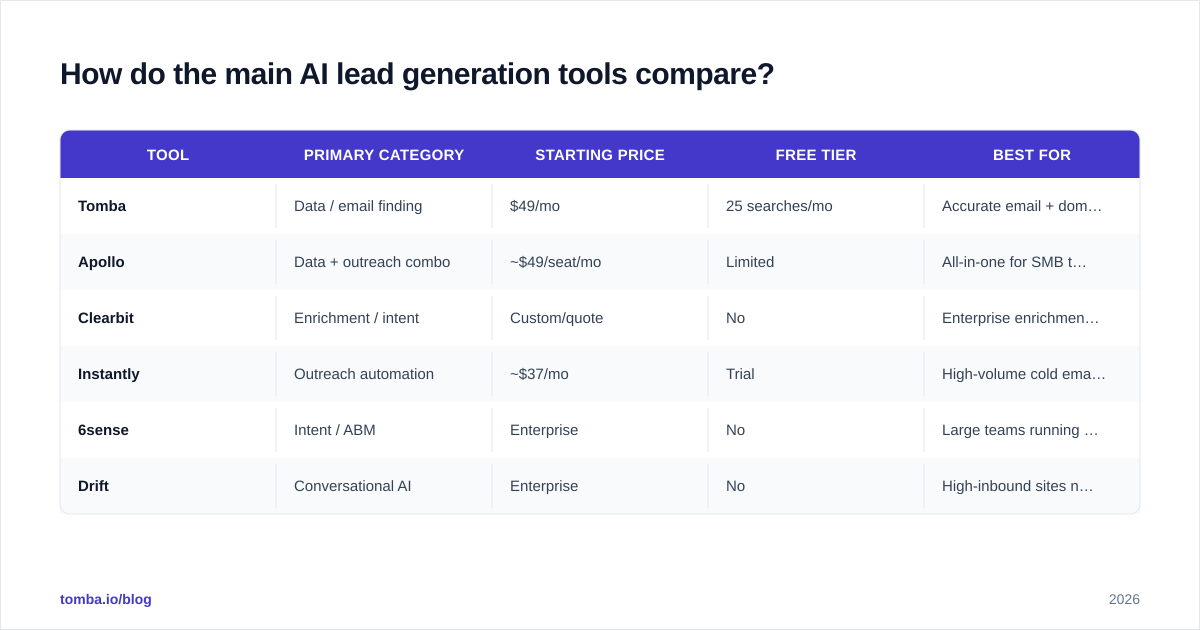
Here's a function-first comparison of common tools by primary category, starting price, and the realistic best-fit use case. Prices are entry tiers and change often — always confirm on the vendor's own pricing page before you commit.
| Tool | Primary category | Starting price | Free tier | Best for |
|---|---|---|---|---|
| Tomba | Data / email finding | $49/mo | 25 searches/mo | Accurate email + domain data at a fair price |
| Apollo | Data + outreach combo | ~$49/seat/mo | Limited | All-in-one for SMB teams that accept data trade-offs |
| Clearbit | Enrichment / intent | Custom/quote | No | Enterprise enrichment inside Salesforce/HubSpot |
| Instantly | Outreach automation | ~$37/mo | Trial | High-volume cold email sending + inbox rotation |
| 6sense | Intent / ABM | Enterprise | No | Large teams running account-based plays |
| Drift | Conversational AI | Enterprise | No | High-inbound sites needing chat qualification |
A few honest notes on this table. "All-in-one" platforms like Apollo are convenient, but the data layer is usually the weakest part of a bundle — you're paying for breadth, not depth. Intent platforms like 6sense and ABM-focused tools are powerful but priced for teams with real budget and a dedicated ops person to run them; a three-rep startup will not extract their value. And outreach tools are only as good as the list you feed them, which loops back to category one.
For a deeper side-by-side of specific vendors, the Apollo alternative and Clearbit alternative breakdowns go tool-by-tool on accuracy and price.
Why does data accuracy matter more than the AI features?#
Conclusion first: the smartest AI in the world can't save a bad list. Data quality is the ceiling on everything else.
Here's the chain of consequences. You buy a slick outreach platform with AI-written sequences. You load 2,000 "leads" from a cheap database. Of those, 600 emails are invalid or catch-all guesses. Your bounce rate spikes past 5%, your domain reputation tanks, and now even your valid emails land in spam. The AI didn't fail — the data underneath it did, and it dragged the rest down with it.
This is why the data and finding layer deserves your attention first. A few things to demand from any data tool:
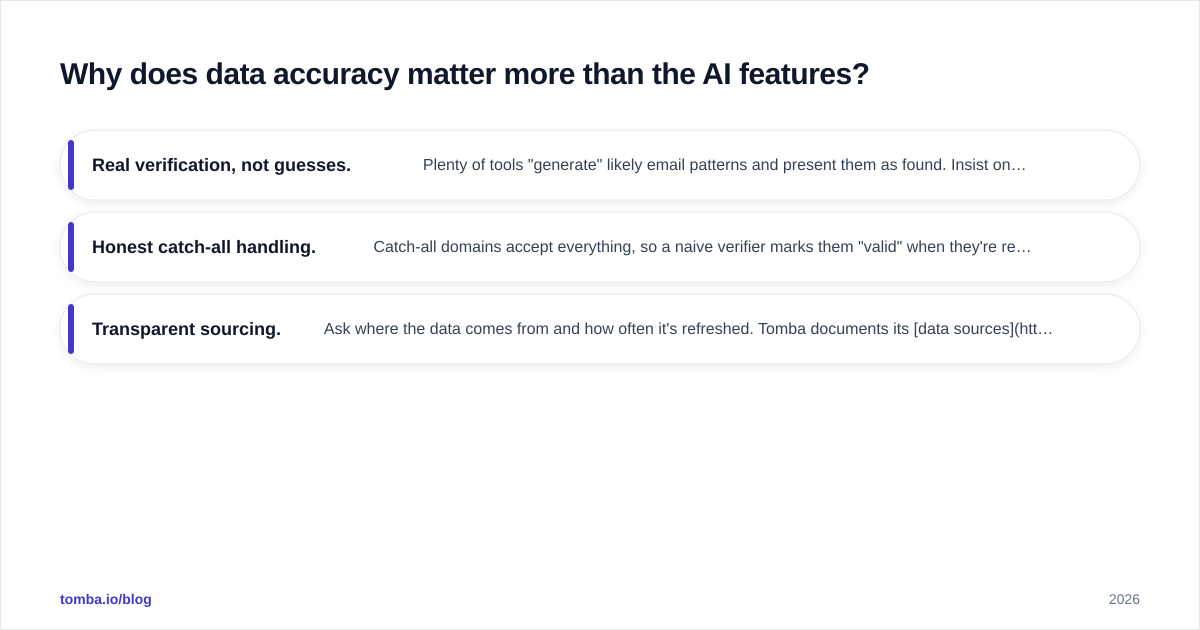
- Real verification, not guesses. Plenty of tools "generate" likely email patterns and present them as found. Insist on a tool that verifies against the mail server. Run questionable contacts through an email verifier before they ever hit a sequence.
- Honest catch-all handling. Catch-all domains accept everything, so a naive verifier marks them "valid" when they're really unknown. A proper catch-all verifier tells you the truth instead of inflating your valid count.
- Transparent sourcing. Ask where the data comes from and how often it's refreshed. Tomba documents its data sources openly; many competitors won't.
Industry benchmarks are sobering. B2B data decays roughly 30% per year as people change jobs, according to widely cited figures from HubSpot, which means a database bought 18 months ago is nearly half wrong today. AI can't fix decay it can't see — only fresh verification can.
How do you build a 2026 AI lead generation stack?#
Build modular, not monolithic. The mistake teams make is buying one platform that promises to do everything, then discovering it does each thing at a C-minus. A modular stack lets you swap the weak link without ripping out the whole system.
A practical starter stack for a small-to-mid B2B team:
- Data layer — a focused email finder and verifier for accurate contacts. Start with the Tomba Email Finder and add bulk lead generation when you scale lists.
- Enrichment layer — fill in role, company size, tech stack, and phone where you have only an email or a domain. Use data enrichment to turn thin records into actionable profiles.
- Outreach layer — a sequencer you control, with deliverability features. Whether you pick Instantly, Saleshandy, or another, feed it only verified contacts.
- Workflow glue — push everything into your CRM automatically via integrations like HubSpot, Pipedrive, or
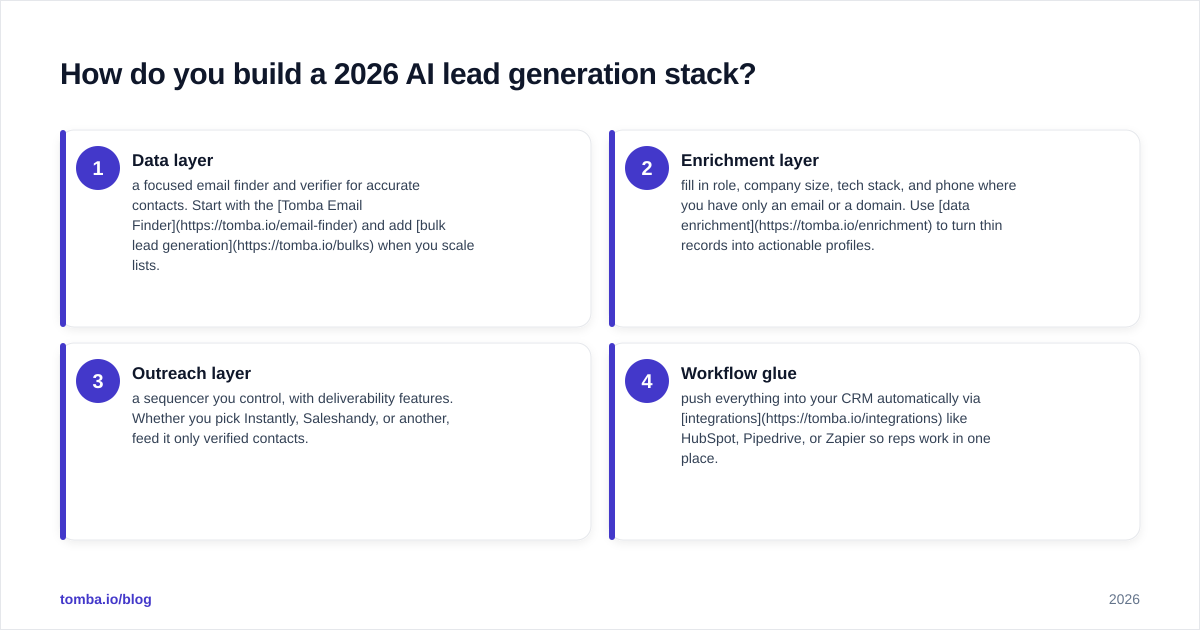
Zapier so reps work in one place.
The reason this beats a monolith: each layer has a best-in-class option, and your switching cost stays low. If your outreach tool's deliverability slips next quarter, you change one component — not your entire revenue engine.
What should you actually pay for AI lead generation tools?#
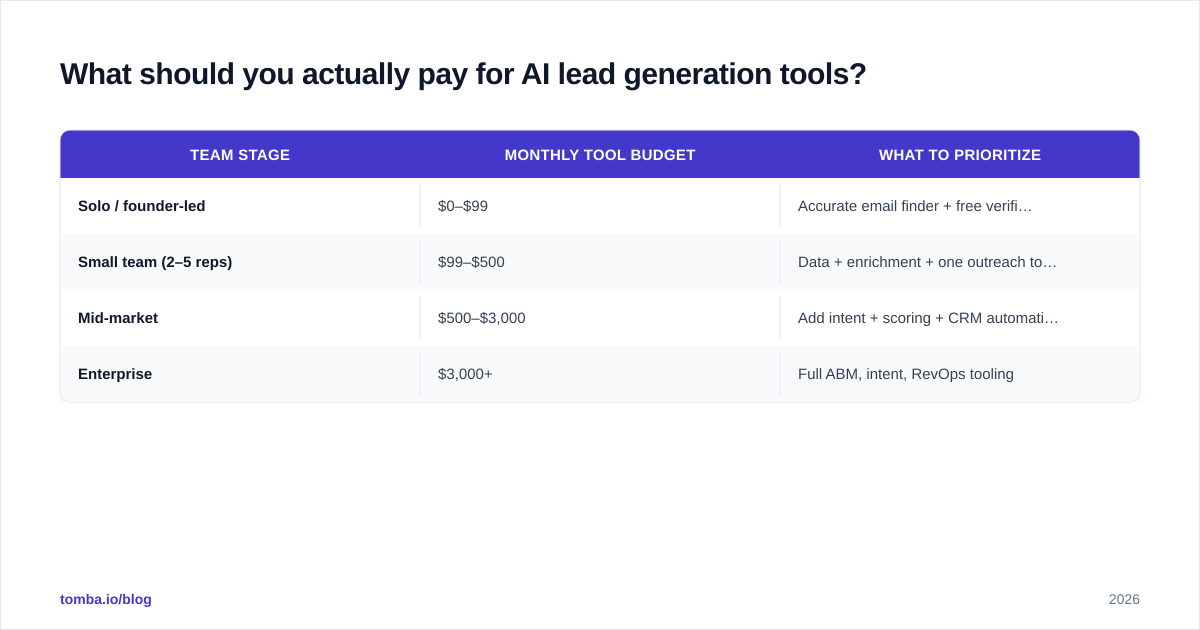
Match spend to stage, and refuse to overbuy. Here's a rough budget map by team size.
| Team stage | Monthly tool budget | What to prioritize |
|---|---|---|
| Solo / founder-led | $0–$99 | Accurate email finder + free verifier |
| Small team (2–5 reps) | $99–$500 | Data + enrichment + one outreach tool |
| Mid-market | $500–$3,000 | Add intent + scoring + CRM automation |
| Enterprise | $3,000+ | Full ABM, intent, RevOps tooling |
On the data layer specifically, Tomba's tiers are built to grow with you: a free tier at 25 searches/month, Starter at $49/mo, Growth at $99/mo, and Pro at $249/mo, with Enterprise custom. Full details are on the Tomba pricing page. The point of showing this isn't to anchor you to one vendor — it's to show that the foundational data layer should be the affordable part of your stack, freeing budget for the outreach and intent tools that cost more.
Watch for two pricing traps. First, credit games: some tools charge a credit even for a failed or unverified lookup, so your "1,000 credits" yields 600 usable contacts. Second, seat inflation: all-in-one platforms often gate the good features behind per-seat upgrades, so the advertised price triples by the time your whole team is on it. Read the G2 reviews for any tool before buying — the pricing complaints in real reviews tell you more than the pricing page does.
How is AI changing lead generation in 2026?#
The biggest shift is from volume to precision. For a decade, "lead gen" meant scraping the largest list possible and blasting it. That era is ending for two reasons: inboxes now filter aggressively, and buyers ignore obvious mass mail. AI tilts the advantage back toward teams that send fewer, sharper, better-targeted messages.
Three concrete changes worth planning around:
Signal-based targeting is becoming table stakes. Instead of "all SaaS companies with 50–200 employees," AI lets you target "companies that just hired a VP of Sales and added a competing tool to their stack." That specificity is what makes a cold message feel relevant. Pair signals with a B2B database you can query precisely.
Deliverability is now a first-class concern. As more teams automate sending, mailbox providers tighten the screws. Authentication, list hygiene, and warmup matter more than clever copy. If you're new to this, the fundamentals of email deliverability are worth an hour of reading before you send a single campaign.
AI SDRs are real but oversold. Fully autonomous "AI sales reps" generate buzz, but in practice they work best for narrow, high-volume top-of-funnel qualification — not closing. Treat them as a force multiplier for your humans, not a replacement. The research from analysts like Gartner consistently shows the highest ROI comes from AI that augments reps rather than replacing the relationship-driven parts of selling.
The teams winning in 2026 aren't the ones with the most AI tools. They're the ones who got the data layer right, then layered automation on top of clean inputs.
How do you choose the right tool for your team?#
Run a short, honest diagnostic before you spend anything:
- Where's the actual bottleneck? Not enough contacts (data problem), contacts but no replies (targeting/copy problem), or replies but no meetings (qualification/process problem)? Buy for the bottleneck, not the buzzword.
- What's your real list quality? Run a sample of your current list through a free email checker. If more than 10% is invalid, fix data before buying anything else.
- Can you run it? Intent and ABM platforms need an ops person. If you don't have one, that powerful tool becomes shelfware.
- Does it integrate? A tool that doesn't sync to your CRM creates manual work that erases its time savings.
Score each candidate tool against those four questions before the demo, not during it. Vendors are great at making you want a feature you'll never use.
Frequently asked questions#
Are AI lead generation tools worth it for a small team? Yes, but start narrow. A solo founder gets the most leverage from an accurate email finder plus a free verifier — under $50/month — before touching intent or outreach platforms.
Can AI find verified emails reliably? The good tools can, when they verify against the mail server rather than guessing patterns. Always confirm the tool distinguishes verified from guessed, and handles catch-all domains honestly.
Will AI replace SDRs? Not the relationship-driven parts. AI is strong at finding, enriching, and first-touch qualification; humans still win the trust and the close. Plan for augmentation, not replacement.
Start with the layer everything else depends on#
If you take one thing from this guide: get the data layer right first, because every AI feature you bolt on top inherits its quality. The cleverest sequence, the sharpest intent signal, and the smartest scoring model all collapse onto a foundation of bad contacts.
That's where Tomba fits. The Tomba Email Finder gives you verified, accurately sourced contacts by name, domain, or company — with transparent data sourcing and honest catch-all handling, at a price that leaves room in your budget for the rest of the stack. Start free with 25 searches a month, confirm the accuracy against your own list, and build the rest of your AI lead generation stack on a foundation you can trust.
// get started
Find, verify and enrich your first contacts today
Start on the free plan with 25 searches a month, then scale when your team is ready.
Free plan · No credit card required · GDPR & CCPA
// about the author