AI Sales in 2026: How AI Is Rewiring the B2B Sales Process
AI sales tools promise to automate prospecting, scoring, and outreach. Here's what actually works in 2026, what's hype, and how to build a stack that closes.
TL;DR
- AI sales means using machine learning to automate or augment prospecting, lead scoring, outreach, forecasting, and coaching — not replacing reps, but removing the busywork that eats their day.
- The biggest 2026 wins are in research and data: AI finds, enriches, and prioritizes accounts far faster than any SDR doing it by hand.
- AI writing tools lift reply rates only when paired with clean, verified contact data — garbage in still means garbage out.
- A practical AI sales stack has four layers: data, signals, engagement, and intelligence. Most teams over-invest in engagement and under-invest in data.
- Start with one high-leverage workflow (usually data enrichment + scoring), measure it, then expand. Buying ten AI tools at once is how budgets die.
AI sales is the use of artificial intelligence — machine learning, large language models, and predictive analytics — to automate or assist the work of finding, qualifying, engaging, and closing buyers. If "sales automation" was about rules ("if lead opens email twice, notify rep"), AI sales is about prediction and generation ("this account looks like your last five closed-won deals, and here's the email that will resonate").
Think of it like a GPS for selling. A paper map (your CRM) shows you the roads. AI is the live navigation layer on top: it reads traffic, reroutes you around dead deals, and tells you which exit to take next. The map didn't disappear — it got a brain.
What does "AI sales" actually mean in 2026?#
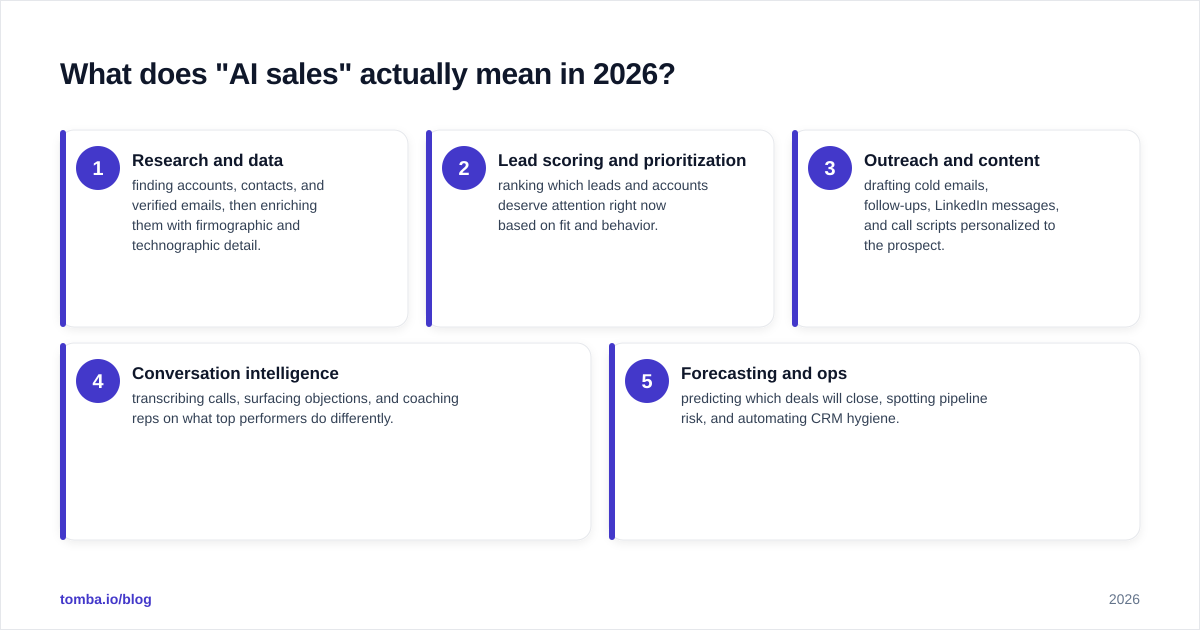
The term gets stretched to cover everything from a chatbot on a pricing page to a fully autonomous outbound agent. To cut through it, group AI sales into five jobs it actually performs:
- Research and data — finding accounts, contacts, and verified emails, then enriching them with firmographic and technographic detail.
- Lead scoring and prioritization — ranking which leads and accounts deserve attention right now based on fit and behavior.
- Outreach and content — drafting cold emails, follow-ups, LinkedIn messages, and call scripts personalized to the prospect.
- Conversation intelligence — transcribing calls, surfacing objections, and coaching reps on what top performers do differently.
- Forecasting and ops — predicting which deals will close, spotting pipeline risk, and automating CRM hygiene.
Most "AI sales platforms" are strong in one or two of these and thin in the rest. The marketing rarely admits that. According to Gartner, the majority of B2B sales organizations are now investing in AI, but the gap between buying a tool and getting ROI from it remains wide — usually because the underlying data is a mess.
Where does AI create the most value in the sales process?#
Conclusion first: AI pays off fastest at the top of the funnel, in research and data work, because that's where reps waste the most time on tasks a machine does better.
A typical SDR spends a large share of the week just building lists, hunting for email addresses, and copy-pasting between LinkedIn, a spreadsheet, and the CRM. None of that is selling. It's data assembly. When you hand that to AI-driven tooling — an email finder, an enrichment engine, and a scoring model — you give the rep back hours to actually talk to humans.
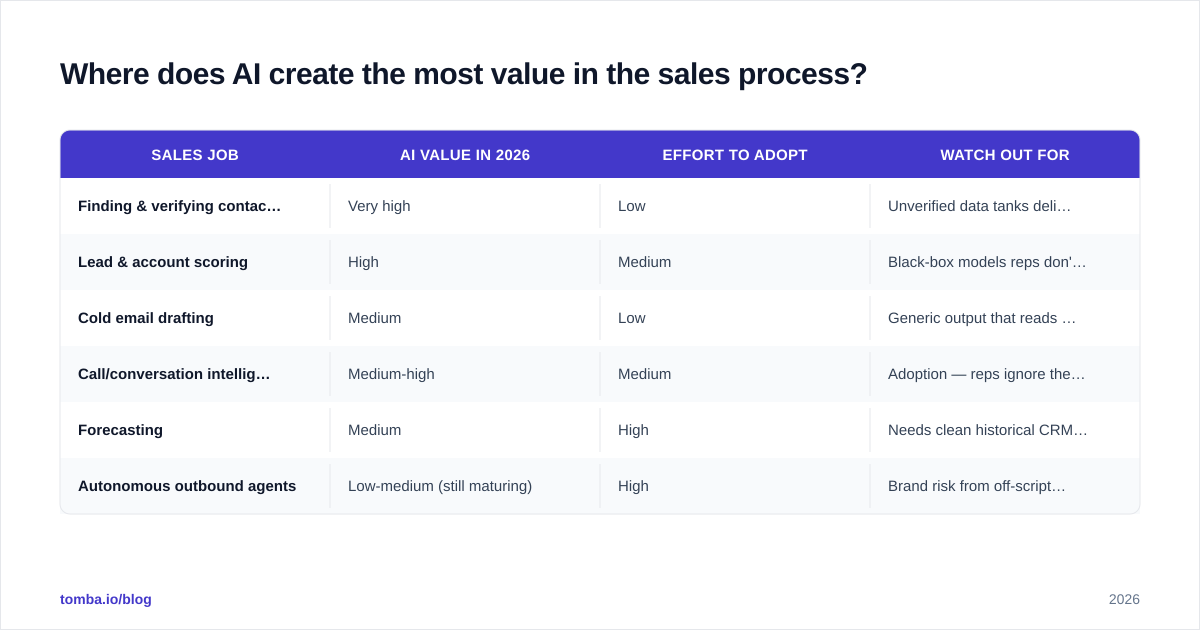
Here's the value-vs-effort breakdown most teams discover after a year of experimenting:
| Sales job | AI value in 2026 | Effort to adopt | Watch out for |
|---|---|---|---|
| Finding & verifying contacts | Very high | Low | Unverified data tanks deliverability |
| Lead & account scoring | High | Medium | Black-box models reps don't trust |
| Cold email drafting | Medium | Low | Generic output that reads like spam |
| Call/conversation intelligence | Medium-high | Medium | Adoption — reps ignore the insights |
| Forecasting | Medium | High | Needs clean historical CRM data |
| Autonomous outbound agents | Low-medium (still maturing) | High | Brand risk from off-script sends |
The pattern is clear: the cheapest, lowest-risk, highest-return entry point is data. The flashiest category — fully autonomous AI sales agents — is also the riskiest and least mature.
)
Will AI replace salespeople?#
No — and anyone selling you that is selling fear. AI replaces tasks, not the relationship. B2B buyers still want to talk to a person before signing a six-figure contract. What changes is what the person spends time on.
The realistic 2026 picture looks like this:
- Disappearing work: manual list-building, data entry, first-draft email writing, call note-taking, basic lead research.
- Growing work: judgment calls, multi-threaded relationship building, complex negotiation, and editing AI output so it doesn't sound robotic.
A useful analogy: spreadsheets didn't fire accountants. They killed manual ledger arithmetic and freed accountants to do analysis. AI is doing the same to sales — automating the arithmetic of prospecting so reps can focus on the analysis of whom to call and what to say.
The reps who lose are the ones who treated list-building as their value-add. The reps who win treat AI as a sales automation layer that makes them faster, and spend the reclaimed time on conversations machines can't have.
How do you build an AI sales stack without wasting money?#
Start with the four-layer model and fill the bottom first. Most teams do the opposite — they buy a shiny engagement or "AI SDR" tool, point it at a dirty list, and watch their domain reputation collapse.
Layer 1 — Data (build this first). Verified contact data is the foundation. If the email bounces, nothing above it matters. This is where an email finder and an email verifier live. Clean data also feeds every model above: scoring, personalization, and forecasting all degrade when the inputs are wrong.
Layer 2 — Signals. Intent data, technographics, job changes, funding events. This is the "who's in-market right now" layer that turns a static list into a prioritized queue.
Layer 3 — Engagement. Sequencers, cold-email platforms, dialers, and AI writing assistants. This is where personalization at scale happens — but only as good as Layers 1 and 2.
Layer 4 — Intelligence. Conversation analytics, forecasting, and coaching. This layer learns from the deals you run and feeds insight back down.
)
A sane rollout sequence:
- Fix your data first. Run your existing list through verification and enrichment before buying anything else.
- Add a scoring or signal layer so reps work the best 20% of leads, not all of them.
- Layer in AI-assisted outreach — but keep a human editing every template.
- Only then evaluate conversation intelligence and forecasting, which need volume and history to be useful.
For teams that live in spreadsheets, a Google Sheets email finder or bulk email finder often delivers more measurable ROI in week one than a six-figure "AI platform" delivers in a quarter.
What should you look for in an AI sales tool?#
Evaluate on five concrete criteria, not on demo polish:
- Data accuracy and freshness. Ask for a documented verification rate and how often the database refreshes. Vague answers are a red flag.
- Coverage of your market. A tool with great US data and weak EMEA coverage is useless if you sell into Europe.
- Integrations. It has to flow into your CRM and sequencer without manual export. Check for native HubSpot, Salesforce, and [
Zapier](https://tomba.io/integrations/zapier) connections.
- Transparency. For scoring and AI agents, you need to know why a lead was ranked high or an email was drafted a certain way. Black boxes erode rep trust fast.
- Pricing that matches usage. Credit-based and per-seat models behave very differently at scale. Map the price to your actual monthly volume before signing.
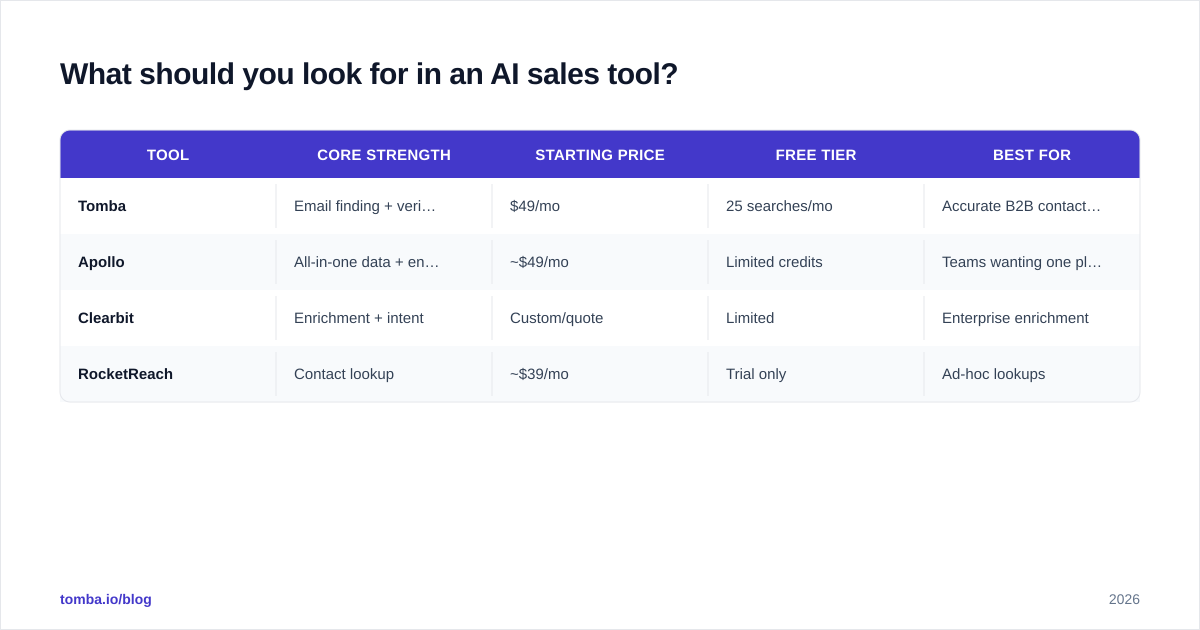
On that last point, compare a few common AI sales data tools at a glance:
| Tool | Core strength | Starting price | Free tier | Best for |
|---|---|---|---|---|
| Tomba | Email finding + verification + enrichment | $49/mo | 25 searches/mo | Accurate B2B contact data |
| Apollo | All-in-one data + engagement | ~$49/mo | Limited credits | Teams wanting one platform |
| Clearbit | Enrichment + intent | Custom/quote | Limited | Enterprise enrichment |
| RocketReach | Contact lookup | ~$39/mo | Trial only | Ad-hoc lookups |
(Prices shift; always confirm on the vendor's own page — for Tomba the current tiers are Free, Starter $49/mo, Growth $99/mo, Pro $249/mo, and Enterprise, listed on the Tomba pricing page. If you're weighing platforms, the Apollo alternative and Clearbit alternative breakdowns go deeper than this table.)
Notice what the strongest tools have in common: they're anchored in data quality, not just AI features. An AI writer bolted onto a stale database produces confident, personalized emails to addresses that don't exist. The intelligence is only as good as the contact record underneath it.
How do you measure if AI sales is working?#
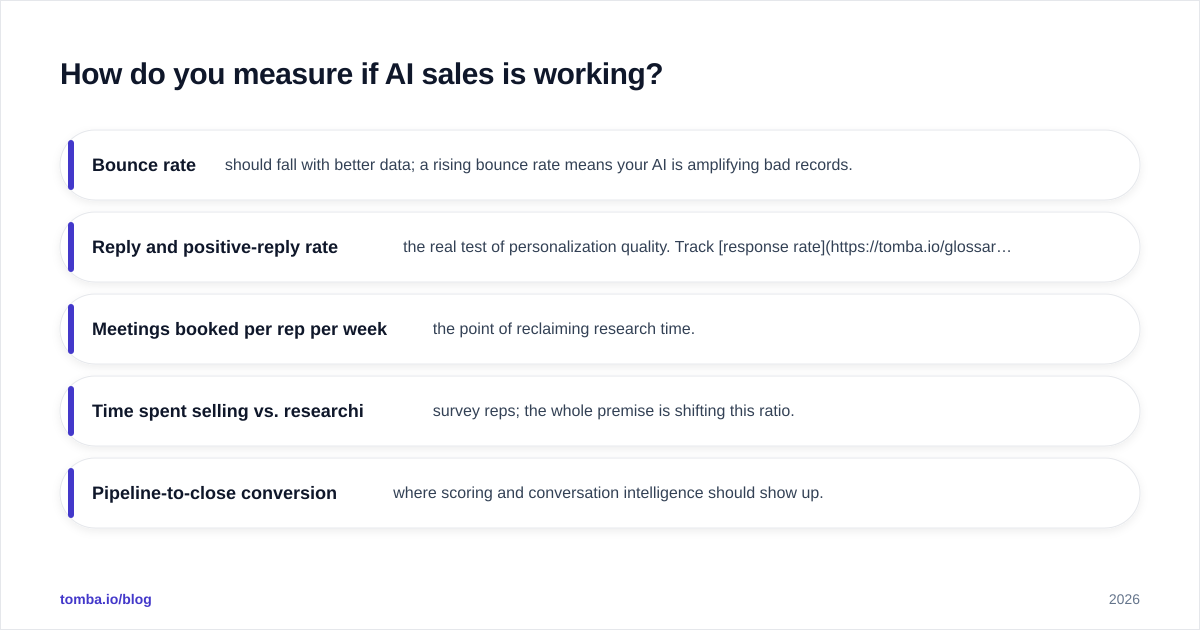
Track outcomes, not activity. It's easy to celebrate "10,000 AI-personalized emails sent" and miss that your reply rate dropped. Watch these metrics before and after each AI tool you add:
- Bounce rate — should fall with better data; a rising bounce rate means your AI is amplifying bad records.
- Reply and positive-reply rate — the real test of personalization quality. Track response rate as your north star for outreach.
- Meetings booked per rep per week — the point of reclaiming research time.
- Time spent selling vs. researching — survey reps; the whole premise is shifting this ratio.
- Pipeline-to-close conversion — where scoring and conversation intelligence should show up.
A simple before/after test beats vendor case studies. Pick one segment, run it with the AI tool and a control group without it for a month, and compare bounce, reply, and meetings booked. If the lift is real, scale it. If it's noise, you just saved yourself an annual contract.
What are the biggest AI sales mistakes to avoid?#
Three failures show up again and again:
1. Skipping verification. AI lets you send more, faster — which means it also lets you torch your sender reputation faster. Every list, AI-built or not, should pass through verification before the first send. This protects email deliverability, which is the silent killer of outbound programs.
2. Trusting AI output blind. LLM-drafted emails are a starting point, not a finished product. Models hallucinate company facts, misread intent, and default to the same three-sentence structure everyone else's AI also generates. A human edit pass is non-negotiable — that's what separates personalization from spam.
3. Buying the platform before fixing the foundation. The instinct is to buy the all-in-one "AI sales OS." The reality is that without verified data and clean CRM hygiene, that platform just automates your existing problems at scale. Foundation first, automation second.
Do those three things right and AI becomes a genuine multiplier. Get them wrong and you've bought an expensive way to email the wrong people more often.
Getting started: the one workflow that pays for itself#
If you do nothing else this quarter, fix your contact data. It's the lowest-risk, highest-return AI sales move available, and it makes every other tool you own work better.
Tomba's Email Finder finds verified professional email addresses by name, domain, or company, then confirms they're deliverable before they ever hit your sequencer — so your AI-personalized outreach actually reaches a real inbox instead of bouncing and dragging down your sender reputation. Pair it with domain search to map every contact at a target account, and you've got the clean, accurate foundation the rest of your AI stack depends on. Start free with 25 searches a month, prove the lift on your own list, then scale up. Build the data layer right, and the intelligence layer finally has something true to learn from.
// get started
Find, verify and enrich your first contacts today
Start on the free plan with 25 searches a month, then scale when your team is ready.
Free plan · No credit card required · GDPR & CCPA
// about the author