Airscale Pricing in 2026: Plans, Costs & Alternatives
A neutral breakdown of Airscale pricing in 2026 — how its credit model works, what each tier really costs per lead, and when a cheaper email-finder stack wins.
TL;DR
- Airscale is a LinkedIn-first prospecting and enrichment tool priced on a credit + per-seat model, so your real cost depends on how many leads you scrape, enrich, and export each month — not the sticker price.
- Plans scale from a low entry tier into multi-hundred-dollar territory once you add seats and enrichment volume. The headline number is rarely what teams actually pay.
- The single biggest cost driver is enrichment credits (email, phone, data points). One lead can burn several credits, which is where budgets quietly blow up.
- If your core need is finding and verifying business emails at volume, a dedicated stack like the Tomba Email Finder at a flat Tomba pricing tier is usually cheaper per verified contact.
- Always price Airscale on a cost-per-usable-lead basis, not cost-per-month. This guide shows you how.
What is Airscale and how does its pricing work?#
Airscale is a B2B prospecting platform built around LinkedIn and Sales Navigator. Think of it as a funnel: you pull lists out of LinkedIn, enrich each contact with emails and phone numbers, clean the data, and push it into your CRM or outreach sequencer. It competes in the same space as Phantombuster, Evaboot, and Captain Data.
Here's the conclusion first: Airscale pricing is consumption-based, not flat. You pay for two things stacked together — seats (per user) and credits (per enrichment action). That combination makes the monthly invoice elastic. Two teams on the "same plan" can pay wildly different amounts depending on how aggressively they enrich.
An everyday analogy: it's like a phone plan with a base line rental plus pay-as-you-go data. The line rental (your seat) is predictable. The data (your credits) is where the bill surprises you at month-end if nobody's watching the meter.
Because Airscale updates its packaging periodically, treat every number in this article as directional and confirm the live figures on the official Airscale site before you buy. What does not change is the underlying model — and that's what you should plan around.
What are the Airscale pricing tiers in 2026?#
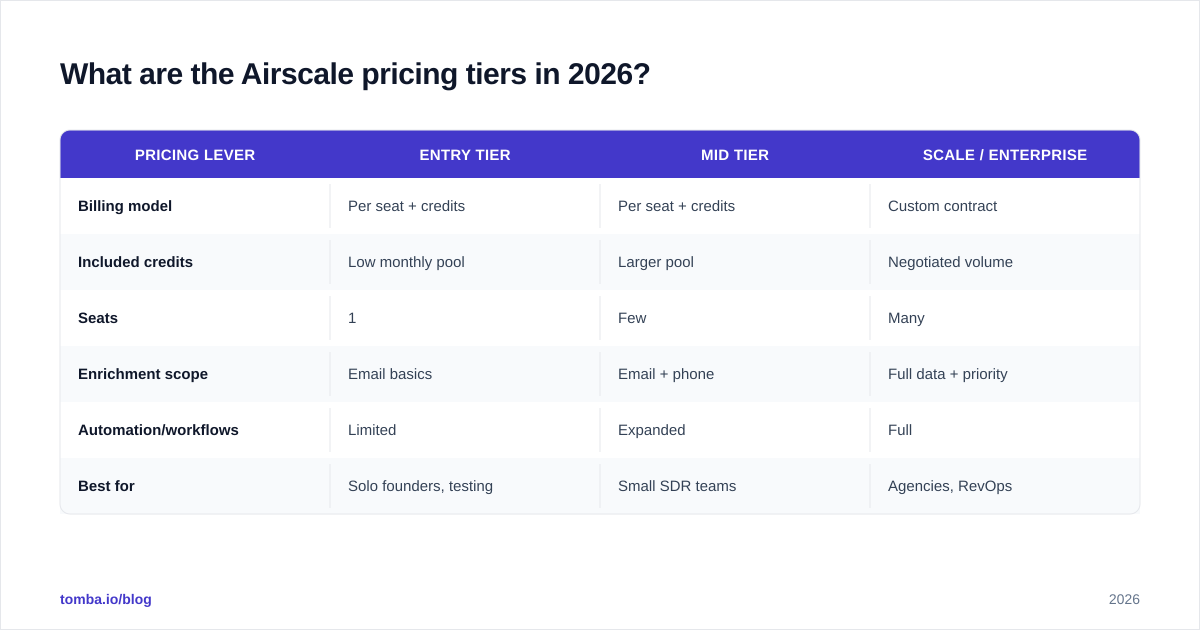
Airscale typically structures its offer as a free trial followed by graduated paid tiers, with credit allotments rising at each level and enterprise pricing negotiated directly. The exact credit counts and dollar figures move over time, so the table below frames the shape of the pricing rather than promising fixed cents.
The thing to internalize: tiers gate three levers at once — number of seats, monthly credits, and advanced features (automation, integrations, team workspaces). You rarely get to mix and match freely.

| Pricing lever | Entry tier | Mid tier | Scale / Enterprise |
|---|---|---|---|
| Billing model | Per seat + credits | Per seat + credits | Custom contract |
| Included credits | Low monthly pool | Larger pool | Negotiated volume |
| Seats | 1 | Few | Many |
| Enrichment scope | Email basics | Email + phone | Full data + priority |
| Automation/workflows | Limited | Expanded | Full |
| Best for | Solo founders, testing | Small SDR teams | Agencies, RevOps |
If you only remember one row, make it the first: the per-seat-plus-credits structure is what separates a $79 month from a $700 month on nominally similar plans.
How much does Airscale actually cost per lead?#
Short answer: more than the plan price suggests, because one "lead" is not one credit.
A typical enriched contact can consume credits for the email lookup, an additional charge for a verified mobile phone, and sometimes more for extra data points like company attributes. So a plan that advertises, say, 1,000 credits might only yield a few hundred fully enriched leads.
To price it honestly, use this formula:
Cost per usable lead = (monthly plan price + seat add-ons)
                       ÷ (credits ÷ avg credits per enriched lead)
                       ÷ usable-data rate
Two numbers wreck most budgets:
- Average credits per enriched lead. If email + phone + enrichment burns 3–4 credits, your effective lead count is a quarter of your credit count.
- Usable-data rate. Not every scraped contact returns a valid, deliverable email. If 20–30% bounce or come back empty, your real cost-per-usable-lead climbs again.
This is why teams that scrape aggressively and verify carelessly overpay. Running contacts through a dedicated email verifier before you commit them to a sequence protects both your spend and your sender reputation.
What's included — and what costs extra?#
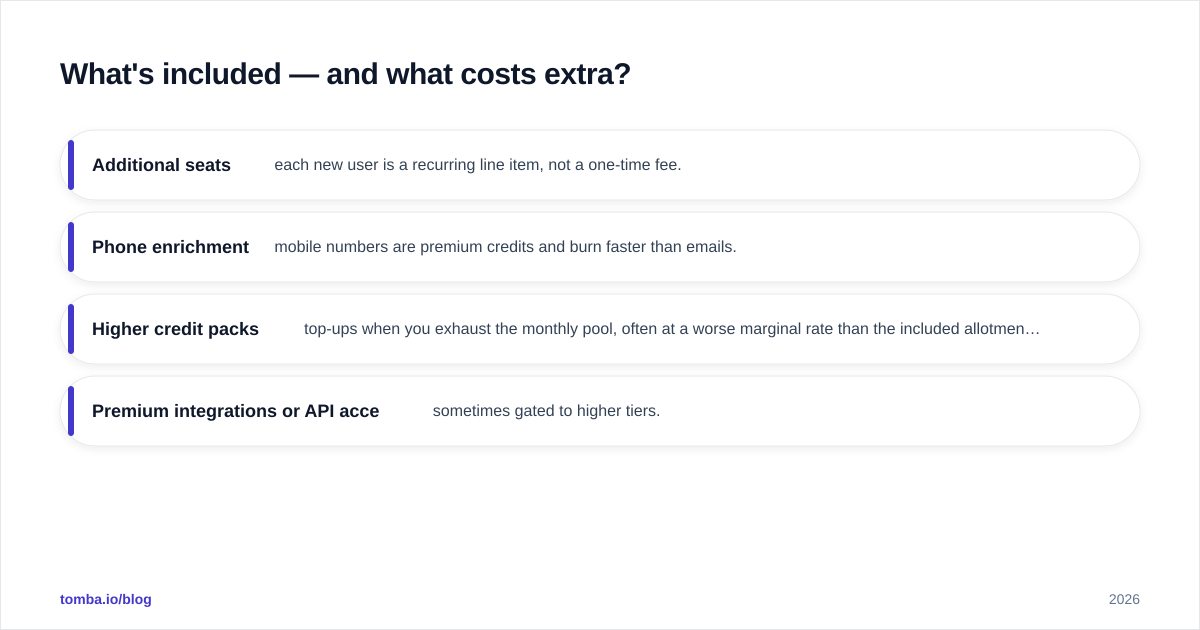
The base subscription usually covers LinkedIn/Sales Navigator list extraction, the core enrichment engine, CSV export, and basic CRM pushes. The extras that inflate invoices tend to be:
- Additional seats — each new user is a recurring line item, not a one-time fee.
- Phone enrichment — mobile numbers are premium credits and burn faster than emails.
- Higher credit packs — top-ups when you exhaust the monthly pool, often at a worse marginal rate than the included allotment.
- Premium integrations or API access — sometimes gated to higher tiers.
The pattern here mirrors most consumption tools: the headline plan looks affordable, and the margin lives in the add-ons. Map your real workflow — how many seats, how many phones, how much top-up — before you anchor on the entry price.
Is Airscale better than the alternatives?#
It depends on what job you're hiring the tool for. Airscale is strong as a LinkedIn-to-CRM prospecting pipeline — extraction, enrichment, and routing in one flow. But if your bottleneck is specifically finding and verifying business emails at scale, a focused email-data tool is usually cheaper and more accurate per contact, because that's the one thing it's built to do.
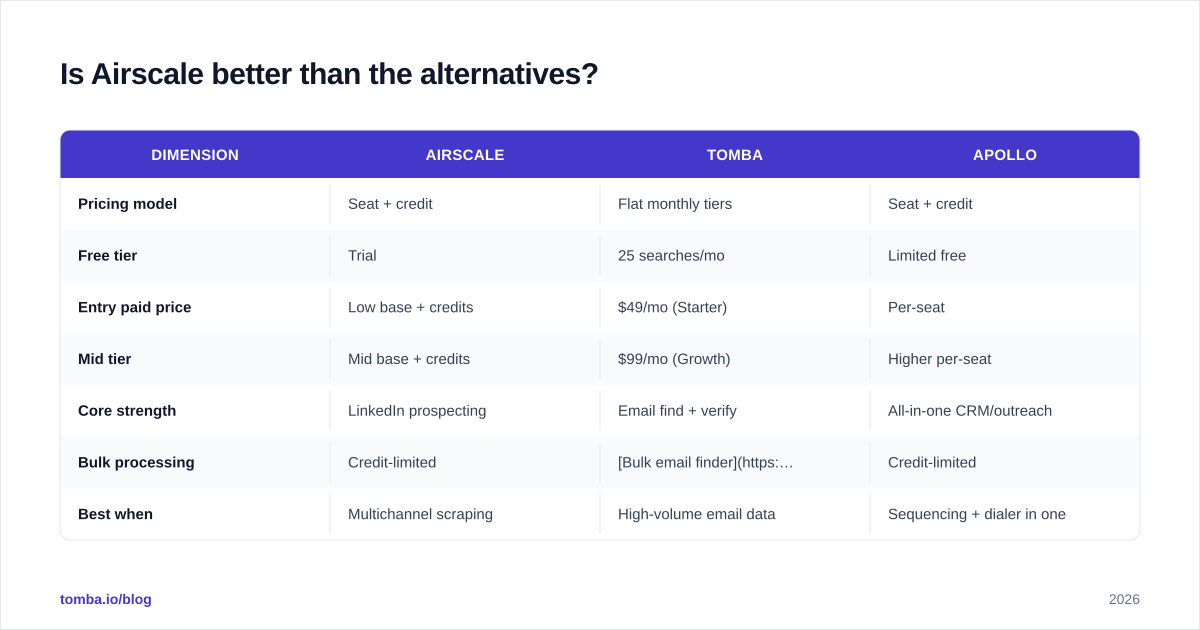
Here's a like-for-like cost comparison against a flat-rate email-finder stack and a broader all-in-one. Tomba figures are current published pricing; Airscale and Apollo are framed by model since their effective cost is usage-dependent.
| Dimension | Airscale | Tomba | Apollo |
|---|---|---|---|
| Pricing model | Seat + credit | Flat monthly tiers | Seat + credit |
| Free tier | Trial | 25 searches/mo | Limited free |
| Entry paid price | Low base + credits | $49/mo (Starter) | Per-seat |
| Mid tier | Mid base + credits | $99/mo (Growth) | Higher per-seat |
| Core strength | LinkedIn prospecting | Email find + verify | All-in-one CRM/outreach |
| Bulk processing | Credit-limited | Bulk email finder | Credit-limited |
| Best when | Multichannel scraping | High-volume email data | Sequencing + dialer in one |
The honest read: if you live inside Sales Navigator and want one tool to scrape and enrich, Airscale earns its keep. If you mostly need clean, verified emails to feed an existing sequencer, paying per credit for a prospecting suite is overkill — and that's where Tomba's flat pricing wins on predictability. For teams evaluating broader suites, an honest comparison also means looking at an Apollo alternative for the data layer specifically.
You can sanity-check any of these claims against third-party reviews on G2 rather than taking a vendor's word — including ours.

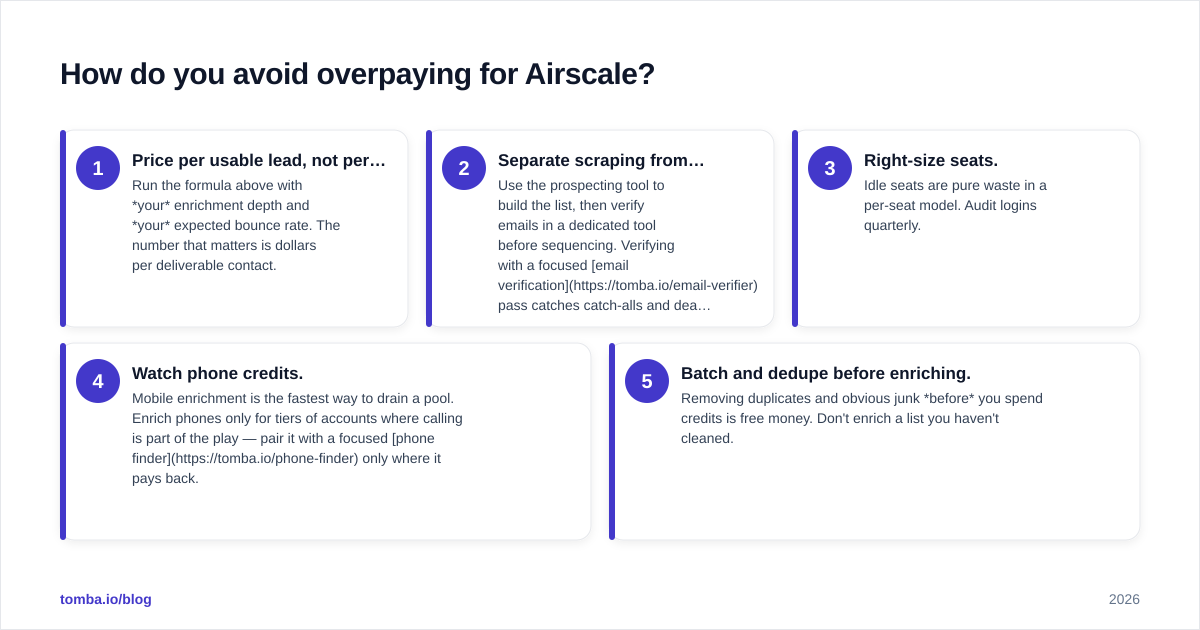
How do you avoid overpaying for Airscale?#
Five concrete moves, in order of impact:
- Price per usable lead, not per month. Run the formula above with your enrichment depth and your expected bounce rate. The number that matters is dollars per deliverable contact.
- Separate scraping from verification. Use the prospecting tool to build the list, then verify emails in a dedicated tool before sequencing. Verifying with a focused email verification pass catches catch-alls and dead addresses cheaply.
- Right-size seats. Idle seats are pure waste in a per-seat model. Audit logins quarterly.
- Watch phone credits. Mobile enrichment is the fastest way to drain a pool. Enrich phones only for tiers of accounts where calling is part of the play — pair it with a focused phone finder only where it pays back.
- Batch and dedupe before enriching. Removing duplicates and obvious junk before you spend credits is free money. Don't enrich a list you haven't cleaned.
The meta-principle: in any credit-based tool, every credit you spend on a contact you'll never email is margin handed to the vendor. Discipline at the front of the funnel is the cheapest optimization you have.
When does a flat-rate email stack beat a credit model?#
A flat-rate stack wins whenever your volume is high and predictable. Credit models are attractive at low, spiky usage and punishing at steady high usage — the marginal credit is where they make money.
Run this quick test:
- Do you process the same large list size every month? → Flat rate is likely cheaper.
- Is email your primary channel, with phone as a rare add-on? → A dedicated email finder beats a multichannel credit suite.
- Do you need to push thousands of lookups through an API? → A flat or volume-tiered email finder API gives you cost certainty that per-credit billing can't.
- Is your usage genuinely sporadic and exploratory? → A credit/trial model like Airscale's may fit better.
There's no universal winner. There's only the model that matches your usage curve. The mistake is buying on the headline price instead of plotting your actual monthly volume against each pricing model and seeing where the lines cross.
The bottom line on Airscale pricing#
Airscale is a capable LinkedIn-centric prospecting tool, and its pricing is reasonable for that job — provided you understand that the seat-plus-credit model makes your real cost a moving target. Budget on cost-per-usable-lead, keep phone credits on a leash, and verify before you send.
But if you strip the requirement down to its core — get accurate, deliverable business emails, in volume, at a predictable price — a focused tool almost always comes out ahead on cost-per-verified-contact. That's the gap Tomba is built to fill.
Start with the Tomba Email Finder on the free tier (25 searches a month, no card), then move to the $49/mo Starter or $99/mo Growth plan once you know your real volume. You get flat, plannable Tomba pricing, built-in verification, bulk processing, and a clean API — no credit math, no surprise invoice at month-end. Price it against your Airscale spend per usable lead and let the numbers decide.
// get started
Find, verify and enrich your first contacts today
Start on the free plan with 25 searches a month, then scale when your team is ready.
Free plan · No credit card required · GDPR & CCPA
// about the author