Allegrow vs DiscoverOrg 2026: Deliverability vs Data
Allegrow optimizes inbox placement; DiscoverOrg (now ZoomInfo) sells B2B data. Here's how the two compare in 2026 — and why most teams need both, plus a finder.
TL;DR
- Allegrow and DiscoverOrg solve different problems. Allegrow is a sender-reputation and inbox-placement tool; DiscoverOrg is a B2B data platform that has since folded into ZoomInfo. Comparing them head-to-head is comparing a fuel-quality additive to the gas station itself.
- If your emails are landing in spam, you need Allegrow (or a deliverability tool like it). If you don't know who to email, you need a data provider like DiscoverOrg/ZoomInfo.
- DiscoverOrg the brand is effectively retired — it merged with ZoomInfo in 2019 and the name is winding down. Buying "DiscoverOrg" in 2026 means buying ZoomInfo.
- Both tools are expensive and aimed at mid-market and enterprise. Lean teams usually get 80% of the outcome from a focused email finder plus basic warmup, at a fraction of the cost.
- The honest stack for most outbound teams: a finder for contacts, a verifier to protect deliverability, and a warmup routine — then add a reputation monitor or a full data platform only when volume justifies it.
Why are people comparing Allegrow vs DiscoverOrg?#
Short answer: because the names get thrown into the same "sales tooling" bucket, even though they sit at opposite ends of the outbound pipeline.
Think of cold outreach like running a restaurant. DiscoverOrg is your supplier — it tells you which customers exist, where they are, and what they buy. Allegrow is your health inspector and kitchen hygiene system — it makes sure the food you send actually reaches the table instead of getting tossed at the door. You can have the best supplier list in the world and still fail if every dish ends up in the spam bin. And you can have a spotless kitchen serving no one if you don't know who to cook for.
So the real question behind "allegrow vs discoverorg" usually isn't "which one wins." It's "which problem do I actually have right now — bad data or bad deliverability?" This post answers both, shows where each tool fits, and explains where a lean finder-plus-verifier stack beats paying for either.
What is Allegrow?#
Allegrow is a deliverability optimization platform. Its core job is to lift the share of your emails that land in the primary inbox rather than spam or the Promotions tab, and to monitor your sender reputation over time.
In practice, Allegrow runs seed-list testing (sending to a network of monitored inboxes to see where your mail lands), tracks reputation signals, and nudges your sending behavior toward patterns the mailbox providers reward. It plugs into outbound sequencers and is built for teams sending real volume who have watched reply rates quietly collapse because mail stopped reaching humans.
What Allegrow does not do: it doesn't find you contacts, build account lists, or enrich records with firmographics. It assumes you already have a list and a sending setup. Its entire value is making that sending land.
If you've never audited where your cold email actually arrives, that blind spot is the problem Allegrow exists to fix. You can get a rough read for free first with an email reputation checker before paying for a full platform.
What is DiscoverOrg (and why is it now ZoomInfo)?#
DiscoverOrg was a B2B data and sales-intelligence provider known for deeply researched org charts, direct-dial phone numbers, and technographic data. It built a reputation for human-verified accuracy in a market full of scraped, stale records.
Here's the part that matters in 2026: DiscoverOrg merged with ZoomInfo in 2019, and the combined company operates under the ZoomInfo brand. The DiscoverOrg name has been sunset for years. When a vendor, list, or old blog post says "DiscoverOrg," the product you'd actually buy today is ZoomInfo. So any honest "allegrow vs discoverorg" decision in 2026 is really "Allegrow vs ZoomInfo's data platform."
ZoomInfo (the DiscoverOrg lineage) gives you a contact and company database, intent data, org charts, enrichment, and workflow integrations into CRMs and sequencers. It answers "who should we sell to and how do we reach them," not "will our email land."

Allegrow vs DiscoverOrg: how do they actually compare?#
Because they target different pipeline stages, a feature table is the clearest way to see the gap. Treat "DiscoverOrg" below as the
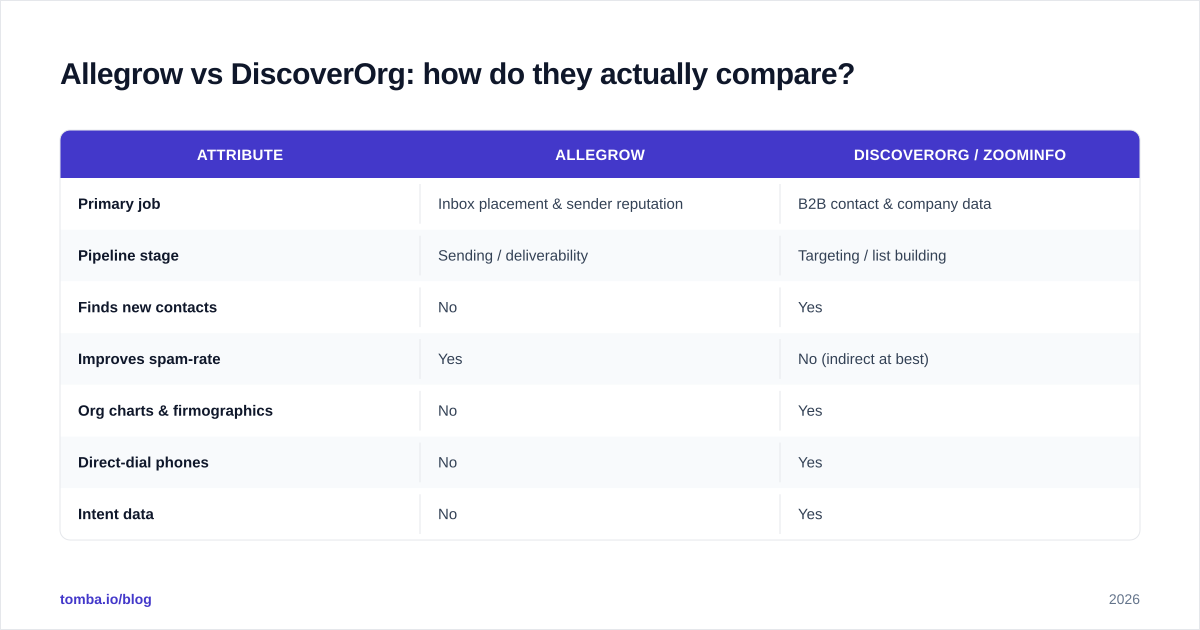
ZoomInfo data platform it became.
| Attribute | Allegrow | DiscoverOrg / ZoomInfo |
|---|---|---|
| Primary job | Inbox placement & sender reputation | B2B contact & company data |
| Pipeline stage | Sending / deliverability | Targeting / list building |
| Finds new contacts | No | Yes |
| Improves spam-rate | Yes | No (indirect at best) |
| Org charts & firmographics | No | Yes |
| Direct-dial phones | No | Yes |
| Intent data | No | Yes |
| Typical buyer | Outbound ops, SDR leaders | Marketing, RevOps, enterprise sales |
| Pricing model | Subscription, seat/volume | Annual contract, often 4–5 figures |
| Best for | Teams with lists but spam problems | Teams that need accounts & contacts |
The pattern is obvious once it's laid out: there's almost no feature overlap. These tools are complements, not substitutes. Choosing between them only makes sense when your budget forces a single bet — and then the choice is dictated entirely by which problem is bleeding you more.
Which problem do you actually have?#
Decide by symptom, not by brand. Run this quick diagnostic.
You likely need Allegrow (a deliverability tool) if:
- Your open and reply rates dropped without a copy or list change.
- You send from a few domains at meaningful volume and suspect reputation damage.
- You've already got contact data but don't trust where it's landing.
- You're scaling sending and want to protect domains proactively.
You likely need DiscoverOrg/ZoomInfo (a data platform) if:
- You're entering new markets and have no account list.
- You need org charts, direct dials, or intent signals to prioritize.
- Your CRM is full of decayed records that need enrichment.
- You're an enterprise team that can absorb an annual data contract.
You likely need neither (yet) if:
- You're a small team doing targeted outbound to a known niche.
- Your volume is modest and your main gap is simply finding verified emails.
That last case is where most early-stage and SMB teams actually live, and it's where a focused email finder plus a verifier carries the load that a full data platform would otherwise — without the contract. You build a clean list, you keep bounce rates low, and your deliverability stays healthy because you never blasted dead addresses in the first place.

Is Allegrow better than DiscoverOrg?#
Neither is "better" — they're answers to different questions, so the honest verdict is a tie wrapped in "it depends." But here's the nuance that matters for budget owners.
Deliverability problems compound silently. A reputation slide doesn't announce itself; reply rates just erode until someone investigates. That makes a tool like Allegrow valuable precisely because the problem is invisible. But — and this is the part vendors won't tell you — the cheapest deliverability fix is upstream hygiene: verify before you send, warm your domain, and don't email catch-all or risky addresses. Do that and you may not need a dedicated reputation platform at all until you're sending serious volume.
Data problems, by contrast, are loud. You know when you have no one to email. DiscoverOrg/ZoomInfo solves that comprehensively, but at enterprise pricing and with a database that, like all databases, decays. Even premium data needs verification at the moment of send, because a record accurate last quarter may bounce today.
So the strategic read for 2026: deliverability is becoming table stakes as mailbox providers tighten bulk-sender rules, and clean data is the input that protects it. Both vendors are strong in their lane; both are priced for teams past the scrappy stage.
What does each one cost?#
Pricing transparency differs sharply between the two, which itself tells you who they're built for.
| Plan dimension | Allegrow | DiscoverOrg /ZoomInfo | Tomba (for comparison) |
|---|---|---|---|
| Public pricing | Limited, sales-led | Opaque, annual contract | Published, self-serve |
| Free tier | No | No | 25 searches/mo |
| Entry monthly | Custom quote | Typically 4-figure+/yr | $49/mo Starter |
| Mid tier | Volume-based | 5-figure common | $99/mo Growth |
| Best-fit team size | Mid-market+ | Mid-market & enterprise | Solo to mid-market |
| Contract | Subscription | Usually annual commit | Monthly, no commit |
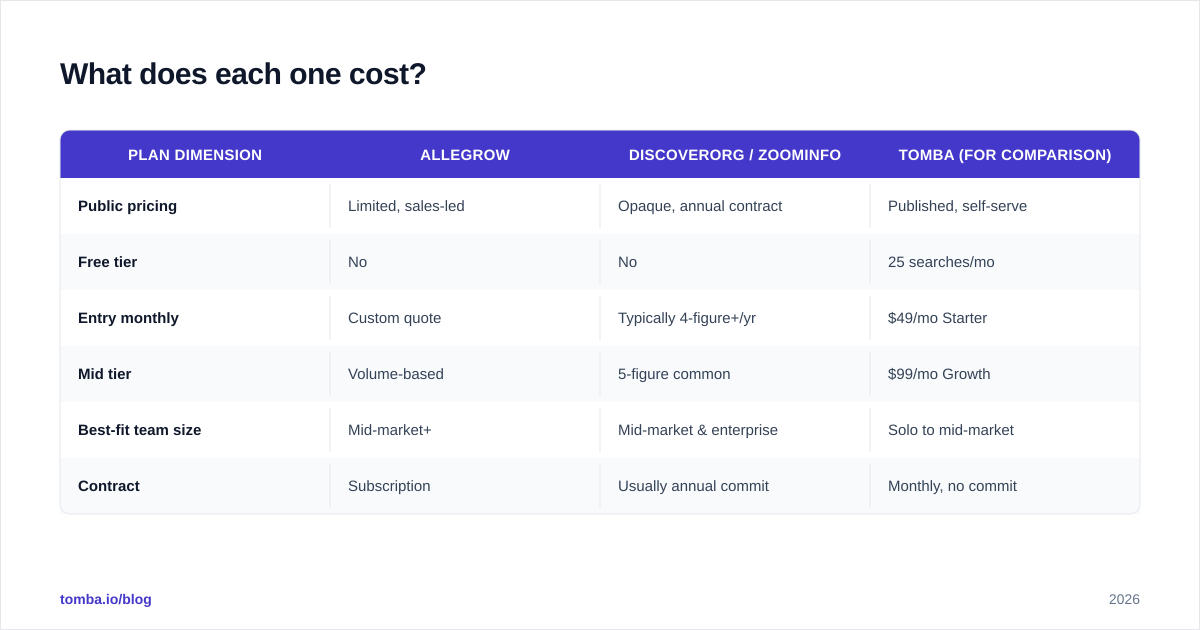
DiscoverOrg/ZoomInfo is notorious for sales-led, annual-commit pricing that often starts in the low five figures per year. Allegrow is subscription-based but quote-driven. Neither publishes a self-serve entry price the way a finder does.
For teams that want to know the number before a sales call, Tomba pricing is published outright: a free tier with 25 searches a month, then Starter at $49/mo, Growth at $99/mo, Pro at $249/mo, and custom Enterprise. That's not a like-for-like swap for a full data platform — it's the point that you can solve the find verified contacts job for a fraction of an annual ZoomInfo contract, and reinvest the difference into deliverability where it counts.
How do they fit into a real outbound stack?#
Stop thinking "either/or" and think "in what order." A working outbound pipeline runs in stages, and each tool category owns one.
- Find — get verified contact emails for your target accounts. A finder or data platform lives here. For domain-level prospecting, find emails by domain turns a company list into reachable contacts.
- Verify — confirm each address is live before sending, so bounces don't wreck your reputation. This is your cheapest deliverability insurance.
- Warm & send — ramp a domain, keep volume sane, write like a human. Estimate a safe ramp with a warmup calculator.
- Monitor — watch inbox placement and reputation over time. This is Allegrow's home turf.
- Enrich & expand — layer in firmographics, intent, and org charts as you scale. This is DiscoverOrg/
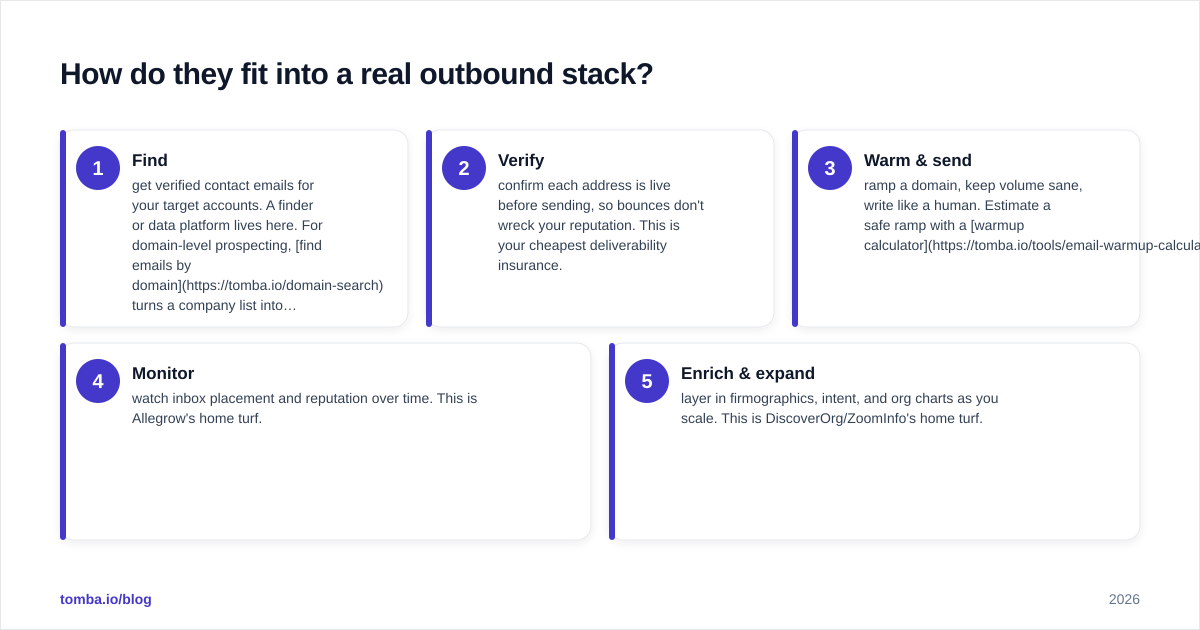
ZoomInfo's home turf.
Most teams over-invest in stage 5 (big data contract) and under-invest in stages 2–4 (verify, warm, monitor). The result is a beautiful list that lands in spam. Flip that priority. Nail find-verify-warm first; add a reputation platform like Allegrow when volume justifies it; add a full data platform like ZoomInfo when your market is big enough that manual finding can't keep up.
When should you skip both and just use a finder?#
Skip both when your bottleneck is simply getting accurate emails for the people you already know you want to reach — which is the majority of SMB and early-mid-market outbound.
In that situation, a dedicated finder beats a data platform on cost and beats a deliverability tool on relevance, because the single highest-leverage deliverability move is not sending to bad addresses in the first place. Clean inputs protect reputation for free. You can pair a finder with bulk processing to build lists at scale via the bulk email finder, then keep your list tidy and your bounce rate low.
You'd graduate to Allegrow when you're sending enough that reputation needs active monitoring, and to DiscoverOrg/ZoomInfo when you need org charts, intent, and enrichment that a finder doesn't provide. Those are real thresholds — just later ones than most vendors imply. Independent reviews on G2 make the same point between the lines: buyers rate both categories well, but the complaints cluster around price and onboarding, not capability.
The honest verdict on Allegrow vs DiscoverOrg#
Pick by problem, not by hype. If your mail is landing in spam, you want Allegrow or another deliverability monitor. If you don't know who to email, you want ZoomInfo (the platform DiscoverOrg became). They are not rivals; they're two stages of the same pipeline, and well-funded teams eventually run both.
But before you sign either contract, make sure the cheap fundamentals are in place: verified contacts, a warmed domain, and a sane sending cadence. Get those right and you'll need less of both expensive tools than you think.
That's exactly where Tomba fits. Use the Tomba Email Finder to source professional emails by name, company, or domain, then verify them before you send so your reputation never takes the hit that pulls teams toward Allegrow in the first place. Start free with 25 searches a month, scale on a published price, and put your budget where it compounds: clean data feeding a healthy inbox.
Ready to find emails that actually work?
Join 150,000+ professionals who stopped guessing and started sending. Free credits on signup — no credit card required.
Get the Tomba newsletter
Practical outbound tactics and product updates — once every two weeks.
About the author