Ambition Pricing and Reviews 2026: Pros, Cons, Verdict
A neutral breakdown of Ambition's pricing model, real user reviews, and the honest pros and cons before you commit your sales floor to a gamification platform in 2026.
Ambition is one of the better-known sales gamification and coaching platforms, but its quote-only pricing makes it hard to judge whether it fits your team before a sales call. This post strips the marketing away and weighs what you actually get.
TL;DR#
- Ambition is a sales performance platform combining gamification (leaderboards, TV "slides," competitions), coaching workflows, and KPI scorecards on top of your CRM and dialer data.
- Pricing is quote-based, not public. Reviewers consistently report a per-seat annual model that lands in the mid-to-high range for sales tooling, with implementation and minimum-seat commitments common.
- Strongest for mid-market and enterprise inside-sales floors (20+ reps) that already run a structured cadence and want to motivate and coach at scale.
- Weakest for small teams, bootstrapped startups, or anyone wanting transparent self-serve pricing and a quick setup.
- Honest verdict: real ROI when culture and data hygiene are already in place; an expensive TV decoration when they are not.
What is Ambition and who is it for?#
Ambition is a sales management and enablement layer that sits on top of the systems your reps already use — your CRM, dialer, and email tool — and turns the raw activity data into motivation and coaching. Think of it less as a place reps log in to work and more as the scoreboard, referee, and coach standing next to the field.
Three core jobs:
- Gamification — live leaderboards, TV broadcasts on the sales floor, head-to-head competitions, and "triggers" that fire a celebration (a gong sound, a Slack shout) the moment a rep books a meeting.
- Coaching — structured 1:1 agendas, coaching programs, and accountability tracking so managers run consistent, documented sessions instead of ad-hoc check-ins.
- Scorecards & analytics — KPI dashboards that roll activity and outcome metrics into a single performance score per rep, team, or segment.
The target buyer is a VP of Sales or RevOps leader at a mid-market or enterprise company running a high-volume inside-sales or SDR motion. If your reps make calls, send sequences, and book meetings all day, Ambition is built for you. If you run a small consultative team closing a handful of large deals a quarter, the fit is weaker.
How much does Ambition cost in 2026?#
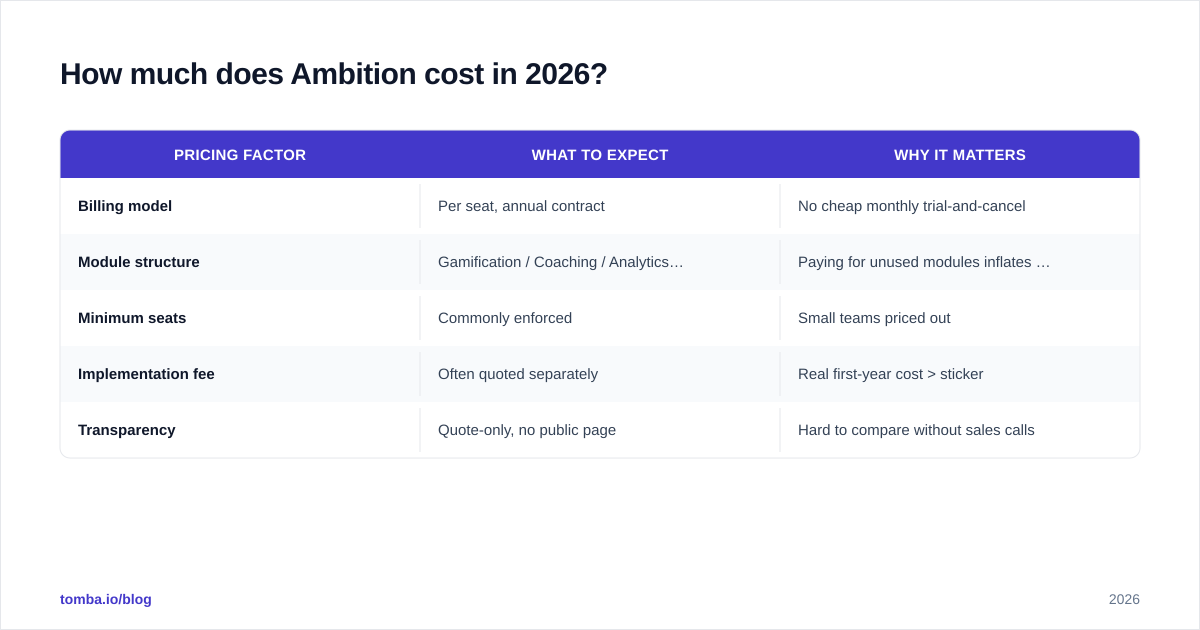
The honest answer: Ambition does not publish pricing, and you have to book a demo to get a quote. I'm not going to invent a number. What the public record (G2, Capterra, and buyer reports) consistently indicates is a per-seat, annually-billed model with these characteristics:
- Pricing scales with number of seats and which modules you turn on (gamification, coaching, and analytics are often packaged separately or as tiers).
- There is usually a minimum seat commitment and an annual contract, not monthly self-serve.
- Implementation/onboarding fees are common, especially when integrating multiple data sources.
- Reviewers describe it as a premium-priced tool relative to a basic leaderboard widget — you're paying for the coaching and analytics depth, not just the TVs.
Because the number depends entirely on your seat count and module mix, treat any "Ambition costs $X" claim you see elsewhere with skepticism. Get the quote, then benchmark it against the alternatives below.
| Pricing factor | What to expect | Why it matters |
|---|---|---|
| Billing model | Per seat, annual contract | No cheap monthly trial-and-cancel |
| Module structure | Gamification / Coaching / Analytics tiers | Paying for unused modules inflates cost |
| Minimum seats | Commonly enforced | Small teams priced out |
| Implementation fee | Often quoted separately | Real first-year cost > sticker |
| Transparency | Quote-only, no public page | Hard to compare without sales calls |
For a frame of reference on how transparent SaaS pricing reads when a vendor does publish it, compare with Tomba pricing — a clear free-to-enterprise ladder. Ambition's opacity isn't unusual for enterprise sales software, but it does slow down your evaluation.
What do Ambition reviews actually say?#
Pulling the signal out of Ambition's G2 reviews and Capterra, a consistent pattern emerges. Reviewers rate it highly overall, but the praise and the complaints cluster predictably.
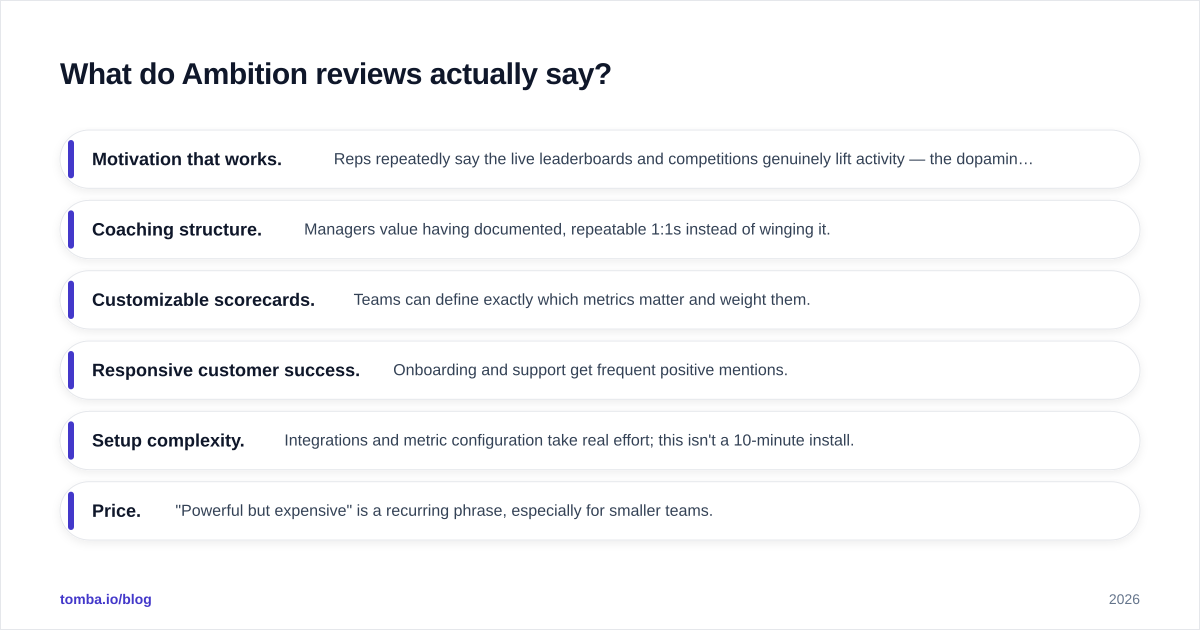
What reviewers praise:
- Motivation that works. Reps repeatedly say the live leaderboards and competitions genuinely lift activity — the dopamine of seeing your name climb is real.
- Coaching structure. Managers value having documented, repeatable 1:1s instead of winging it.
- Customizable scorecards. Teams can define exactly which metrics matter and weight them.
- Responsive customer success. Onboarding and support get frequent positive mentions.
What reviewers criticize:
- Setup complexity. Integrations and metric configuration take real effort; this isn't a 10-minute install.
- Price. "Powerful but expensive" is a recurring phrase, especially for smaller teams.
- Data dependency. If your CRM data is messy, the scorecards inherit the mess — garbage in, garbage on the TV.
- Occasional sync lag. Some reviewers note delays between activity and the leaderboard updating.
The throughline: Ambition amplifies whatever sales culture and data discipline you already have. It rewards organized teams and exposes disorganized ones.
What are the pros and cons of Ambition?#
Here's the balanced ledger, the part most "Ambition pricing reviews pros and cons" searches actually want.
| Pros | Cons |
|---|---|
| Proven motivation lift on high-volume floors | Quote-only pricing; no self-serve trial |
| Deep, customizable coaching workflows | Premium cost, minimum seat commitments |
| Strong CRM/dialer integrations | Setup and configuration are non-trivial |
| Real-time leaderboards and TV broadcasts | ROI depends heavily on clean source data |
| Documented 1:1s improve manager consistency | Overkill for small or low-volume teams |
| Responsive onboarding and support | Some reported activity-to-display sync lag |
If most of the left column describes problems you have today and most of the right column describes constraints you can absorb, Ambition is a strong candidate. If the right column scares you, look at lighter options first.
How does Ambition compare to alternatives?#
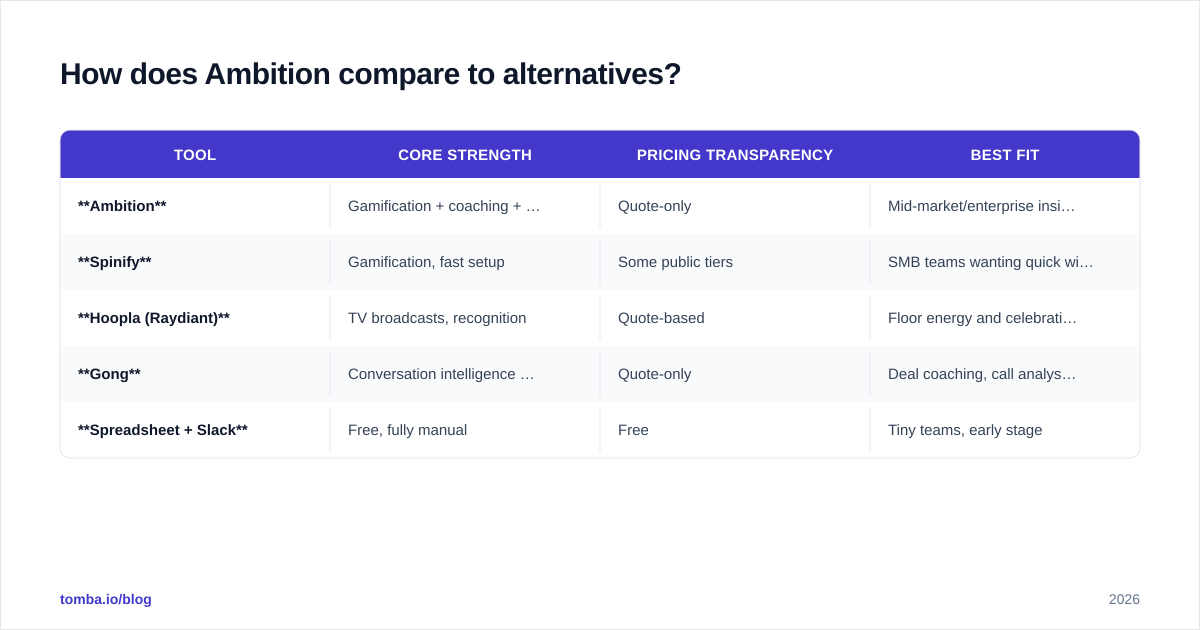
Ambition isn't the only way to motivate and coach a sales team. The right pick depends on whether you want gamification, coaching, conversation intelligence, or all three.
| Tool | Core strength | Pricing transparency | Best fit |
|---|---|---|---|
| Ambition | Gamification + coaching + scorecards | Quote-only | Mid-market/enterprise inside sales |
| Spinify | Gamification, fast setup | Some public tiers | SMB teams wanting quick wins |
| Hoopla (Raydiant) | TV broadcasts, recognition | Quote-based | Floor energy and celebrations |
| Gong | Conversation intelligence + coaching | Quote-only | Deal coaching, call analysis |
| Spreadsheet + Slack | Free, fully manual | Free | Tiny teams, early stage |
A few honest notes:
- Gong overlaps on coaching but is fundamentally a conversation-intelligence tool, not a gamification engine. Many teams run both. If you're weighing that direction, a Gong alternative comparison is worth your time.
- Spinify and Hoopla are more narrowly gamification-focused and often cheaper, but lighter on structured coaching and scorecards.
- The spreadsheet is free and surprisingly common — but it doesn't scale, doesn't update live, and nobody on the floor looks at it.
Does Ambition deliver ROI?#
ROI is real but conditional. Ambition pays off when three things are already true:
- Activity volume is high enough to gamify. Leaderboards motivate when there are dozens of calls and meetings to compete over daily. With five enterprise deals a quarter, there's nothing to race.
- Your source data is clean. Scorecards are only as honest as the CRM behind them. If reps don't log activity reliably, the numbers lie and the leaderboard loses credibility fast.
- Managers will actually use the coaching tools. The coaching module is half the value. If managers ignore it, you're paying enterprise prices for fancy TVs.
This is where your upstream data stack matters more than the gamification layer. A leaderboard that ranks reps on "meetings booked" is worthless if half those meetings were booked with bad contact data that no-shows. Feeding your pipeline with accurate, verified contacts — using a dedicated email finder and data enrichment before the lead ever hits the CRM — is what makes the metrics on the Ambition scoreboard worth competing over. The same logic applies to your win rate: gamifying a broken funnel just makes reps race faster toward no-shows.
Who should skip Ambition?#
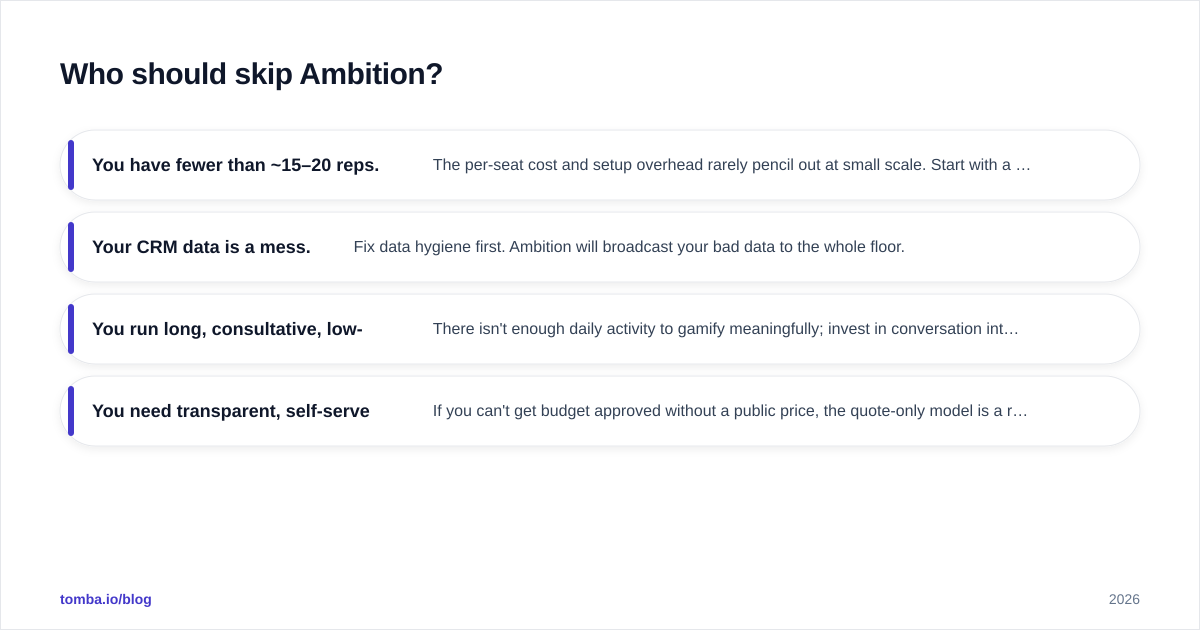
Be honest with yourself. Skip it, at least for now, if:
- You have fewer than ~15–20 reps. The per-seat cost and setup overhead rarely pencil out at small scale. Start with a Slack channel and a shared dashboard.
- Your CRM data is a mess. Fix data hygiene first. Ambition will broadcast your bad data to the whole floor.
- You run long, consultative, low-volume deals. There isn't enough daily activity to gamify meaningfully; invest in conversation intelligence and deal reviews instead.
- You need transparent, self-serve pricing today. If you can't get budget approved without a public price, the quote-only model is a real friction point.
None of these mean Ambition is bad — they mean the fit is wrong, and a wrong-fit purchase of a premium tool is how shelfware happens. Your reps still need clean numbers to dial, whether or not you buy a scoreboard; a reliable phone finder and verified emails matter more on day one than a leaderboard does.
What's the final verdict on Ambition pricing, reviews, pros and cons?#
Ambition is a strong, premium-priced platform that earns its cost on organized, high-volume sales floors — and wastes it everywhere else. The reviews back this up: teams with the right size, data discipline, and management buy-in love it; teams hoping it will manufacture a sales culture from scratch get expensive disappointment.
Your evaluation checklist:
- Confirm you have the activity volume to gamify.
- Audit your CRM data quality before, not after, you buy.
- Get the full quote including implementation and minimum seats.
- Pressure-test it against Spinify, Hoopla, and Gong for your specific need.
- Make sure managers commit to the coaching workflows.
Get those right and Ambition is a genuine performance multiplier. Get them wrong and it's the most expensive TV in the office.
Build the pipeline before you build the scoreboard#
A leaderboard only motivates when the numbers underneath it are real. Before you invest in gamifying activity, make sure that activity is aimed at accurate, verified contacts — not bounced emails and dead phone numbers that quietly poison every scorecard. Tomba's Email Finder gives your reps verified, deliverable B2B emails by name, company, or domain, so the meetings on your Ambition leaderboard are meetings that actually happen. Start free with 25 searches a month, then scale on the Starter plan at $49/mo as your team grows. Fix the data first; the scoreboard takes care of itself.
// get started
Find, verify and enrich your first contacts today
Start on the free plan with 25 searches a month, then scale when your team is ready.
Free plan · No credit card required · GDPR & CCPA
// about the author