Amplemarket Reviews 2026: Features, Pricing & Verdict
An honest 2026 breakdown of Amplemarket: what its AI sales platform does well, where it falls short, real pricing, and the alternatives worth testing first.
Amplemarket markets itself as an all-in-one AI sales platform: data, multichannel sequencing, deliverability tooling, and a layer of "AI agents" stitched on top. If you are evaluating it in 2026, the question is not whether it works — it does — but whether the bundle justifies the price versus assembling sharper point tools. This review answers that with concrete numbers, not vibes.
TL;DR — Should you buy Amplemarket?#
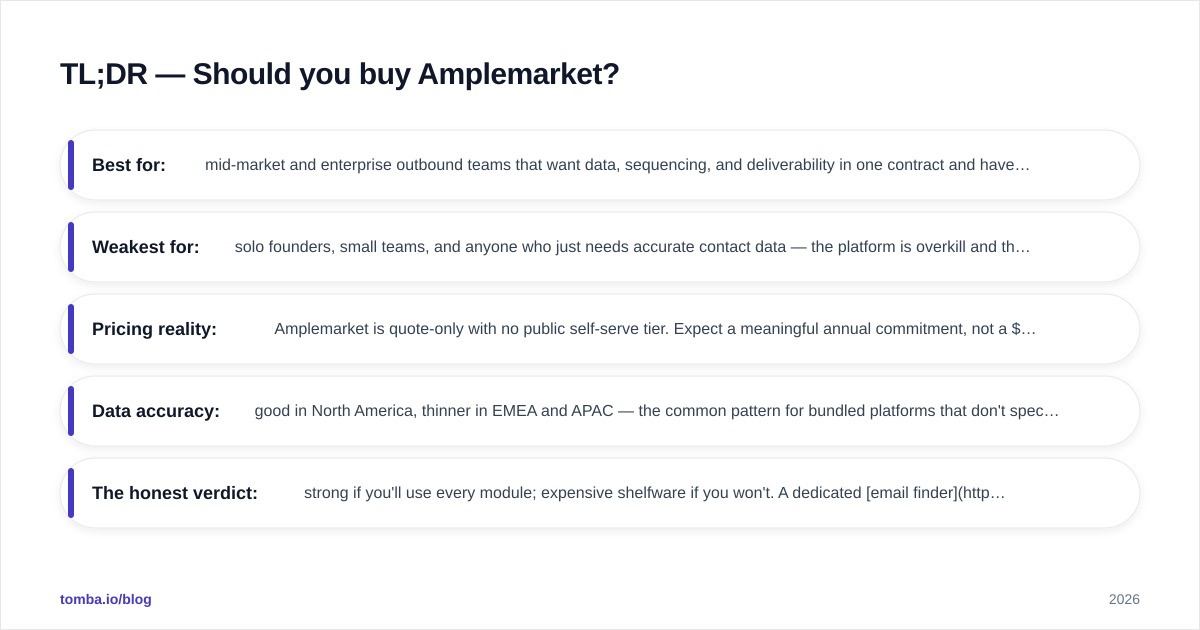
- Best for: mid-market and enterprise outbound teams that want data, sequencing, and deliverability in one contract and have the volume to use it.
- Weakest for: solo founders, small teams, and anyone who just needs accurate contact data — the platform is overkill and the entry price reflects it.
- Pricing reality: Amplemarket is quote-only with no public self-serve tier. Expect a meaningful annual commitment, not a $49/month card swipe.
- Data accuracy: good in North America, thinner in EMEA and APAC — the common pattern for bundled platforms that don't specialize in data.
- The honest verdict: strong if you'll use every module; expensive shelfware if you won't. A dedicated email finder plus a sequencing tool often beats it on cost and accuracy.
What is Amplemarket and who is it for?#
Amplemarket is a sales engagement platform that combines a B2B contact database, multichannel outreach (email, LinkedIn, calls), email deliverability features, and AI assistants that draft copy and prioritize leads. The pitch is consolidation: instead of paying for a data vendor, a sequencer, a warmup tool, and an enrichment API separately, you run outbound from one login.
That pitch lands with a specific buyer — a sales or RevOps leader at a Series B-and-up company who is tired of duct-taping five subscriptions together and wants one throat to choke. For that person, the integration is the product. For a three-person startup, the same integration is a reason to look elsewhere, because you pay for breadth you can't yet exhaust.
The platform has matured into four functional pillars, and most reviews conflate them. Separating them is the only way to judge fit.
What does Amplemarket actually include?#
Here is the honest module-by-module breakdown, because "all-in-one" hides a lot of variance in quality.
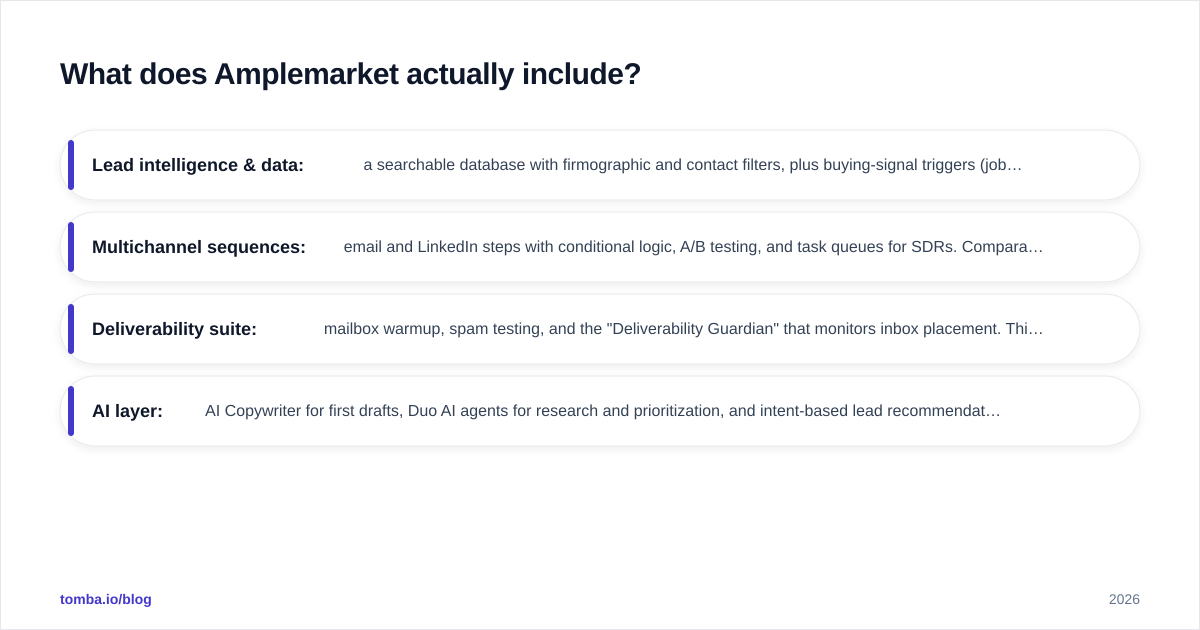
- Lead intelligence & data: a searchable database with firmographic and contact filters, plus buying-signal triggers (job changes, hiring, funding). Coverage is strong in the US and good in Western Europe.
- Multichannel sequences: email and LinkedIn steps with conditional logic, A/B testing, and task queues for SDRs. Comparable to Outreach or Salesloft in capability, simpler in execution.
- Deliverability suite: mailbox warmup, spam testing, and the "Deliverability Guardian" that monitors inbox placement. This is a genuine differentiator versus pure data vendors.
- AI layer: AI Copywriter for first drafts, Duo AI agents for research and prioritization, and intent-based lead recommendations. Useful as a starting point; still needs human editing.
The AI features are the headline in 2026 marketing, but treat them as accelerants, not autopilot. The copy they produce is competent and generic — fine for a first draft, dangerous if you ship it unedited at scale, because generic copy is exactly what kills response rate.

How accurate is Amplemarket's data?#
Accurate enough in core markets, inconsistent outside them — which is the recurring story for bundled platforms. When data is one module among four, it rarely matches a vendor that does nothing but data.
In practice, North American direct dials and corporate emails verify well. Once you push into EMEA mid-market or APAC, coverage thins and bounce rates climb. If your ICP is global or heavily non-US, validate a sample before committing, and keep a standalone email verifier in the loop regardless of what any all-in-one promises. No platform's internal verification removes the need to confirm deliverability on a list you're about to burn your domain reputation on.
This is the single most important due-diligence step in any Amplemarket evaluation: pull 200 contacts in your real target segment, verify them independently, and measure the actual valid rate. Vendor-reported accuracy numbers are marketing; your sample is data.
How much does Amplemarket cost in 2026?#
Amplemarket does not publish pricing. It is quote-only, sold annually, and typically gated behind a demo and a seat minimum. Based on user-reported figures, entry engagements land in the four-to-five-figure annual range depending on seats, data credits, and modules — far above a self-serve tool.
That opacity matters for the buying decision. You cannot start small, test for a month, and walk away cleanly the way you can with transparent, monthly tools. Compare that to Tomba pricing, which is public and starts free, and you can see the structural trade-off: Amplemarket asks for commitment before you've proven ROI.
Amplemarket vs. alternatives: how does it compare?#
The real question isn't "is Amplemarket good?" — it's "is the bundle better than the parts?" Here is how it stacks against the common alternatives buyers evaluate alongside it.
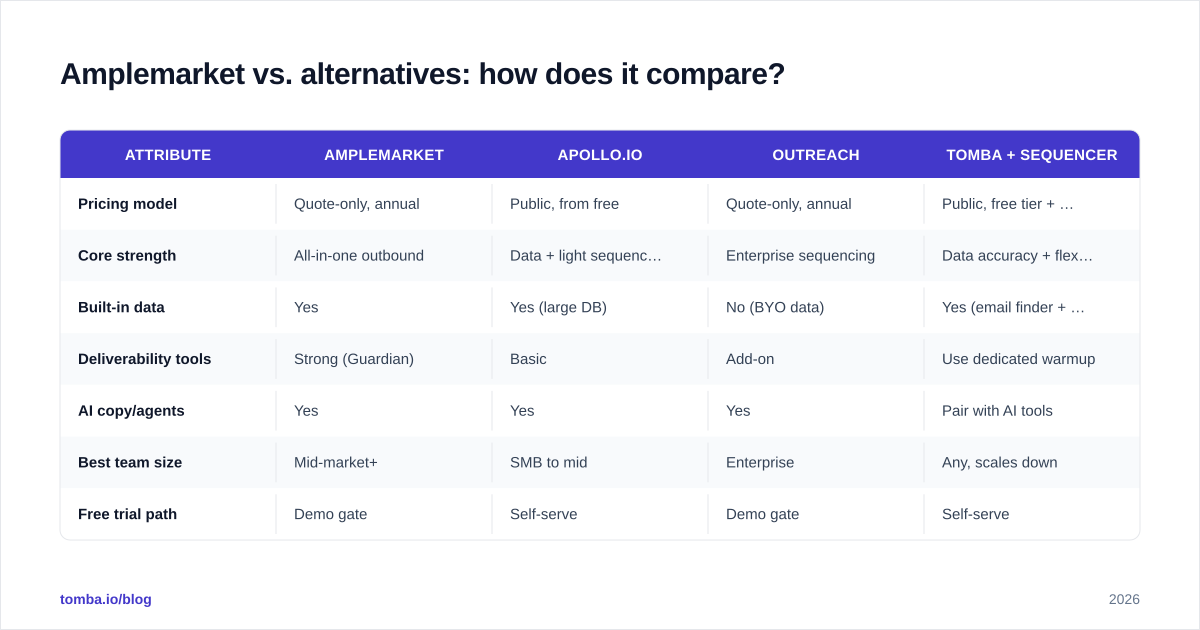
| Attribute | Amplemarket | Apollo.io | Outreach | Tomba + sequencer |
|---|---|---|---|---|
| Pricing model | Quote-only, annual | Public, from free | Quote-only, annual | Public, free tier + $49/mo |
| Core strength | All-in-one outbound | Data + light sequencing | Enterprise sequencing | Data accuracy + flexibility |
| Built-in data | Yes | Yes (large DB) | No (BYO data) | Yes (email finder + verifier) |
| Deliverability tools | Strong (Guardian) | Basic | Add-on | Use dedicated warmup |
| AI copy/agents | Yes | Yes | Yes | Pair with AI tools |
| Best team size | Mid-market+ | SMB to mid | Enterprise | Any, scales down |
| Free trial path | Demo gate | Self-serve | Demo gate | Self-serve |
The pattern is clear. Amplemarket competes on consolidation and deliverability, not on having the cheapest or most accurate data. If your bottleneck is sequencing and inbox placement, it's compelling. If your bottleneck is finding and verifying the right contacts cheaply, a focused stack wins.
For teams specifically weighing the consolidation play, it's worth reading a direct Amplemarket alternative breakdown and an Apollo alternative comparison before signing, because those two are the platforms most often shortlisted in the same evaluation.

What do real Amplemarket reviews say?#
Pulling from public review sites, the sentiment is consistent enough to summarize fairly. On G2 and Capterra, Amplemarket earns solid ratings, with praise and complaints that cluster predictably.
What users consistently praise:
- The deliverability and warmup tooling, which several reviewers credit for measurably better inbox placement.
- Genuinely responsive customer success and onboarding — a recurring positive for the mid-market segment.
- Time saved by having sequences, data, and signals in one interface instead of switching tabs.
What users consistently criticize:
- Pricing opacity and the size of the annual commitment, especially for teams that under-use modules.
- Data gaps outside North America, with bounce rates higher than advertised on non-US lists.
- AI-generated copy that reads generic without heavy editing — useful as a draft, risky at scale.
- A learning curve on the more advanced sequence logic and agent configuration.
None of this is disqualifying. It's the normal profile of a capable platform sold to teams who don't all use it the same way. The negative reviews almost always trace back to a mismatch between what was bought and what the team actually needed.
What's the right way to evaluate Amplemarket?#
Don't evaluate the demo — evaluate your use case against the platform. Use this framework before any quote-only platform earns your signature.
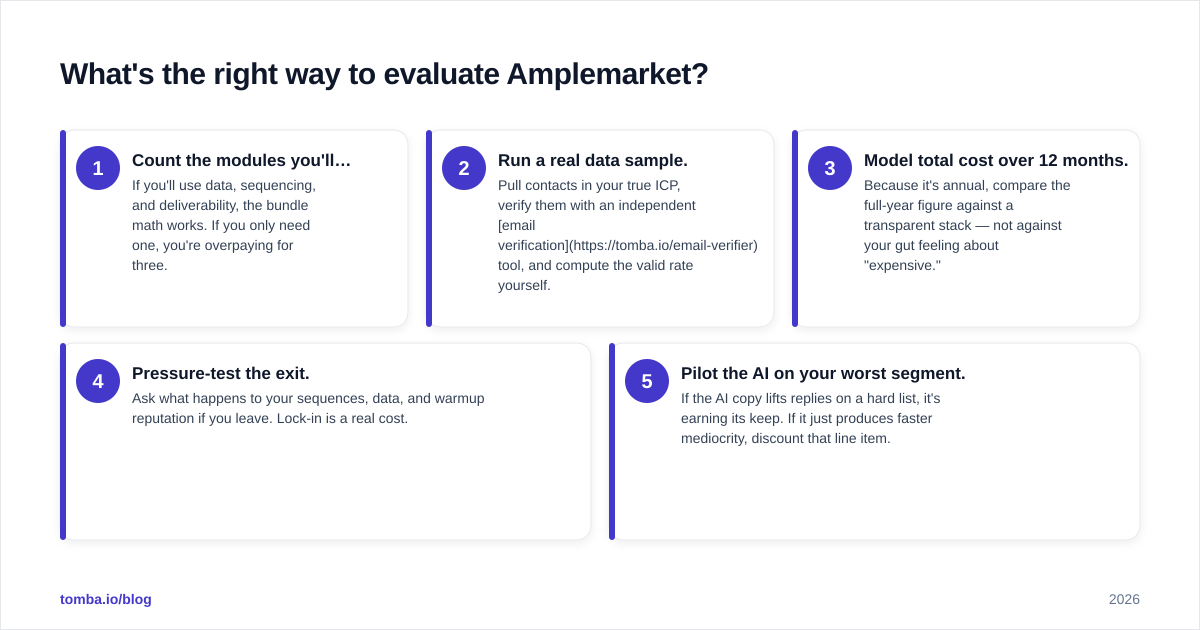
- Count the modules you'll actually use. If you'll use data, sequencing, and deliverability, the bundle math works. If you only need one, you're overpaying for three.
- Run a real data sample. Pull contacts in your true ICP, verify them with an independent email verification tool, and compute the valid rate yourself.
- Model total cost over 12 months. Because it's annual, compare the full-year figure against a transparent stack — not against your gut feeling about "expensive."
- Pressure-test the exit. Ask what happens to your sequences, data, and warmup reputation if you leave. Lock-in is a real cost.
- Pilot the AI on your worst segment. If the AI copy lifts replies on a hard list, it's earning its keep. If it just produces faster mediocrity, discount that line item.
Teams that run this framework rarely regret the outcome either way. Teams that buy on the strength of a polished demo are the ones writing the one-star reviews six months later.
Is Amplemarket worth it in 2026?#
Yes, conditionally — it's worth it when you'll genuinely exhaust the bundle, and a poor fit when you won't. That's the entire verdict.
Buy Amplemarket if you're a mid-market or enterprise outbound team, you value deliverability tooling, you have the volume to justify annual data credits, and consolidation onto one contract has real operational value for you. In that scenario, the platform is coherent and the support is a genuine asset.
Skip it if you're early-stage, budget-sensitive, primarily targeting non-US markets, or your real bottleneck is simply finding accurate contacts. In those cases, a focused stack — a precise email finder, an independent verifier, and a sequencing tool you can pay for monthly — delivers more outcome per dollar and far less lock-in. You can always graduate to an all-in-one later, once your volume and process justify it.
The mistake to avoid is buying breadth to solve a depth problem. If your numbers say "we can't find enough of the right people," no amount of bundled sequencing fixes that. Fix the data layer first.
Where Tomba fits in your evaluation#
If your honest diagnosis is a data problem — not a sequencing or deliverability problem — start with the layer that actually moves your pipeline. Tomba's Email Finder gives you accurate, source-cited professional emails by name, domain, or company, with a built-in verifier and transparent pricing that starts free and scales to $49/month — no annual lock-in, no demo gate. Use it standalone, or pair it with whatever sequencer you choose so you're paying premium platform rates only for the modules you'll truly use. Run a free sample against your ICP today, measure the valid rate yourself, and let the numbers — not a sales deck — decide your stack.
// get started
Find, verify and enrich your first contacts today
Start on the free plan with 25 searches a month, then scale when your team is ready.
Free plan · No credit card required · GDPR & CCPA
Get the Tomba newsletter
Product and data updates
// about the author