Ampliz vs Pubrio 2026: B2B Data & Email Finder Compared
Ampliz leans into healthcare data; Pubrio chases AI-driven prospecting. We break down pricing, accuracy, and coverage so you can pick the right B2B data tool in 2026.
Choosing between Ampliz and Pubrio usually comes down to one question: do you need deep, niche B2B data, or do you need an AI layer that turns raw contacts into ready-to-send sequences? Both tools promise accurate emails and direct dials, but they were built for different buyers. This breakdown compares pricing, data accuracy, coverage, and workflow fit so you can pick without a 14-day trial detour.
TL;DR — Ampliz vs Pubrio at a glance#
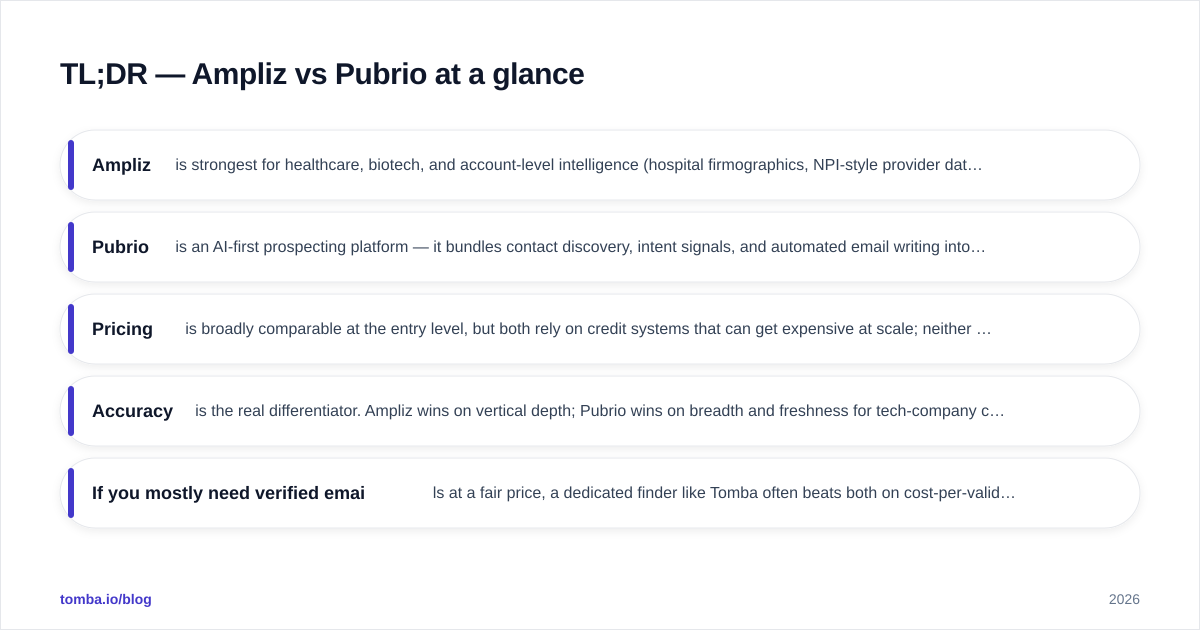
- Ampliz is strongest for healthcare, biotech, and account-level intelligence (hospital firmographics, NPI-style provider data), with a database team that handles custom list builds.
- Pubrio is an AI-first prospecting platform — it bundles contact discovery, intent signals, and automated email writing into a single dashboard aimed at general B2B SaaS sellers.
- Pricing is broadly comparable at the entry level, but both rely on credit systems that can get expensive at scale; neither publishes a generous free tier.
- Accuracy is the real differentiator. Ampliz wins on vertical depth; Pubrio wins on breadth and freshness for tech-company contacts.
- If you mostly need verified emails at a fair price, a dedicated finder like Tomba often beats both on cost-per-valid-email — more on that below.
What is Ampliz and who is it for?#
Ampliz is a B2B data intelligence platform best known for its healthcare and life-sciences database. It sells "global B2B contacts" but its real moat is provider-level data: physicians, hospital decision-makers, clinic firmographics, and specialty segmentation that generic databases miss. Sales teams selling medical devices, pharma services, or healthcare SaaS use Ampliz to build targeted lists by specialty, bed count, or geography.
Beyond healthcare, Ampliz offers an "APAC Intelligence" dataset and a Salesforce-style enrichment layer. The product is part self-serve, part managed service — for larger list builds you often work with their data team rather than pulling everything from a dashboard. You can read more about how vertical databases are assembled on the official site at ampliz.com.
That managed-service angle matters. If your ICP is "VP of Nursing at 200+ bed hospitals in Texas," Ampliz can usually deliver. If your ICP is "any B2B decision-maker," you are paying a premium for depth you will not use.
What is Pubrio and who is it for?#
Pubrio (sometimes written Pub.rio) is an AI-powered prospecting and sales-intelligence tool. It positions itself against Apollo and Seamless.AI: a single workspace where you search a large contact database, layer on buying-intent signals, and then let AI draft personalized cold emails based on each prospect's profile. The pitch is speed — go from "who should I contact" to "here is the email" without switching tabs.
Pubrio's database skews toward technology companies, startups, and general B2B roles. Its standout features are the AI email writer and the intent data that flags accounts actively researching your category. For a small SDR team that wants prospecting and copywriting in one subscription, that consolidation is attractive.
The trade-off: AI-generated copy still needs human editing, and intent data is only as useful as your follow-up motion. A tool that drafts 500 emails is worthless if your email deliverability is poor and they all land in spam.
Ampliz vs Pubrio: full feature and pricing comparison#
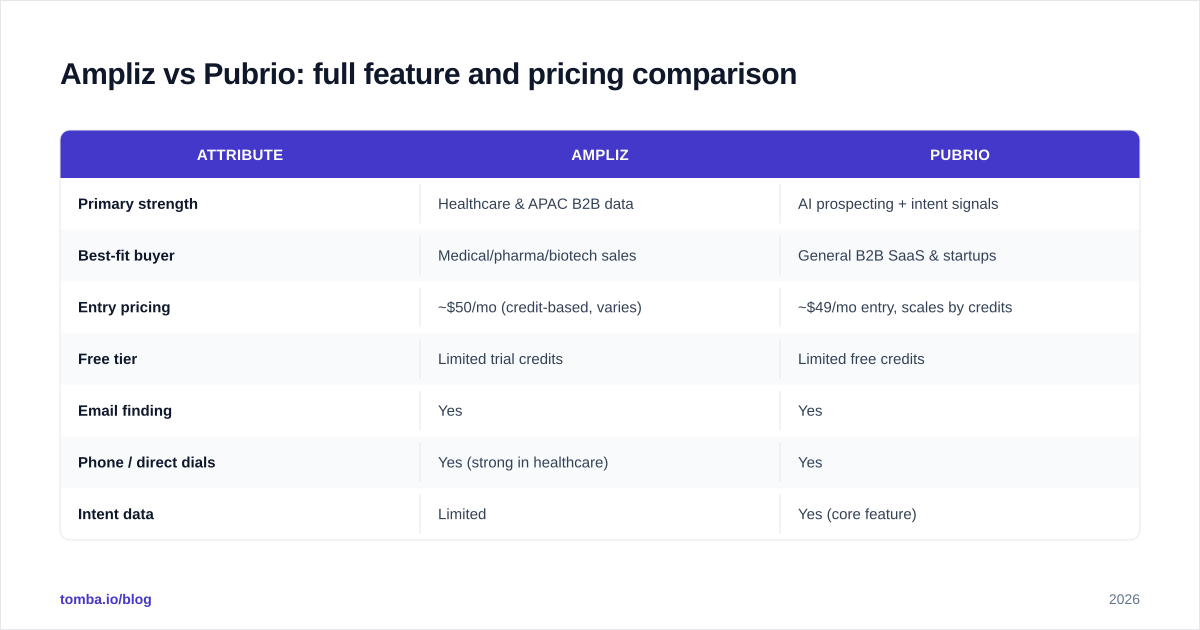
Here is the side-by-side. Treat published prices as starting points — both vendors negotiate at the annual and enterprise tiers, and credit definitions differ (a "credit" on one platform may unlock more fields than on the other).
| Attribute | Ampliz | Pubrio |
|---|---|---|
| Primary strength | Healthcare & APAC B2B data | AI prospecting + intent signals |
| Best-fit buyer | Medical/pharma/biotech sales | General B2B SaaS & startups |
| Entry pricing | ~$50/mo (credit-based, varies) | ~$49/mo entry, scales by credits |
| Free tier | Limited trial credits | Limited free credits |
| Email finding | Yes | Yes |
| Phone / direct dials | Yes (strong in healthcare) | Yes |
| Intent data | Limited | Yes (core feature) |
| AI email writing | No | Yes |
| Managed list-build service | Yes | No |
| Data freshness | Strong in niche verticals | Strong for tech contacts |
| Native CRM sync | Salesforce, HubSpot | HubSpot, Salesforce, API |
A few practical notes. Ampliz's value is concentrated — if you are outside healthcare/APAC, you are buying a general database at a niche-data price. Pubrio's value is in consolidation — you replace a finder plus a copywriting tool, but you accept a database that is wider than it is deep. Neither is a pure-play email verifier, so plan to run lists through a verification step before any send.
Is Ampliz or Pubrio more accurate?#
Accuracy is the metric that actually moves revenue, and it splits cleanly by use case. Ampliz is more accurate inside its verticals because the data is human-curated and specialty-tagged — a cardiologist record is genuinely a cardiologist, not a guess from a job-title string. Pubrio is more accurate for technology and startup contacts because its sources refresh faster and its AI cross-checks multiple signals before surfacing an email.
The catch for both: bounce rates climb the moment you step outside their sweet spot. Ampliz emails for a non-healthcare SaaS buyer can be stale; Pubrio records for a niche manufacturing role can be thin. This is why a third-party verification pass is non-negotiable regardless of which tool you choose.

In head-to-head testing against dedicated email-finding tools, multi-purpose platforms like Ampliz and Pubrio tend to trade raw coverage for verification rigor. A focused email finder that scores every result against live SMTP and catch-all checks will usually return a lower bounce rate per validated email, even if its total database is smaller.

How do Ampliz and Pubrio handle deliverability and verification?#
Neither platform is built primarily to protect your sender reputation — they are built to find contacts. Both return emails with a confidence indicator, but neither replaces a true verification workflow. If you push unverified data straight into a cold sequence, you risk spam traps, hard bounces, and the slow erosion of sender reputation that quietly kills inbox placement.
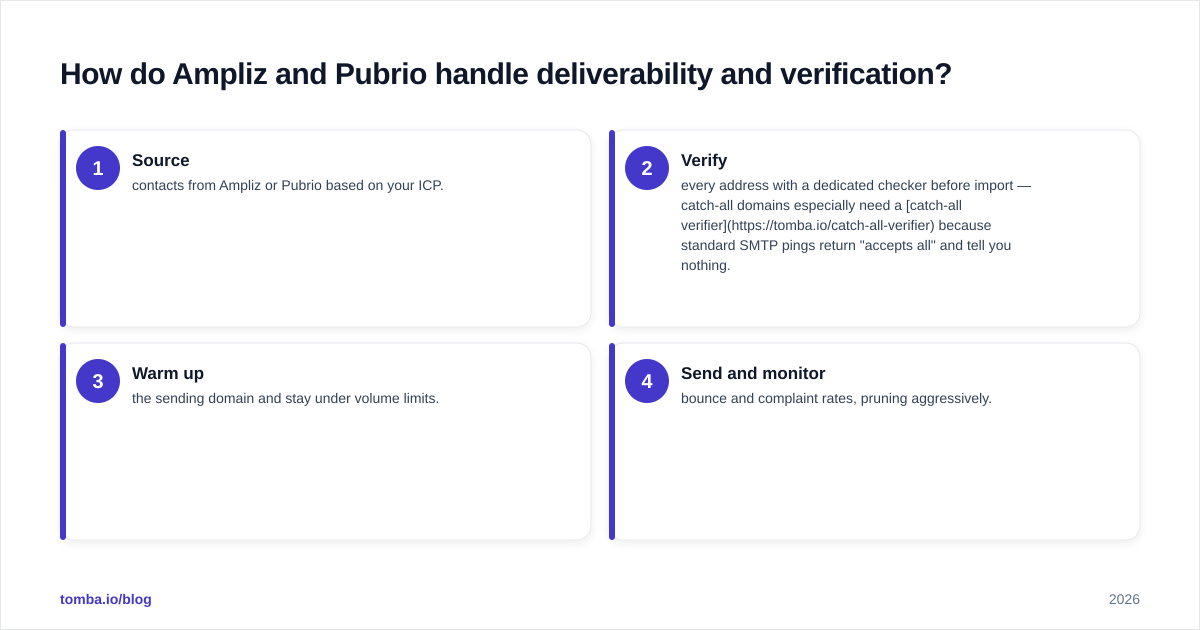
The reliable pattern looks like this:
- Source contacts from Ampliz or Pubrio based on your ICP.
- Verify every address with a dedicated checker before import — catch-all domains especially need a catch-all verifier because standard SMTP pings return "accepts all" and tell you nothing.
- Warm up the sending domain and stay under volume limits.
- Send and monitor bounce and complaint rates, pruning aggressively.
Skipping step two is the most common mistake teams make with any data platform. A 5% bounce rate is enough to throttle a new domain, and both Ampliz and Pubrio can produce that on out-of-vertical lists. For background on why placement depends on more than the email itself, Google's own Postmaster Tools documentation is the canonical reference.
Ampliz vs Pubrio: which should you pick in 2026?#
Pick Ampliz if you sell into healthcare, life sciences, or APAC markets and need specialty-level segmentation you cannot get from a general database. The managed list-build service is worth the premium when your ICP is narrow and high-value, and a single closed deal pays for the subscription many times over.
Pick Pubrio if you are a generalist B2B or SaaS team that wants prospecting, intent data, and AI copy in one tab. The consolidation saves tool sprawl, and the AI writer is a real time-saver for SDRs who would otherwise stare at a blank email. Just budget editing time — the drafts are starting points, not final copy.

Pick neither as your only tool if your core need is simply "accurate, verified emails at a predictable cost." That is where a focused finder-and-verifier stack wins. You can compare full database approaches on our B2B database overview, and review transparent Tomba pricing against the credit math you would pay on a multi-feature platform.

What are the best Ampliz and Pubrio alternatives?#
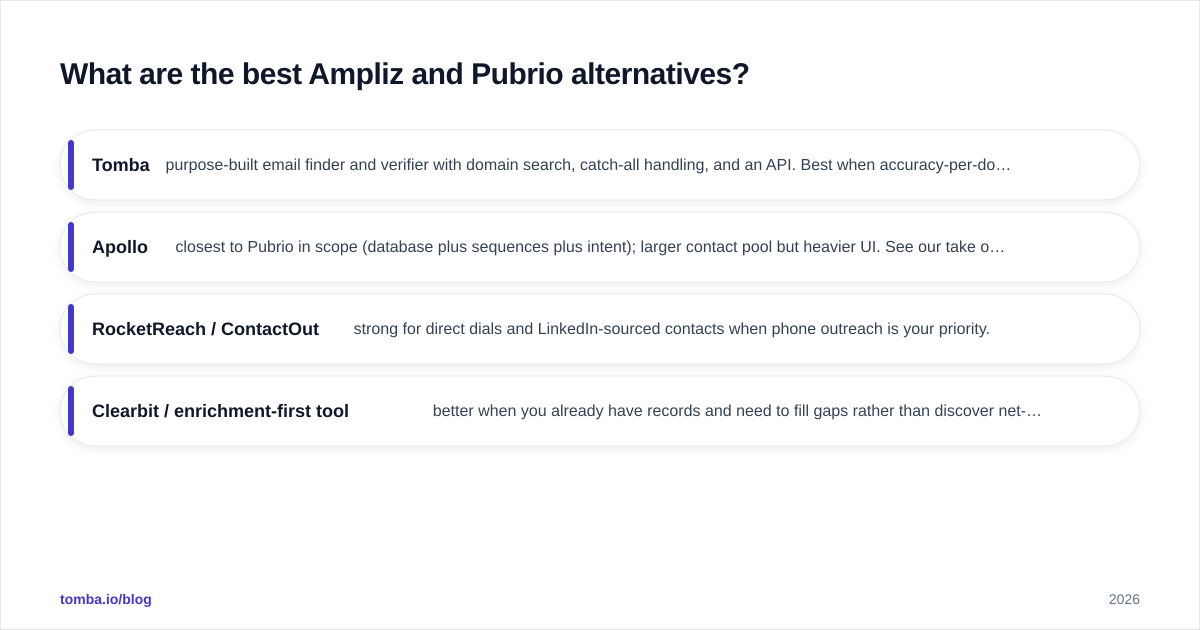
Both tools are strong in their lanes, but they are not the only options — and they are often overkill for teams that just need clean emails. Worth evaluating:
- Tomba — purpose-built email finder and verifier with domain search, catch-all handling, and an API. Best when accuracy-per-dollar matters more than bundled features.
- Apollo — closest to Pubrio in scope (database plus sequences plus intent); larger contact pool but heavier UI. See our take on Apollo alternatives.
- RocketReach / ContactOut — strong for direct dials and LinkedIn-sourced contacts when phone outreach is your priority.
- Clearbit / enrichment-first tools — better when you already have records and need to fill gaps rather than discover net-new contacts.
For most outbound teams, the smartest stack is "specialist finder + specialist verifier + your own sequencing tool," rather than one platform that does everything at a B-minus. You keep accuracy high, swap components as needs change, and avoid being locked into one vendor's credit economy.
On the data-quality side, independent reviews on G2 are useful for seeing how Ampliz and Pubrio perform outside their marketing — filter for reviewers in your industry, since vertical fit dominates the experience.
Frequently asked questions#
Is Ampliz only for healthcare? No, but that is where it is strongest. Its general and APAC datasets exist, but you are paying for vertical depth, so non-healthcare buyers often find better value elsewhere.
Does Pubrio write good cold emails? The AI drafts are solid first passes that personalize from profile data. They still need a human edit for tone and a clear CTA — treat them as 80% done, not 100%.
Do I still need a verifier with either tool? Yes. Both return confidence scores, not guaranteed-deliverable addresses. Run lists through a dedicated email verification step before sending, especially for catch-all domains.
Which is cheaper? Entry prices are comparable, but total cost depends on credit consumption and how much you use the bundled features. Map your monthly contact volume to each vendor's credit definition before committing.
The bottom line#
Ampliz and Pubrio solve different problems. Ampliz is a vertical data specialist; Pubrio is a horizontal AI prospecting suite. Match the tool to your motion: niche healthcare/APAC selling leans Ampliz, generalist SaaS outbound leans Pubrio. But if your real goal is verified emails that actually land — without paying for features you will not use — start with a dedicated finder.
Try the Tomba Email Finder free: find professional emails by domain, name, or company, verify them in the same workflow, and pay only for what you use. It is the simplest way to get accurate B2B contacts without committing to a heavyweight platform before you know your numbers. Spin up the free tier, run your top 25 target accounts, and compare the bounce rate against whatever Ampliz or Pubrio quotes you.
Ready to find emails that actually work?
Join 150,000+ professionals who stopped guessing and started sending. Free credits on signup — no credit card required.
Get the Tomba newsletter
Practical outbound tactics and product updates — once every two weeks.
About the author