Ampliz vs RocketReach 2026: B2B Data & Email Finder Compared
Ampliz leans into healthcare and APAC intelligence; RocketReach bets on a 700M+ contact graph. Here's how the two stack up on coverage, accuracy, and price in 2026 — and where a verified alternative beats both.
Choosing between Ampliz and RocketReach usually comes down to one question: do you need deep, niche intelligence for a specific market, or do you need broad contact reach across every industry? They look similar on a feature page, but they solve different problems — and picking the wrong one means you either overpay for data you won't use or run dry on the segments you care about.
This guide breaks down both platforms on coverage, accuracy, workflow, and price, then shows where a verified-first alternative changes the math.
TL;DR#
- Ampliz is strongest for healthcare and APAC-focused outbound, with firmographic and intent layers built for niche account targeting. Pricing is quote-based, which slows down small teams.
- RocketReach wins on raw breadth — a contact graph it markets at 700M+ people and 60M+ companies — and ships transparent, self-serve pricing starting around $39/mo billed annually.
- Neither tool leads on verified email accuracy out of the box; both surface contacts you still need to validate before sending.
- For teams that mostly need accurate, verified B2B emails per domain without a per-seat enterprise contract, a dedicated email finder like Tomba Email Finder covers the core job at a lower entry price.
- Read to the end for a side-by-side pricing and use-case table plus a decision framework.
What is Ampliz?#
Ampliz is a B2B data and sales intelligence platform best known for its healthcare intelligence module and its coverage of the Asia-Pacific market. Instead of trying to be a universal contact database, Ampliz leans into depth: hospital data, physician specialties, technographics, and intent signals for accounts you define.
The pitch is account-based. You tell Ampliz the firmographic profile you're chasing — industry, geography, company size, tech stack — and it returns matching companies and contacts enriched with attributes you'd otherwise stitch together from three tools. For teams selling medical devices, health SaaS, or anything where "the right specialty at the right facility" matters, that focus is the whole value.
The trade-off: Ampliz pricing is quote-based and sales-led. There's no public self-serve tier, so a two-person startup can't swipe a card and start today. You talk to sales, scope a contract, and onboard. That's normal for enterprise data vendors, but it raises the floor.
What is RocketReach?#
RocketReach is a contact-finding platform built around scale. It markets access to a graph of 700M+ professionals across 60M+ companies, and its core job is simple: give it a name and company (or a LinkedIn profile) and it returns emails and phone numbers.
Where Ampliz is a scalpel, RocketReach is a wide net. It's industry-agnostic, has a browser extension that works over LinkedIn and company sites, and — crucially — publishes its pricing openly with monthly and annual tiers. You can sign up, run lookups, and integrate it into your CRM without a sales call.
The catch is the same one that comes with any breadth-first database: coverage is wide but uneven, and the emails it returns are often "found" rather than freshly verified. You'll still want an email verifier in the loop before a real campaign, especially on catch-all domains.
Ampliz vs RocketReach: how do they compare?#
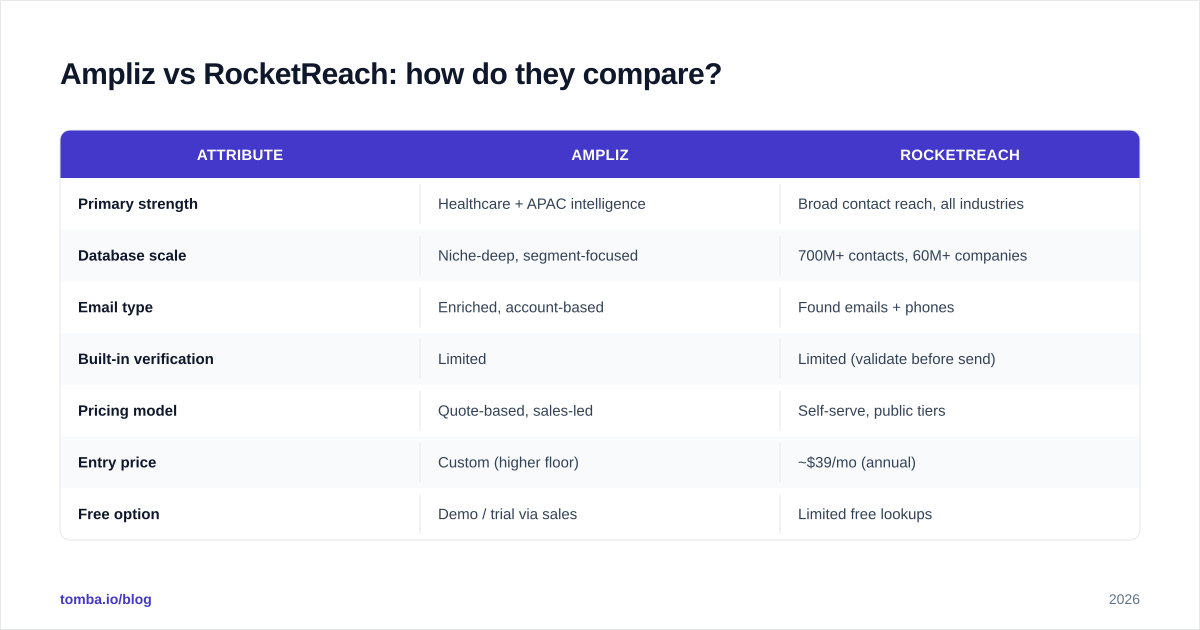
Here's the head-to-head on the attributes that actually change a buying decision.
| Attribute | Ampliz | RocketReach |
|---|---|---|
| Primary strength | Healthcare + APAC intelligence | Broad contact reach, all industries |
| Database scale | Niche-deep, segment-focused | 700M+ contacts, 60M+ companies |
| Email type | Enriched, account-based | Found emails + phones |
| Built-in verification | Limited | Limited (validate before send) |
| Pricing model | Quote-based, sales-led | Self-serve, public tiers |
| Entry price | Custom (higher floor) | ~$39/mo (annual) |
| Free option | Demo / trial via sales | Limited free lookups |
| Browser extension | Yes | Yes (LinkedIn + web) |
| Best for | ABM in regulated/niche verticals | High-volume multi-industry prospecting |
The pattern is clear. If your total addressable market is "every hospital procurement lead in Southeast Asia," Ampliz earns its contract. If your TAM is "anyone with a job title and a company," RocketReach's breadth and transparent pricing make it the faster start.
Which has better email accuracy?#
Neither tool is built primarily as a verification engine, and that's the gap most buyers underestimate.
Ampliz enriches contacts as part of its account data, so the emails come bundled with firmographic context — but that doesn't guarantee the inbox is live today. RocketReach finds emails across a massive index, which means more hits but more stale and pattern-guessed addresses mixed in. Both will hand you addresses that bounce if you send blind.
This matters because email deliverability is downstream of list hygiene. A 5% bounce rate on a cold campaign signals mailbox providers that you're sending to bad data, which drags your sender reputation down and lands future messages in spam — even to good addresses. Independent review sites like G2 consistently show that "data accuracy" and "bounce rates" are the most common complaints across every contact database, not just these two.
The practical fix is the same regardless of which platform you pick: run every list through a dedicated verifier before launch. If a chunk of your targets sit on catch-all domains — common in healthcare and enterprise — you'll also want a catch-all verifier so you're not flying blind on the "accept-all" addresses that most tools mark as "unknown."

How do Ampliz and RocketReach pricing compare?#
The pricing models are philosophically opposite, and that difference often decides the purchase before features do.
RocketReach is transparent and self-serve. Plans scale by monthly lookup volume, with emails-only tiers cheaper than email-plus-phone tiers, and annual billing knocking the effective rate down to roughly $39/mo at entry. You always know what you'll pay, and you can start the same day.
Ampliz is quote-based. You'll get a custom proposal sized to your seat count, segments, and data volume. For an enterprise ABM motion that's fine — the contract reflects the niche depth. For a lean team testing a new channel, the procurement cycle is friction, and you may end up paying for coverage outside your actual segment.
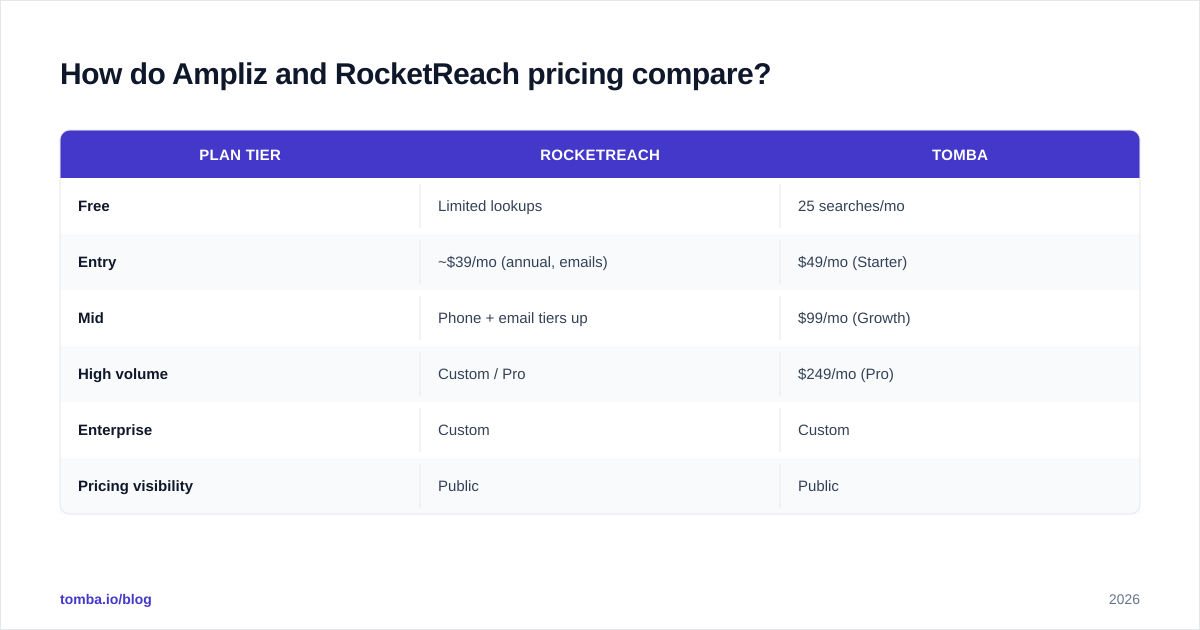
Here's how a transparent third option compares against RocketReach's published structure:
| Plan tier | RocketReach | Tomba |
|---|---|---|
| Free | Limited lookups | 25 searches/mo |
| Entry | ~$39/mo (annual, emails) | $49/mo (Starter) |
| Mid | Phone + email tiers up | $99/mo (Growth) |
| High volume | Custom / Pro | $249/mo (Pro) |
| Enterprise | Custom | Custom |
| Pricing visibility | Public | Public |
You can see the full Tomba pricing breakdown for credit counts per tier. The headline: if your job is "find and verify B2B emails by domain," you don't need an enterprise data contract to do it well.
When should you choose Ampliz?#
Pick Ampliz when your go-to-market depends on segment depth you can't get from a generic database:
- You sell into healthcare and need physician specialty, facility type, or care-setting data attached to contacts.
- Your priority market is APAC, where many Western databases thin out.
- You run a true account-based motion and want intent and technographic layers baked into your target list, not assembled from separate tools.
- You have the budget and procurement patience for a custom contract, and you'll use enough of the niche coverage to justify it.
If three of those four describe you, Ampliz's focus is a feature, not a limitation. You're paying for the parts of the market other vendors gloss over.
When should you choose RocketReach?#
Pick RocketReach when breadth and speed beat depth:
- You prospect across many industries and can't predict next quarter's ICP.
- You want a browser extension your reps live in over LinkedIn and company sites.
- You need phone numbers alongside emails for a calling motion — pair it with a phone finder workflow if coverage gaps show up.
- You want transparent pricing and self-serve onboarding without a sales cycle.
- You're comfortable adding a verification step before you send.
RocketReach is the safer default for a generalist sales team. The breadth means you'll rarely come up empty, and the public pricing means you can scale spend predictably as volume grows. Compare it against other options on a directory like Capterra before you commit a budget line.
What about a verified-first alternative?#
Both Ampliz and RocketReach are databases first and verifiers second. That's the recurring theme — and it's why many teams add a third tool to close the accuracy gap, or replace one of them entirely.
A dedicated email finder flips the priority. Instead of indexing a huge graph and hoping the emails are current, it finds the address by domain and pattern, then confirms it's deliverable in the same flow. For the most common B2B job — "I have a company and a name, get me a verified email" — that's the entire task done in one step.
This is where Tomba fits between the two. Its core is the email finder, with an email verifier, domain search for mapping every address at a company, a catch-all finder, and data enrichment sitting alongside. You can compare accuracy and coverage approaches across the major tools below.

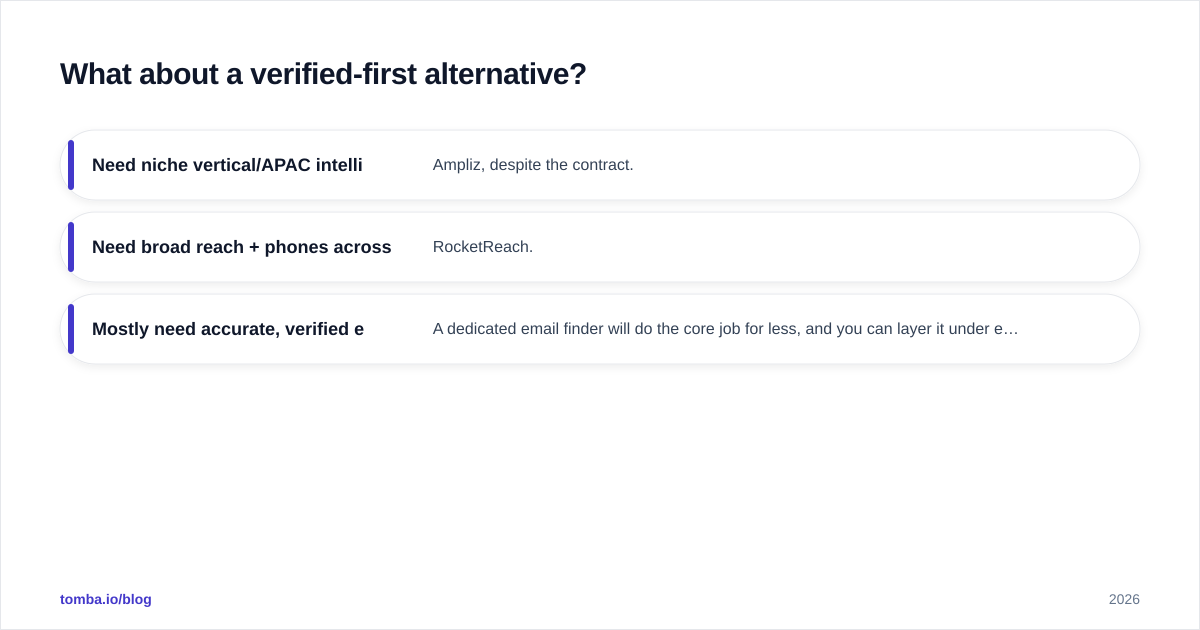
The decision tree is short:
- Need niche vertical/APAC intelligence? Ampliz, despite the contract.
- Need broad reach + phones across industries? RocketReach.
- Mostly need accurate, verified emails by domain at a predictable price? A dedicated email finder will do the core job for less, and you can layer it under either platform to fix the bounce problem.
For most outbound teams, the honest answer is "verified emails first, breadth second." A clean list of 500 confirmed addresses outperforms 5,000 unverified ones on reply rate and protects the domain you spent months warming up.
The bottom line#
Ampliz and RocketReach aren't really competitors — they're tools for different jobs. Ampliz is the specialist's database for healthcare and APAC account-based selling, justified by depth and priced like an enterprise contract. RocketReach is the generalist's reach engine, justified by scale and priced for self-serve. The shared weakness is verification: both hand you emails you should validate before you send.
If your work is account intelligence in a regulated niche, pay for Ampliz. If it's broad, fast, multi-industry prospecting, RocketReach is the cleaner buy. And if what you actually need is accurate, verified B2B email at a transparent price, start with the Tomba Email Finder — find emails by domain or name, verify them in the same flow, and skip the per-seat contract. The free tier gives you 25 searches a month to test the accuracy yourself before you commit a dollar.
Ready to find emails that actually work?
Join 150,000+ professionals who stopped guessing and started sending. Free credits on signup — no credit card required.
Get the Tomba newsletter
Practical outbound tactics and product updates — once every two weeks.
About the author