Antideo vs DiscoverOrg 2026: Data & Verification Compared
Antideo is a free email and IP validation API; DiscoverOrg (now ZoomInfo) is an enterprise B2B data platform. Here's how they actually compare in 2026 — and which one fits your stack.
TL;DR
- Antideo and DiscoverOrg are not the same kind of tool. Antideo is a lightweight, mostly-free email/IP/phone validation API. DiscoverOrg is an enterprise B2B sales-intelligence database (now part of ZoomInfo).
- Pick Antideo if you need cheap, programmatic data hygiene — blocking disposable emails at signup, flagging risky IPs, light verification.
- Pick DiscoverOrg/ZoomInfo if you need org charts, intent data, direct dials, and millions of enriched company records for an outbound sales motion — and you have the budget.
- Most teams don't actually need either extreme. A mid-market email finder plus a verifier covers prospecting and hygiene at a fraction of ZoomInfo's annual contract.
- This guide compares both on price, data depth, accuracy, and fit — then shows where a tool like Tomba lands between them.
What are Antideo and DiscoverOrg?#
Short answer: they solve opposite ends of the data problem.
Antideo is a developer-focused validation service. Think of it as a bouncer at the door of your forms and database — it checks whether an email is disposable, whether an IP is on a blacklist, whether a phone number is plausibly real. It's an API you call at signup or before sending. It does not find contacts or tell you who works where. Its appeal is that the core checks are free up to a generous daily limit, with no sales call required. You can read their public docs at antideo.com.
DiscoverOrg is the opposite: a heavyweight B2B intelligence platform built for revenue teams. It pioneered human-verified org charts, direct-dial phone numbers, and technographic data. In 2019 DiscoverOrg acquired ZoomInfo and adopted the name, so today "DiscoverOrg" effectively means ZoomInfo. It's sold as an annual platform contract, not a pay-as-you-go API, and it's priced for that — typically four to five figures per year.
So "Antideo vs DiscoverOrg" is less a head-to-head and more a question of which layer of the data stack you're trying to fill: hygiene and fraud-prevention, or prospecting and account intelligence.
How do they differ at a glance?#
| Attribute | Antideo | DiscoverOrg (ZoomInfo) |
|---|---|---|
| Primary job | Email/IP/phone validation | B2B contact & company database |
| Delivery | REST API | Web app + API + CRM sync |
| Free tier | Yes (daily free quota) | No (demo only) |
| Entry price | Free → low monthly add-ons | Custom annual, often $10k+/yr |
| Contact discovery | No | Yes (millions of records) |
| Org charts / intent data | No | Yes |
| Direct dials | No | Yes |
| Disposable email blocking | Yes (core feature) | Partial |
| Best for | Developers, signup hygiene | Mid-market & enterprise sales |
| Contract | Self-serve, cancel anytime | Annual, sales-led |
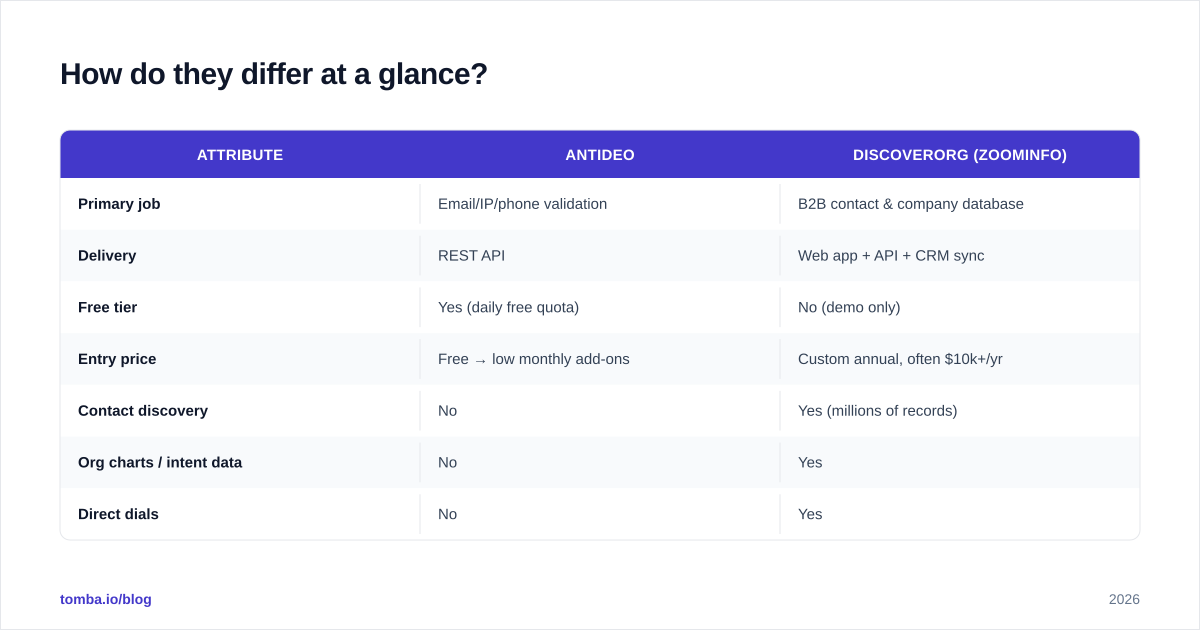
The table makes the gap obvious. Antideo wins on cost and simplicity; DiscoverOrg wins on depth and breadth. They rarely compete for the same buyer — but they often show up in the same RFP because someone is trying to figure out "what data tool do we buy?"

Is DiscoverOrg better than Antideo?#
Better at what it does — and far more expensive. DiscoverOrg/
ZoomInfo gives you something Antideo never will: actual people to sell to.
If your team needs to build target-account lists, see who reports to whom, pull direct phone numbers, and layer on buying-intent signals, Antideo is simply the wrong category. DiscoverOrg's data is human-verified and refreshed on a cycle, and its coverage of North American mid-market and enterprise accounts is among the deepest available. Independent buyers consistently rank it near the top on G2's sales intelligence category.
The cost of that depth is real, though:
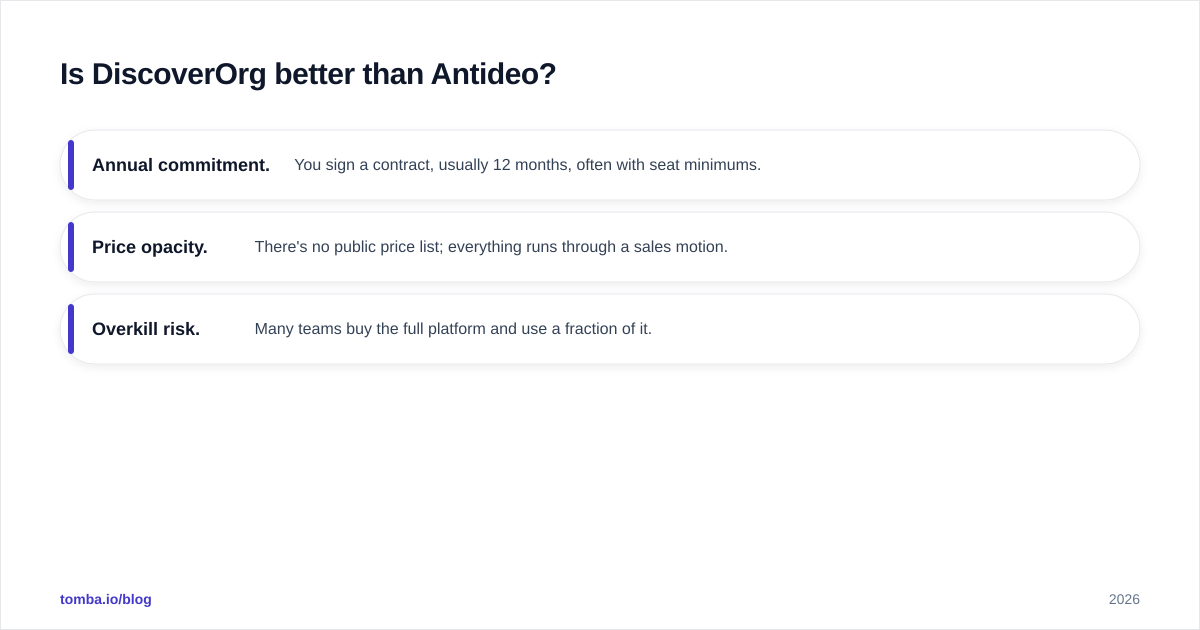
- Annual commitment. You sign a contract, usually 12 months, often with seat minimums.
- Price opacity. There's no public price list; everything runs through a sales motion.
- Overkill risk. Many teams buy the full platform and use a fraction of it.
Antideo, by contrast, will never impress a VP of Sales — because it isn't trying to. It does one narrow thing well and charges almost nothing for it.
Is Antideo better than DiscoverOrg?#
For data hygiene and fraud prevention, yes — and it's not close on price.
If your problem is "junk signups are polluting my database" or "I need to block disposable emails before they hit my CRM," Antideo solves that for free or near-free, with a few lines of code. DiscoverOrg is not built for inline validation at form-submit time; using it for that would be like renting a moving truck to carry a backpack.
Antideo's strengths:
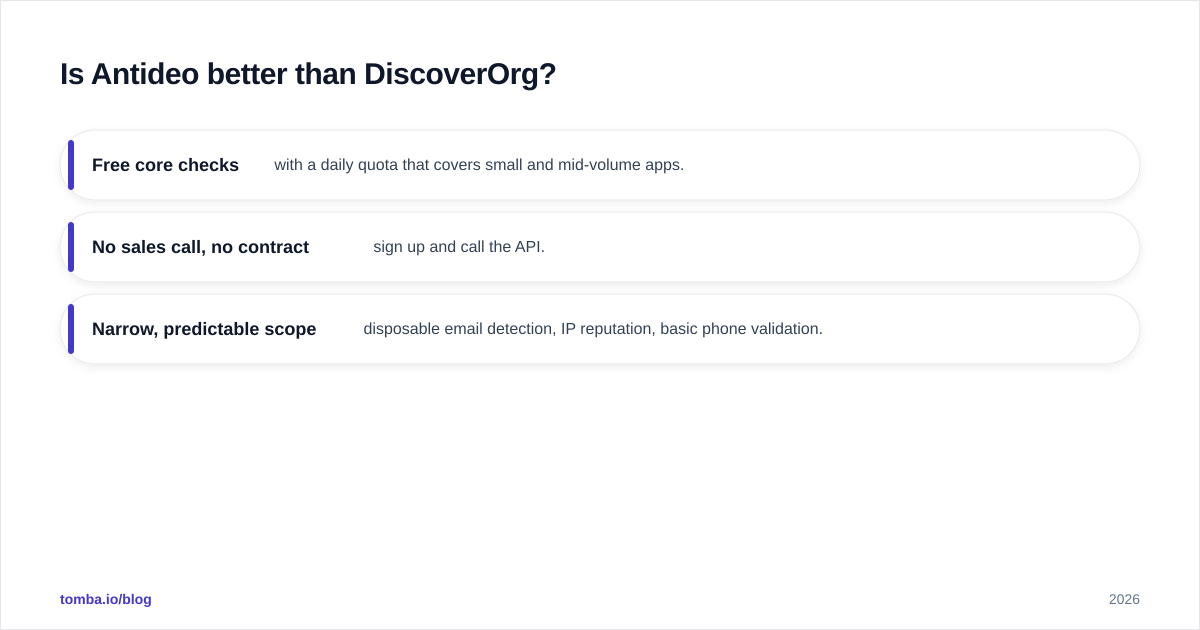
- Free core checks with a daily quota that covers small and mid-volume apps.
- No sales call, no contract — sign up and call the API.
- Narrow, predictable scope — disposable email detection, IP reputation, basic phone validation.
Its limits are equally clear: it doesn't enrich, it doesn't find contacts, and its validation depth is lighter than a dedicated email verifier built for deliverability. If your real goal is protecting cold-email deliverability and sender reputation, a verifier that performs SMTP and catch-all checks will outperform a generic fraud API.
What about accuracy and data freshness?#
This is where the two tools can't be measured on the same yardstick.
DiscoverOrg's accuracy claim is about contact and company data — is this person still the CTO, is this the right direct dial, is this the current tech stack. That data decays fast (B2B contacts churn 25–30% a year), so freshness depends on the vendor's re-verification cadence. ZoomInfo invests heavily here, which is part of what you're paying for.
Antideo's accuracy claim is about a single attribute at a moment in time — is this email disposable right now, is this IP currently flagged. There's no contact record to go stale, so "freshness" means little. The question is only whether its blocklists are comprehensive, and for disposable-domain detection they're solid.
If deliverability is your actual concern, don't rely on a fraud API or a sales database alone. Run addresses through a dedicated verifier and check your sender reputation before you send. Validation that only checks "is this disposable" misses bounces, full mailboxes, and risky catch-all domains — the things that actually wreck a cold campaign.
Where does a tool like Tomba fit between them?#
In the middle — and for most prospecting teams, that middle is the sweet spot.
Neither Antideo nor DiscoverOrg is built for the common job of "find the right person's email at a target company and confirm it's deliverable." Antideo can't find anything; DiscoverOrg can, but at enterprise prices. A focused email-finding platform fills that gap.
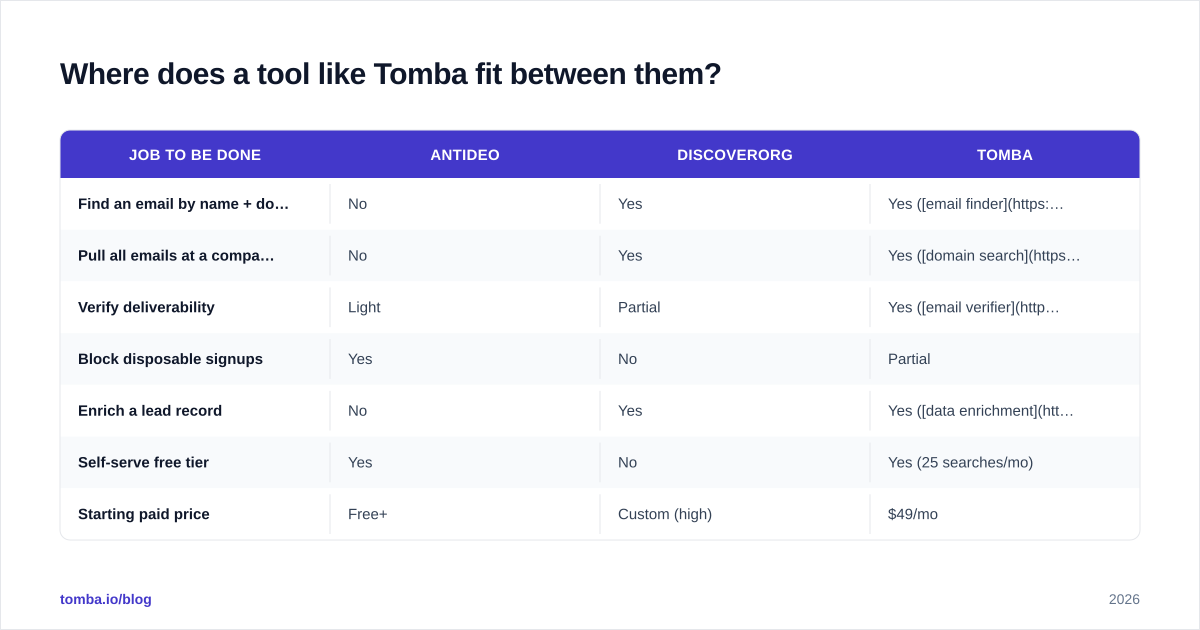
Here's how the three stack up on the jobs a typical SDR or founder actually has:
| Job to be done | Antideo | DiscoverOrg | Tomba |
|---|---|---|---|
| Find an email by name + domain | No | Yes | Yes (email finder) |
| Pull all emails at a company | No | Yes | Yes (domain search) |
| Verify deliverability | Light | Partial | Yes (email verifier) |
| Block disposable signups | Yes | No | Partial |
| Enrich a lead record | No | Yes | Yes (data enrichment) |
| Self-serve free tier | Yes | No | Yes (25 searches/mo) |
| Starting paid price | Free+ | Custom (high) | $49/mo |
Tomba's Tomba pricing is public and self-serve: a free tier with 25 searches a month, then Starter at $49/mo, Growth at $99/mo, Pro at $249/mo, and custom Enterprise. That's a different universe from a DiscoverOrg annual contract, while still doing the contact-discovery work Antideo can't touch. If you're cost-comparing against
ZoomInfo specifically, the Apollo alternative and broader B2B database pages lay out coverage.
The point isn't that Tomba replaces ZoomInfo's intent data or org charts — it doesn't. It's that a large share of teams evaluating DiscoverOrg only need find-and-verify, and are about to overpay by 10x for the rest.
Which one should you choose?#
Match the tool to the actual problem, not the bigger brand name.
Choose Antideo if:
- You're a developer who needs to block disposable emails and flag risky IPs at signup.
- You want a free or near-free API with no contract.
- You do not need to discover or enrich contacts.
Choose DiscoverOrg / ZoomInfo if:
- You run a mid-market or enterprise outbound motion that lives on org charts, direct dials, and intent data.
- You have budget for an annual platform contract and seats.
- Data depth and human verification at scale justify the price.
Choose a middle option like Tomba if:
- Your core need is finding and verifying business emails for outreach.
- You want self-serve, transparent pricing and a free tier to test with.
- You'd rather pay per outcome than sign a five-figure annual deal.
A practical pattern many teams land on: use a finder/verifier for prospecting and hygiene, and only layer on a heavyweight platform like ZoomInfo if and when intent data and org charts become a proven bottleneck. Buying the enterprise platform first, "to be safe," is how data budgets get wasted.
Common questions#
Is DiscoverOrg the same as ZoomInfo? Effectively yes. DiscoverOrg acquired ZoomInfo in 2019 and rebranded under the ZoomInfo name, so current buyers are evaluating the ZoomInfo platform.
Is Antideo really free? The core validation checks have a free daily quota. High volume or premium features move you into paid tiers, but there's a genuine free path with no sales call.
Can Antideo replace an email verifier for cold email? Not reliably. It's tuned for fraud and disposable detection, not deliverability. For campaigns, use a verifier that does MX, SMTP, and catch-all verification.
Do I need both a finder and a verifier? Usually yes — find the address, then verify it before sending. Many platforms, including Tomba, bundle both so you don't stitch two vendors together.
The bottom line#
Antideo and DiscoverOrg aren't rivals so much as bookends: one is a free hygiene API, the other an enterprise data engine. The mistake is treating "which one wins" as the question. The real question is what job you're hiring a tool to do.
If that job is finding verified business emails and enriching leads without an enterprise contract, start with the Tomba Email Finder. You get 25 free searches a month to test accuracy on your own target accounts, transparent $49/mo pricing when you scale, and a built-in verifier so the addresses you find actually land. Try it on ten of your real prospects before you sign anything annual — the comparison makes the decision for you.
Ready to find emails that actually work?
Join 150,000+ professionals who stopped guessing and started sending. Free credits on signup — no credit card required.
Get the Tomba newsletter
Practical outbound tactics and product updates — once every two weeks.
About the author