Best Anymail Finder Alternatives in 2026: Top 7 Compared
Anymail Finder is solid, but its credit model and feature gaps push many teams to look elsewhere. Here are 7 Anymail Finder alternatives compared on accuracy, pricing, and data depth for 2026.

Best Anymail Finder Alternatives in 2026
Anymail Finder built its reputation on a simple promise: you only pay for verified emails. That pay-for-valid model is genuinely good, but it's not the whole story. As prospecting stacks get more demanding — bulk enrichment, phone numbers, catch-all handling, API depth — a lot of teams hit the edges of what Anymail Finder offers and start shopping for something broader or cheaper. This guide compares the seven strongest Anymail Finder alternatives for 2026 so you can match a tool to how you actually prospect.
TL;DR#
- Best overall alternative: Tomba — wider data toolkit (email finder, verifier, domain search, phone finder, enrichment) with a free tier and a $49/mo starter plan.
- Anymail Finder's strength is its verified-only billing; its weakness is a narrow feature set and limited enrichment beyond email.
- If you live in bulk lists, prioritize tools with native bulk processing and a real API, not just a search box.
- Catch-all domains are where most "accuracy" claims fall apart — pick a tool that verifies catch-alls instead of guessing.
- Pricing reality: credit-style billing favors low volume; flat monthly plans favor steady, repeatable outbound.
Why look for an Anymail Finder alternative?#
The short answer: Anymail Finder does one job well, and modern outbound usually needs more than one job done.
Think of Anymail Finder like a great single-blade pocket knife. It cuts cleanly, and if cutting is all you need, you're set. But the moment you also need a screwdriver, scissors, and a bottle opener — phone numbers, data enrichment, catch-all verification, CRM sync — you start wishing you'd brought the full multi-tool.
The most common reasons teams switch:
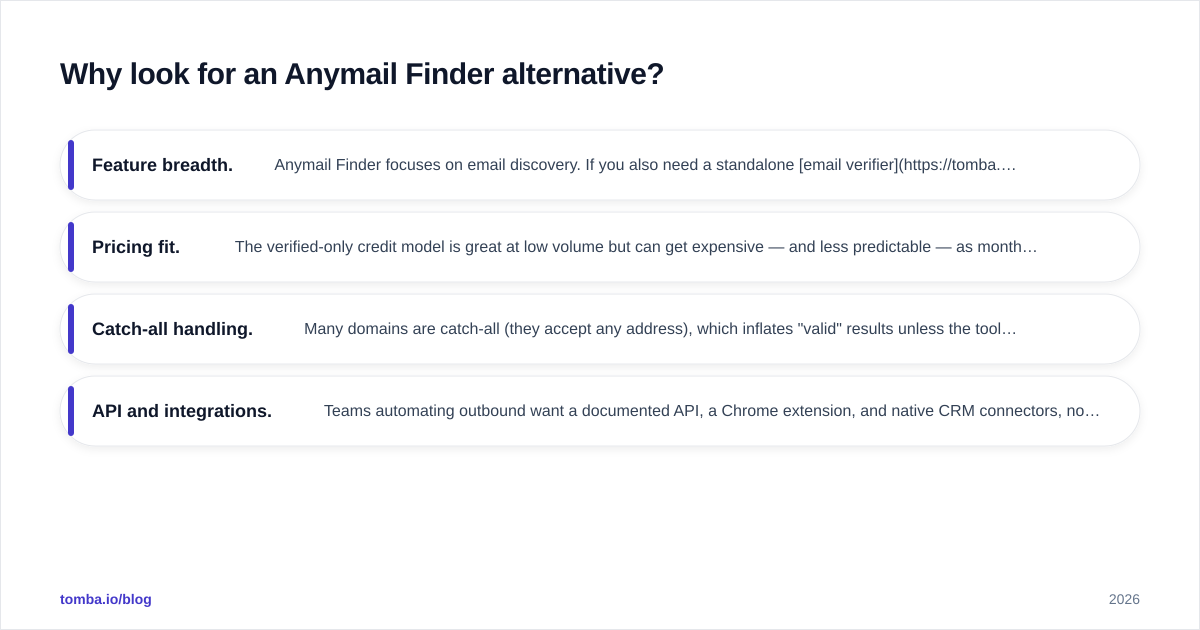
- Feature breadth. Anymail Finder focuses on email discovery. If you also need a standalone email verifier, phone finder, or data enrichment, you end up buying a second tool anyway.
- Pricing fit. The verified-only credit model is great at low volume but can get expensive — and less predictable — as monthly volume climbs.
- Catch-all handling. Many domains are catch-all (they accept any address), which inflates "valid" results unless the tool truly verifies them with a catch-all verifier.
- API and integrations. Teams automating outbound want a documented API, a Chrome extension, and native CRM connectors, not just a web UI.

What should a good email finder actually do?#
Before comparing logos, get clear on the evaluation criteria. An email finder is only as useful as the workflow it plugs into, so judge candidates on the full pipeline — from discovery to deliverability.
The five dimensions that matter:
- Accuracy — what percentage of returned emails are actually deliverable, measured against a real send, not a self-reported number.
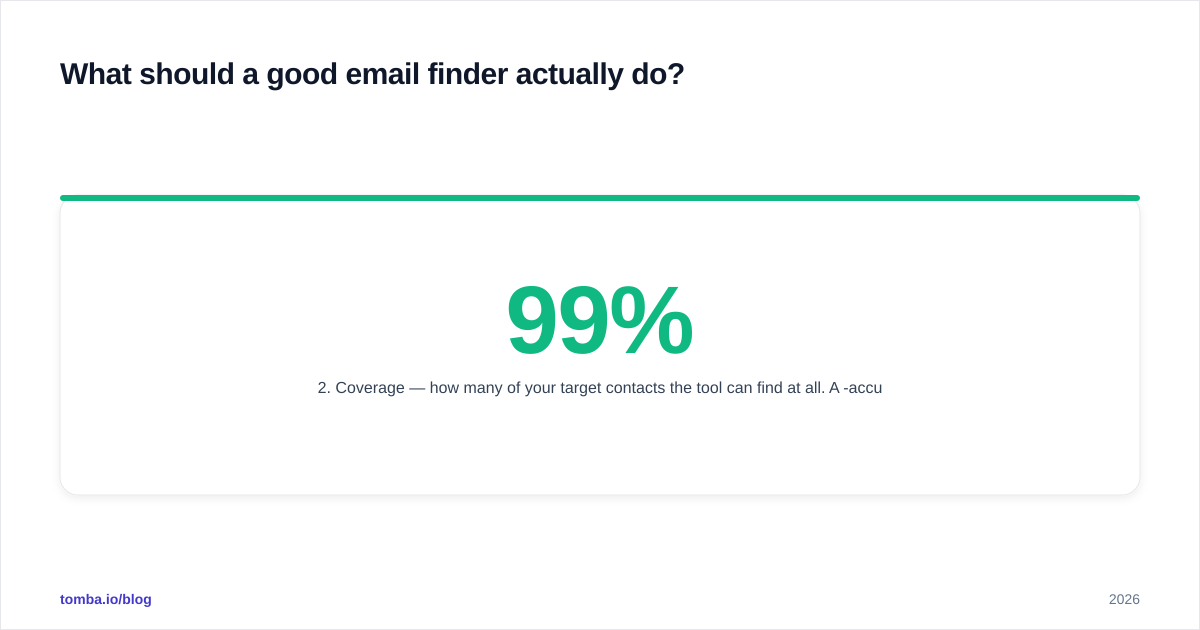
- Coverage — how many of your target contacts the tool can find at all. A 99%-accurate tool that finds 40% of your list is worse than a 95%-accurate tool that finds 80%.
- Verification depth — does it catch-all-test, SMTP-check, and flag risky addresses, or just pattern-guess?
- Data breadth — emails only, or also phone numbers, social profiles, and firmographics for full contact enrichment?
- Workflow fit — API, bulk upload, browser extension, CRM integrations, and pricing that scales the way your team works.
Accuracy gets the headlines, but coverage and verification are where deals are won or lost. A tool that quietly passes catch-all guesses as "valid" will tank your sender reputation faster than one that simply returns fewer, cleaner results.

What are the best Anymail Finder alternatives in 2026?#
Here's the shortlist, then a side-by-side table, then the detail on each.
The seven tools worth evaluating:
- Tomba — broadest toolkit + free tier
- Hunter.io — simple, popular, strong domain search
- Snov.io — finder + outreach sequences in one
- RocketReach — large contact database, B2B focus
- Apollo.io — database-first sales platform
- Findymail — verified-only, niche-friendly
- Clearbit (Breeze) — enrichment-first, enterprise
How do the top Anymail Finder alternatives compare?#
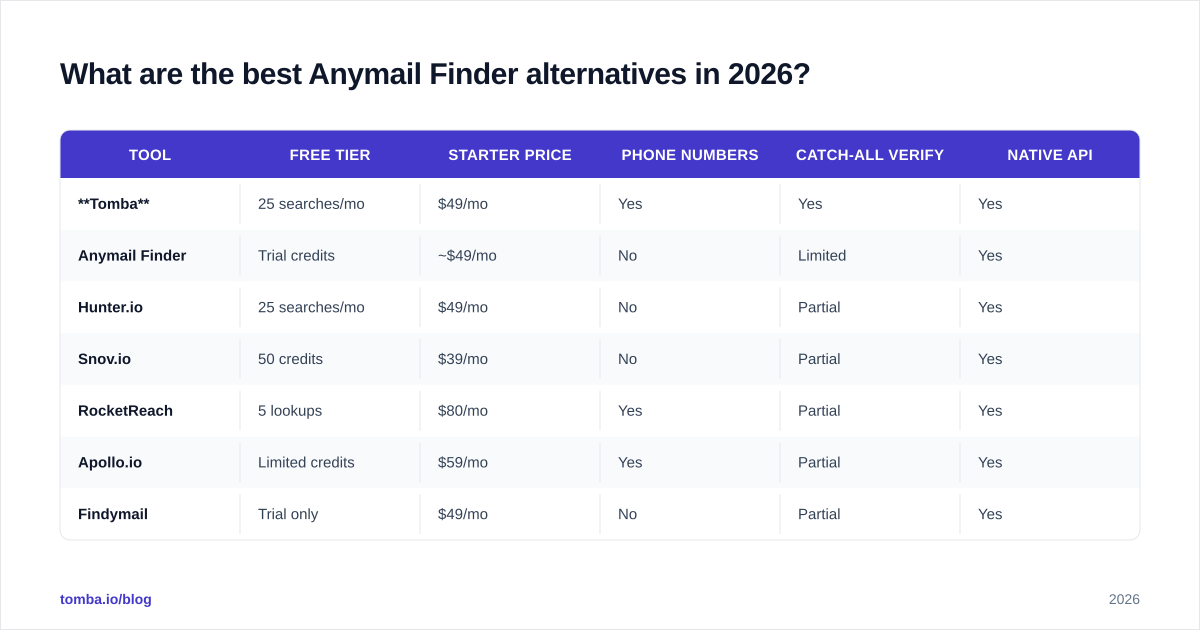
| Tool | Free tier | Starter price | Phone numbers | Catch-all verify | Native API |
|---|---|---|---|---|---|
| Tomba | 25 searches/mo | $49/mo | Yes | Yes | Yes |
| Anymail Finder | Trial credits | ~$49/mo | No | Limited | Yes |
| Hunter.io | 25 searches/mo | $49/mo | No | Partial | Yes |
| Snov.io | 50 credits | $39/mo | No | Partial | Yes |
| RocketReach | 5 lookups | $80/mo | Yes | Partial | Yes |
| Apollo.io | Limited credits | $59/mo | Yes | Partial | Yes |
| Findymail | Trial only | $49/mo | No | Partial | Yes |
Prices and limits shift, so confirm on each vendor's pricing page before you buy. The pattern, though, is stable: tools cluster around a ~$39–$80 entry point, and the real differentiators are phone data, genuine catch-all verification, and how usable the free tier is for testing.
Tomba#
Tomba is the most direct "do more without paying more" swap for Anymail Finder. Where Anymail Finder concentrates on email discovery, Tomba bundles an email finder, verifier, domain search, phone finder, and enrichment under one account — plus a Chrome extension, bulk tools, and a documented email finder API.
- Free tier: 25 searches/month, enough to validate quality before paying.
- Pricing: Starter $49/mo, Growth $99/mo, Pro $249/mo, Enterprise custom — see full Tomba pricing.
- Standout: real catch-all verification and multi-data-type output, so you're not stitching three subscriptions together.
- Watch-out: the sheer number of tools means a slightly steeper first-hour learning curve than a single-box finder.
Hunter.io#
Hunter is the most recognizable name in the category and a sensible Anymail Finder alternative if you mostly do domain-level prospecting. Its domain search is clean, and the free tier matches Tomba's at 25 searches. The trade-off: it's email-only — no phone numbers — and catch-all results can be optimistic.
Snov.io#
Snov.io folds email finding into a light outreach platform, so you can find and sequence in one place. That's handy for small teams that don't want a separate sending tool. Coverage is decent and the entry price is low, but heavy senders often outgrow its deliverability tooling and move to dedicated stacks.
RocketReach#
RocketReach leans on a large contact database and is strong for phone numbers and senior-contact coverage. If your motion is account-based and you need mobile numbers, it's worth a look. Pricing starts higher (~$80/mo), and accuracy varies by region and seniority.

Apollo.io#
Apollo is a database-first sales platform — finder, sequencer, and CRM-lite rolled together. It's a strong pick if you want an all-in-one and don't mind a heavier tool. The flip side is that data accuracy on Apollo's bulk exports is inconsistent, and many teams pair it with a dedicated verifier to clean lists before sending. (If you're weighing that route, see Tomba's take as an Apollo alternative.)
Findymail#
Findymail shares Anymail Finder's verified-only philosophy and is popular in niche outbound communities for clean results. It's email-focused and lacks the broader enrichment toolkit, so it's best as a precise finder rather than a data platform.
Clearbit (Breeze)#
Now part of HubSpot's ecosystem, Clearbit is enrichment-first and aimed at enterprise GTM teams that want firmographic data flowing into HubSpot automatically. It's powerful but priced and scoped for larger orgs — overkill if you mainly need emails. Tomba positions against it directly as a lighter Clearbit alternative.
How do you handle catch-all domains?#
Catch-all domains are the single biggest reason "accuracy" numbers mislead.
A catch-all domain accepts mail to any address — anything@company.com returns "valid" at the SMTP layer even if no such mailbox exists. Tools that don't specifically handle this will happily report a guessed address as deliverable, and you find out it wasn't only when your bounce rate spikes and your domain reputation drops.
The fix is a tool that runs dedicated catch-all logic — pattern confidence scoring plus secondary verification signals — rather than treating an SMTP "accept" as proof. Tomba's catch-all verifier and standalone email verification are built for exactly this, and it's a meaningful gap in several finder-only competitors.
A quick rule of thumb: if a vendor can't tell you how it scores catch-alls, assume it's guessing. Protecting email deliverability is worth more than a slightly higher "found" count.
Which Anymail Finder alternative is right for you?#
Match the tool to the motion:
- Solo founder / low volume: Start on a free tier. Tomba or Hunter both give you 25 searches/month to test real accuracy before spending.
- Steady outbound team: A flat monthly plan beats credit math. Tomba's $49/mo Starter or Snov.io's entry plan keep costs predictable.
- Account-based / need phones: RocketReach or Tomba's phone finder for mobile coverage alongside email.
- All-in-one platform: Apollo if you want sequencing baked in and can tolerate variable data quality.
- Enterprise enrichment into HubSpot: Clearbit, with the budget to match.
- Bulk list builders: Prioritize a real bulk email finder and API so you're not pasting names one at a time.
For most teams leaving Anymail Finder because they've outgrown an email-only tool, the practical winner is the one that covers the next three things you'll need — verification, phones, enrichment — without a second invoice.

How should you test an alternative before switching?#
Don't trust marketing accuracy numbers — run your own 50-contact bake-off.
- Pull 50 real target contacts you can later validate.
- Run the same list through Anymail Finder and one or two candidates.
- Send a small, warmed campaign and measure actual bounce rate, not the tool's claimed validity.
- Note coverage (how many were found at all) and any catch-all flags.
- Compare cost-per-usable-email, not cost-per-search.
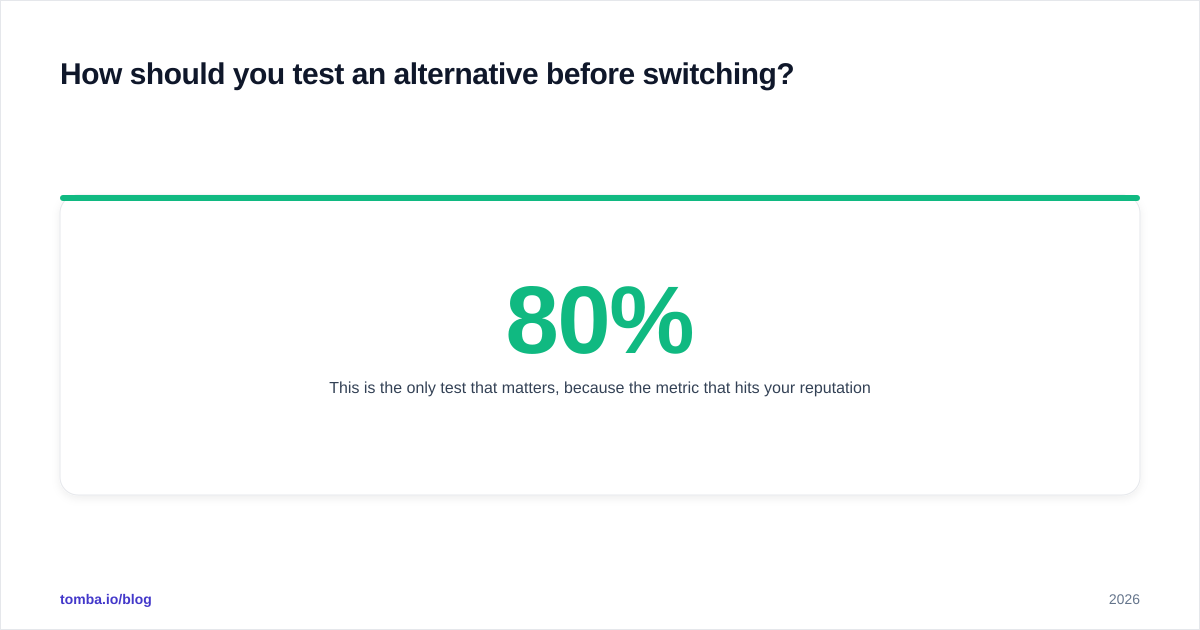
This is the only test that matters, because the metric that hits your reputation is what bounces in production. A tool that finds 80% of your list at a 2% bounce rate beats one that finds 50% at a "guaranteed" 0% — because you can actually reach more people. You can sanity-check any list for free with Tomba's free email checker before committing budget. For broader vendor reviews, cross-reference real user feedback on G2 and Capterra rather than vendor pages alone.
The bottom line#
Anymail Finder isn't a bad tool — it's a focused one. You move on when "find an email" stops being the whole job and you need verification, phone numbers, enrichment, and an API that scales with your outbound. Among the Anymail Finder alternatives here, the broad-toolkit options (Tomba) win for teams consolidating their stack, while finder-only tools (Hunter, Findymail) make sense if you truly only need email discovery.
Ready to test a fuller toolkit without changing how you work? Start with the Tomba Email Finder — find professional emails by name, domain, or company, verify them (including catch-alls), and pull phone and enrichment data from one account. The free tier gives you 25 searches a month to run the 50-contact bake-off above, and the $49/mo Starter plan covers most steady outbound teams. Find the emails, keep your deliverability, and skip the second subscription.
// get started
Find, verify and enrich your first contacts today
Start on the free plan with 25 searches a month, then scale when your team is ready.
Free plan · No credit card required · GDPR & CCPA
// about the author