Anymail Finder vs Clodura.ai 2026: Which Tool Wins?
Anymail Finder vs Clodura.ai compared on accuracy, pricing, data depth, and verification. See which email-finding tool actually fits your 2026 outbound stack.
TL;DR
- Anymail Finder is a focused email-finding tool: paste a name and domain, get a verified email, and pay only for valid results. It does one job and does it cleanly.
- Clodura.ai is a broader sales-intelligence platform — a B2B database, email and direct-dial finder, sequences, and buyer-intent signals bundled together.
- Pick Anymail Finder if you want simple, accuracy-first email lookup. Pick Clodura.ai if you want an all-in-one prospecting suite and can tolerate more complexity.
- On raw email accuracy and transparent verification, single-purpose finders tend to beat platform "finders" that treat email as one feature among many.
- If you want both deep data and high email accuracy without overpaying, a third option like Tomba Email Finder is worth benchmarking before you commit.
When you are choosing between Anymail Finder vs Clodura.ai, you are really choosing between two philosophies: a sharp single-purpose tool versus a wide all-in-one platform. This guide breaks down accuracy, pricing, data depth, verification, and the real-world workflows each one fits — so you can pick on evidence instead of marketing copy.
What is Anymail Finder?#
Anymail Finder is a dedicated email-finding tool built around one promise: you only pay for emails it can verify. You give it a full name plus a company domain (or a domain on its own), and it returns either a "verified" address or nothing — instead of charging you for risky guesses.
Its core strengths:
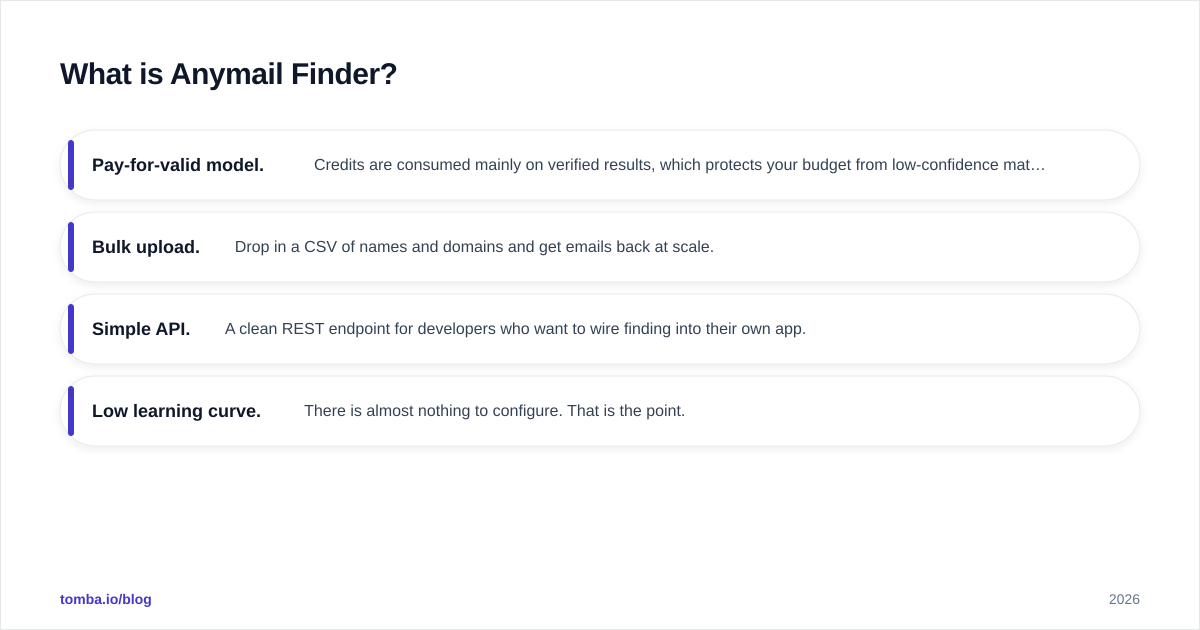
- Pay-for-valid model. Credits are consumed mainly on verified results, which protects your budget from low-confidence matches.
- Bulk upload. Drop in a CSV of names and domains and get emails back at scale.
- Simple API. A clean REST endpoint for developers who want to wire finding into their own app.
- Low learning curve. There is almost nothing to configure. That is the point.
What it deliberately is not: a CRM, a sequence sender, or a buyer-intent engine. Anymail Finder stays in its lane, which is exactly why some teams love it and others find it too narrow.
What is Clodura.ai?#
Clodura.ai is a B2B sales-intelligence platform. Email finding is one module inside a much larger product that also ships a contact database (it advertises hundreds of millions of contacts), direct-dial phone numbers, org charts, buyer-intent and technographic signals, email sequencing, and a built-in cadence tool.
Its core strengths:
- All-in-one prospecting. Build a list, find contact data, and run a sequence without leaving the app.
- Direct dials and org charts. Useful when phone outreach and multi-threading matter.
- Intent and technographics. Surface accounts showing buying signals or running a specific tech stack.
- Free tier with monthly credits. Generous enough to test the waters.
The trade-off is scope. A platform that does eight things rarely does any single one as well as a specialist, and email accuracy is frequently the feature that suffers when "find email" is buried inside a sequencer and an intent dashboard.
Anymail Finder vs Clodura.ai: how do they compare?#
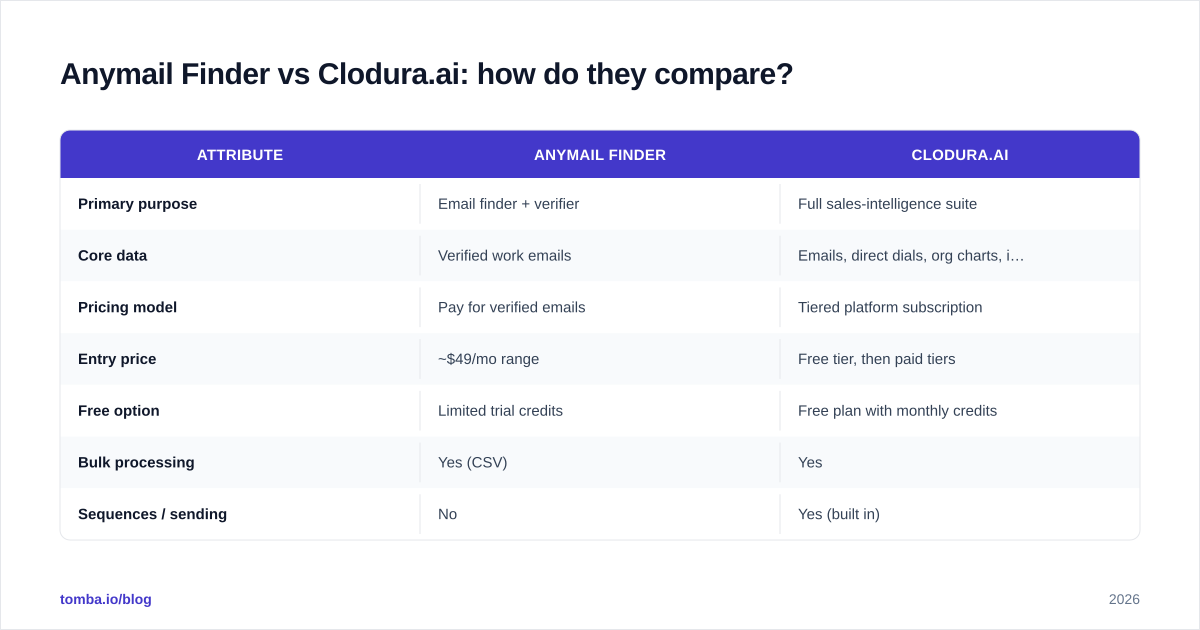
Here is the side-by-side. Prices and limits move over time, so confirm on each vendor's own page before you buy — but the shape of the comparison holds.
| Attribute | Anymail Finder | Clodura.ai |
|---|---|---|
| Primary purpose | Email finder + verifier | Full sales-intelligence suite |
| Core data | Verified work emails | Emails, direct dials, org charts, intent |
| Pricing model | Pay for verified emails | Tiered platform subscription |
| Entry price | ~$49/mo range | Free tier, then paid tiers |
| Free option | Limited trial credits | Free plan with monthly credits |
| Bulk processing | Yes (CSV) | Yes |
| Sequences / sending | No | Yes (built in) |
| Phone numbers | No | Yes (direct dials) |
| API access | Yes | Yes |
| Best for | Accuracy-first email lookup | All-in-one outbound teams |
The headline difference: Anymail Finder is a scalpel, Clodura.ai is a Swiss Army knife. If your only pain is "I need correct email addresses," the scalpel usually wins. If your pain is "I need a whole prospecting workflow in one login," the knife makes sense.
Which one is more accurate?#
Accuracy is the whole game in email finding, because a bounced email does not just waste a credit — it damages your sender reputation and drags down deliverability for every future send.

Two structural factors decide who wins on accuracy:
- Verification depth. Anymail Finder's pay-for-valid model forces it to verify before it bills you, which aligns its incentives with your bounce rate. Platforms that bundle email into a subscription have weaker pressure to confirm every address, because you have already paid the monthly fee.
- Catch-all handling. Roughly 20–30% of business domains are catch-all, meaning the server accepts any address and standard SMTP checks return a false "valid." Tools that flag catch-alls honestly save you from a silent bounce spike. Always check how a vendor labels catch-all results before trusting a green checkmark — a dedicated catch-all verifier exists precisely because this is hard.
In practice, single-purpose finders like Anymail Finder tend to report cleaner, more conservative results, while broad databases like Clodura.ai trade some precision for sheer volume and breadth of fields. Neither approach is "wrong" — they optimize for different things. Run your own test on 100 known contacts before you scale either one.
For a deeper methodology on testing this yourself, see how vendors document where their data comes from, and cross-check any claim against third-party reviews on G2.
How does pricing compare?#
Pricing is where the two diverge most, because they are not really selling the same thing.
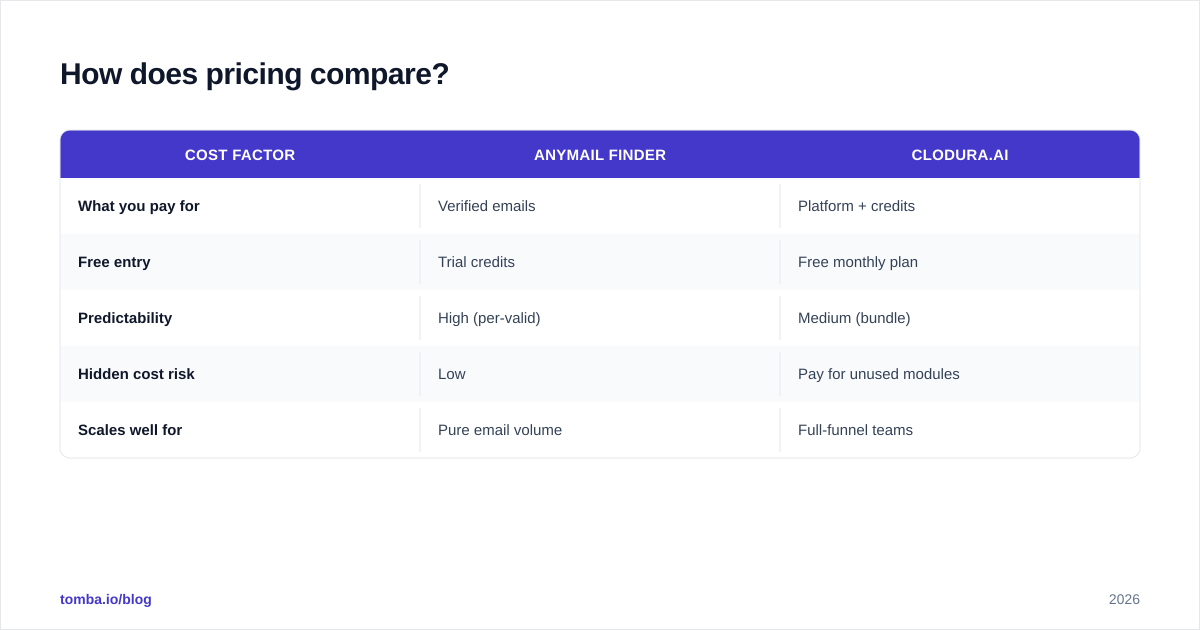
Anymail Finder charges around the $49/mo range for entry usage and bills primarily on verified results. That model is predictable: you roughly know your cost per valid email, and you are not paying for misses.
Clodura.ai sells a platform subscription. There is a free plan with a monthly credit allowance, then paid tiers that unlock more credits, sequences, direct dials, and intent data. You are buying a workflow, so the price reflects the bundle — not the cost of a single email.
| Cost factor | Anymail Finder | Clodura.ai |
|---|---|---|
| What you pay for | Verified emails | Platform + credits |
| Free entry | Trial credits | Free monthly plan |
| Predictability | High (per-valid) | Medium (bundle) |
| Hidden cost risk | Low | Pay for unused modules |
| Scales well for | Pure email volume | Full-funnel teams |
The honest framing: if you only need emails, paying for a full sales-intelligence suite means subsidizing modules you may never open. If you need the whole suite anyway, Clodura.ai's bundle can be cheaper than buying a finder, a dialer, and a sequencer separately. Map the tools to what you actually use.
For a transparent, usage-based comparison point, the published Tomba pricing tiers — Free (25 searches), Starter $49/mo, Growth $99/mo, Pro $249/mo — give you a clean baseline to measure both contenders against.
Which tool fits which team?#
Match the tool to the job, not the hype.
Choose Anymail Finder if you:
- Already have a CRM and sequencer you like, and just need a reliable email finder to feed them.
- Care more about low bounce rates than about breadth of fields.
- Want predictable, pay-for-valid costs.
- Run bulk lookups from a clean list of names and domains.
Choose Clodura.ai if you:
- Are starting from scratch and want database, dialer, and sequences in one login.
- Sell into accounts where direct dials and org charts matter.
- Want buyer-intent and technographic signals baked in.
- Prefer one vendor invoice over a stitched-together stack.
What about verification and list hygiene?#
Whichever tool you pick, finding the email is only half the workflow. Before any address enters a campaign, it should pass an independent verification pass — ideally from a tool that did not also find it, so you get a second opinion.
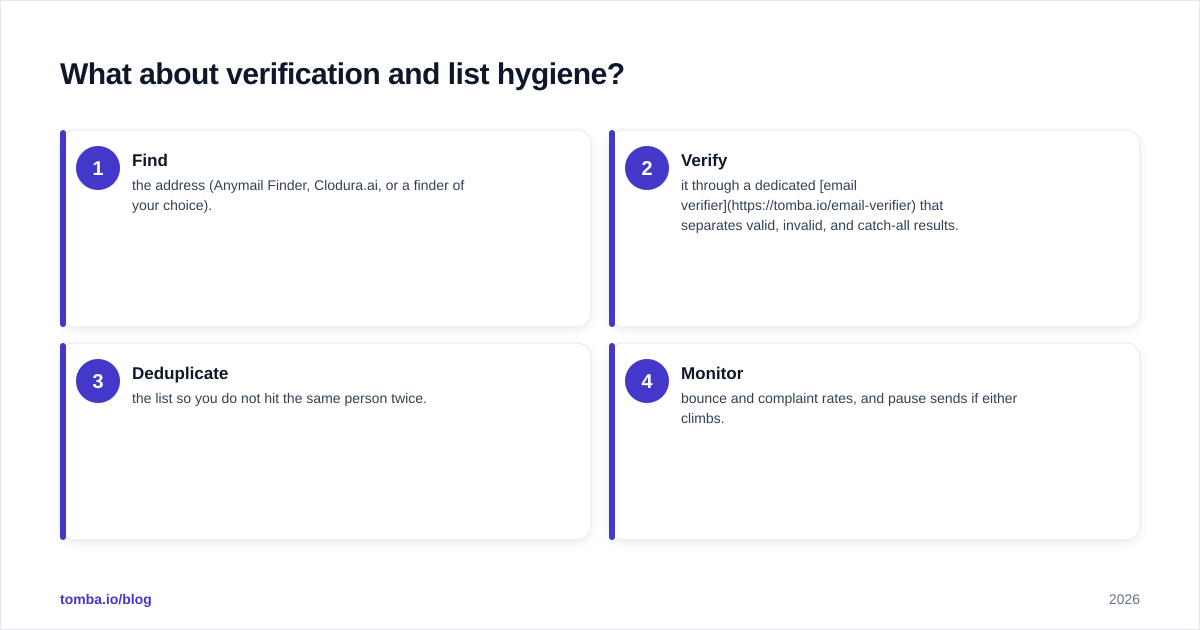
A solid hygiene routine looks like this:
- Find the address (Anymail Finder, Clodura.ai, or a finder of your choice).
- Verify it through a dedicated email verifier that separates valid, invalid, and catch-all results.
- Deduplicate the list so you do not hit the same person twice.
- Monitor bounce and complaint rates, and pause sends if either climbs.
This matters because email deliverability is cumulative. A single dirty import can land your domain on a blocklist that takes weeks to escape. Treating verification as a separate, deliberate step — rather than trusting any one finder's internal checkmark — is the cheapest insurance you can buy.
Is there a stronger alternative to both?#
Often, yes — because the real choice is rarely binary. The weakness of Anymail Finder is narrow scope; the weakness of Clodura.ai is diluted email accuracy. A finder that combines deep data sources with accuracy-first verification closes both gaps.
Below is how the email-finding category stacks up when you put accuracy, data depth, and price side by side.

Tomba sits in that middle ground: a specialist email-finding engine with transparent verification, plus adjacent tools — domain search, bulk email finder, catch-all verification, and data enrichment — so you get platform breadth without sacrificing per-email precision. It is also a common landing spot for teams shopping for an Apollo alternative or a leaner replacement for heavier suites.
The point is not that one logo always wins. The point is to benchmark all three on your list, with your domains, and let the bounce rate decide.
How should you actually run the test?#
Stop reading reviews and run a 30-minute bake-off:
- Pull 100 contacts you already know the correct email for (your CRM is full of them).
- Strip the emails, keep names and domains.
- Run the list through each tool.
- Score: match rate, accuracy against the known answer, catch-all honesty, and cost per verified email.
- Pick the winner on numbers, not narrative.
This single exercise tells you more than any comparison article — including this one — because it uses your industry, your geographies, and your data shape. Vendors optimize for different segments; only your own list reveals which one optimized for yours.
Final verdict#
Anymail Finder vs Clodura.ai comes down to focus versus breadth. Anymail Finder is the better pure email finder: accurate, predictable, and refreshingly simple. Clodura.ai is the better all-in-one platform: more data types, sequences, and intent signals under one roof, at the cost of some email precision and added complexity.
If your stack already has a sequencer and CRM, lean toward a specialist finder. If you are building outbound from zero and want one tool to rule the funnel, the platform play makes sense. Either way, verify before you send and test on your own list first.
Ready to benchmark a precision-first option against both? Start with the Tomba Email Finder — search by name, company, or domain, verify in the same workflow, and measure the bounce rate yourself on the free tier before you spend a dollar. The right tool is the one your own data votes for.
Ready to find emails that actually work?
Join 150,000+ professionals who stopped guessing and started sending. Free credits on signup — no credit card required.
Get the Tomba newsletter
Practical outbound tactics and product updates — once every two weeks.
About the author