Apollo Contact Database in 2026: Size, Accuracy & Limits
Apollo claims 200M+ contacts, but raw size isn't accuracy. Here's how the Apollo contact database actually performs in 2026 — coverage, decay, pricing, and when to verify before you send.
TL;DR
- The Apollo contact database is one of the largest in B2B — 200M+ contacts and 60M+ companies — but database size and database accuracy are not the same metric, and conflating them costs you deliverability.
- Crowd-sourced and scraped records decay fast: roughly 25-30% of B2B contact data goes stale every year as people change jobs, so a "verified" Apollo record can be wrong by the time you send.
- Apollo is strongest as an all-in-one prospecting platform (search + sequences + dialer); it's weaker when you need surgical, just-in-time email accuracy for a specific domain.
- For high-stakes outbound, treat Apollo as a discovery layer and run every address through a dedicated email verifier before it touches your sequencer.
- If your real need is "find and confirm emails for this list of people," a focused email finder like Tomba is cheaper and more accurate than paying for a full sales-intelligence suite.
What is the Apollo contact database?#
Apollo.io is a sales-intelligence platform, and its contact database is the asset everything else is built on. At its core it's a giant directory of people and companies — names, job titles, work emails, phone numbers, LinkedIn URLs, company size, tech stack, funding, and intent signals — that you can filter and export into sequences.
The headline numbers are big: Apollo markets over 200 million contacts and more than 60 million companies, assembled from public web data, third-party licensed datasets, and a community contribution model where users' connected inboxes and activity help refresh records. You can read the current claims on the Apollo.io homepage and cross-check user sentiment on G2.
The important mental model: Apollo is a database-plus-workflow product. You're not just buying records, you're buying search filters, a Chrome extension, email sequencing, a dialer, and CRM enrichment around those records. That bundle is the real pitch — and the real reason the pricing is what it is.
How big and how accurate is the Apollo contact database?#
Big. The accuracy question is where it gets honest.
Raw count is the easy part — 200M+ contacts is genuinely one of the largest pools in the category. But three things separate a large database from a usable one:
- Coverage for your ICP. A database can have 200M records and still be thin for German mid-market manufacturers or Japanese SaaS founders. Volume skews heavily toward US tech.
- Freshness. B2B contact data decays at roughly 25-30% per year. People change roles, companies rebrand, domains migrate. A record marked "verified" six months ago is a coin flip today.
- Email validity at send time. Apollo flags emails as verified or guessed. "Verified" means it passed a check when it was checked — not necessarily now, and catch-all domains slip through as "verified" far more often than they should.
This is why experienced teams don't send straight from any aggregated database. The pattern that works is discover in the database, then confirm with a live check. Catch-all domains in particular need a dedicated catch-all verifier because standard SMTP checks return "accept all" and tell you nothing.
Where does Apollo's data come from?#
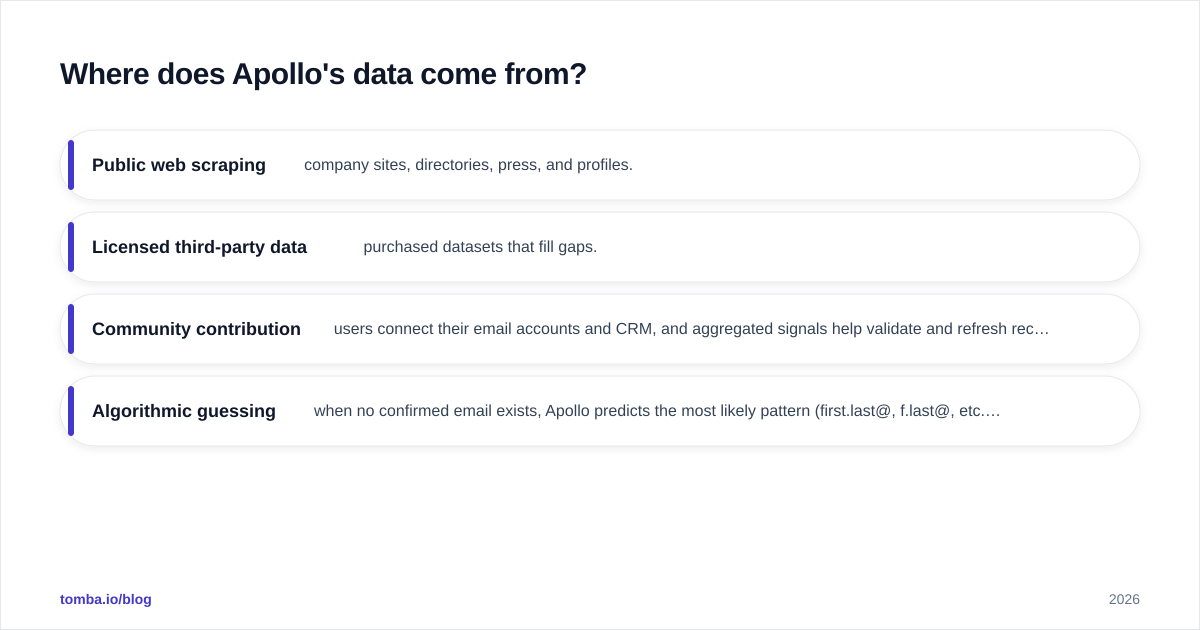
Apollo's database is assembled from a mix of sources, and understanding the mix tells you where to trust it and where to double-check.
- Public web scraping — company sites, directories, press, and profiles.
- Licensed third-party data — purchased datasets that fill gaps.
- Community contribution — users connect their email accounts and CRM, and aggregated signals help validate and refresh records.
- Algorithmic guessing — when no confirmed email exists, Apollo predicts the most likely pattern (first.last@, f.last@, etc.).
That last bucket is the one to watch. A guessed email is a permutation, not a confirmation. It might be right, but sending to it untested is how you rack up bounces and damage sender reputation. If you want to understand how a dedicated provider sources and confirms records instead of guessing, compare it against how Tomba documents its data sources.
How should you evaluate any B2B contact database?#
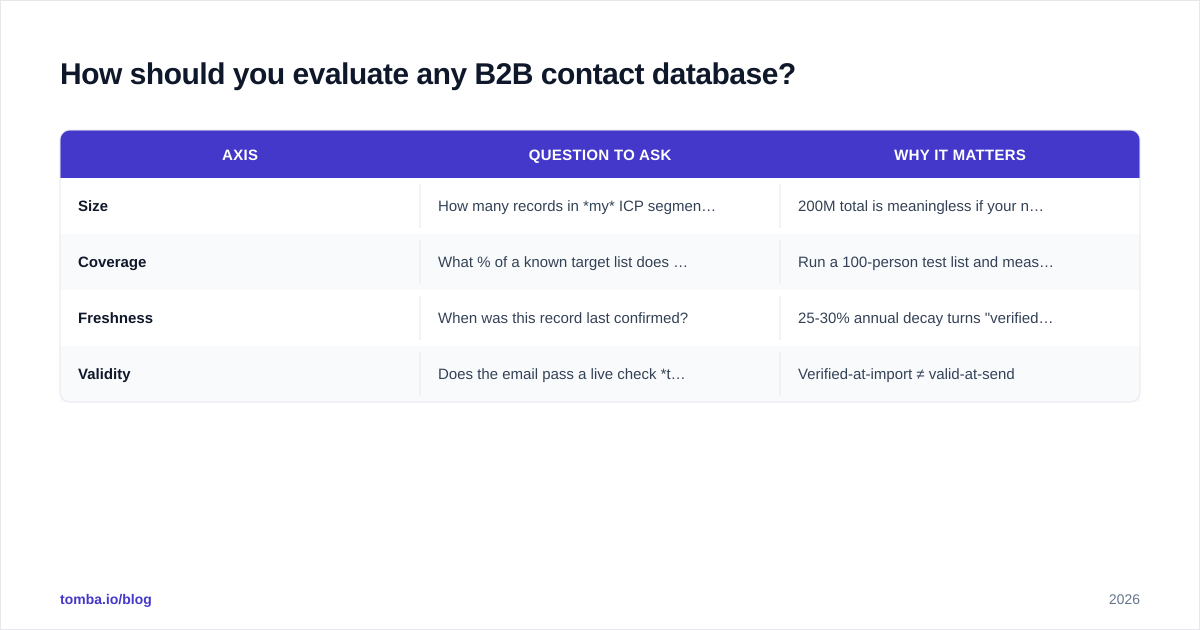
Use a four-axis framework instead of trusting the marketing count. Score each axis for your specific use case, not in the abstract.
| Axis | Question to ask | Why it matters |
|---|---|---|
| Size | How many records in my ICP segment? | 200M total is meaningless if your niche has 4,000 |
| Coverage | What % of a known target list does it return? | Run a 100-person test list and measure hit rate |
| Freshness | When was this record last confirmed? | 25-30% annual decay turns "verified" stale fast |
| Validity | Does the email pass a live check today? | Verified-at-import ≠ valid-at-send |
The practical test: take a real list of 100 prospects you already know, run it through the database, and measure how many it finds and how many survive a fresh verification pass. That single experiment tells you more than any vendor benchmark. Do the same test across two or three providers and you have a real decision.
Apollo contact database vs. a dedicated email finder#
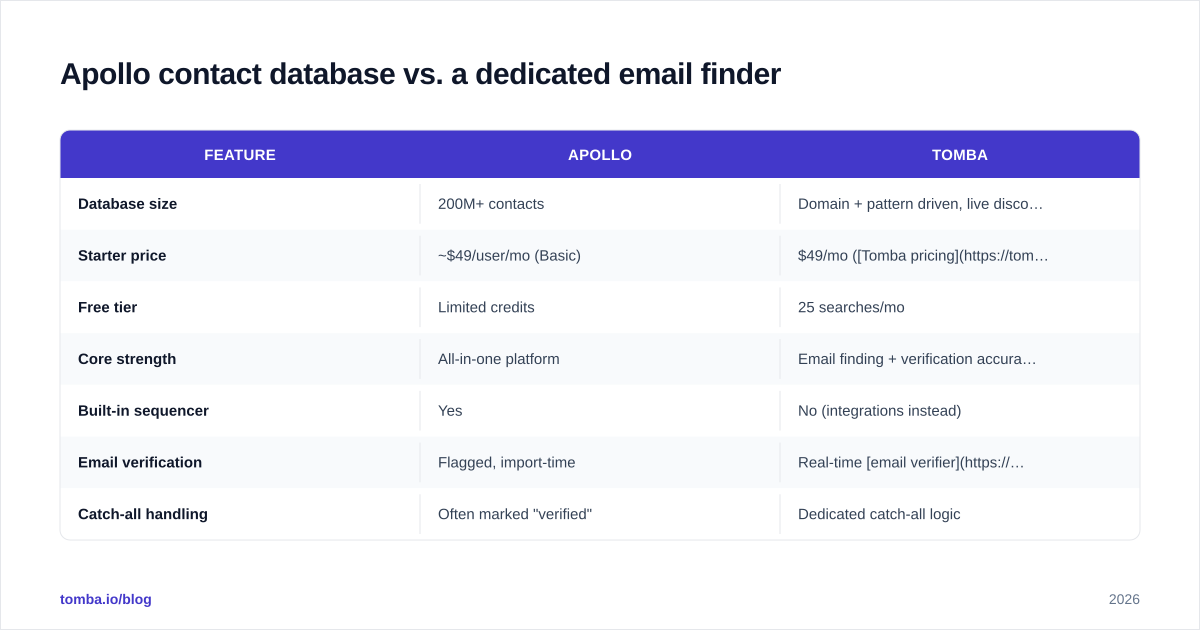
Apollo and a focused email finder solve overlapping but different problems. Apollo wants to be your whole prospecting motion. A tool like Tomba wants to find and confirm the right email for a specific person or domain — and do it more accurately because that's the only job.
| Feature | Apollo | Tomba |
|---|---|---|
| Database size | 200M+ contacts | Domain + pattern driven, live discovery |
| Starter price | ~$49/user/mo (Basic) | $49/mo (Tomba pricing) |
| Free tier | Limited credits | 25 searches/mo |
| Core strength | All-in-one platform | Email finding + verification accuracy |
| Built-in sequencer | Yes | No (integrations instead) |
| Email verification | Flagged, import-time | Real-time email verifier |
| Catch-all handling | Often marked "verified" | Dedicated catch-all logic |
| Bulk workflows | Export + sequence | Bulk email finder + API |
The honest read: if you want one tool to discover, sequence, and dial, Apollo's bundle is compelling. If your bottleneck is email accuracy — you already have a sequencer, a CRM, and a list of targets — then paying for a full suite to get addresses is overkill, and a finder plus verifier will give you cleaner data per dollar. Plenty of teams run both, using Apollo to discover and a finder to confirm. If you're actively shopping the suite category, the Apollo alternative breakdown lays out the trade-offs in detail.
What are the Apollo contact database's biggest limitations?#
Four limits show up repeatedly in real usage.
1. "Verified" doesn't mean valid today. The verification flag is a snapshot. By the time you export and send, the snapshot may be weeks or months old. Always re-verify before a campaign.
2. Catch-all domains slip through. Many corporate domains accept all mail at the SMTP layer, so they can't be confirmed by a standard check. Apollo frequently marks these optimistically. You need explicit catch-all verification to avoid sending into a black hole.
3. Credit math gets expensive at scale. Export and enrichment credits are the real cost driver. Heavy enrichment users routinely blow through plan limits, and per-seat pricing compounds it for larger teams.
4. Coverage is uneven. Strong on US tech and mid-market; thinner outside it. EMEA, APAC, and non-English markets have more gaps and more decay.
None of these make Apollo a bad product — they make it a database that, like every aggregated database, needs a verification step downstream. The mistake is treating any export as send-ready.
How do you actually use the Apollo contact database well?#
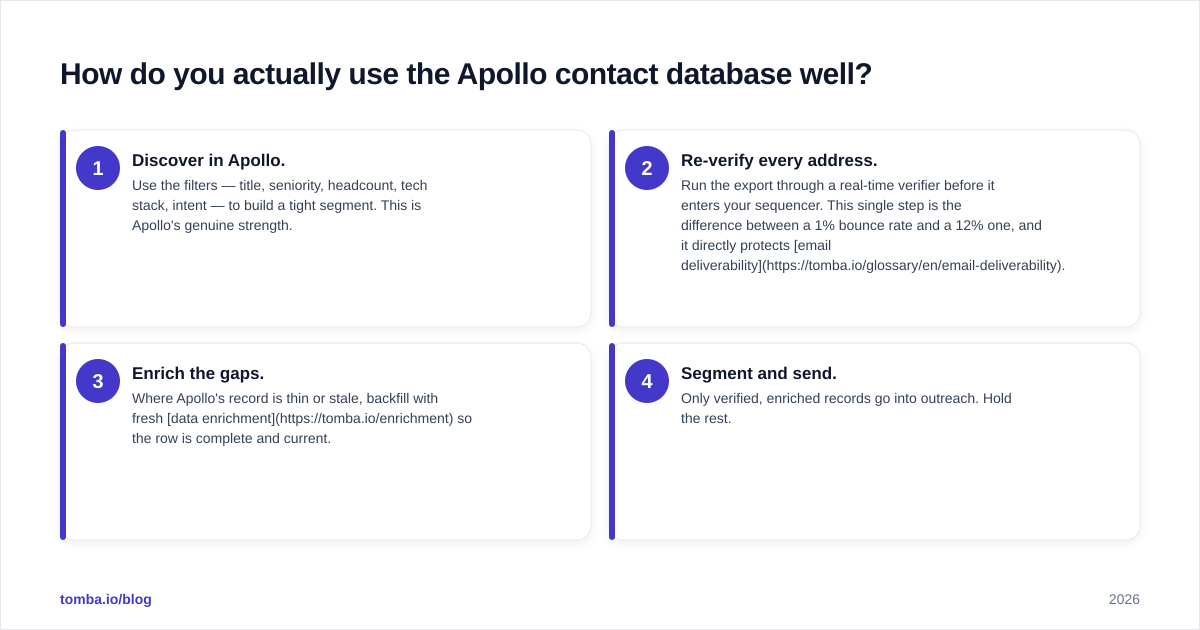
The teams that get value follow a discover → verify → enrich → send pipeline rather than export-and-blast.
- Discover in Apollo. Use the filters — title, seniority, headcount, tech stack, intent — to build a tight segment. This is Apollo's genuine strength.
- Re-verify every address. Run the export through a real-time verifier before it enters your sequencer. This single step is the difference between a 1% bounce rate and a 12% one, and it directly protects email deliverability.
- Enrich the gaps. Where Apollo's record is thin or stale, backfill with fresh data enrichment so the row is complete and current.
- Segment and send. Only verified, enriched records go into outreach. Hold the rest.
This pipeline also future-proofs you against vendor lock-in. When discovery and verification are separate steps, you can swap the database without rebuilding your whole motion.
Is the Apollo contact database worth it in 2026?#
Conclusion first: yes, if you want an all-in-one prospecting platform and you commit to verifying before you send. No, if your only real need is accurate emails for known targets — in that case a finder plus verifier is cheaper and cleaner.
Apollo's database remains one of the largest and most filterable in the market, and for teams that want discovery, sequencing, and dialing in one place, the bundle earns its price. The catch — true of every aggregated database, not just Apollo — is that size is not accuracy, and "verified" is not "valid today." Build the verification step into your process and Apollo becomes a strong discovery engine. Skip it and you'll pay in bounces and a damaged sender reputation that takes months to rebuild.
For more on how contact data ages and what to do about it, the data-decay research summarized across vendor docs and Wikipedia's overview of data quality is a useful neutral primer before you commit budget.
The bottom line#
Treat the Apollo contact database as a starting point, not a finish line. Discover broadly, then confirm surgically. If your bottleneck is finding and verifying the right email for real people at real companies — without paying for a full suite you won't fully use — start with the Tomba Email Finder. It's built for one job: returning accurate, verifiable addresses by name, company, or domain, with a free tier to test on your own list and a $49/mo starter plan when you scale. Run your next 100-prospect list through both, compare the verified hit rate, and let the numbers decide.
Ready to find emails that actually work?
Join 150,000+ professionals who stopped guessing and started sending. Free credits on signup — no credit card required.
Get the Tomba newsletter
Practical outbound tactics and product updates — once every two weeks.
About the author