Apollo Email Finder Review 2026: Accuracy, Pricing & Alternatives
Is the Apollo email finder worth it in 2026? We break down its accuracy, credit pricing, catch-all handling, and the alternatives worth testing.
The Apollo email finder is one of the most-used contact tools in B2B sales, but "most-used" and "most accurate" are not the same thing. If you are paying for credits that get burned on guessed, unverified, or risky catch-all addresses, your bounce rate and your sender reputation pay the bill — not Apollo.
This review is a neutral teardown of what the Apollo email finder actually does well in 2026, where it falls short, how its pricing really works once you scale, and which alternatives are worth a side-by-side test before you commit a year of budget.
TL;DR#
- Apollo is a database-first platform, not a pure finder. You get emails plus a CRM, sequencer, and dialer — great if you want one tool, heavier than you need if you only want clean emails.
- Accuracy is solid on well-known company domains but drops on SMBs, non-US contacts, and catch-all domains, where Apollo often returns "likely" guesses without strong verification.
- Credit pricing gets expensive at volume, and export/credit caps on lower tiers surprise teams that scale outreach fast.
- The real cost of low accuracy is deliverability — every bad email you send raises bounce rate and erodes sender reputation.
- If your only job is finding and verifying B2B emails, a focused finder like the Tomba Email Finder is usually cheaper and more accurate per valid contact.
What is the Apollo email finder?#
Apollo.io is a go-to-market platform built around a large B2B contact database (Apollo claims hundreds of millions of contacts). The email finder is one feature inside that platform: you search for a person or company, and Apollo returns a work email pulled from its database or inferred from the company's known email pattern.
Think of Apollo like a supermarket with its own warehouse. The email finder is the produce aisle — fresh enough on popular items, but quality varies on the long-tail stock that turns over slowly. Because Apollo's emails come from a static database plus pattern inference, freshness depends on how recently that record was updated and how confidently the pattern was verified.
That architecture matters. A database-first finder is fast and cheap when the record already exists. It struggles when the contact is new, niche, or sits on a domain that hides its real mailbox behind a catch-all.
How accurate is the Apollo email finder in 2026?#
Accuracy is the only metric that matters, because a "found" email that bounces is worse than no email at all. Here is the honest picture: Apollo performs well on large, well-documented companies and US-based contacts, and noticeably worse on small businesses, international domains, and catch-all setups.
Two factors drag Apollo's real-world hit rate down:
- Pattern guessing without hard verification. When Apollo doesn't have a confirmed address, it can return
firstname.lastname@company.combased on the domain's dominant pattern. That guess is often right, but "often" is not "verified," and it is your bounce rate on the line. - Catch-all blind spots. Many B2B domains accept every address at the SMTP layer, so a server check returns "valid" for mailboxes that don't exist. Finders that don't run a dedicated catch-all verifier over-report these as deliverable.
Before you trust any provider's marketing number, test it against your own list and measure bounce rate in your sending tool. Independent reviews on G2 echo the same pattern: strong on enterprise data, weaker on the SMB and international long tail.

How much does the Apollo email finder cost?#
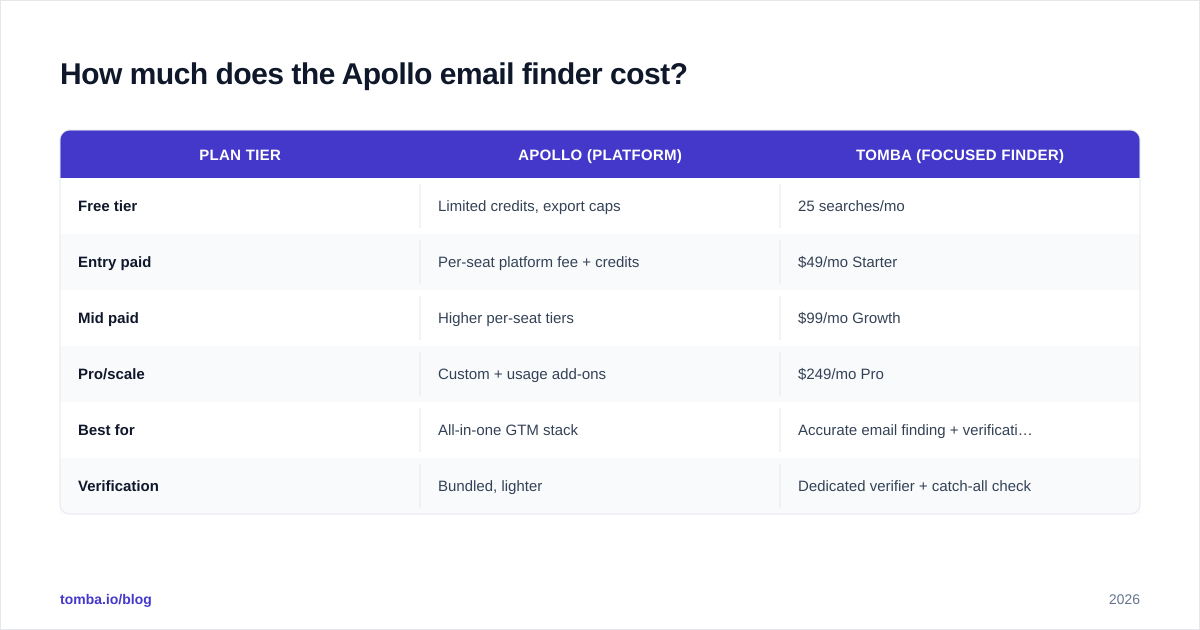
Apollo uses a credit model layered on subscription tiers. The headline prices look approachable, but the constraints — export caps, credit rollover rules, and per-seat costs — are where teams get surprised at scale. Always read Apollo's current pricing page before budgeting, since tier limits change.
The bigger question is cost per valid email, not cost per credit. If a cheaper credit returns a guessed address that bounces, you paid for the credit, the bounce, and the reputation damage.
Here is how a focused finder's pricing compares so you can model both:
| Plan tier | Apollo (platform) | Tomba (focused finder) |
|---|---|---|
| Free tier | Limited credits, export caps | 25 searches/mo |
| Entry paid | Per-seat platform fee + credits | $49/mo Starter |
| Mid paid | Higher per-seat tiers | $99/mo Growth |
| Pro/scale | Custom + usage add-ons | $249/mo Pro |
| Best for | All-in-one GTM stack | Accurate email finding + verification |
| Verification | Bundled, lighter | Dedicated verifier + catch-all check |
For the exact, current Tomba numbers, see the Tomba pricing page. The takeaway: if you want the whole sales stack, Apollo's bundle can be worth the spend; if you want clean, verified emails at the lowest cost per valid contact, a dedicated finder usually wins.
Is Apollo better than a dedicated email finder?#
It depends on what job you are hiring the tool to do. Apollo is better when you want one platform to find contacts, sequence them, dial them, and log activity in a built-in CRM. A dedicated finder is better when accuracy, verification depth, and cost-per-valid-email are your priorities.
The trade-off is focus versus breadth:
- Apollo (breadth): database + CRM + sequencer + dialer. Fewer tools to manage, but each piece is "good enough" rather than best-in-class, and you pay for features you may not use.
- Dedicated finder (focus): finds and verifies emails, then hands clean data to whatever sequencer or CRM you already run. Less lock-in, lower cost per contact, and typically stronger verification.
This is why many teams run both: Apollo (or another database) for discovery, and a finder + email verifier as the quality gate before anything hits the sending tool.
What are the best Apollo email finder alternatives in 2026?#
If Apollo's accuracy on your target segment is weak, or the platform is more than you need, several alternatives are worth a real test. Don't switch on a review alone — run the same 100 contacts through each and compare verified hit rate and bounce rate.
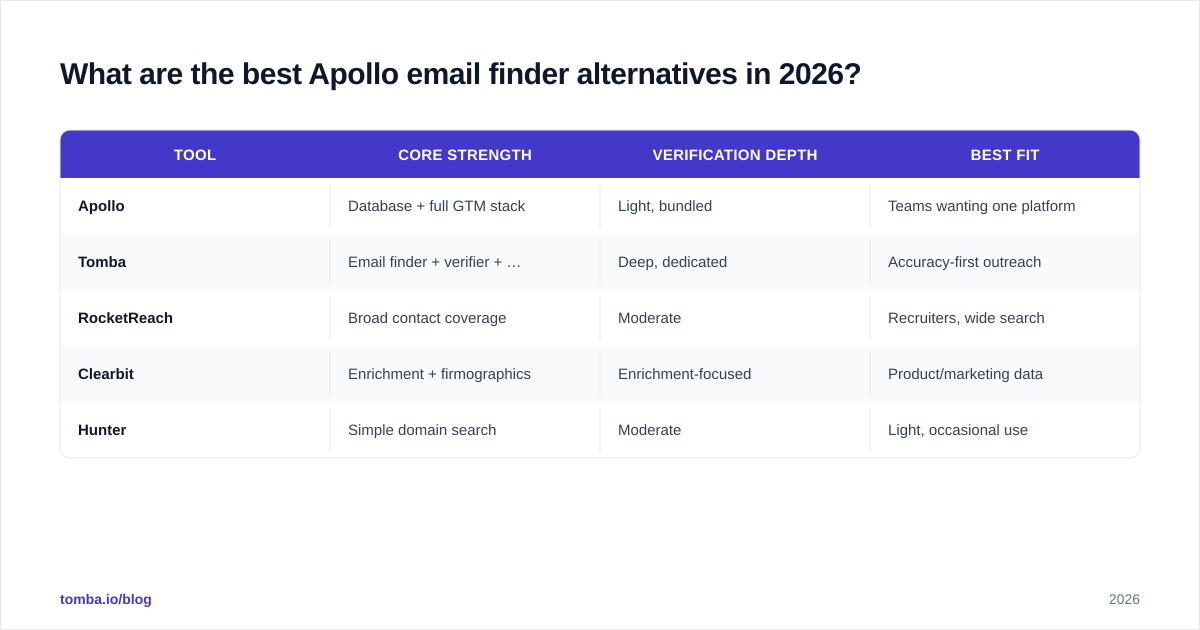
| Tool | Core strength | Verification depth | Best fit |
|---|---|---|---|
| Apollo | Database + full GTM stack | Light, bundled | Teams wanting one platform |
| Tomba | Email finder + verifier + catch-all | Deep, dedicated | Accuracy-first outreach |
| RocketReach | Broad contact coverage | Moderate | Recruiters, wide search |
| Clearbit | Enrichment + firmographics | Enrichment-focused | Product/marketing data |
| Hunter | Simple domain search | Moderate | Light, occasional use |
A few notes on picking from this list:
- If you want to replace just the finder while keeping your stack, compare an Apollo alternative head-to-head on a sample list first.
- If your workflow is domain-led ("find everyone at this company"), prioritize a strong domain search feature over raw database size.
- If catch-all domains are common in your market, verification depth should be your top selection criterion — it is the single biggest driver of bounce rate.

How do you verify emails the Apollo email finder returns?#
Treat every found email as a hypothesis until it is verified. The cleanest workflow puts a verification step between discovery and sending, no matter which finder you use.
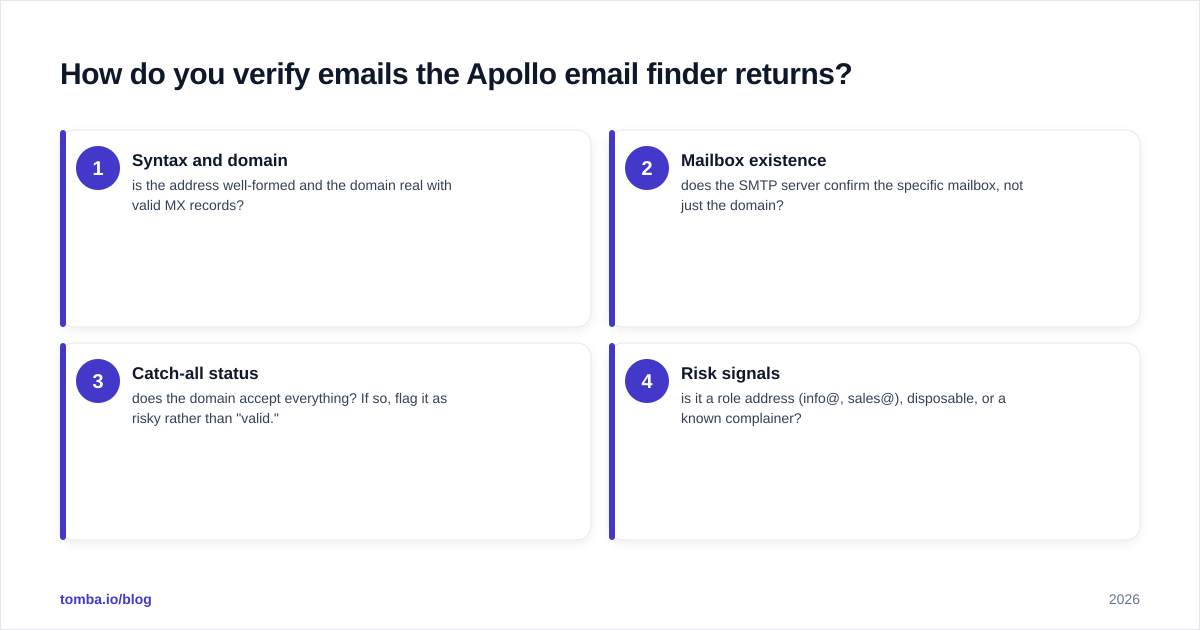
A reliable verification pass checks four things:
- Syntax and domain — is the address well-formed and the domain real with valid MX records?
- Mailbox existence — does the SMTP server confirm the specific mailbox, not just the domain?
- Catch-all status — does the domain accept everything? If so, flag it as risky rather than "valid."
- Risk signals — is it a role address (info@, sales@), disposable, or a known complainer?
Run this in bulk with a bulk email finder workflow before any campaign. The goal is simple: only addresses that pass all four checks go into your sequencer. Everything else gets quarantined or re-found. This single discipline does more for email deliverability than any subject-line tweak ever will.
Does the Apollo email finder hurt deliverability?#
Indirectly, yes — any finder that returns unverified guesses will hurt deliverability if you send to them blindly. Inbox providers track your bounce rate and spam complaints, and a spike in either pushes you toward the spam folder for all recipients, including the good ones.
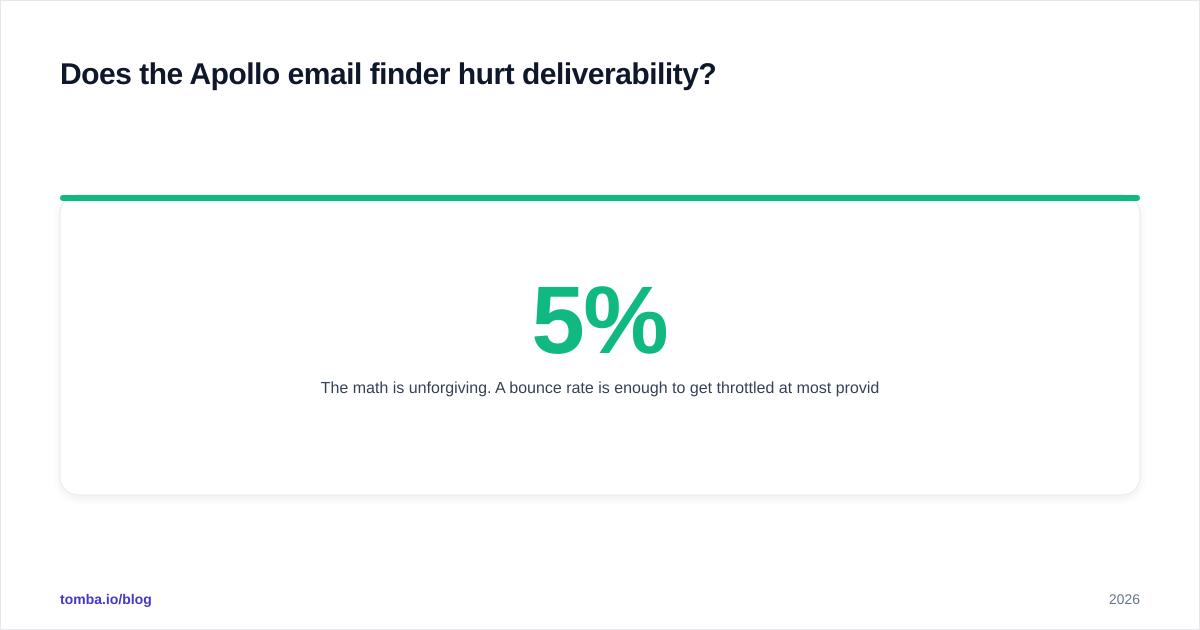
The math is unforgiving. A 5% bounce rate is enough to get throttled at most providers. If your finder reports a 95% "valid" rate but 10% of those are catch-all guesses, you can blow past the safe threshold on your first big send. That is why the verification gate above is not optional — it is the firewall protecting the domain you spent years warming up.
The fix is not to abandon database tools like Apollo; it is to never send what you haven't verified. Discover widely, verify ruthlessly, send conservatively.
Who should use the Apollo email finder?#
Apollo is a strong choice if you check most of these boxes:
- You want a single platform for prospecting, sequencing, dialing, and basic CRM.
- Your targets skew toward larger, US-based companies where Apollo's data is strongest.
- You value workflow consolidation over best-in-class accuracy on every record.
- Your team is fine adding a verification step before high-volume sends.
Apollo is a weaker fit if:
- You only need emails and already have a sequencer/CRM you like.
- Your market is SMB-heavy, international, or full of catch-all domains.
- Cost per valid email is your key metric and you want to minimize wasted credits.
- You need deep, dedicated verification rather than a bundled light check.
In the second scenario, a focused finder paired with your existing stack is almost always leaner and more accurate. You can also enrich whatever you find with data enrichment to fill in titles, company size, and phone numbers without buying a second platform.
The bottom line on the Apollo email finder#
Apollo earns its popularity: it is a capable all-in-one platform with a large database and a smooth workflow for teams that want everything in one login. But if your single most important outcome is clean, verified B2B emails at the lowest cost per valid contact, a dedicated finder will usually beat it on accuracy and price — especially on SMB, international, and catch-all domains where database-first tools fade.
The smart move is not Apollo or a finder; it is testing both on your own list and measuring the only numbers that matter: verified hit rate and bounce rate.
If accuracy is your priority, start with the Tomba Email Finder. It is built to find professional emails by name, domain, or company and pair every result with a dedicated verifier and catch-all check — so the addresses you send to are the ones that actually exist. Run your next 25 prospects through the free tier, compare the bounce rate against your current tool, and let the data pick your winner.
// get started
Find, verify and enrich your first contacts today
Start on the free plan with 25 searches a month, then scale when your team is ready.
Free plan · No credit card required · GDPR & CCPA
// about the author