Apollo Sales Intelligence in 2026: Features, Pricing & Review
A neutral, hands-on breakdown of Apollo's sales intelligence platform in 2026 — data accuracy, pricing tiers, intent signals, and where leaner tools win.
TL;DR
- Apollo sales intelligence bundles a 275M+ contact database, intent signals, email/LinkedIn sequencing, and a Chrome extension into one platform — strongest as an all-in-one for SMB and mid-market outbound teams.
- Data accuracy is good but not flawless: expect 80–90% on direct emails for well-covered industries, lower for niche verticals and EU contacts.
- Pricing starts free (limited credits) and climbs to roughly $49–$119/user/mo on annual billing; export and enrichment caps are the real cost driver, not the headline seat price.
- If you only need accurate B2B emails and verification, a focused tool like a dedicated email finder is cheaper and avoids paying for a sequencer you may not use.
- Choose Apollo for the all-in-one workflow; choose a specialist when data quality, verification, and per-credit cost matter more than the bundle.
What is Apollo sales intelligence?#
Apollo sales intelligence is the data-and-engagement layer of Apollo.io — a platform that combines a large B2B contact database with prospecting filters, buying-intent signals, email and LinkedIn sequences, a dialer, and CRM enrichment. Think of it as a Swiss Army knife for outbound: instead of buying a database from one vendor, a sequencer from another, and an enrichment API from a third, you get all of it under one login.
That bundling is the whole pitch. A rep can search for "VP of Marketing at 50–200 employee SaaS companies in the US," pull verified contacts, drop them into a multi-step sequence, and track replies — without leaving the tool. For teams that hate stitching five products together, that workflow is genuinely valuable.
The trade-off is the one every all-in-one platform makes: each module is good, few are best-in-class. The database is broad but not the most accurate. The sequencer works but lacks the deliverability depth of dedicated tools. Understanding where Apollo is strong and where it leaks is the point of this review.
How does Apollo's sales intelligence actually work?#
Apollo's intelligence rests on four pillars. Knowing how they connect explains both the value and the limits.
1. The contact and company database. Apollo claims 275M+ contacts and 70M+ companies, assembled from public web crawling, user contributions, and third-party licensing. You filter by title, seniority, department, headcount, tech stack, location, and dozens of other attributes.
2. Buying intent. Apollo layers intent topics (sourced through a Bombora partnership and its own signals) so you can prioritize accounts already researching your category. This is the "intelligence" that separates it from a static list provider.
3. Engagement. Once you have a list, sequences let you automate email steps, LinkedIn tasks, and calls. The built-in dialer and email sending mean you can run a basic outbound motion without a separate platform.
4. Enrichment. Apollo can enrich your CRM records — filling missing emails, phone numbers, job titles, and firmographics — either on demand or on a schedule via integrations with Salesforce, HubSpot, and others.
The catch: every one of these features draws from the same credit pool. Searching is cheap, but exporting contacts, revealing mobile numbers, and enriching records all consume credits that reset monthly. Your effective cost depends far more on export volume than on the seat price.
How accurate is Apollo's data?#
Accuracy is the question that decides whether sales intelligence is an asset or a bounce-rate liability. Honest answer: Apollo is solid for mainstream B2B and weaker at the edges.
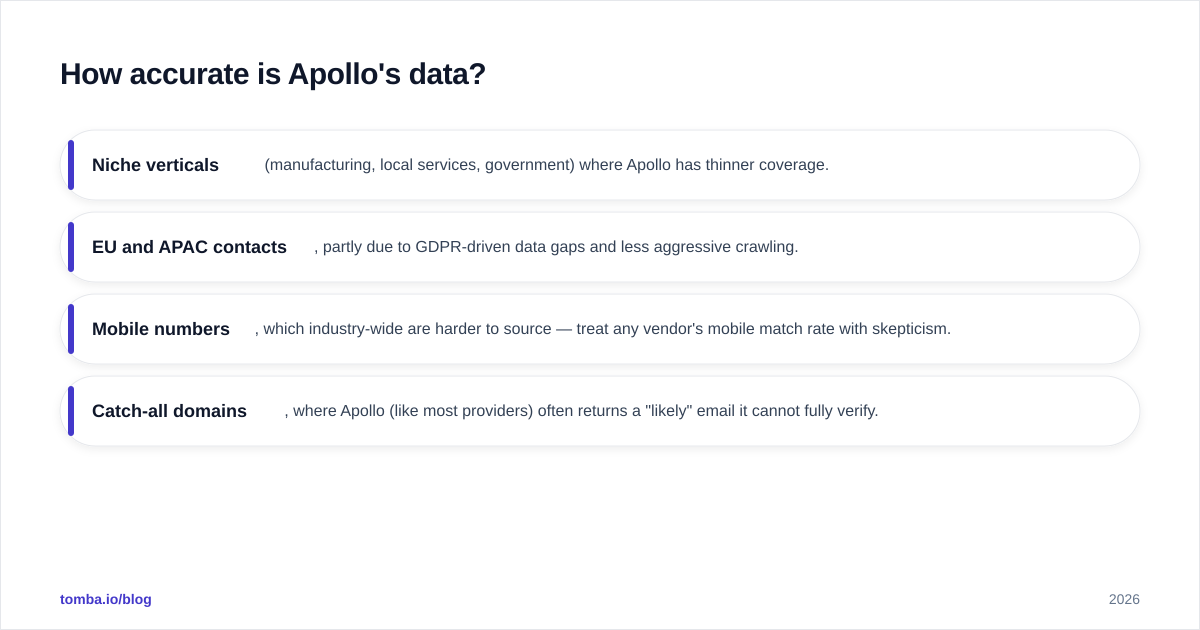
In practical use across well-covered segments — US/UK tech, SaaS, marketing, mid-market companies — direct work emails land in the 80–90% deliverable range. Where it degrades:
- Niche verticals (manufacturing, local services, government) where Apollo has thinner coverage.
- EU and APAC contacts, partly due to GDPR-driven data gaps and less aggressive crawling.
- Mobile numbers, which industry-wide are harder to source — treat any vendor's mobile match rate with skepticism.
- Catch-all domains, where Apollo (like most providers) often returns a "likely" email it cannot fully verify.
The fix most teams use is a verification pass before sending. Even a strong database produces stale records as people change jobs, so running exported emails through an email verifier catches the 10–20% that would otherwise bounce and damage your sender reputation. If you work heavily with catch-all domains, a dedicated catch-all verifier resolves the addresses Apollo flags as uncertain.
Reviews on G2 echo this: high marks for breadth and ease of use, recurring complaints about outdated contacts and bounce rates in specific industries. No database is perfect — the question is whether you build verification into your workflow or trust the export blindly.
What does Apollo cost in 2026?#
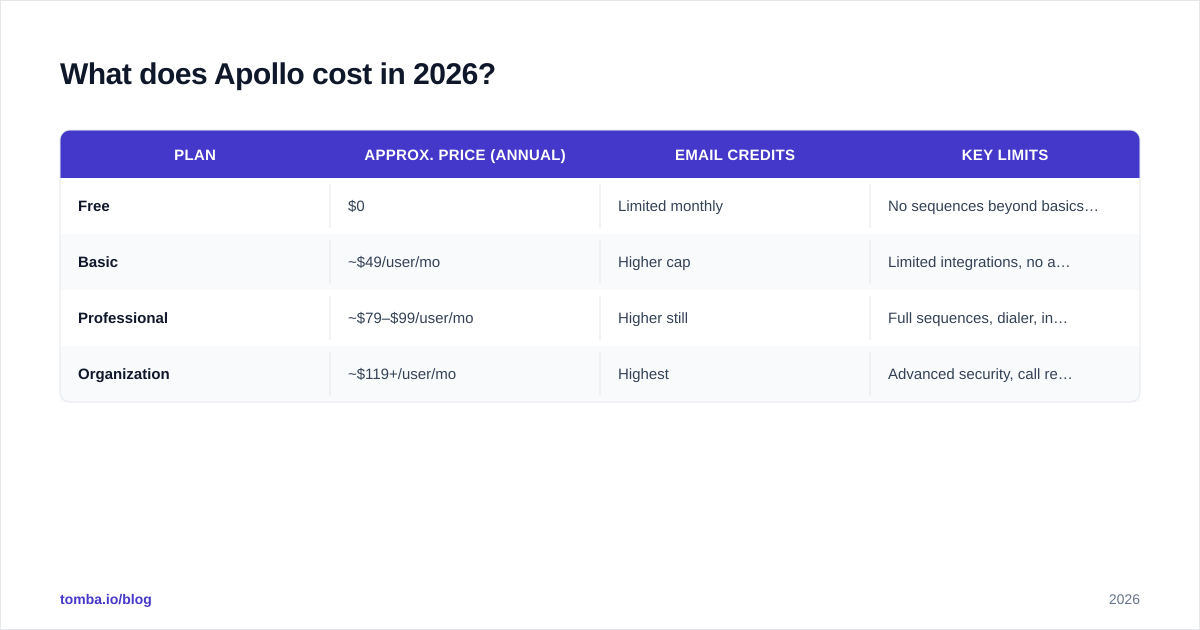
Apollo's pricing is seat-based with credit caps layered on top. Approximate annual-billing rates (Apollo runs frequent promotions, so confirm live numbers on their site):
| Plan | Approx. price (annual) | Email credits | Key limits |
|---|---|---|---|
| Free | $0 | Limited monthly | No sequences beyond basics, capped exports |
| Basic | ~$49/user/mo | Higher cap | Limited integrations, no advanced intent |
| Professional | ~$79–$99/user/mo | Higher still | Full sequences, dialer, intent topics |
| Organization | ~$119+/user/mo | Highest | Advanced security, call recording, SSO |
The headline seat price understates real cost. Email credits, mobile-number reveals, and export limits gate how much you can actually pull. Teams doing high-volume prospecting routinely hit caps mid-month and either upgrade or buy credit top-ups. Budget for the workload, not the per-seat sticker.
This is where a build-your-own stack can win on price. If your bottleneck is "I need accurate emails for a list of domains I already have," a usage-based email finder bills for what you use instead of a per-seat bundle you partially consume. Compare transparent per-credit Tomba pricing against Apollo's seat-plus-credit model with your real monthly volume — the gap is often large for lean teams.
Is Apollo sales intelligence better than the alternatives?#
It depends on whether you want a platform or a precision tool. Here's how Apollo stacks against common options and a focused alternative.
| Capability | Apollo | ZoomInfo | Tomba | Best for |
|---|---|---|---|---|
| Database size | 275M+ contacts | 300M+ contacts | Domain-driven search | Apollo/ZoomInfo for raw breadth |
| Email accuracy | 80–90% mainstream | High, enterprise-grade | High, verification-first | Tomba for clean sends |
| Intent data | Yes (Bombora + native) | Yes (deep) | No | ZoomInfo for enterprise intent |
| Built-in sequencing | Yes | Add-on (Engage) | No | Apollo for all-in-one |
| Pricing model | Seat + credits | Quote-based, premium | Usage-based, transparent | Tomba for cost control |
| Free tier | Yes, limited | No | Yes (25 searches/mo) | Apollo/Tomba for trials |
| Verification built in | Partial | Partial | Dedicated verifier | Tomba for deliverability |
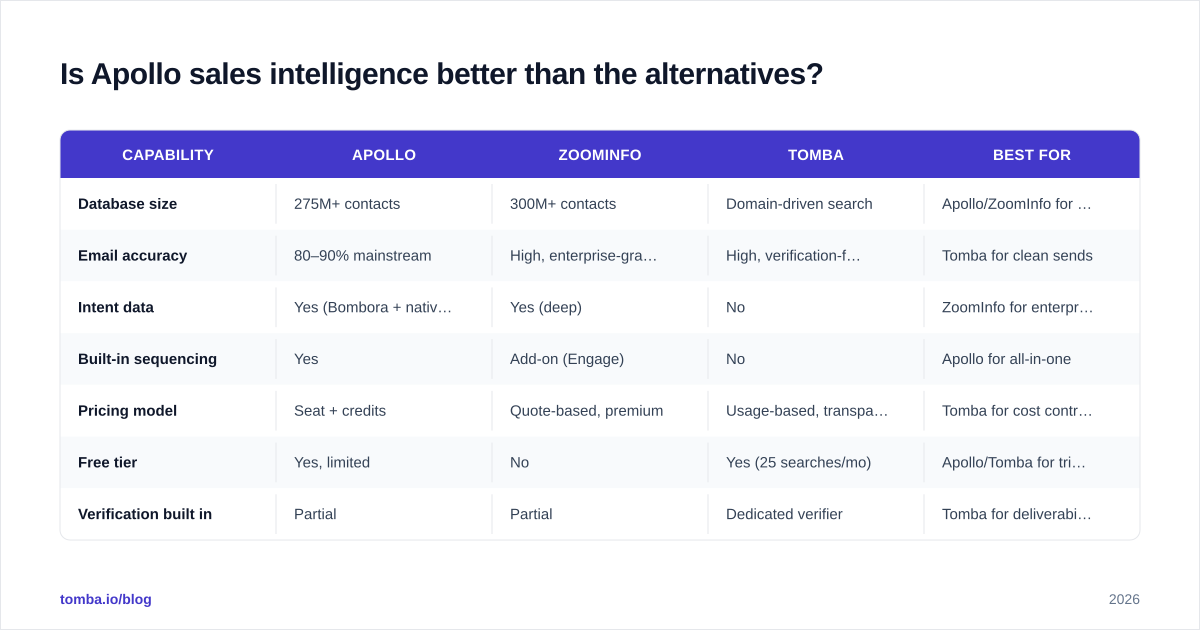
The pattern is clear. ZoomInfo is the enterprise heavyweight — deepest intent and firmographics, priciest contracts, quote-only. Apollo is the best-value all-in-one for SMB and mid-market: broad data plus engagement at a reasonable seat cost. Specialist tools like Tomba win when your job is finding and verifying emails at predictable, low cost, and you already own your CRM and sequencer.
If Apollo's bundle feels like more than you need — or its export caps pinch — a focused Apollo alternative gives you the email-finding and verification core without the seat tax. Many teams run both: Apollo for discovery and intent, a specialist for the clean verification pass before send.

Who should use Apollo, and who shouldn't?#
Apollo is a strong fit if you:
- Run an SMB or mid-market outbound team that wants one tool for data, sequences, and dialing.
- Value workflow speed — search, list-build, and sequence in minutes — over best-in-class accuracy.
- Want intent signals to prioritize accounts without a separate enterprise contract.
- Operate mostly in US/UK mainstream B2B segments where coverage is strongest.
Look elsewhere if you:
- Need the cleanest possible send list and are willing to verify aggressively — pair or replace with a verification-first tool.
- Already own a sequencer (Instantly, Smartlead) and a CRM, and only need a data/email source.
- Work niche verticals or EU-heavy lists where Apollo's coverage thins out.
- Prefer usage-based billing and hate paying per seat for features you partly use.
A common hybrid: use Apollo to discover accounts and read intent, export the contacts, then run them through a dedicated data enrichment and verification step before they hit your sequencer. You get Apollo's breadth and a specialist's accuracy without overpaying for either.
How do you get the most out of Apollo sales intelligence?#
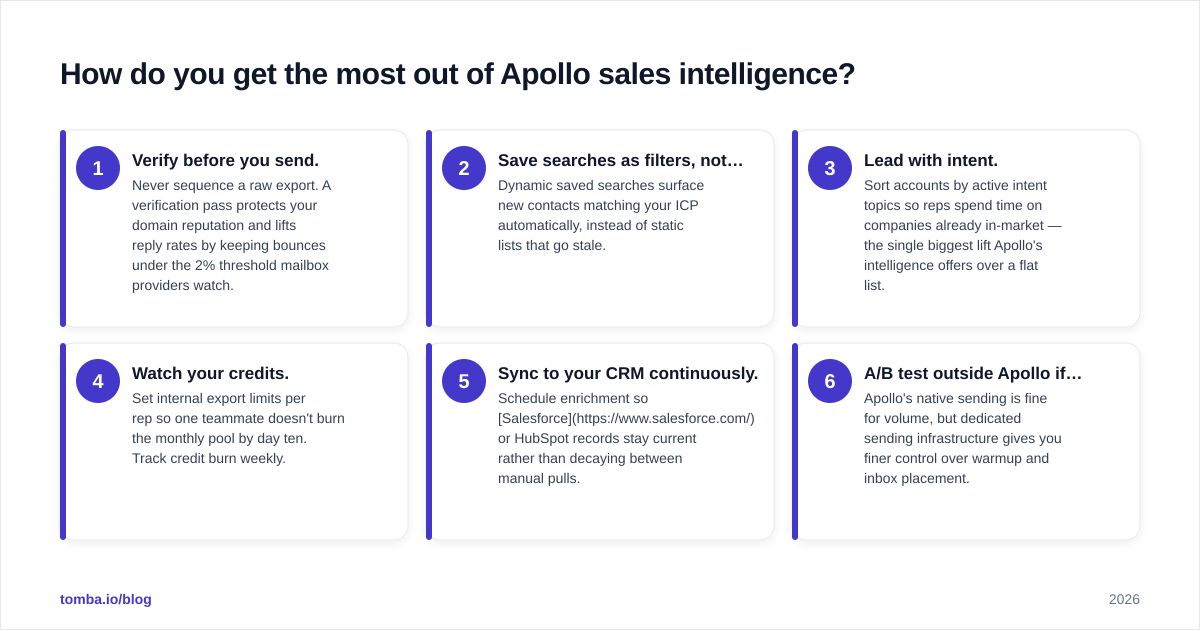
If you commit to Apollo, these practices stretch the value:
- Verify before you send. Never sequence a raw export. A verification pass protects your domain reputation and lifts reply rates by keeping bounces under the 2% threshold mailbox providers watch.
- Save searches as filters, not lists. Dynamic saved searches surface new contacts matching your ICP automatically, instead of static lists that go stale.
- Lead with intent. Sort accounts by active intent topics so reps spend time on companies already in-market — the single biggest lift Apollo's intelligence offers over a flat list.
- Watch your credits. Set internal export limits per rep so one teammate doesn't burn the monthly pool by day ten. Track credit burn weekly.
- Sync to your CRM continuously. Schedule enrichment so Salesforce or HubSpot records stay current rather than decaying between manual pulls.
- A/B test outside Apollo if deliverability matters. Apollo's native sending is fine for volume, but dedicated sending infrastructure gives you finer control over warmup and inbox placement.
The throughline: Apollo gives you raw intelligence; your process turns it into pipeline. Verification and intent prioritization are where most teams leave value on the table.
Frequently asked questions#
Is Apollo's free plan enough to start? For testing and very light prospecting, yes. The credit and feature caps mean any serious team will outgrow it within weeks, but it's a legitimate way to evaluate data quality before paying.
Does Apollo replace ZoomInfo? For SMB and mid-market, often yes — at a fraction of the cost. For large enterprises that need the deepest intent, org charts, and compliance guarantees, ZoomInfo still leads.
Can I trust Apollo's emails without verifying? No vendor's emails should be sent unverified. Apollo's accuracy is good, but a verification pass is cheap insurance against bounces and blacklisting.
Is Apollo GDPR compliant? Apollo provides compliance tooling and honors opt-outs, but EU outreach carries obligations regardless of vendor. Review your legal basis for processing before prospecting EU contacts.
The bottom line#
Apollo sales intelligence is one of the best all-in-one prospecting platforms for SMB and mid-market teams in 2026 — broad data, useful intent signals, and built-in engagement at a fair seat price. It is not the most accurate database on the market, and its credit caps can surprise high-volume teams, so build verification and credit discipline into your workflow.
If your real need is accurate, verified B2B emails at transparent, usage-based cost — without paying for a sequencer and dialer you may not use — start with the Tomba Email Finder. Find emails by domain, name, or company, verify them in the same flow, and keep your bounce rate low and your sender reputation clean. Run it alongside Apollo for discovery, or on its own as a leaner, lower-cost core. Either way, your send list stays clean and your pipeline stays honest.
// get started
Find, verify and enrich your first contacts today
Start on the free plan with 25 searches a month, then scale when your team is ready.
Free plan · No credit card required · GDPR & CCPA
// about the author