Apollo.io Pricing in 2026: Plans, Credits, and Real Costs
A no-spin breakdown of Apollo.io pricing in 2026 — every tier, what credits really cost, the per-seat traps, and when a cheaper stack wins.

Apollo.io sells itself as an all-in-one prospecting platform: a B2B database, an email finder, a dialer, and a sequencing engine bundled under one login. The pricing looks simple on the marketing page and gets complicated the moment you read the fine print. This guide breaks down what Apollo actually costs in 2026, where the per-seat math bites, and when a leaner stack does the same job for less.
TL;DR#
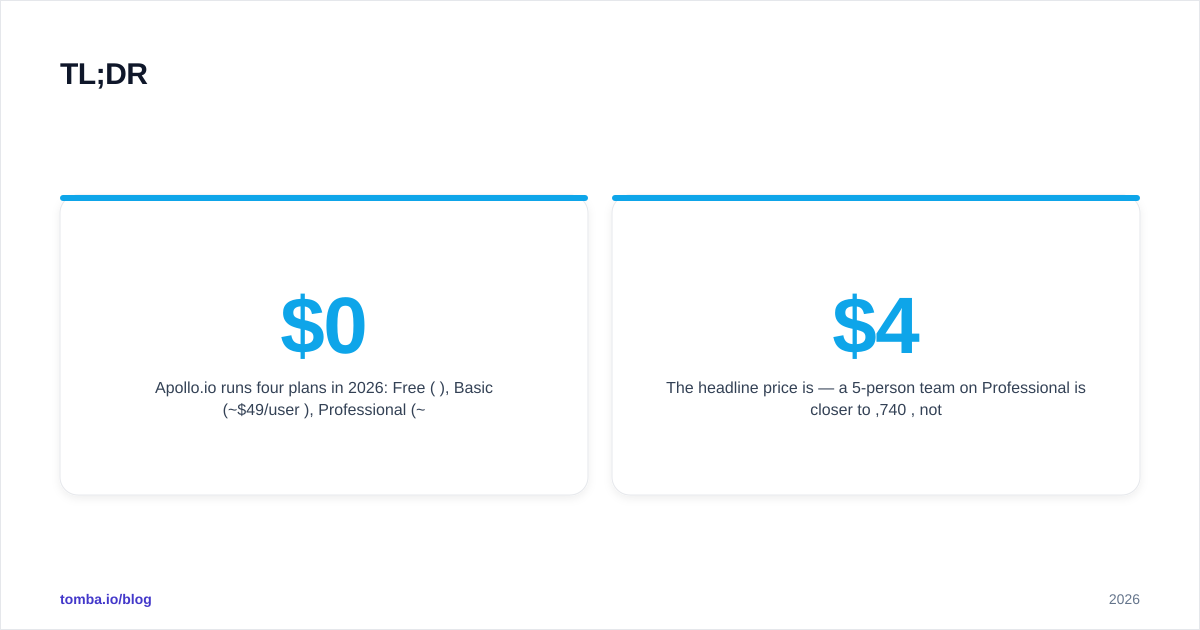
- Apollo.io runs four plans in 2026: Free ($0), Basic (~$49/user/mo), Professional (~$79/user/mo), and Organization (~$119/user/mo), all cheaper when billed annually.
- The headline price is per seat — a 5-person team on Professional is closer to $4,740/year, not the "$79" you see first.
- "Unlimited email credits" is real on paid tiers, but mobile numbers and export credits are capped and are where Apollo upsells hardest.
- The Free plan is genuinely usable for solo prospecting, but rate limits and reduced data visibility push serious users to pay fast.
- If you only need accurate emails — not a dialer and sequencer — a focused email finder costs a fraction of an Apollo seat.
What is Apollo.io and what are you actually paying for?#
Think of Apollo less as one tool and more as a bundle — like a phone plan that throws in streaming and cloud storage you may never touch. You pay one monthly fee per person and get a contact database, email and phone lookups, a Chrome extension, email sequences, a built-in dialer, and basic CRM features.
That bundling is the whole pricing story. Apollo's value proposition is "replace four tools with one subscription." Whether that saves you money depends entirely on how many of those four tools you'd otherwise buy. If you genuinely need data plus sequencing plus dialing, the bundle is competitive. If you only need clean contact data, you're subsidizing features you'll never open.
Apollo's official pricing lives on apollo.io/pricing, and the plans shift periodically, so always confirm live numbers before you commit a card.
How much does Apollo.io pricing cost in 2026?#
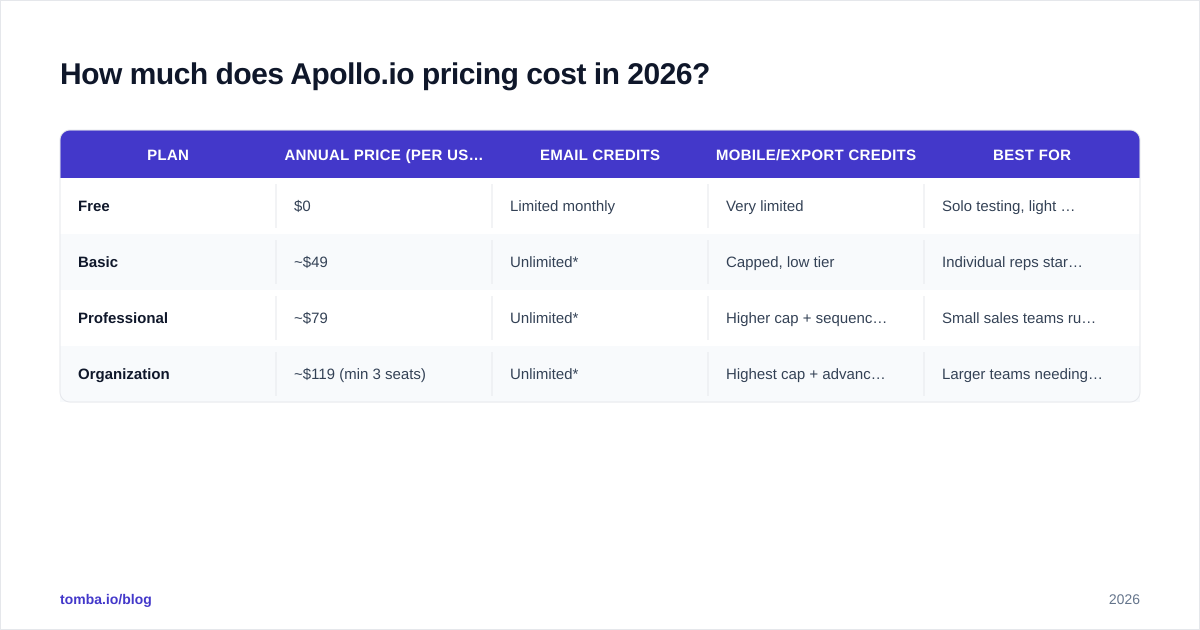
Here is the current four-tier structure. Prices below reflect annual billing (Apollo's default discount); month-to-month runs roughly 25–40% higher per seat.
| Plan | Annual price (per user/mo) | Email credits | Mobile/export credits | Best for |
|---|---|---|---|---|
| Free | $0 | Limited monthly | Very limited | Solo testing, light prospecting |
| Basic | ~$49 | Unlimited* | Capped, low tier | Individual reps starting outbound |
| Professional | ~$79 | Unlimited* | Higher cap + sequences/dialer | Small sales teams running cadences |
| Organization | ~$119 (min 3 seats) | Unlimited* | Highest cap + advanced controls | Larger teams needing admin + security |
*"Unlimited" email credits are subject to fair-use and daily rate limits. Mobile-number and bulk-export credits remain metered on every paid tier.
The two numbers that matter most are buried: mobile credits and export credits. Apollo gives you generous email allowances to make the plans feel limitless, then meters the data sales teams fight over — direct dials and bulk CSV exports. Run a heavy outbound month and you'll hit those caps well before month-end, which is exactly when the in-app "buy more credits" prompt appears.

Is the Apollo.io free plan good enough?#
Short answer: good enough to evaluate, rarely good enough to scale.
The Free plan gives you a real taste — you can search the database, find emails, install the extension, and send a small volume of sequenced email. For a solo founder doing 20 targeted outreaches a week, it can genuinely carry you for a while.
The walls show up fast once you push volume:
- Daily and monthly search limits throttle how many records you can pull.
- Reduced data access — some fields and exports are gated behind paid tiers.
- Credit starvation — mobile numbers are nearly absent on Free.
The Free plan is a 14-day-trial-that-never-expires in spirit: enough to prove the data quality, not enough to run a pipeline. That's deliberate, and it's a fair deal — just don't build a quota around it.
Why is per-seat pricing the hidden cost?#
Because the price you remember is the price for one person, and almost nobody runs outbound with one person.
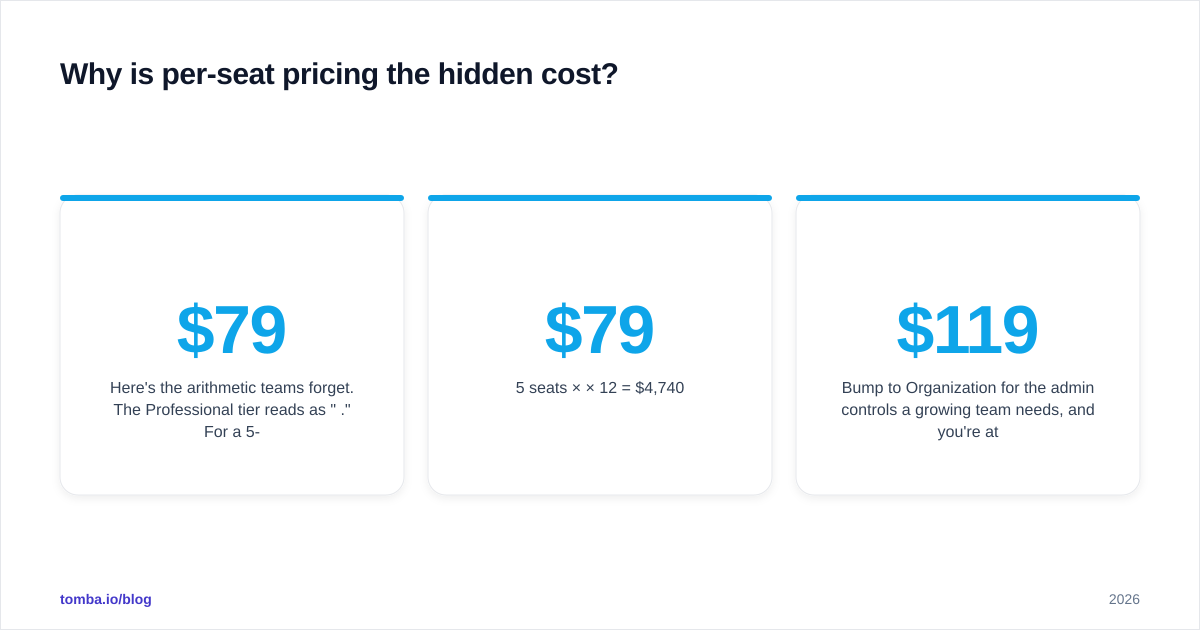
Here's the arithmetic teams forget. The Professional tier reads as "$79." For a 5-rep team billed annually, the real number is:
5 seats × $79 × 12 = $4,740/year
Bump to Organization for the admin controls a growing team needs, and you're at 5 × $119 × 12 = $7,140/year — and Organization enforces a 3-seat minimum, so even a 2-person team pays for three.
This is the single biggest reason Apollo's true cost surprises buyers. The platform is priced like SaaS productivity software (per head), but it's sold as a data tool (where buyers expect to pay for volume, not people). A two-person team that needs 10,000 verified emails a month doesn't care about ten logins — but the per-seat model charges them as if they do.

How do Apollo credits actually work?#
Credits are Apollo's metering currency, and understanding them is the difference between a predictable bill and a surprise one.
There are effectively three credit types:
- Email credits — spent when you reveal a verified email. "Unlimited" on paid plans, but governed by daily caps and fair use.
- Mobile credits — spent when you reveal a direct dial or mobile number. Metered on every tier, including paid ones.
- Export credits — spent when you push records out of Apollo into a CSV or CRM in bulk.
The trap is assuming "unlimited email" means "unlimited everything." It doesn't. The credits that gate your real workflow — getting numbers for the dialer, exporting lists into your CRM — are exactly the ones still rationed. Independent reviews on G2 repeatedly flag credit confusion and overage charges as the most common complaint.
If your motion is email-first, this matters less. If it's phone-heavy or you live in spreadsheets, model your monthly mobile and export volume before you pick a tier.
How does Apollo.io pricing compare to alternatives?#
Apollo competes on bundling. Most alternatives compete on either depth (better data) or focus (do one thing cheaply). Here's how the trade-offs line up.
| Tool | Pricing model | Starting paid price | Strength | Weakness |
|---|---|---|---|---|
| Apollo.io | Per seat | ~$49/user/mo | All-in-one bundle | Per-seat cost scales fast; metered mobile/export |
| ZoomInfo | Custom/quote | High (enterprise) | Deepest enterprise data | Opaque pricing, annual lock-in |
| Lusha | Per seat + credits | ~$36/user/mo | Strong mobile data | Credit-limited, smaller TAM |
| Tomba | Credit/volume | $49/mo flat | Email finding + verification accuracy | Not a full sequencer/dialer |
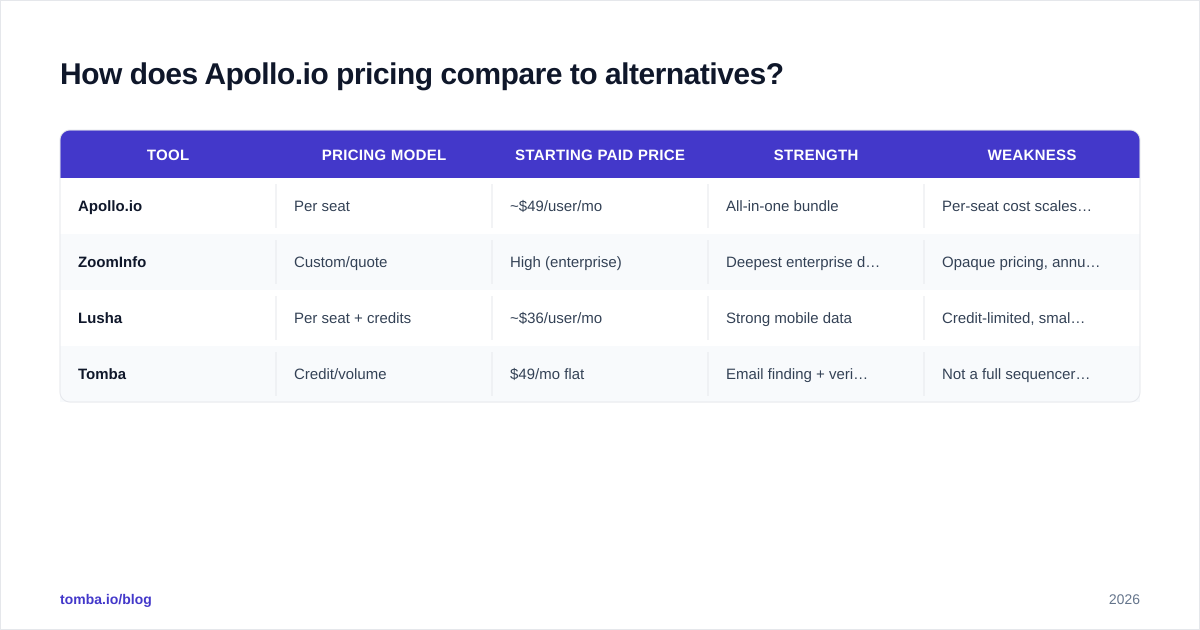
The honest read: if you need the whole outbound stack in one tab and you'll use the dialer and sequencer daily, Apollo's bundle is defensible. If you've noticed your reps mostly use Apollo to find and verify emails and then export them elsewhere, you're paying bundle prices for a single feature.
That's where a focused tool changes the math. A volume-priced email verifier and finder isn't billed per head, so a 5-person team pays once, not five times. For teams whose Apollo usage is 80% "get me the email," that gap is the entire ROI conversation. If Apollo is on your shortlist mainly for data, it's worth reading our take on the broader Apollo alternative landscape before you sign an annual contract.
When should you actually pay for Apollo.io?#
Pay for Apollo when at least three of these are true:
- You run multi-step email sequences and want them in the same tool as your data.
- Your reps make outbound calls and need a native dialer plus mobile numbers.
- You want lead scoring and basic CRM signals without buying a separate platform.
- Your team is large enough that consolidating tools genuinely reduces admin overhead.
- You've modeled per-seat cost across your real headcount and it still beats buying point solutions.
Skip Apollo, or downgrade your expectations, when:
- You only need accurate B2B emails and the occasional phone number.
- Your team is small (2–3 people) and per-seat math inflates the cost.
- You already own a sequencer (Instantly, Smartlead) and a CRM you like.
- Your outbound is email-first, so the dialer is dead weight you'd never touch.
The decision isn't "is Apollo good" — it's good. The decision is "am I using enough of the bundle to justify per-seat pricing." Most disappointed Apollo buyers answered that question after signing, not before.
What's the smartest way to control Apollo costs?#
Treat Apollo like a gym membership: the price is fine if you use everything, wasteful if you only use the treadmill.
Three practical moves:
- Right-size seats. Don't buy Organization for admin features two people will configure once. Keep most reps on the tier they actually need.
- Separate data from delivery. If your bottleneck is email accuracy, pair a cheaper, volume-priced finder with whatever sequencer you already run. You stop paying per seat for the part of Apollo you'd use anyway.
- Audit credit burn monthly. Track mobile and export consumption. If you're constantly buying overages, a flat-rate tool is almost certainly cheaper at your volume — compare against transparent Tomba pricing to see the break-even point.
The teams that win with Apollo are the ones who measured their usage instead of trusting the headline number. The teams that churn are the ones who paid for a bundle to use one feature.
The bottom line#
Apollo.io pricing in 2026 is fair for what it is — an all-in-one platform priced per seat. The confusion comes from buyers expecting data-tool economics (pay for volume) and getting SaaS economics (pay per person), then hitting metered mobile and export credits the marketing page downplays. Model your real headcount and your real credit burn before you commit, and the right tier becomes obvious.
If your honest answer is "we mostly use Apollo to find and verify business emails," you're overpaying for the bundle. Tomba's Email Finder delivers verified professional emails by name, domain, or company at flat, volume-based pricing — no per-seat tax, no credit roulette. Start free with 25 searches a month, scale on a $49/mo Starter plan, and put the savings into the parts of your outbound that actually move pipeline. See how the data stacks up and decide with numbers, not marketing.
// get started
Find, verify and enrich your first contacts today
Start on the free plan with 25 searches a month, then scale when your team is ready.
Free plan · No credit card required · GDPR & CCPA
// about the author