Apolloio Reviews 2026: Apollo.io Pricing, Data Accuracy & Alternatives
Honest Apollo.io reviews for 2026: real pricing, data accuracy benchmarks, hidden seat costs, and where a focused email finder beats the all-in-one.
TL;DR
- These apolloio reviews cover the full picture. Apollo.io bundles a 275M+ contact database, sequencing, a dialer, and a Chrome extension into one seat-priced plan.
- The top complaints are stale contact data, tight email-credit limits, seat pricing that climbs fast, and bounce damage from unverified sends.
- Pricing starts free. The useful tier (Basic) is about $49 per user each month. Professional runs $79–99 per user. Both bill yearly, so big teams feel the cost fast.
- Need accurate email discovery and verification? A focused tool like Tomba often finds more valid emails per dollar than Apollo's bundled data.
- This review hands you a simple scoring framework. Use it to decide if Apollo's breadth fits your team.
What is Apollo.io and who is it for?#
Apollo.io is a B2B sales intelligence and outreach platform. Think of it as a Swiss Army knife. One tool holds a contact database, an email finder, a verifier, multi-step sequences, a dialer, and light CRM tracking. You pay per seat, and each rep gets the whole bundle.
That breadth is the pitch. You skip stitching together a data provider, a sequencer, and a dialer. Instead you log into one dashboard. For an SDR team that wants a single flow — find a contact, start a sequence, dial, log the call — Apollo is genuinely handy.
Who loves Apollo? Usually full-cycle SDRs and small outbound teams that prospect at high volume. Who churns? Usually teams that care about data quality, like recruiting, partnerships, and ABM. They want the right contact, not a thousand contacts. Keep that split in mind as you read these apolloio reviews. Your role decides whether the tradeoffs sting.
How much does Apollo.io actually cost in 2026?#
Short answer: Apollo looks cheap on the pricing page and gets pricey on the invoice. Credits and seats both meter how much you use.
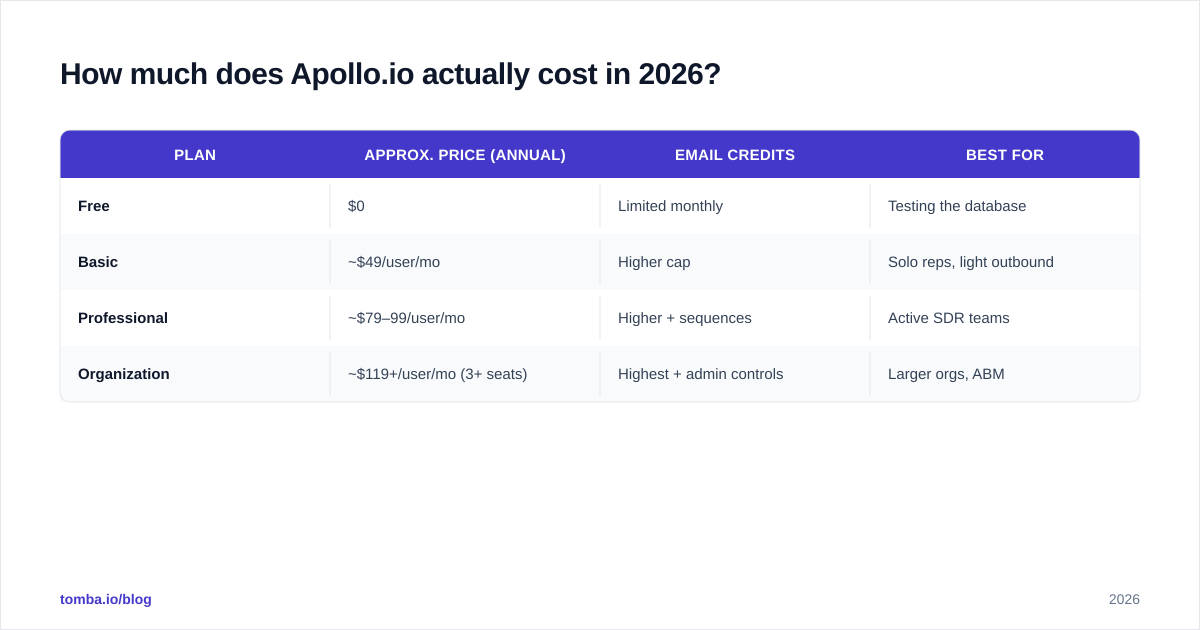
Apollo lists four tiers. The numbers below show yearly-billing prices as posted publicly. Month-to-month costs more. Also, "email credits" and "export credits" are tracked apart, which confuses many new buyers.
| Plan | Approx. price (annual) | Email credits | Best for |
|---|---|---|---|
| Free | $0 | Limited monthly | Testing the database |
| Basic | ~$49/user/mo | Higher cap | Solo reps, light outbound |
| Professional | ~$79–99/user/mo | Higher + sequences | Active SDR teams |
| Organization | ~$119+/user/mo (3+ seats) | Highest + admin controls | Larger orgs, ABM |
Two things bite people. First, you pay per seat. A five-rep team on Professional is a five-figure yearly bill, and you can't easily share one seat. Second, credits run out. Enrich or export in bulk and you can burn a month's allotment mid-campaign. Then you wait or upgrade.
Now compare flat or usage-based email-finder pricing. A focused provider like Tomba has a free tier (25 searches a month). Paid plans are $49, $99, and $249 a month, and headcount does not multiply them. Say eight reps need data but only two need a sequencer. Paying eight Apollo seats is pure waste. Check the Tomba pricing page and run the per-rep math yourself.
Are Apollo.io's data and accuracy any good?#
Honest answer: coverage is excellent, but accuracy is uneven. The database is huge, so you almost always find a record. Whether the email still works is the gamble.
Public apolloio reviews on G2 and Capterra repeat the same theme: bounce-prone exports. You get contacts who left the company, catch-all addresses marked "verified," and phone numbers that ring the wrong desk. Apollo does verify, but community data drifts fast. A "verified" flag at index time is not a live check at send time.
This matters more than it sounds. Bad data does not just waste time. It hurts your sending setup. Every hard bounce chips at your sender reputation. Once your email deliverability drops, even good emails land in spam. One bad list can poison a clean domain.
The fix is a verification layer you trust. Many teams keep Apollo for discovery. Then they run exports through a dedicated email verifier before the sequencer. Catch-all domains are the tricky part. They accept every address at the SMTP layer, so a basic check passes them. That is why a catch-all verifier exists as a separate step. Skip it, and Apollo's "99% deliverable" promise becomes your bounce problem.
How do you evaluate Apollo.io vs the alternatives?#
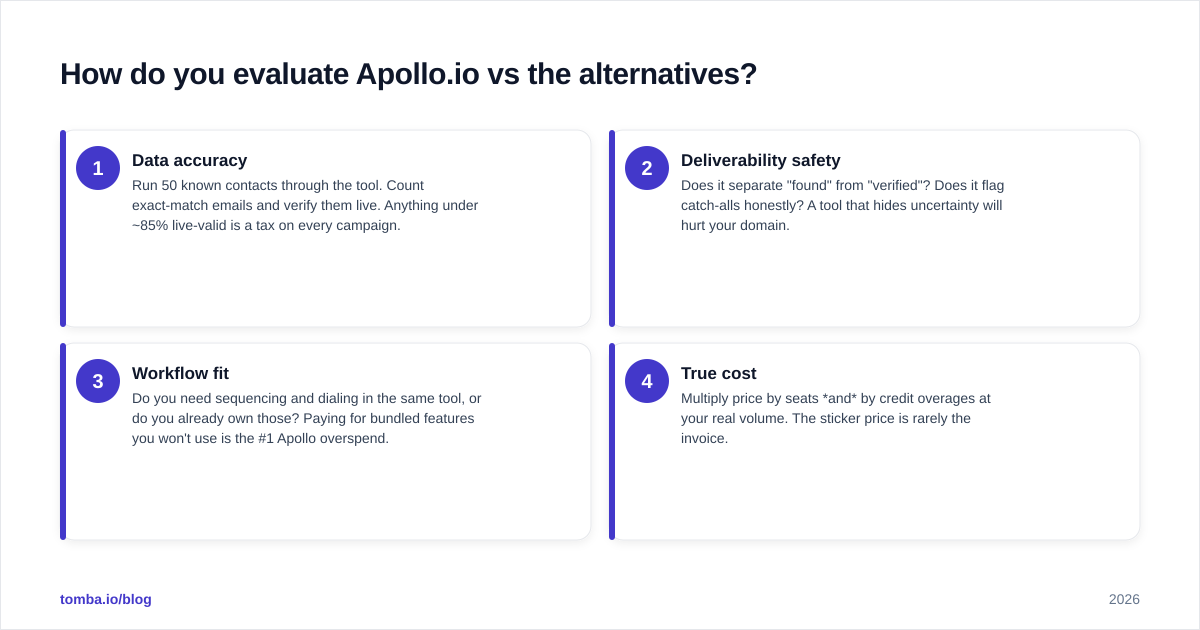
Don't compare on feature lists. Compare on the four things that move revenue. Score any tool, Apollo included, on data accuracy, deliverability safety, workflow fit, and true cost.
Use the framework like this:
- Data accuracy — Run 50 known contacts through the tool. Count exact-match emails and verify them live. Under about 85% live-valid is a tax on every campaign.
- Deliverability safety — Does it split "found" from "verified"? Does it flag catch-alls honestly? A tool that hides doubt will hurt your domain.
- Workflow fit — Do you need sequencing and dialing in one tool? Or do you already own them? Paying for bundled features you skip is the top Apollo overspend.
- True cost — Multiply price by seats and by credit overages at your real volume. The sticker price is rarely the invoice.
A platform like Apollo scores high on workflow fit and coverage. It scores medium on cost and mixed on accuracy. A focused stack scores higher on accuracy and cost, but lower on convenience. That stack is a best-in-class email finder, a verifier, and your current sequencer. Neither path is always better. It depends on which column you weight.
Apollo.io vs a focused email-finding stack: which wins?#
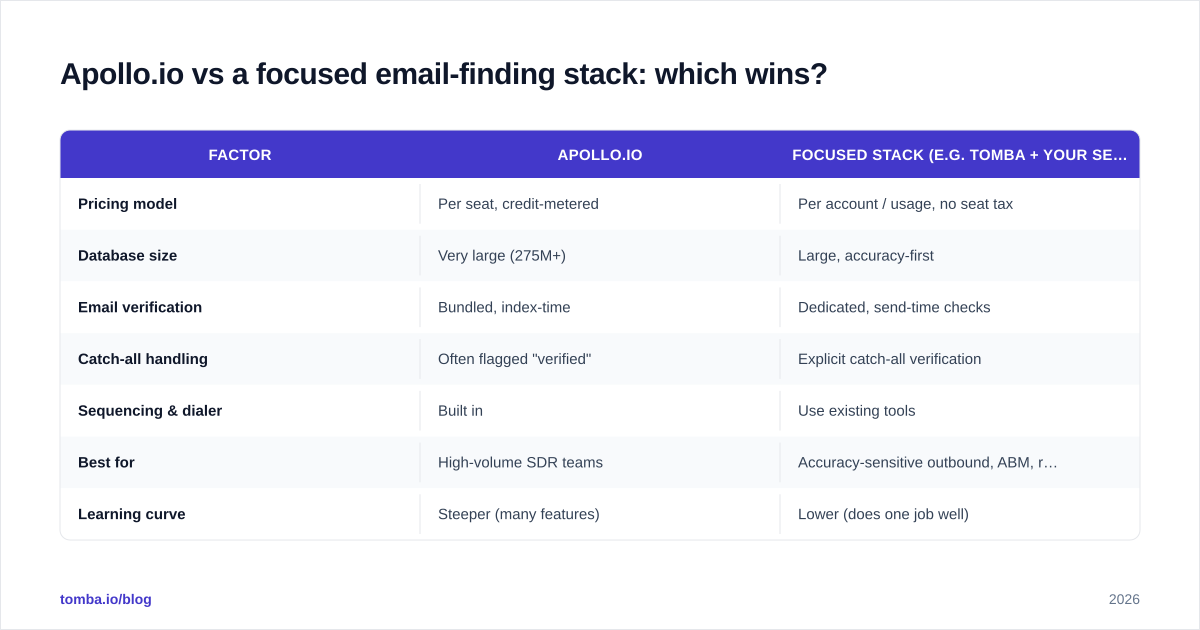
Quick verdict: Apollo wins if you want one login and don't mind paying per seat for breadth. A focused stack wins if accuracy and cost-per-valid-contact come first.
| Factor | Apollo.io | Focused stack (e.g. Tomba + your sequencer) |
|---|---|---|
| Pricing model | Per seat, credit-metered | Per account / usage, no seat tax |
| Database size | Very large (275M+) | Large, accuracy-first |
| Email verification | Bundled, index-time | Dedicated, send-time checks |
| Catch-all handling | Often flagged "verified" | Explicit catch-all verification |
| Sequencing & dialer | Built in | Use existing tools |
| Best for | High-volume SDR teams | Accuracy-sensitive outbound, ABM, recruiting |
| Learning curve | Steeper (many features) | Lower (does one job well) |
The honest tradeoff: Apollo's all-in-one design is real convenience, and convenience has value. But all-in-one also locks you into their verification quality and their seat pricing. Teams usually unbundle for one of two reasons. Their bounce rates got too high, or their seat count made the invoice hard to defend.
Shopping just for the discovery layer? The Tomba Email Finder and domain search do the same "find the contact" job Apollo does. The Tomba API wires verification into any sequencer or CRM you already run, including HubSpot and Salesforce. That is the unbundling path most leavers take.
What do apolloio reviews say are the biggest downsides?#
Pull the patterns from public apolloio reviews and five complaints come up again and again:
- Data decay. Contacts who changed jobs months ago still show as current. This is the most-cited gripe.
- Credit anxiety. Reps ration exports because they fear the cap. That defeats the point of a prospecting tool.
- Seat pricing at scale. What feels cheap for one rep turns into a budget fight at ten.
- Deliverability fallout. Teams that trusted the "verified" label and skipped their own checks report damaged domains and more spam placement.
- Feature bloat. New users get lost in a dashboard built for a dozen jobs when they wanted two.
None of this makes Apollo a bad product. It makes Apollo a generalist, with a generalist's weak spots. If your biggest pain is "I need emails that land," index-time verification is the wrong place to cut corners.
What are the best Apollo.io alternatives in 2026?#
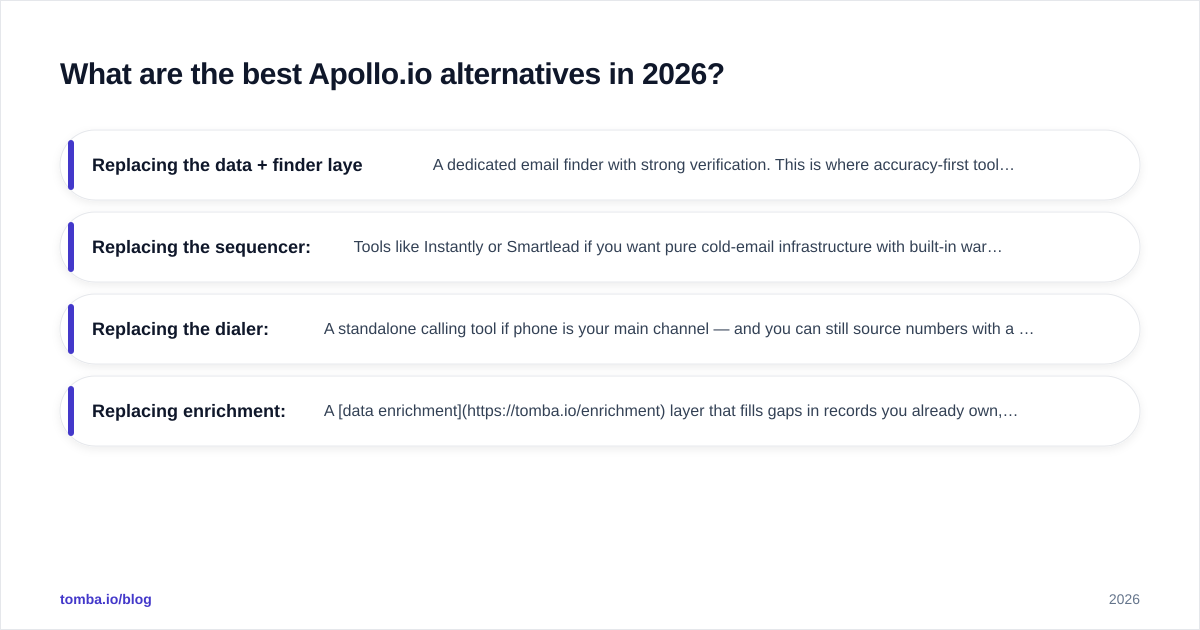
It depends on which Apollo job you're replacing. There is no single drop-in, because Apollo does several jobs at once.
- Data + finder layer: A dedicated email finder with strong verification. Accuracy-first tools shine here, and your bounce rate usually drops. See the full Apollo alternative breakdown for a side-by-side.
- Sequencer: Tools like Instantly or Smartlead for pure cold-email infrastructure with built-in warmup.
- Dialer: A standalone calling tool if phone is your main channel. You can still source numbers with a phone finder.
- Enrichment: A data enrichment layer that fills gaps in records you already own, so you don't re-buy contacts.
The mistake is hunting for one tool that does everything Apollo does, but better. That tool tends to carry the same generalist tradeoffs. The happiest teams after leaving Apollo pick the two jobs that matter most and buy a specialist for each.
So, is Apollo.io worth it in 2026?#
Bottom line: Apollo.io is worth it for high-volume SDR teams that value one workflow and can absorb seat pricing. It is the wrong fit for accuracy-sensitive teams who would rather pay for clean data than for bundled features they skip.
Run the four-factor framework against your real numbers before you commit for a year. Test 50 contacts. Count live-valid emails. Multiply price by seats and overages. If Apollo clears your bar, the convenience is real and worth paying for. If accuracy comes back weak, you now know which layer to unbundle.
If accurate, verified email discovery is the job you need solved, start with the Tomba Email Finder. Find professional emails by name, company, or domain. Verify them before you send. Skip the per-seat tax. The free tier gives you 25 searches a month to benchmark hit rates against your current Apollo exports, no card needed. Test both on the same 50 contacts and let the bounce rate decide.
// get started
Find, verify and enrich your first contacts today
Start on the free plan with 25 searches a month, then scale when your team is ready.
Free plan · No credit card required · GDPR & CCPA
Get the Tomba newsletter
Product and data updates
// about the author