Arounddeal vs Growmeorganic: 2026 B2B Data Showdown
AroundDeal and GrowMeOrganic both promise B2B contact data and outreach, but they solve different problems. Here is the honest 2026 breakdown on data accuracy, pricing, and fit.
You are choosing between two B2B prospecting platforms that look similar on a feature grid but behave very differently once real outreach starts. This is the practical breakdown of AroundDeal vs GrowMeOrganic for 2026 — what each does well, where each leaks money, and how to decide without a 30-day trial detour.
TL;DR#
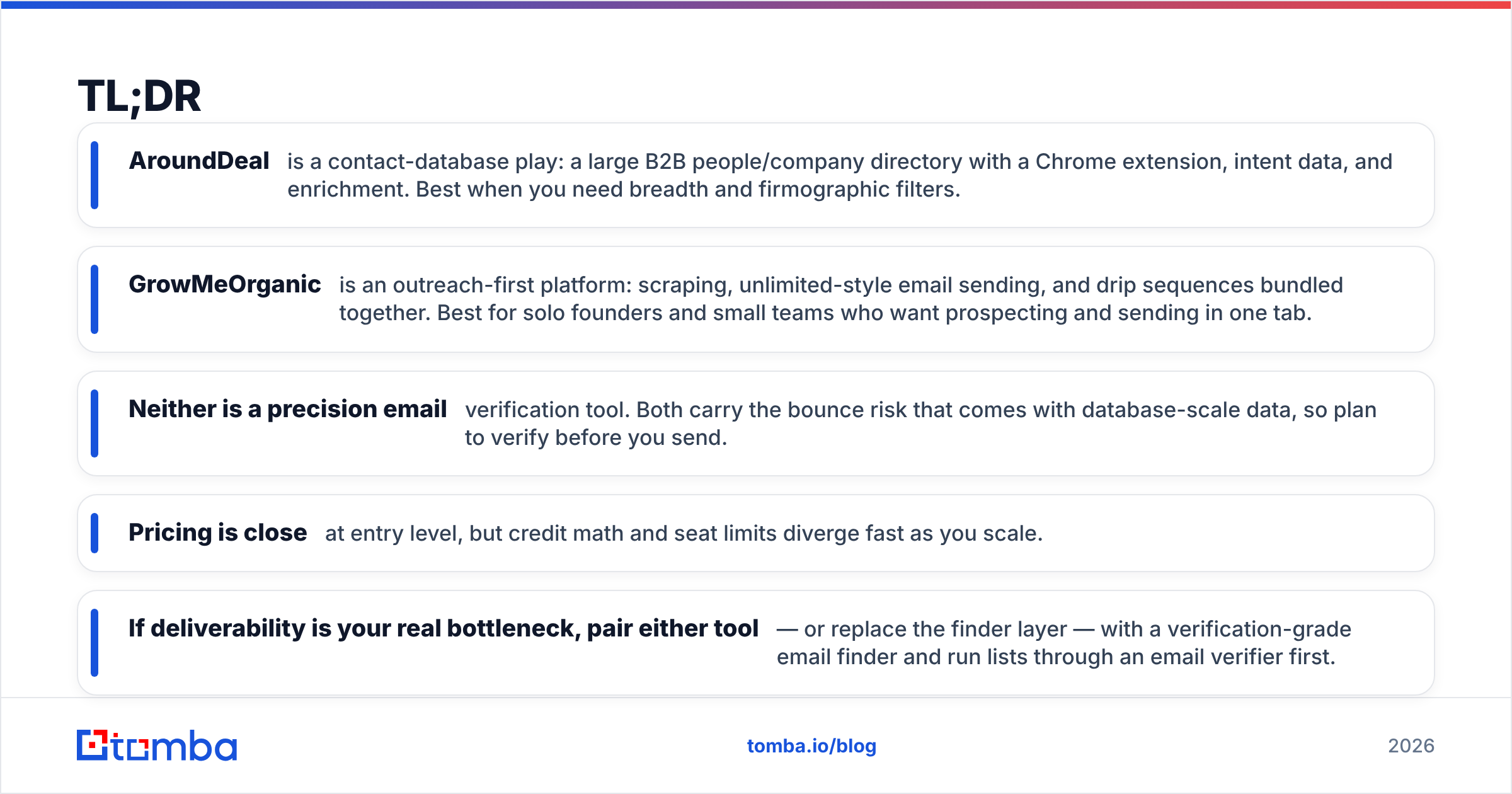
- AroundDeal is a contact-database play: a large B2B people/company directory with a Chrome extension, intent data, and enrichment. Best when you need breadth and firmographic filters.
- GrowMeOrganic is an outreach-first platform: scraping, unlimited-style email sending, and drip sequences bundled together. Best for solo founders and small teams who want prospecting and sending in one tab.
- Neither is a precision email-verification tool. Both carry the bounce risk that comes with database-scale data, so plan to verify before you send.
- Pricing is close at entry level, but credit math and seat limits diverge fast as you scale.
- If deliverability is your real bottleneck, pair either tool — or replace the finder layer — with a verification-grade email finder and run lists through an email verifier first.
What is AroundDeal?#
AroundDeal is a B2B contact and company intelligence platform. Think of it as a directory you query: you filter by title, industry, geography, headcount, or technology, and it returns contact records with emails and direct dials. It layers on intent signals (companies showing buying behavior), a Chrome extension for LinkedIn prospecting, and CRM-style enrichment to fill gaps in records you already own.
Its center of gravity is data discovery. You go to AroundDeal when you don't yet have a list and need to build one from firmographic criteria. The platform leans on a global database that skews strong in APAC and EMEA coverage relative to some US-centric competitors, which matters if your ICP lives outside North America.
What AroundDeal is not is a sending engine. It will hand you contacts and push them into your CRM or sequencer, but the actual cold-email cadence happens elsewhere. That separation is a feature if you already run Instantly or Smartlead, and a friction point if you wanted one tool to do everything.
What is GrowMeOrganic?#
GrowMeOrganic bundles the whole outbound motion into one subscription: prospecting (a database plus LinkedIn/Google Maps/website scrapers), email finding, and a built-in email-sequencing tool with drip campaigns. Its headline pitch is "unlimited" — unlimited email sending and generous extraction on higher tiers — aimed squarely at founders and small agencies who hate paying per seat and per send.
The everyday-analogy version: AroundDeal is a well-organized library where you check out exactly the records you ask for; GrowMeOrganic is a Swiss Army knife you keep in your pocket — it scrapes, finds, and sends, all good enough, none of it specialized.
That bundling is the selling point and the catch. You get fewer tabs and one invoice, but the scraped data is rawer than a curated database, and the email-finder layer is a means to an end rather than a precision instrument. For high-volume founders chasing reach over surgical accuracy, that trade is often acceptable. For a RevOps team protecting domain reputation, it usually isn't.
How do AroundDeal and GrowMeOrganic compare on data accuracy?#
This is where the marketing copy stops being useful. Both tools are database- and scrape-driven, which means coverage is broad but per-record confidence varies. A directory record that was accurate six months ago may now point at someone who changed jobs, and a scraped email is a guess until something validates it.
The honest framing: accuracy is a spectrum, and database tools sit in the middle of it. They beat manual guessing and they lose to dedicated finder-plus-verifier stacks that confirm each address at SMTP level before you ever load it into a sequence. If you send to unverified database exports at volume, expect bounce rates that quietly erode sender reputation and, eventually, inbox placement.

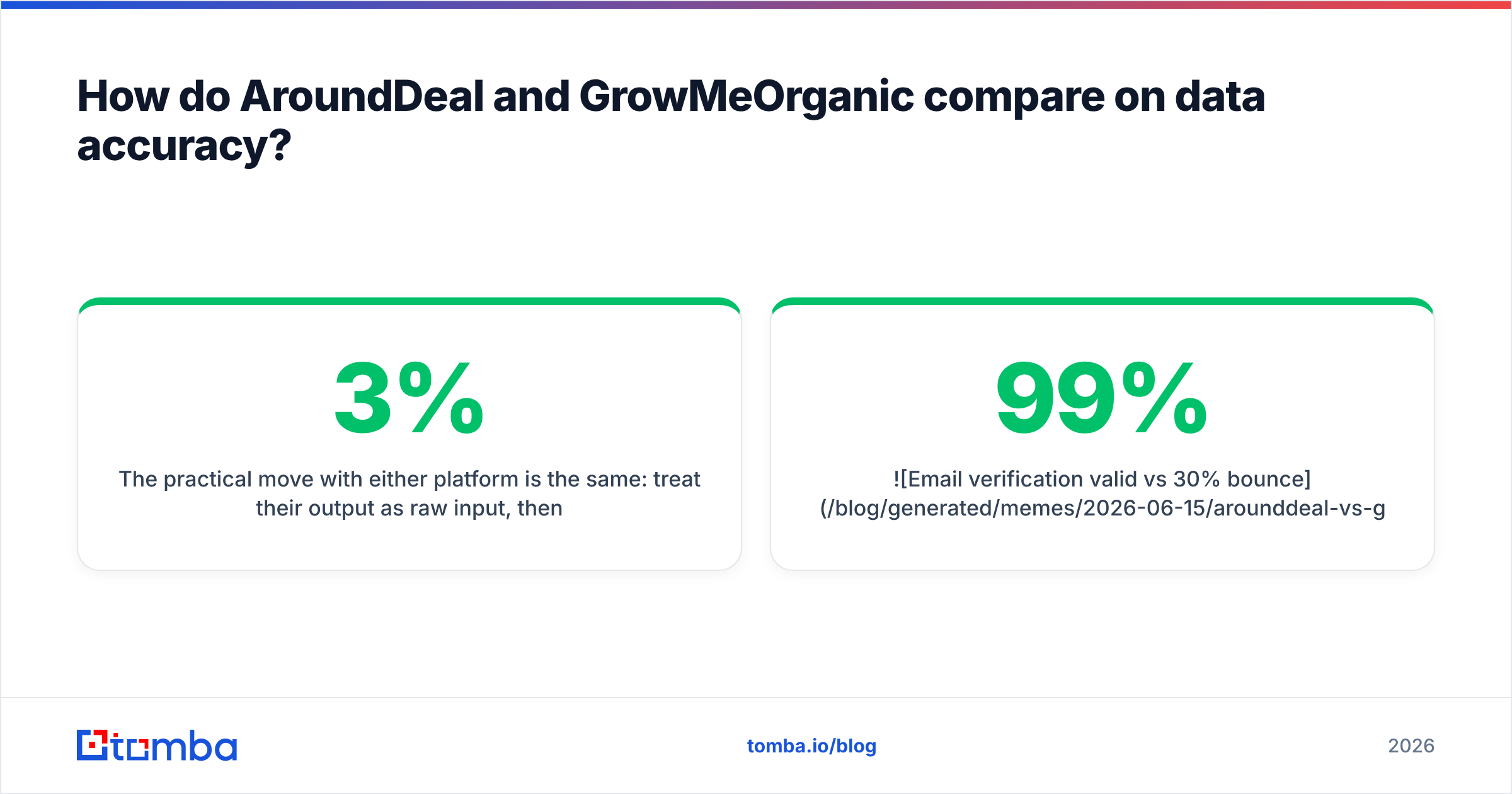
The practical move with either platform is the same: treat their output as raw input, then run it through verification. A 3% bounce rate is the rough line where mailbox providers start throttling you. Hitting that line is easy when you skip the verify step on database data.

Arounddeal vs Growmeorganic: full feature and pricing comparison#
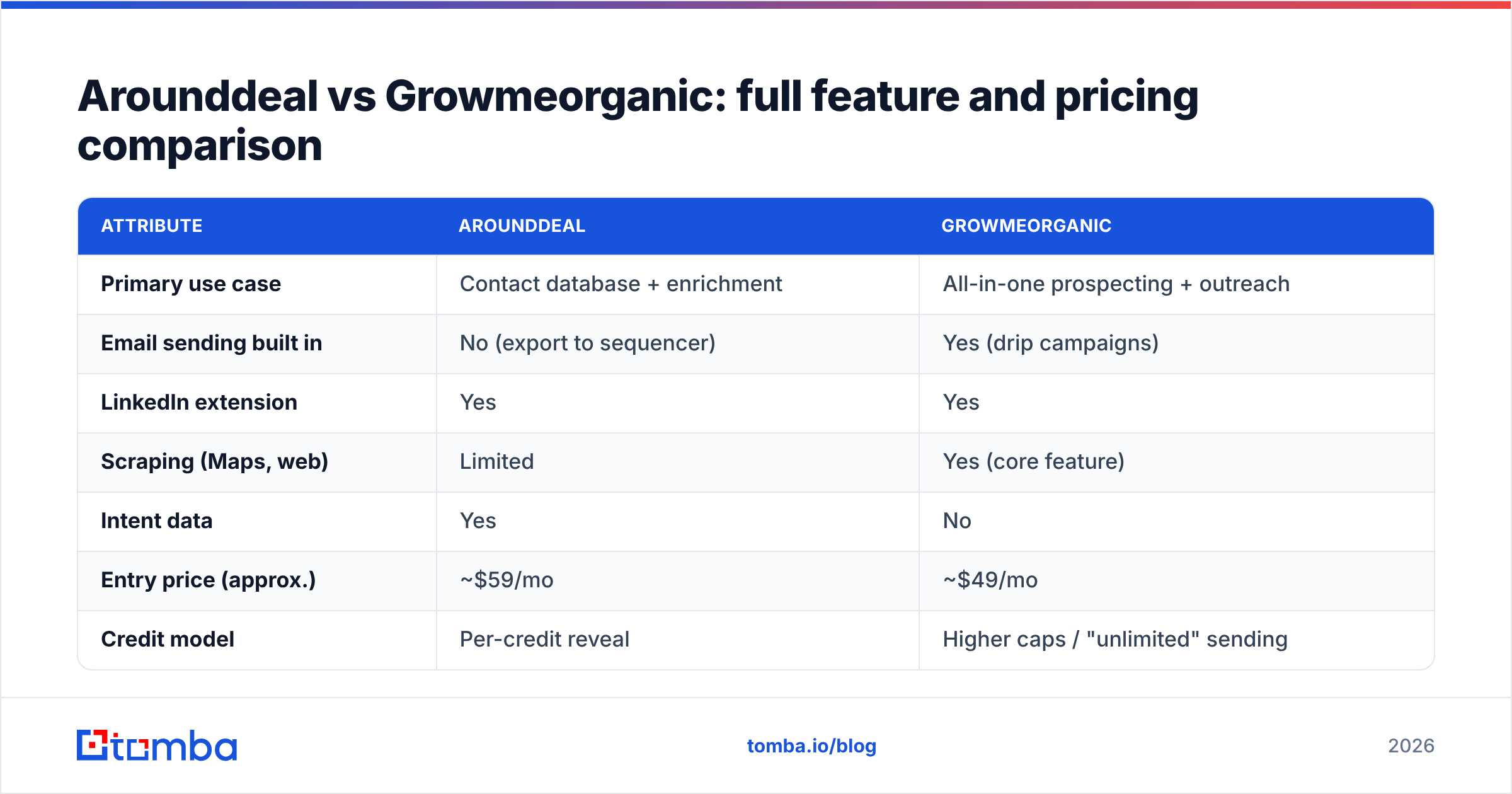
Here is the side-by-side. Treat the prices as entry points — both vendors restructure tiers regularly, so confirm current numbers on their own sites before you buy.
| Attribute | AroundDeal | GrowMeOrganic |
|---|---|---|
| Primary use case | Contact database + enrichment | All-in-one prospecting + outreach |
| Email sending built in | No (export to sequencer) | Yes (drip campaigns) |
| LinkedIn extension | Yes | Yes |
| Scraping (Maps, web) | Limited | Yes (core feature) |
| Intent data | Yes | No |
| Entry price (approx.) | ~$59/mo | ~$49/mo |
| Credit model | Per-credit reveal | Higher caps / "unlimited" sending |
| Best-fit team | SDR teams, APAC/EMEA ICPs | Founders, solo, small agencies |
| Built-in verification | Basic | Basic |
| Seat scaling cost | Climbs with seats | Flatter, founder-friendly |
A few notes the table can't carry. AroundDeal's intent data is a genuine differentiator if your motion depends on timing — reaching accounts when they're researching your category. GrowMeOrganic's all-in-one bundle wins on total cost of ownership for a one-person GTM team, because you're not also paying for a separate sequencer. Once you add multiple SDRs, deliverability tooling, and CRM sync, that math changes and the "cheap bundle" advantage narrows.
For a deeper look at how credit-based pricing actually plays out across this category, the Tomba pricing page lays out a flat-credit model you can use as a sanity-check benchmark against both vendors' tiers.
Which tool is better for cold email and deliverability?#
GrowMeOrganic looks better on paper because it sends for you — but "can send" and "sends well" are different claims. Its sequencing tool is functional, not best-in-class, and "unlimited" sending is a trap if the underlying list isn't verified. Volume without deliverability hygiene just means you burn a domain faster.
AroundDeal sidesteps the question by not sending at all, which forces you to bring a real outreach stack. That's more setup but usually better outcomes, because dedicated sending platforms handle warmup, rotation, and email deliverability properly.
Either way, the deliverability work is yours to own. Before any cold campaign:
- Verify the list. Run exports through an email verifier and drop risky and unknown addresses.
- Handle catch-all domains deliberately — they pass basic checks but still bounce. A catch-all verifier tells you which ones are safe.
- Confirm your authentication. Use a free SPF check and DMARC review before you scale send volume.
Skip those steps and it doesn't matter which platform you chose — your response rate collapses because you're landing in spam.
When should you pick AroundDeal?#
Choose AroundDeal when:
- Your ICP is concentrated in APAC or EMEA, where its database depth tends to beat US-centric rivals.
- You run an SDR team that already has a sequencer (Outreach, Salesloft, Instantly) and just needs a strong data source feeding it.
- Intent signals matter to your motion and you want to prioritize accounts showing buying behavior.
- You value clean firmographic filtering to build precise lists rather than scraping broadly and cleaning later.
AroundDeal is the more "enterprise-shaped" of the two: it slots into an existing stack as the data layer. If you're evaluating it against other database players, our roundup of an Apollo alternative and a RocketReach alternative covers the same buyer questions.
When should you pick GrowMeOrganic?#
Choose GrowMeOrganic when:
- You're a solo founder or a 2–5 person team and want one tool, one invoice, fewer tabs.
- Your motion is volume-oriented — wide nets, high send counts — and you can tolerate rougher data in exchange for reach and cost.
- You need scraping (Google Maps, websites, LinkedIn) as a first-class feature, not an afterthought.
- You don't want to stand up and pay for a separate sequencer yet.
GrowMeOrganic is the pragmatic founder's pick. The risk is that the all-in-one design hides where quality is being traded away — particularly in the email-finder and verification layers — so you only feel the cost later, in bounce reports and a damaged domain.
What's the smarter stack for accurate B2B data in 2026?#
The honest conclusion: neither tool is a verification-grade email source, and that's the variable that decides whether your campaigns work. Both are fine at discovery and weak at confirmation. The winning pattern in 2026 is to separate the jobs.
Use a database or scraper for discovery — building the universe of accounts and contacts. Then run a precision layer for resolution and verification — turning a name and company into a confirmed, deliverable address. That's exactly the gap a dedicated finder fills.

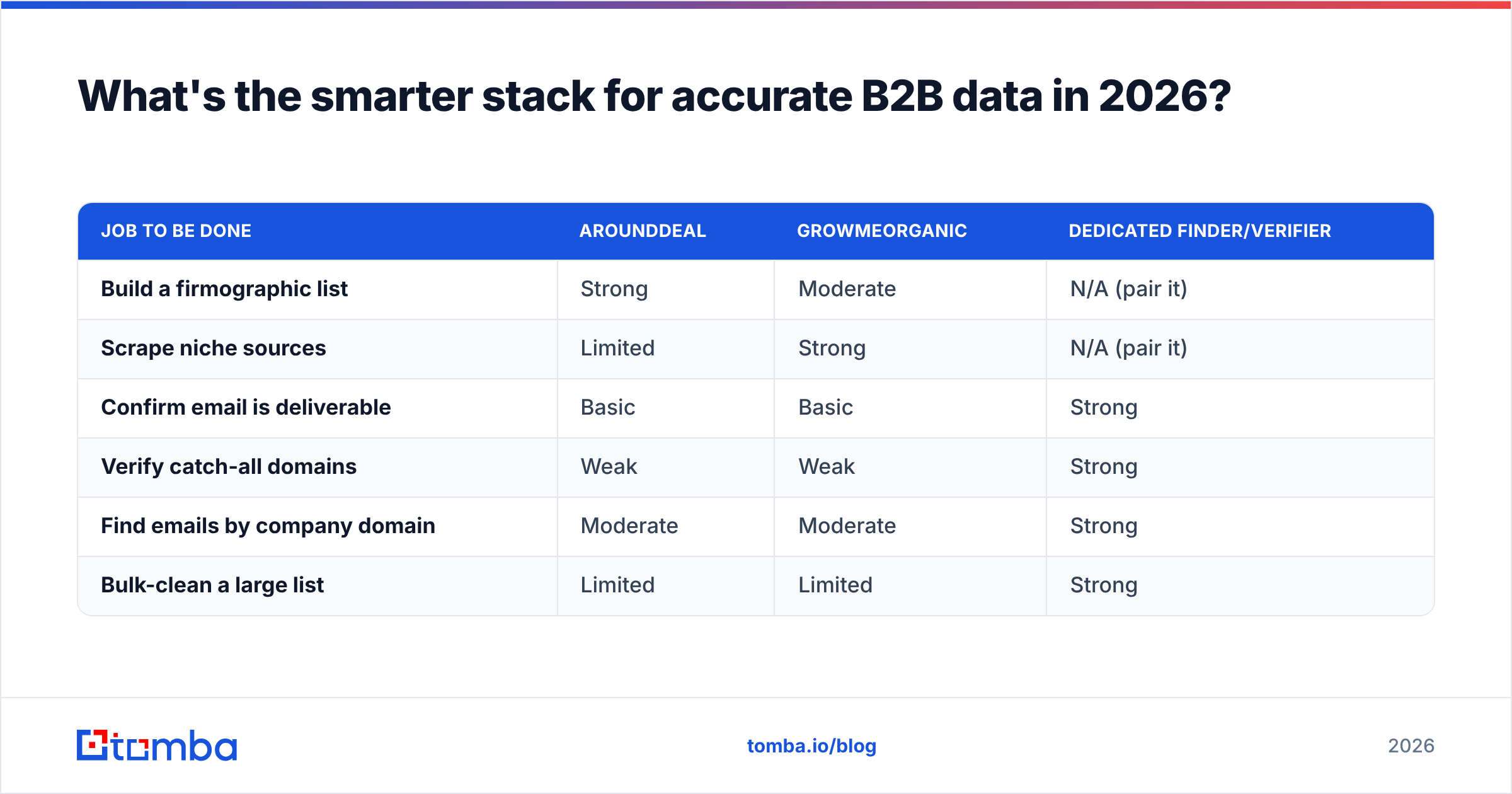
Here's how the layered approach maps to specific jobs:
| Job to be done | AroundDeal | GrowMeOrganic | Dedicated finder/verifier |
|---|---|---|---|
| Build a firmographic list | Strong | Moderate | N/A (pair it) |
| Scrape niche sources | Limited | Strong | N/A (pair it) |
| Confirm email is deliverable | Basic | Basic | Strong |
| Verify catch-all domains | Weak | Weak | Strong |
| Find emails by company domain | Moderate | Moderate | Strong |
| Bulk-clean a large list | Limited | Limited | Strong |
If you want to test this without rebuilding your whole stack, take any list either tool exports and run it through a domain search to fill gaps, then a bulk verify pass to strip the bounces. The difference in your bounce dashboard usually shows up on the first send.
For teams that have outgrown spreadsheet exports entirely, the Tomba API lets you wire finding and verification directly into your CRM or sequencer, so the verify step happens automatically instead of being the thing everyone forgets.
Frequently asked questions#
Is AroundDeal or GrowMeOrganic cheaper? At entry tiers they're close — roughly $49–$59/mo. GrowMeOrganic is usually cheaper in total cost for a solo user because sending is bundled. AroundDeal can cost more as you add seats, but you're buying a deeper database and intent data.
Can I use either for GDPR-compliant outreach? Both provide B2B business contact data, but compliance depends on your legal basis and process, not the vendor's marketing claims. Confirm consent and legitimate-interest handling for your region before sending.
Do I still need a verification tool if I use these? Yes. Database and scraped data both degrade over time, and neither platform verifies at the depth a dedicated tool does. Verifying before you send is the single highest-ROI step in cold outreach.
Which one integrates better with my CRM? Both push to common CRMs, but check the specific connector you need (HubSpot, Pipedrive, Salesforce) against current docs — integration depth changes between plans. You can compare general patterns on G2 and each vendor's own integration page.
The bottom line#
AroundDeal wins on database depth, intent data, and team-scale discovery; GrowMeOrganic wins on all-in-one convenience and founder-friendly cost. But the decision that actually moves your reply rate isn't which of these you pick — it's whether you verify before you send.
If accuracy and deliverability are the metrics you're graded on, put a precision layer in front of your sends. Start with the Tomba Email Finder to turn names and domains into confirmed, deliverable addresses, then verify in bulk before any campaign goes out. You can begin on the free tier (25 searches/mo) and scale into Tomba plans — Starter at $49/mo, Growth at $99/mo — only when the data is proving itself in your bounce dashboard. Discovery tools find people. A finder-plus-verifier stack makes sure your email actually lands.
Ready to find emails that actually work?
Join 150,000+ professionals who stopped guessing and started sending. Free credits on signup — no credit card required.
Get the Tomba newsletter
Practical outbound tactics and product updates — once every two weeks.
About the author