Best Autobound Alternatives for AI Sales Outreach in 2026
Autobound writes hyper-personalized cold emails, but it won't find or verify the contacts behind them. Here are the strongest Autobound alternatives for 2026 and where each one actually fits.

Best Autobound Alternatives for AI Sales Outreach in 2026
Autobound made a name for itself by writing cold emails that actually reference something specific about the prospect — a funding round, a podcast appearance, a tech-stack change. That's genuinely useful. But if you've spent a quarter inside the product, you already know the catch: great copy means nothing if it lands in the wrong inbox, a dead inbox, or no inbox at all.
This guide breaks down the best Autobound alternatives for 2026, what each one is actually good at, and how to stop paying for personalization on top of bad contact data.
TL;DR#
- Autobound is a writing layer, not a data layer. It personalizes messages but relies on you to bring accurate, verified contacts.
- The biggest gap in most Autobound stacks is data quality — bounced emails kill deliverability faster than weak copy kills reply rates.
- Best all-in-one alternatives: Apollo (data + sequencing), Lavender (real-time coaching), Clay (enrichment + AI), Smartlead/Instantly (sending at scale).
- Best data foundation under any of them: a dedicated email finder and verifier like Tomba, so every personalized email reaches a real person.
- Match the tool to the bottleneck. Pick for the problem you have now (data, copy, or sending), not the demo that looked shiniest.
What does Autobound actually do — and where does it stop?#
Autobound is an AI sales-content tool. It scrapes public signals about a prospect and their company, then drafts personalized emails, LinkedIn messages, and openers built around those signals. Think of it as a research assistant that also writes the first draft.
Here's the analogy: Autobound is a brilliant ghostwriter who hands you a perfectly worded letter. But the ghostwriter doesn't know the recipient's address, doesn't check whether they still live there, and doesn't mail it for you. That's the boundary. Autobound personalizes; it does not reliably find contacts, verify them, or send at scale with deliverability controls baked in.
That boundary is exactly why people look for alternatives. The complaints cluster into three buckets:
- Data dependency — you still need a separate source for emails and phone numbers, and Autobound's enrichment is thin.
- Price-to-value — paying a premium for copy when your bounce rate is 12% feels backwards.
- Workflow sprawl — copy in one tool, data in another, sending in a third.

What should you compare Autobound alternatives on?#
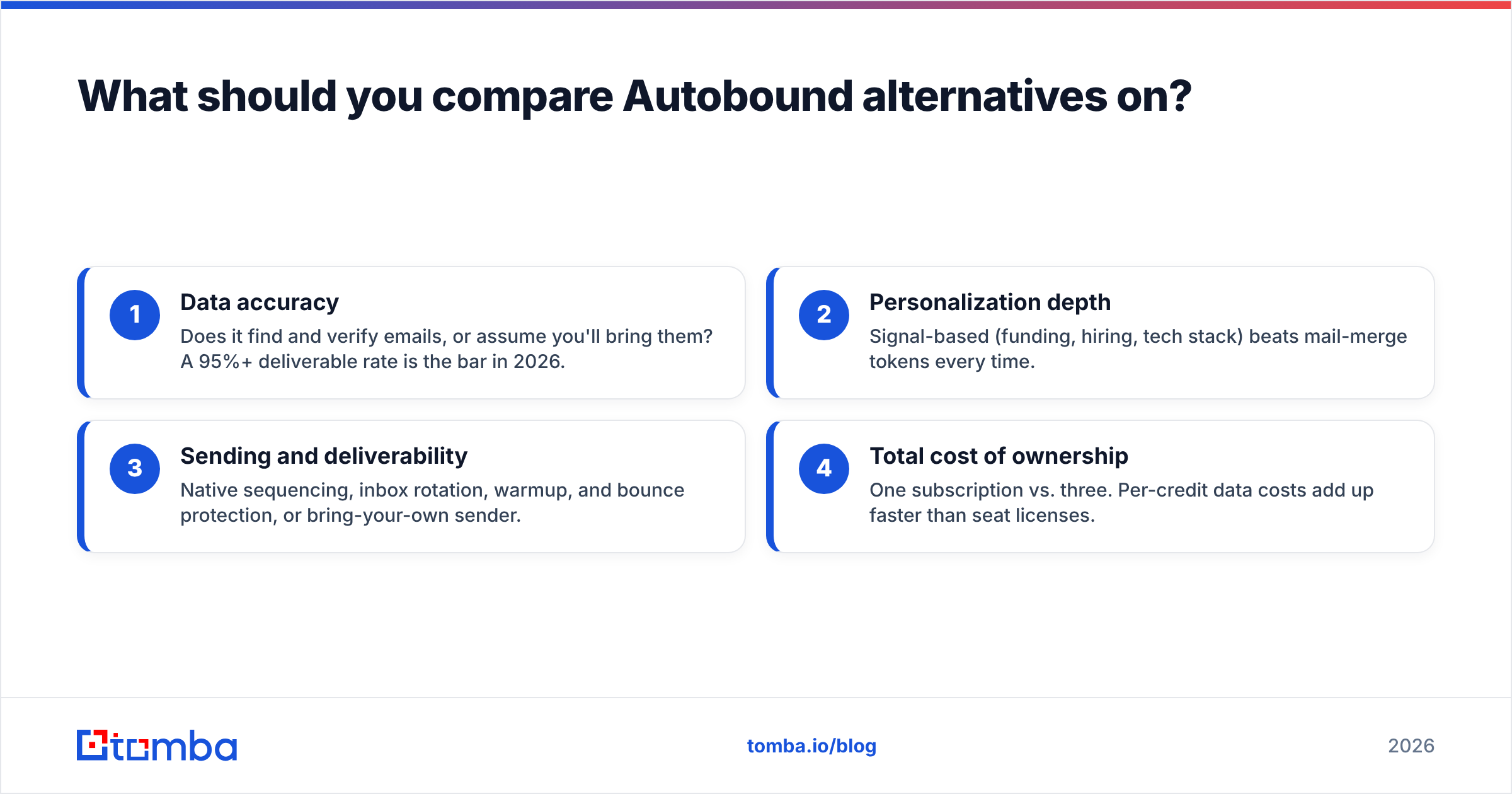
Before you look at logos, get clear on the four dimensions that determine whether a tool earns its seat in your stack. Score each candidate on these:
- Data accuracy — Does it find and verify emails, or assume you'll bring them? A 95%+ deliverable rate is the bar in 2026.
- Personalization depth — Signal-based (funding, hiring, tech stack) beats mail-merge tokens every time.
- Sending and deliverability — Native sequencing, inbox rotation, warmup, and bounce protection, or bring-your-own sender.
- Total cost of ownership — One subscription vs. three. Per-credit data costs add up faster than seat licenses.
Most teams over-index on dimension 2 (copy) because it's the most visible in a demo. The reps who hit quota over-index on dimension 1, because bad data caps the ceiling on everything else. You cannot personalize your way out of a bounced send.
Which are the best Autobound alternatives in 2026?#
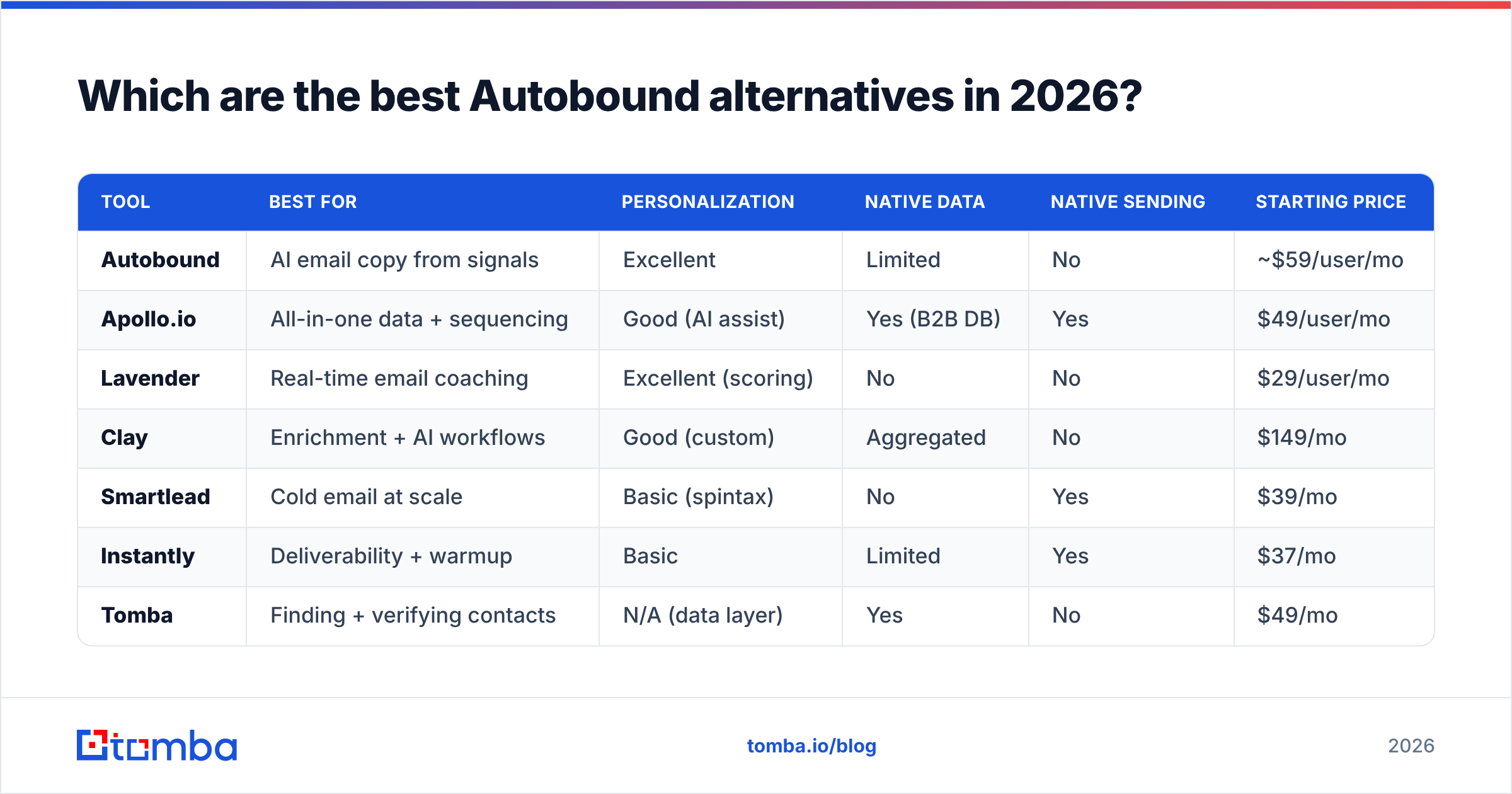
Here's the head-to-head. These are the tools sales teams most often evaluate when replacing or supplementing Autobound, grouped by the job they do best.
| Tool | Best for | Personalization | Native data | Native sending | Starting price |
|---|---|---|---|---|---|
| Autobound | AI email copy from signals | Excellent | Limited | No | ~$59/user/mo |
| Apollo.io | All-in-one data + sequencing | Good (AI assist) | Yes (B2B DB) | Yes | $49/user/mo |
| Lavender | Real-time email coaching | Excellent (scoring) | No | No | $29/user/mo |
| Clay | Enrichment + AI workflows | Good (custom) | Aggregated | No | $149/mo |
| Smartlead | Cold email at scale | Basic (spintax) | No | Yes | $39/mo |
| Instantly | Deliverability + warmup | Basic | Limited | Yes | $37/mo |
| Tomba | Finding + verifying contacts | N/A (data layer) | Yes | No | $49/mo |
A few honest notes on this table. Pricing tiers shift, so confirm on each vendor's site — but the shape of the comparison is the point: no single tool wins every column. Autobound owns copy. Apollo owns the all-in-one middle. Smartlead and Instantly own sending. And the contact-data foundation that every one of them quietly assumes you already have is its own category.
Apollo.io — the all-in-one default#
Apollo bundles a large B2B database, sequencing, and AI email assistance into one platform. If your problem is "too many tools," Apollo collapses three of them. The tradeoff: its database accuracy is inconsistent on smaller or non-US companies, and reps often layer a dedicated email verifier on top. If Apollo is on your shortlist, it's worth reading a focused Apollo alternative breakdown before you commit a full team to seats.
Lavender — coaching, not generating#
Lavender scores your emails in real time and coaches you toward better copy, rather than generating it wholesale. It's the closest philosophical match to Autobound's "make outreach better" promise, but it keeps the human in the loop. No data, no sending — pure copy quality.
Clay — the power user's enrichment engine#
Clay is a spreadsheet-meets-automation tool that pulls from dozens of data providers and runs AI prompts per row. It's enormously flexible and enormously fiddly. Great for ops-minded teams; overkill for a two-person SDR crew.
Smartlead and Instantly — the sending layer#
Both are built for one thing: getting cold email delivered at volume with inbox rotation and warmup. They assume you arrive with a clean, verified list. Pair either with a strong email verifier and your bounce rate stays low enough to protect email deliverability over months, not weeks.
Is the real gap in your stack copy — or contacts?#
Conclusion first: for most teams replacing Autobound, the missing piece isn't another copy tool — it's reliable contact data underneath whatever copy tool you keep.
Run the math. If you send 1,000 personalized emails and 12% bounce, that's 120 wasted sends, a damaged sender reputation, and a deliverability hit that drags down the other 880. The world's best AI opener cannot recover a message that never arrives. This is the part Autobound — and Lavender, and Smartlead — simply don't solve.
That's where a dedicated finding-and-verifying layer earns its keep. Instead of trusting a generic database dump, you resolve the actual person:
- Find email addresses by name + company domain, with the source patterns shown.
- Verify before you send so catch-all and dead addresses get filtered out, not mailed.
- Enrich the rest of the record — title, company, social — so your personalization tool has real fuel to work with via data enrichment.
- Push clean records into your CRM through native HubSpot integration so reps never copy-paste a bad email again.
This is the layer Autobound assumes you already have. Most teams don't — they're stitching it together from stale exports.
How do you build a stack instead of buying one tool?#
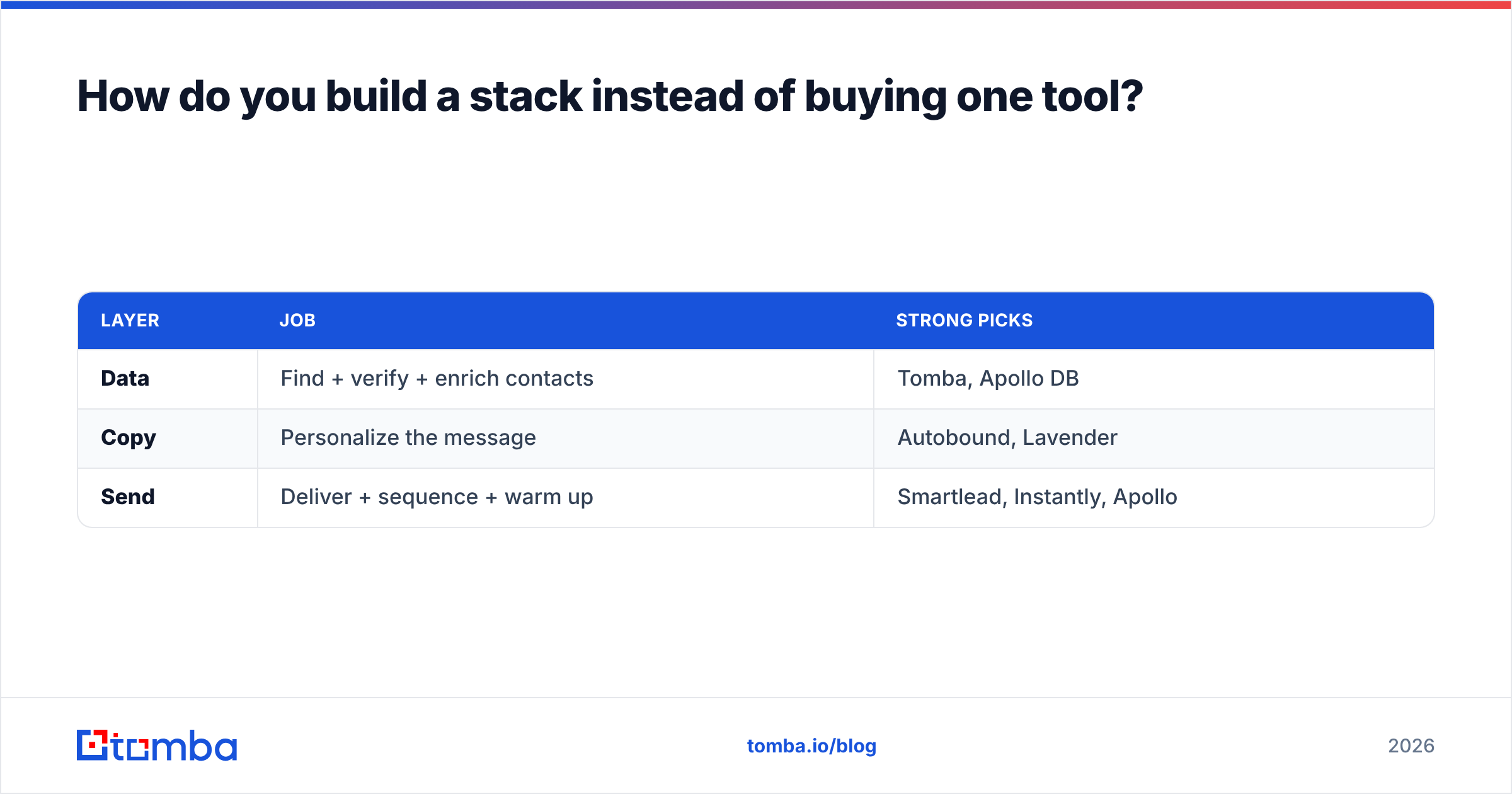
Stop thinking "Autobound replacement" and start thinking "outreach stack." The strongest 2026 setups separate the three jobs and pick a specialist for each:
| Layer | Job | Strong picks |
|---|---|---|
| Data | Find + verify + enrich contacts | Tomba, Apollo DB |
| Copy | Personalize the message | Autobound, Lavender |
| Send | Deliver + sequence + warm up | Smartlead, Instantly, Apollo |
The mistake is buying one tool that claims to do all three and discovering it does one well and two poorly. A specialist data layer plus a specialist copy layer plus a specialist sending layer beats any single "all-in-one" on raw output — and often costs less once you stop paying premium prices for features you barely use.
If you'd rather consolidate, Apollo is the most credible single-vendor route, and the all-in-one tradeoffs are covered well by independent reviews on G2. If you'd rather have best-in-class at each layer, start with the data layer, because it's the one every other tool depends on.
What does this look like in practice?#
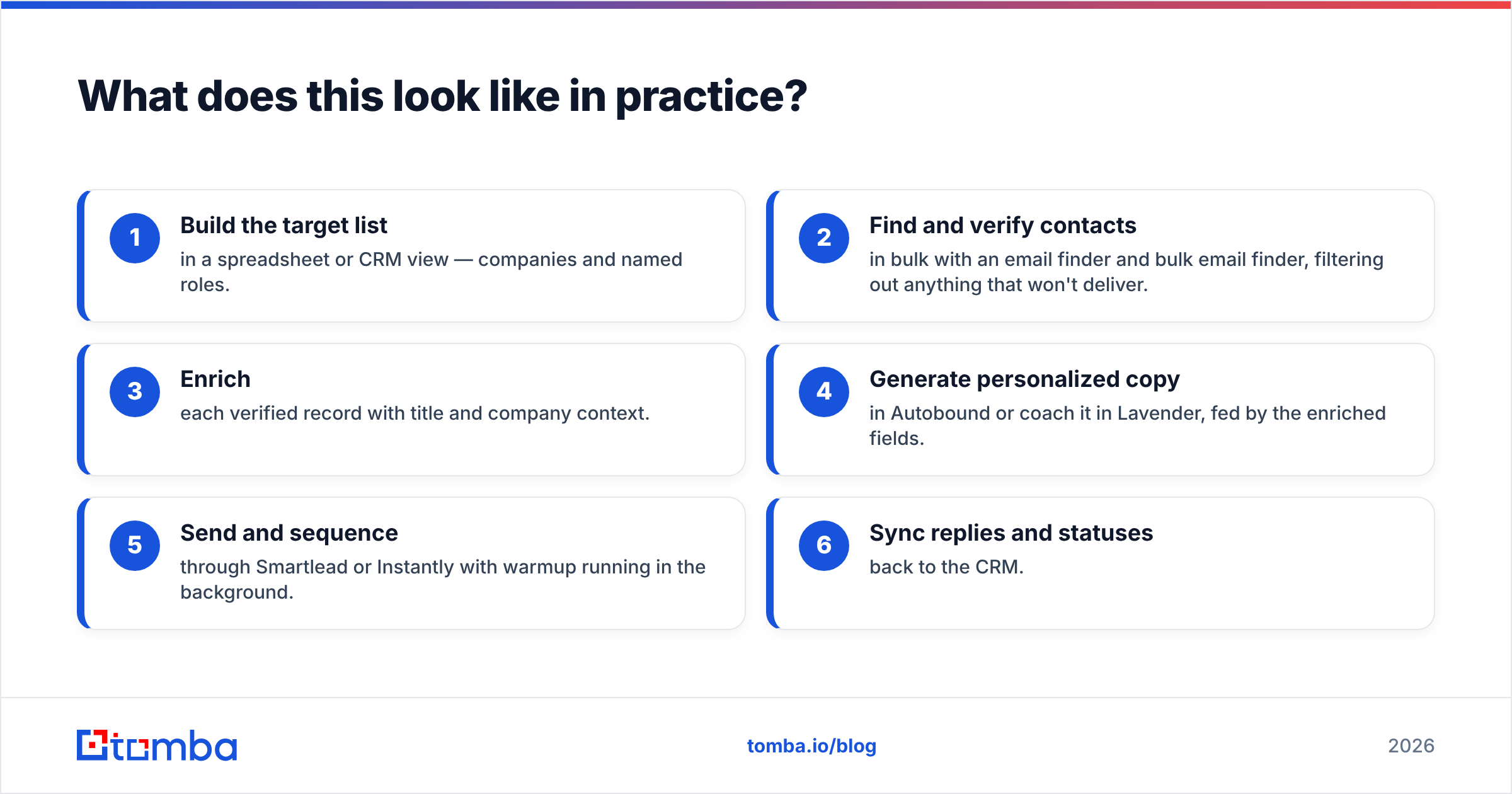
A realistic 2026 outbound workflow for a small SDR team:
- Build the target list in a spreadsheet or CRM view — companies and named roles.
- Find and verify contacts in bulk with an email finder and bulk email finder, filtering out anything that won't deliver.
- Enrich each verified record with title and company context.
- Generate personalized copy in Autobound or coach it in Lavender, fed by the enriched fields.
- Send and sequence through Smartlead or Instantly with warmup running in the background.
- Sync replies and statuses back to the CRM.
Notice that steps 2 and 3 — the data layer — happen before the copy step. The copy is only as good as the record it personalizes. Garbage in, eloquent garbage out.
Frequently asked questions#
Is there a free Autobound alternative? For copy, Lavender has a free tier for limited scoring. For the data layer that actually gates your results, you can start finding and verifying contacts on a free plan — useful for testing accuracy before paying. See Tomba pricing for the free tier (25 searches/month) and paid plans from $49/mo.
Can I keep Autobound and just fix my data? Yes — and for many teams that's the smartest move. Keep Autobound for copy, add a finding-and-verification layer underneath it, and your existing investment immediately performs better because the emails reach real inboxes.
Which alternative is cheapest? On headline price, Instantly and Smartlead start lowest (~$37–39/mo) but only cover sending. Once you add the data and copy layers, total cost matters more than any single sticker price.
Do I still need a separate email verifier? If your tool doesn't verify natively (most copy and sending tools don't), yes. Verification is the single highest-ROI step in cold outreach — it protects deliverability for every other email you send.
The bottom line#
Autobound is a strong writing layer with a real blind spot: it assumes you already have accurate, verified contacts. The best Autobound alternatives in 2026 aren't just "another AI copywriter" — they're the tools that fix whichever layer is actually holding your numbers back. For most teams, that layer is data.
Before you re-up any copy subscription, fix the foundation. Use the Tomba Email Finder to find and verify the people behind your campaigns, enrich the records, and push clean data into your sequencing tool — so every personalized email you send actually lands. Start free with 25 searches a month and measure your bounce rate before and after. The difference is usually bigger than any copy tweak.
// get started
Find, verify and enrich your first contacts today
Start on the free plan with 25 searches a month, then scale when your team is ready.
Free plan · No credit card required · GDPR & CCPA
// about the author