Autoklose Pricing 2026: Plans, Real Costs & Alternatives
A no-fluff breakdown of Autoklose pricing in 2026 — every tier, what's actually included, the hidden data costs, and when a cheaper stack wins.
Autoklose markets itself as an all-in-one sales engagement platform: email sequencing, a built-in B2B contact database, and campaign analytics in one login. The promise is tidy. The pricing is not. Before you put a card down, you need to know what each tier really covers, where the costs creep in, and whether bundling your data and your sending into one vendor actually saves you money.
This guide breaks down Autoklose pricing for 2026 in plain terms, then shows you when a leaner stack — a dedicated email finder plus a sending tool — beats the bundle.
TL;DR#
- Autoklose is billed per user per month, with annual contracts pushing the headline price down and monthly billing pushing it up. Plan on roughly $60–$80 per seat/month at the entry level, more for teams that need the contact database.
- The "all-in-one" pitch hides two meters: your sending seats and your data/contact credits. Heavy prospecting teams hit the data ceiling fast.
- You can replicate most of Autoklose with a dedicated email finder for data and a separate sequencing tool — often for less, with better email accuracy.
- Best fit for Autoklose: small teams that want one bill and don't already own a CRM-centric workflow.
- Skip it if you need surgical data accuracy, already pay for a sequencer, or send at volume where per-seat pricing punishes growth.
What is Autoklose and how does its pricing model work?#
Autoklose is a sales engagement platform — think automated email sequences, follow-up scheduling, A/B testing, and reporting — with an attached database of B2B contacts you can pull leads from directly. It was acquired by VanillaSoft, and the product now sits inside a broader sales-engagement portfolio.
The pricing model rests on two things you should separate in your head:
- Seats — you pay per user who sends campaigns. This is the recurring backbone of the bill.
- Data — access to the built-in contact database (the "unlimited campaigns, limited contacts" reality). Pulling verified contacts draws against your plan's allowance or a separate data package.
That two-meter design is the single most important thing to understand about Autoklose pricing. The sequencing engine is the cheap part to run. The data is where vendors make margin, and where your bill quietly grows as your team prospects harder.
What are the Autoklose pricing tiers in 2026?#
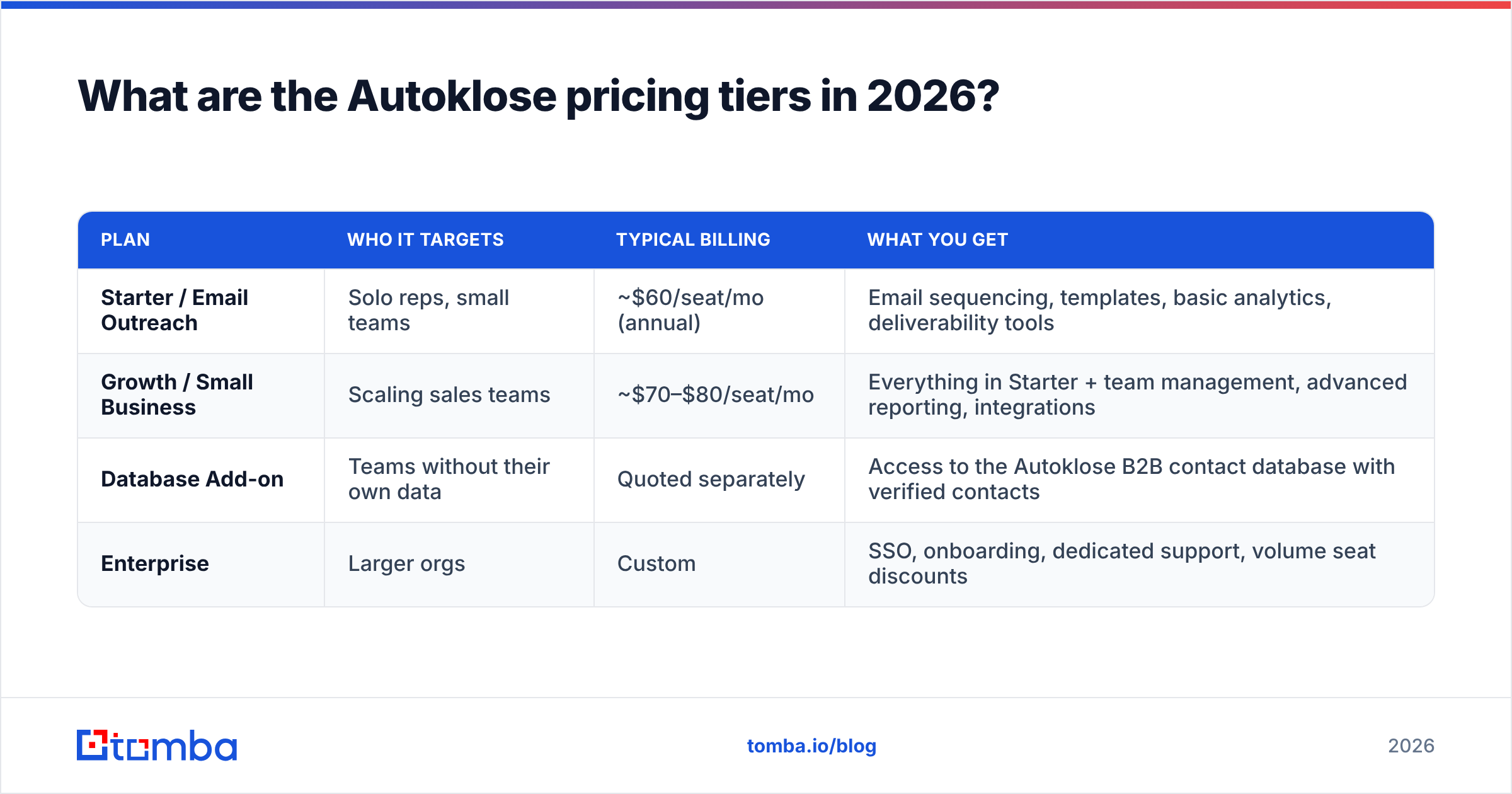
Autoklose publishes seat-based plans that scale with team size and feature depth. Exact numbers shift with promotions and annual-vs-monthly billing, so treat the table below as the shape of the offer rather than a quote — always confirm on the vendor's own pricing page.
| Plan | Who it targets | Typical billing | What you get |
|---|---|---|---|
| Starter / Email Outreach | Solo reps, small teams | ~$60/seat/mo (annual) | Email sequencing, templates, basic analytics, deliverability tools |
| Growth / Small Business | Scaling sales teams | ~$70–$80/seat/mo | Everything in Starter + team management, advanced reporting, integrations |
| Database Add-on | Teams without their own data | Quoted separately | Access to the Autoklose B2B contact database with verified contacts |
| Enterprise | Larger orgs | Custom | SSO, onboarding, dedicated support, volume seat discounts |
A few things this table makes obvious:
- Annual lock-in is the lever. The attractive per-seat numbers usually assume you prepay a year. Month-to-month is meaningfully more expensive.
- The database is its own line item. "All-in-one" doesn't mean "all-included." If you want Autoklose to also be your lead source, budget for it separately.
- Cost scales with headcount, not value. Add a rep, add a full seat — even if that rep sends a fraction of the volume.
What is actually included versus what costs extra?#
Here's where buyers get surprised. The base subscription covers the sending engine. The things that make the platform genuinely useful for outbound often sit in higher tiers or as add-ons.
- Sequencing & follow-ups — included on every plan. This is the core.
- Deliverability tooling (verification, sending caps) — partially included; advanced controls trend upward.
- Contact database access — typically a separate package or higher tier.
- Advanced analytics & team roles — gated to Growth and above.
- Integrations & API — available, but the depth varies by tier.
Compare that to running data and sending as separate, best-in-class tools. You pay for exactly the data you pull and exactly the seats you send from — no bundling tax. If your team's bottleneck is finding accurate contacts rather than sending, paying Autoklose's seat price to access a generalist database is the wrong place to spend.
Is Autoklose's bundled data worth it, or should you use a dedicated email finder?#
Short answer: for accuracy-sensitive outbound, a dedicated email finder usually wins.
Bundled databases optimize for breadth and convenience. They're fine for filling a top-of-funnel list. But cold email lives and dies on deliverability, and deliverability lives and dies on data quality. Sending to stale or guessed addresses spikes your bounce rate, which damages your sender reputation and drags down every campaign you run after it.
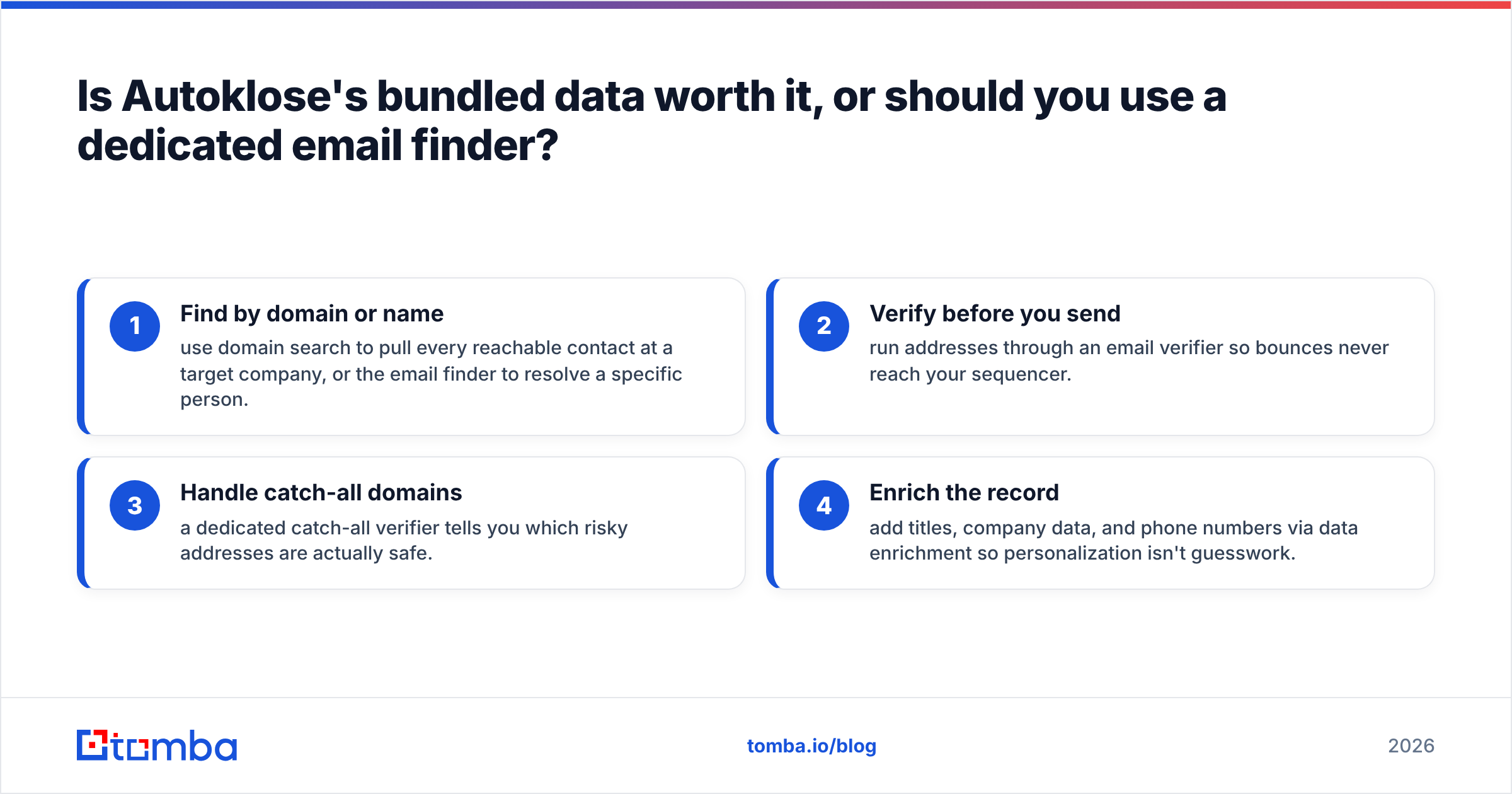
A specialist tool lets you find and verify in one motion:
- Find by domain or name — use domain search to pull every reachable contact at a target company, or the email finder to resolve a specific person.
- Verify before you send — run addresses through an email verifier so bounces never reach your sequencer.
- Handle catch-all domains — a dedicated catch-all verifier tells you which risky addresses are actually safe.
- Enrich the record — add titles, company data, and phone numbers via data enrichment so personalization isn't guesswork.
That's four jobs a bundled database does loosely and a focused tool does precisely. The accuracy difference shows up directly in your bounce rate and reply rate.

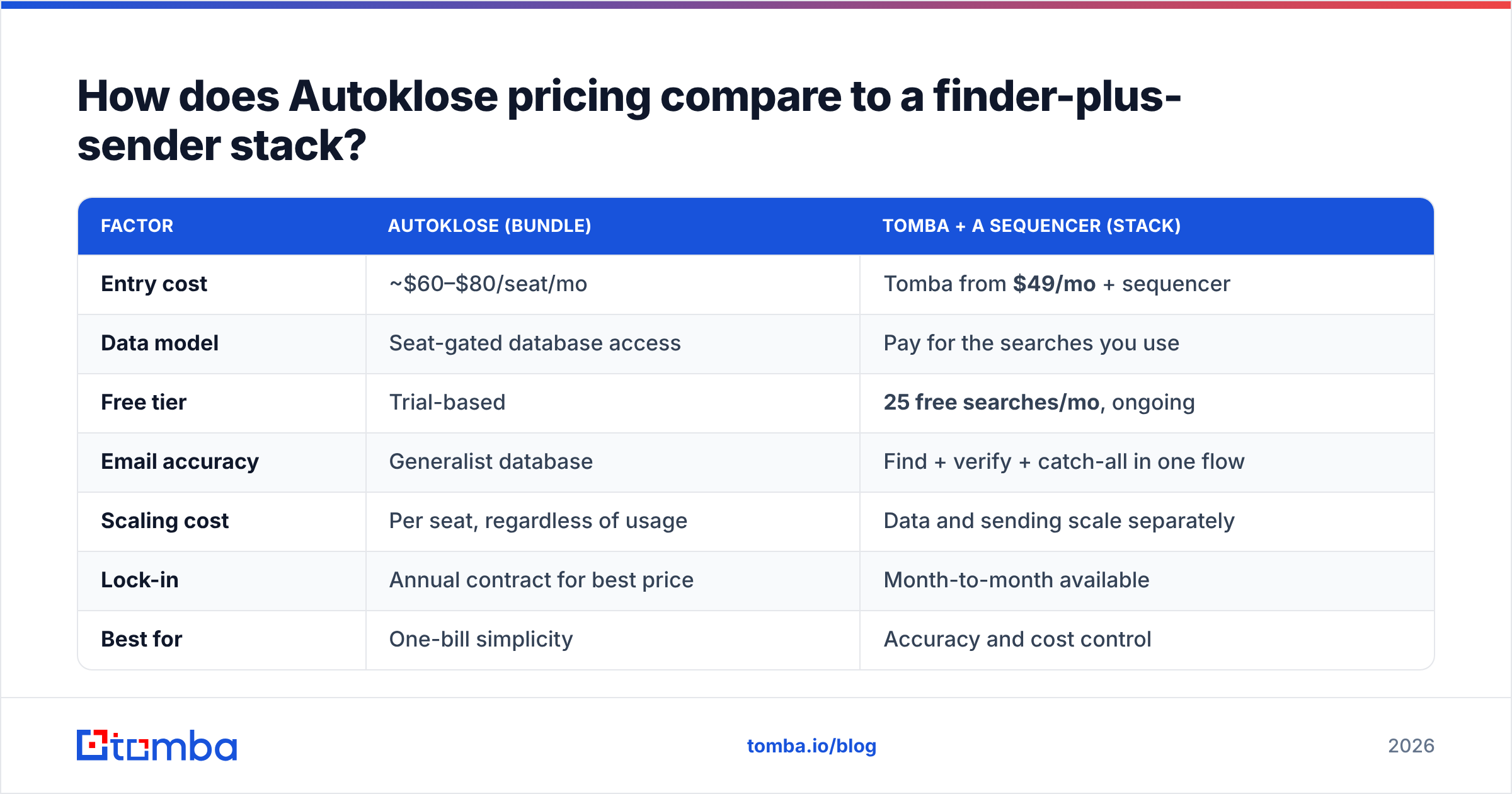
How does Autoklose pricing compare to a finder-plus-sender stack?#
Let's put real shapes side by side. The bundle is one bill; the stack is two cheaper bills that you can scale independently.
| Factor | Autoklose (bundle) | Tomba + a sequencer (stack) |
|---|---|---|
| Entry cost | ~$60–$80/seat/mo | Tomba from $49/mo + sequencer |
| Data model | Seat-gated database access | Pay for the searches you use |
| Free tier | Trial-based | 25 free searches/mo, ongoing |
| Email accuracy | Generalist database | Find + verify + catch-all in one flow |
| Scaling cost | Per seat, regardless of usage | Data and sending scale separately |
| Lock-in | Annual contract for best price | Month-to-month available |
| Best for | One-bill simplicity | Accuracy and cost control |
The stack wins on three fronts that matter for growing teams: you don't pay full freight for light-touch seats, you control data spend independently of headcount, and you get verification built into the data step instead of bolted on. For exact numbers on the data side, see the full Tomba pricing breakdown.
The bundle wins on exactly one front: a single invoice and a single login. For some small teams that's worth real money in saved admin time. Be honest about whether it's worth it for yours.
What are the best Autoklose alternatives by use case?#
Autoklose isn't a bad tool — it's a generalist. The right alternative depends on which job you're actually buying for.
- You mostly need accurate contact data. Lead with a finder. Tomba's bulk email finder turns a list of companies or names into verified contacts, and the Chrome extension pulls emails while you browse LinkedIn or company sites.
- You already own a sequencer (Instantly, Saleshandy, Reply). Don't pay for Autoklose's sending engine twice. Keep your sender, swap in dedicated data. See the Instantly alternative and Saleshandy alternative breakdowns.
- You're escaping an expensive all-in-one. If you came to Autoklose from Apollo or RocketReach, compare the data layer directly — the Apollo alternative and RocketReach alternative pages lay out where each one's data actually holds up.
- You live in spreadsheets or a CRM. Skip the platform entirely and pull data where you work using the Google Sheets add-on or the HubSpot integration.
The pattern: unbundle. Buy the data layer from a data specialist and the sending layer from a sending specialist. You'll usually pay less and perform better than a single vendor that does both adequately.
How do you avoid overpaying on any sales engagement platform?#
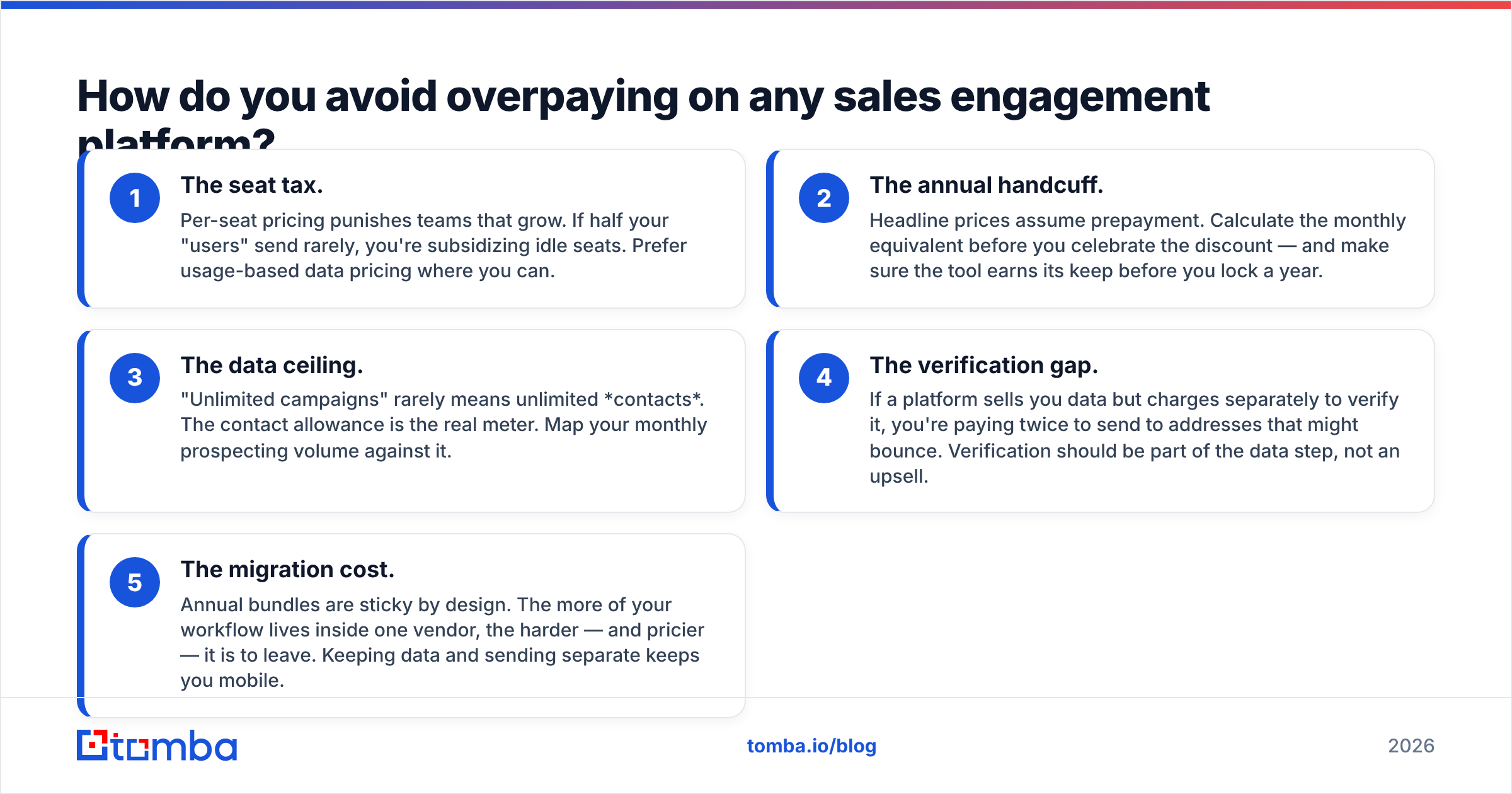
The pricing traps are the same across Autoklose, Apollo, and every all-in-one. Watch for these:
- The seat tax. Per-seat pricing punishes teams that grow. If half your "users" send rarely, you're subsidizing idle seats. Prefer usage-based data pricing where you can.
- The annual handcuff. Headline prices assume prepayment. Calculate the monthly equivalent before you celebrate the discount — and make sure the tool earns its keep before you lock a year.
- The data ceiling. "Unlimited campaigns" rarely means unlimited contacts. The contact allowance is the real meter. Map your monthly prospecting volume against it.
- The verification gap. If a platform sells you data but charges separately to verify it, you're paying twice to send to addresses that might bounce. Verification should be part of the data step, not an upsell.
- The migration cost. Annual bundles are sticky by design. The more of your workflow lives inside one vendor, the harder — and pricier — it is to leave. Keeping data and sending separate keeps you mobile.
Run those five checks against any quote and the right structure for your team becomes obvious. Most teams that audit honestly discover they're paying platform prices for data they could source more accurately, and cheaper, elsewhere.
According to independent reviews on G2, Autoklose users consistently praise the ease of the sequencing workflow while flagging data quality as the area that needs the most attention — which is exactly the half of the bundle worth replacing with a specialist.
The bottom line on Autoklose pricing#
Autoklose pricing is straightforward in structure and slippery in practice: per-seat sending plus a separately-metered contact database, with the best rates locked behind annual contracts. It's a reasonable buy for a small team that values one bill over surgical cost control. For everyone else — especially teams whose real constraint is data accuracy — unbundling wins.
If finding and verifying contacts is where your outbound actually breaks, fix that first. The Tomba Email Finder resolves professional emails by domain, name, or company and verifies them in the same flow, starting free with 25 searches a month and scaling from $49/mo — so you pay for data, not for idle seats. Pair it with whatever sequencer you already trust, and you'll spend less than the bundle while landing in more inboxes.
// get started
Find, verify and enrich your first contacts today
Start on the free plan with 25 searches a month, then scale when your team is ready.
Free plan · No credit card required · GDPR & CCPA
// about the author