Average Open Rates for Email Marketing: 2026 Benchmarks
What counts as a good open rate in 2026? See average open rates for email marketing by industry, how Apple MPP skews the number, and the levers that actually move it.
TL;DR
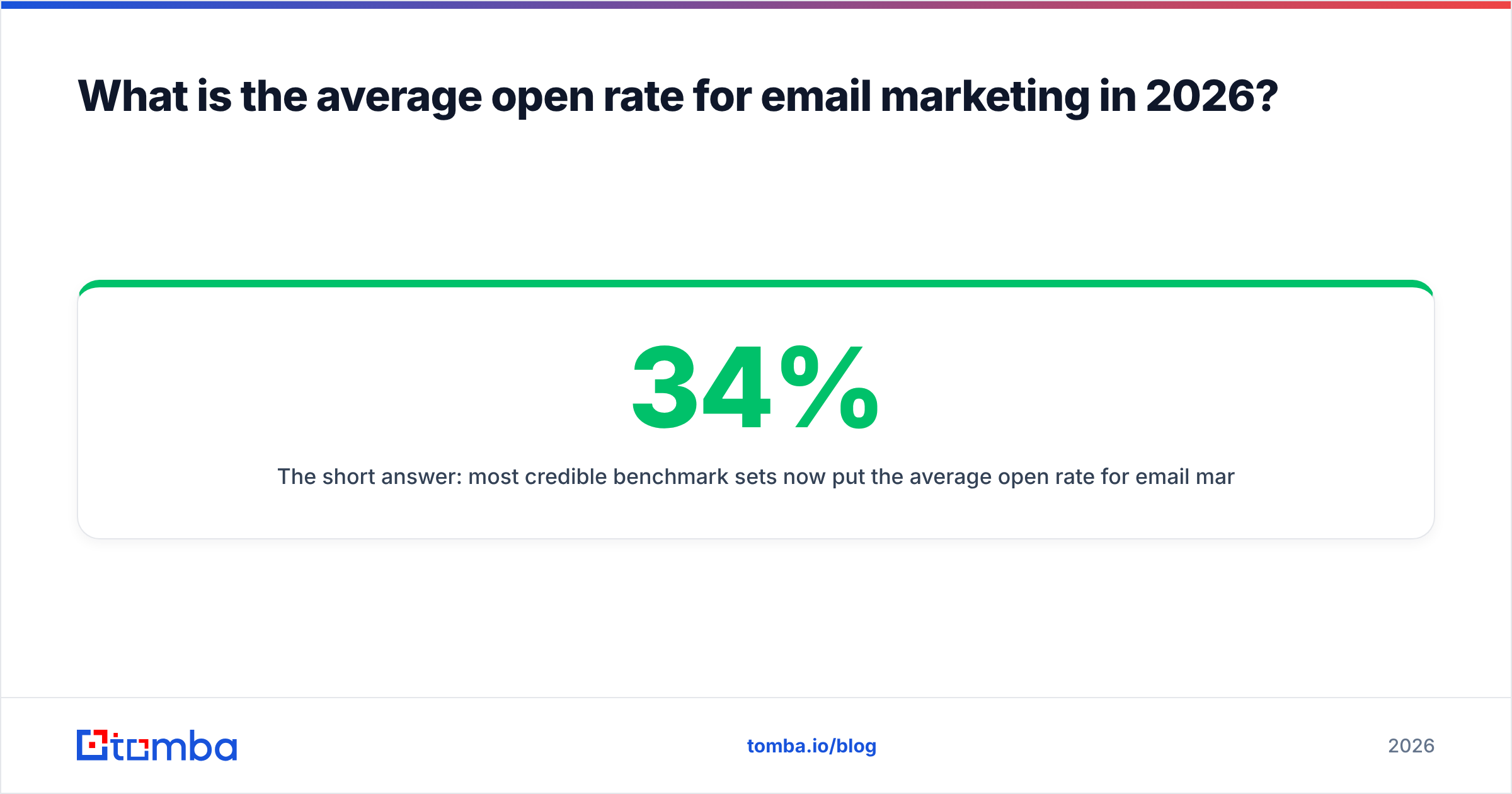
- The average open rate for email marketing in 2026 sits around 34–42% across industries — but that number is inflated by Apple Mail Privacy Protection (MPP) and is no longer a clean engagement signal on its own.
- "Good" is relative: nonprofits, education, and government routinely clear 40%+, while retail and ecommerce often land in the high 20s to low 30s.
- Open rate quality starts with list quality. A clean, verified list beats a bigger dirty one every time — bounces and spam traps quietly tank your sender reputation.
- Subject line, sender name, send time, and segmentation move opens far more than any "best practice" hack.
- Stop optimizing opens in isolation. Pair them with click-through and reply rates so you're measuring real interest, not pixel pings.
What is the average open rate for email marketing in 2026?#
The short answer: most credible benchmark sets now put the average open rate for email marketing between 34% and 42%. That's noticeably higher than the 18–22% everyone quoted five years ago — and the jump is not because your audience suddenly loves you more.
Two things changed. First, Apple's Mail Privacy Protection (rolled out in 2021 and now the default for a large share of inboxes) pre-loads the tracking pixel for Apple Mail users whether or not they actually open the message. That mechanically inflates reported opens. Second, list hygiene and sending tools have matured, so legitimate senders genuinely reach the inbox more often.
The practical takeaway is that an open rate is now a directional metric, not an exact one. Use it to compare your own campaigns against each other and against your industry, not as gospel truth about human behavior.
How is open rate actually calculated?#
Open rate is one of the simplest formulas in marketing — which is exactly why it's so easy to misread.
Open rate = (unique opens ÷ emails delivered) × 100
Note the denominator: delivered, not sent. If you send 10,000 emails and 500 bounce, your delivered figure is 9,500. Open rate is calculated against that 9,500. This is why bounce management matters so much — and why teams that report opens against sent numbers consistently understate their performance.
Here are the variables that decide whether your open rate looks healthy or anemic:
- List quality — Invalid addresses bounce, drag your sender reputation down, and shrink the delivered pool. Verifying contacts before you send is the single highest-leverage fix.
- Sender reputation — Mailbox providers decide inbox-vs-spam placement partly on your historical engagement and complaint rate. A bad sender reputation buries you in spam, where nobody opens anything.
- Subject line and preview text — The only copy a recipient sees before deciding to open. This is where most of your controllable lift lives.
- Sender name recognition — "Sarah from Acme" beats "noreply@acme" almost every time.
- Send timing and frequency — Wrong time zone or too-frequent sends quietly erode opens over weeks.
- Segmentation — A relevant message to a small, targeted segment outperforms a generic blast to everyone.
If you want to dig into the mechanics of inbox placement, the email deliverability glossary entry breaks down the full chain from send to inbox.
What is a good open rate by industry?#
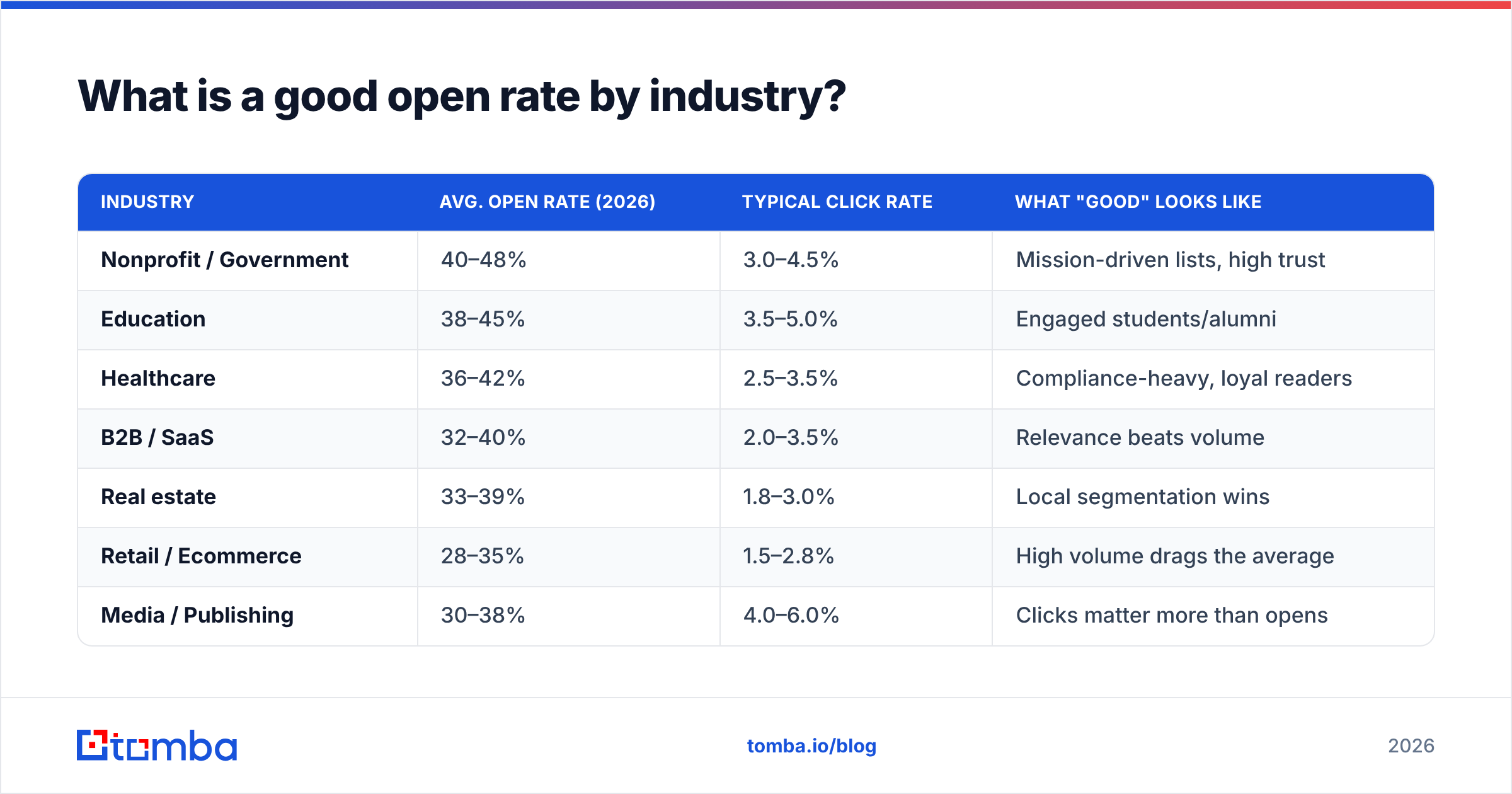
There is no universal "good." A 30% open rate is mediocre for a nonprofit newsletter and excellent for a high-volume retail promo. Benchmarks from Mailchimp and HubSpot consistently show wide spreads by sector. The table below blends typical 2026 ranges so you can find your lane.
| Industry | Avg. open rate (2026) | Typical click rate | What "good" looks like |
|---|---|---|---|
| Nonprofit / Government | 40–48% | 3.0–4.5% | Mission-driven lists, high trust |
| Education | 38–45% | 3.5–5.0% | Engaged students/alumni |
| Healthcare | 36–42% | 2.5–3.5% | Compliance-heavy, loyal readers |
| B2B / SaaS | 32–40% | 2.0–3.5% | Relevance beats volume |
| Real estate | 33–39% | 1.8–3.0% | Local segmentation wins |
| Retail / Ecommerce | 28–35% | 1.5–2.8% | High volume drags the average |
| Media / Publishing | 30–38% | 4.0–6.0% | Clicks matter more than opens |
Read these as starting points, not targets. Your own 90-day rolling average is the only benchmark that fully accounts for your list, your offer, and your sender history.
Why is open rate a flawed metric now?#
Because a recorded "open" no longer reliably means a human opened your email.
Mail Privacy Protection fires the tracking pixel automatically for Apple Mail users, so a meaningful slice of your reported opens are machine events, not eyeballs. Some estimates put Apple Mail's share of opens high enough that it materially shifts your average upward. Other privacy features and image-blocking can push in the opposite direction by suppressing legitimate pixel loads.
The result: open rate has gotten noisier on both ends. That doesn't make it useless — it makes it a metric you triangulate rather than trust blindly. Pair it with metrics that require an actual action:
- Click-through rate (CTR) — someone clicked a link. Hard to fake with a pre-loaded pixel.
- Click-to-open rate (CTOR) — clicks relative to opens; a content-quality signal.
- Reply rate — the gold standard for cold and B2B email, where a human typed back.
- Conversion rate — the only metric your CFO actually cares about.
If your opens are climbing but clicks and replies are flat, you're likely seeing pixel inflation, not real interest.
How do you improve your open rate?#
Improving the average open rate for email marketing comes down to four levers, roughly in order of impact.
1. Fix your list before you fix your copy#
You cannot out-write a bad list. Invalid and stale addresses bounce, spam traps flag you, and your delivered pool shrinks — which mathematically caps your opens. Run every list through an email verifier before a send, and re-verify aging segments periodically. Removing 2,000 dead addresses from a 50,000-contact list often lifts your open rate more than any subject-line test, because every remaining send now reaches a real, reachable inbox.
This is also where data sourcing matters. If you're building lists from scratch, pulling verified, current addresses with an email finder keeps junk out of the funnel from day one instead of cleaning it up after it's already hurt your reputation.
2. Win the subject line and sender name#
The subject line and the "from" name are the entire interface before an open decision. Keep subject lines specific, short enough to survive mobile truncation (roughly 40 characters), and curiosity-driven without crossing into clickbait that erodes trust. Test sender names too — a recognizable human name almost always beats a faceless alias. If you're stuck, a subject line generator is a fast way to brainstorm variants worth A/B testing.
3. Segment and time your sends#
A relevant email to 2,000 people will beat a generic one to 20,000. Segment by behavior, lifecycle stage, or interest, and send when each segment is actually checking email. There's no universal "best time" — there's only your audience's best time, which you find by testing and reading your own analytics.
4. Protect sender reputation over time#
Authentication (SPF, DKIM, DMARC), consistent sending volume, prompt list cleaning, and easy unsubscribes all compound into a strong sender reputation. That reputation is what keeps you in the inbox — and you can't open what you never received. Tools like a free SPF checker help you confirm the technical foundation is solid before you scale volume.
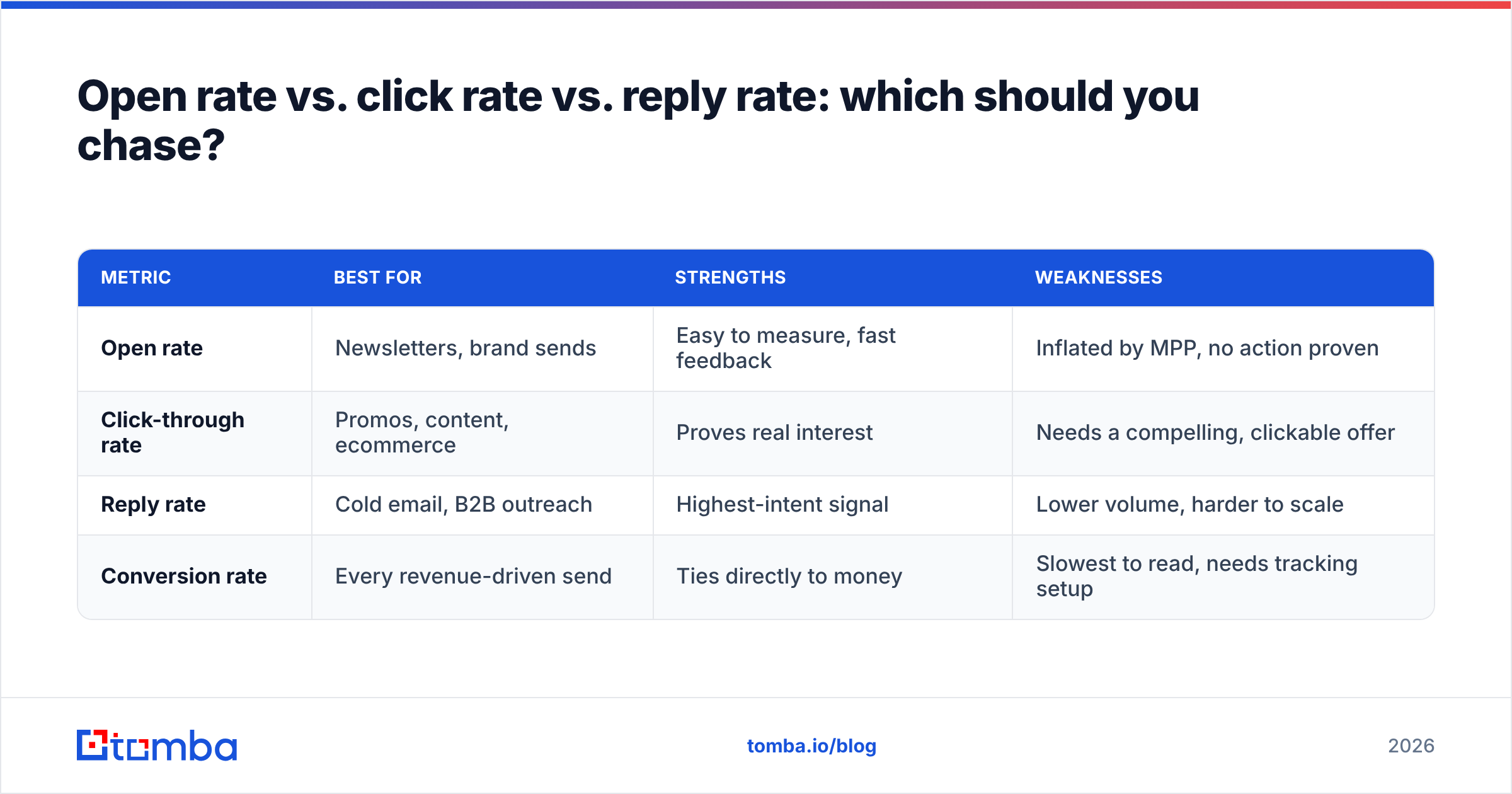
Open rate vs. click rate vs. reply rate: which should you chase?#
Depends on what kind of email you send. Here's a clean way to decide.
| Metric | Best for | Strengths | Weaknesses |
|---|---|---|---|
| Open rate | Newsletters, brand sends | Easy to measure, fast feedback | Inflated by MPP, no action proven |
| Click-through rate | Promos, content, ecommerce | Proves real interest | Needs a compelling, clickable offer |
| Reply rate | Cold email, B2B outreach | Highest-intent signal | Lower volume, harder to scale |
| Conversion rate | Every revenue-driven send | Ties directly to money | Slowest to read, needs tracking setup |
For marketing newsletters, opens and CTOR are reasonable health checks. For outbound and cold email, reply rate is king — a 40% open rate with a 0% reply rate is a vanity number. Match the metric to the job the email is doing.
How does list quality connect to your open rate?#
Directly and mathematically. Every metric downstream of "delivered" depends on the quality of what you put into the top of the funnel.
Think of it like a kitchen. You can be the best chef alive (great copy, perfect timing), but if your ingredients are spoiled (dead addresses, spam traps, typos), the meal fails before it starts. Garbage in, garbage out — except in email, garbage in also poisons the rest of the pantry by damaging your sender reputation, which then suppresses opens on your good contacts too.
That's why high-performing teams treat data hygiene as continuous, not one-time:
- Verify on capture — validate addresses at form submission and at import.
- Re-verify on a schedule — B2B data decays roughly 20–30% per year as people change jobs.
- Suppress hard bounces immediately — never re-send to a confirmed dead address.
- Watch complaint and spam rates — they're early-warning signals for reputation damage.
You can review where contact data comes from and how it's validated on Tomba's data sources page, and benchmark vendors more broadly on G2. The point isn't the specific tool — it's that open rate is a symptom, and list quality is usually the underlying cause.
What open rate should you actually aim for in 2026?#
Aim to beat your own trailing 90-day average, then your industry benchmark, in that order.
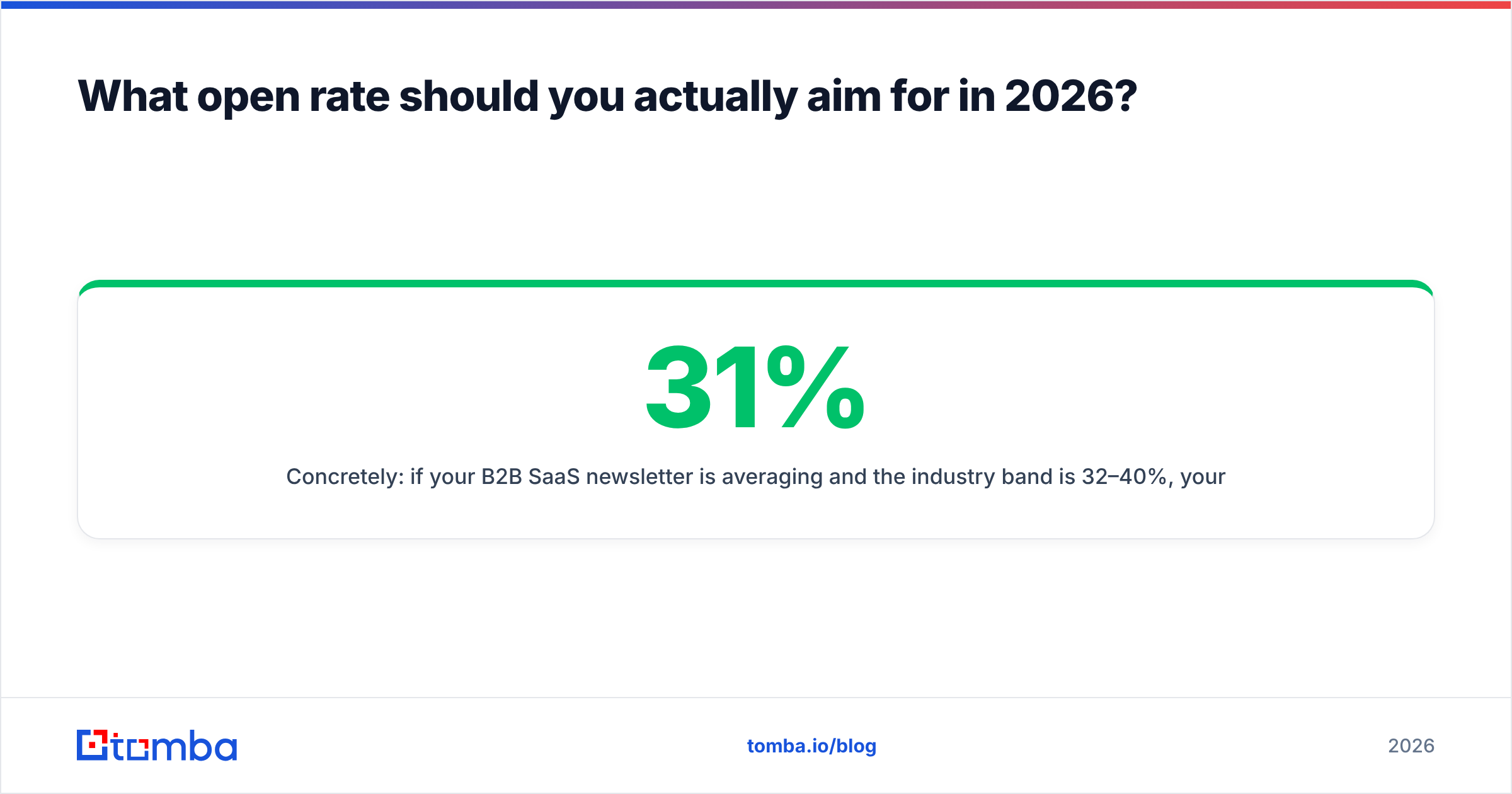
Concretely: if your B2B SaaS newsletter is averaging 31% and the industry band is 32–40%, your near-term goal is to clear 35% consistently, not to chase a nonprofit's 46%. Set the target relative to your sector and your historical performance, then move the four levers — list quality first, copy second, segmentation third, reputation always.
And keep the metric honest. With MPP in the mix, a rising open rate that isn't matched by rising clicks or replies is a warning sign, not a win. The teams that win in 2026 read open rate as one input in a dashboard — alongside CTR, reply rate, and conversions — rather than the headline number they brag about in the Monday standup.
Start with a list worth measuring#
Everything above compounds from one decision: who you send to. The cleanest subject line in the world can't save a list full of bounces and stale contacts, and no benchmark matters if your emails never reach the inbox.
Build that list right from the start. Tomba Email Finder helps you source accurate, current professional email addresses by name, company, or domain — so the contacts entering your funnel are real, reachable, and worth measuring. Pair it with verification before every send, and your open rate stops being a guess and starts being a signal. The free tier gives you 25 searches a month to test it on your next campaign before you scale up.
// get started
Find, verify and enrich your first contacts today
Start on the free plan with 25 searches a month, then scale when your team is ready.
Free plan · No credit card required · GDPR & CCPA
// about the author