B2B Contact Data USA: Best Sources & Accuracy Guide 2026
Buying B2B contact data for the US market? Compare the top providers on coverage, accuracy, pricing, and compliance—and learn how to verify every record before it hits your CRM.
The US market holds the largest pool of reachable B2B buyers on earth, and almost every vendor claims to have the cleanest slice of it. The hard part is telling marketing copy apart from a database that actually connects you to a living decision-maker in Ohio this quarter.
TL;DR#
- B2B contact data USA means business emails, direct dials, job titles, and firmographics for US-based professionals—and its value collapses the moment it goes stale.
- US records decay roughly 2–3% per month as people change jobs, so coverage matters less than freshness and verification.
- No single provider "owns" the US. ZoomInfo and Apollo lead on volume; specialist finders like Tomba win on per-record accuracy and price.
- Always verify before import: a verified list of 2,000 beats an unverified list of 20,000 on deliverability and cost-per-meeting.
- Compliance (CAN-SPAM, CCPA/CPRA, TCPA for calls) is non-negotiable when you buy or enrich US data.
What is B2B contact data in the USA?#
B2B contact data USA is the structured information you need to reach a working professional at a US company: their business email, direct or mobile phone, job title, seniority, department, plus firmographics like company size, industry, revenue, and HQ location. Think of it as a phone book that also tells you who actually makes the buying decision—and whether they still work there.
That last clause is the whole game. A US contact record is a perishable good, like fresh produce. The "list of 50 million US contacts" a vendor advertises is meaningless if a third of those people changed roles last year. Tenure data backs this up: average US job tenure sits around four years and is shorter in sales and tech, which means a database can rot fast if it isn't re-verified continuously.
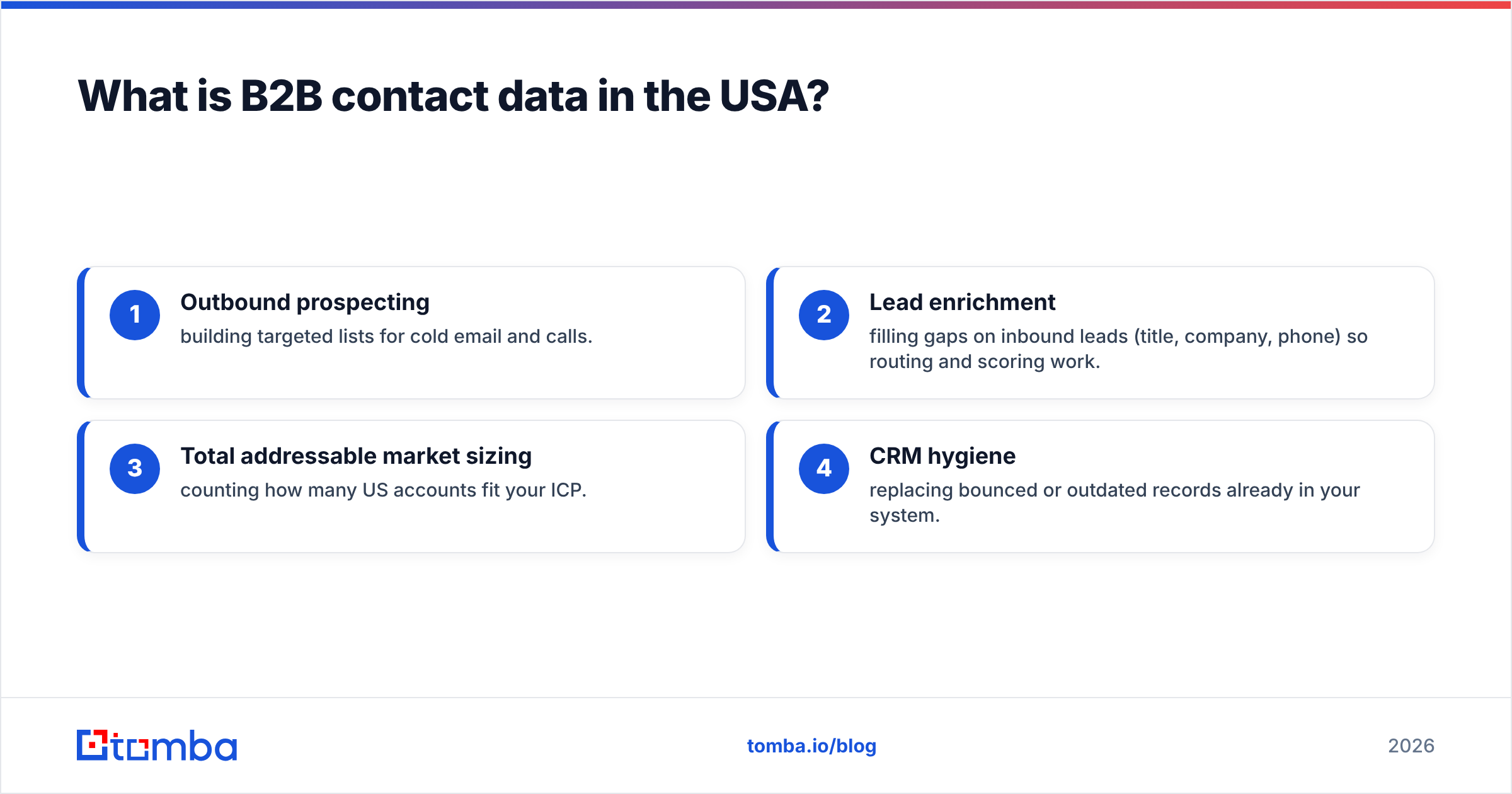
Most teams use this data for four jobs:
- Outbound prospecting — building targeted lists for cold email and calls.
- Lead enrichment — filling gaps on inbound leads (title, company, phone) so routing and scoring work.
- Total addressable market sizing — counting how many US accounts fit your ICP.
- CRM hygiene — replacing bounced or outdated records already in your system.
Where do US B2B contact data providers get their data?#
Providers blend several sources, and the mix explains the quality differences you feel later. Public web and company websites supply firmographics and email patterns. Community or "give-to-get" networks—where users contribute their own contacts in exchange for credits—power the big directories. Public filings, professional profiles, and partner data fill in the rest. Tools like Tomba lean on pattern detection plus live SMTP checks, which is why understanding where Tomba gets data matters when you judge accuracy claims.
Here's the practical takeaway: community-sourced data is broad but uneven, while verified-at-query data is narrower but fresher. The best stacks use both—a wide directory to discover accounts and a verification layer to confirm the specific people you'll actually contact.
How do the top B2B contact data USA providers compare?#
There is no universal winner; there's a best fit for your motion and budget. High-volume sales orgs that live in one platform lean toward
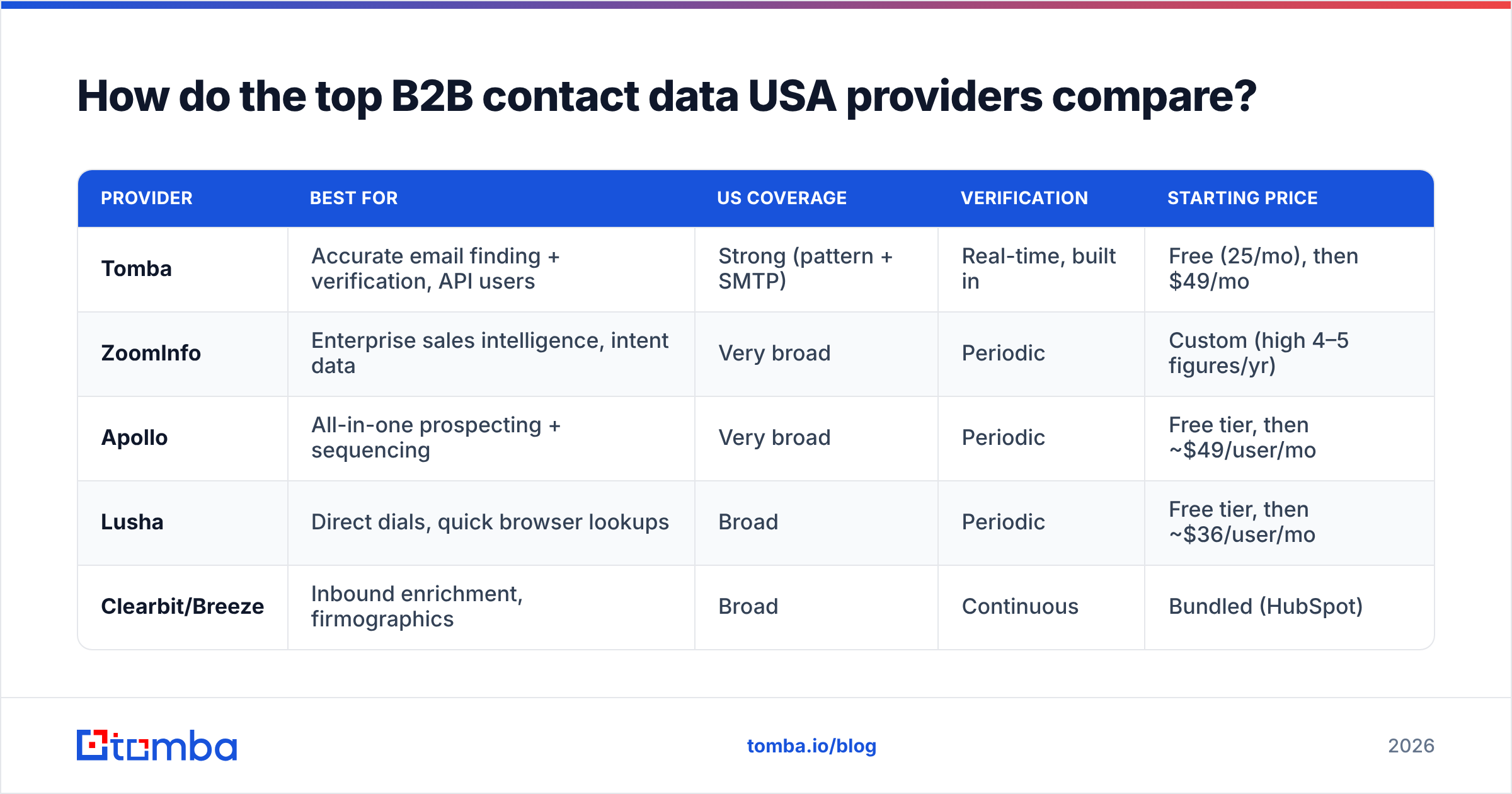
ZoomInfo or Apollo. Lean teams and developers who pay per accurate record favor focused finders. The table below compares the categories on the attributes that move your cost-per-meeting.
| Provider | Best for | US coverage | Verification | Starting price |
|---|---|---|---|---|
| Tomba | Accurate email finding + verification, API users | Strong (pattern + SMTP) | Real-time, built in | Free (25/mo), then $49/mo |
| ZoomInfo | Enterprise sales intelligence, intent data | Very broad | Periodic | Custom (high 4–5 figures/yr) |
| Apollo | All-in-one prospecting + sequencing | Very broad | Periodic | Free tier, then ~$49/user/mo |
| Lusha | Direct dials, quick browser lookups | Broad | Periodic | Free tier, then ~$36/user/mo |
| Clearbit/Breeze | Inbound enrichment, firmographics | Broad | Continuous | Bundled (HubSpot) |
A few honest notes. ZoomInfo's depth and intent signals are real, but the contract floor prices out small teams. Apollo bundles data with sending, which is convenient until you want best-of-breed accuracy. Lusha is fast for one-off direct dials. Tomba sits in the verification-first lane: you can find email addresses by domain or name and get a confidence score on each, with transparent Tomba pricing that doesn't require a sales call. For a deeper bench of options, cross-reference user reviews on G2's email finder category before committing.
Is more US contact data always better?#
No—and this is the most expensive mistake teams make. A bigger raw count usually means a lower verified percentage, and you pay for the gap twice: once in credits, once in deliverability damage.
Run the math. Suppose Provider A sells 20,000 US contacts at 70% accuracy and Provider B sells 8,000 at 95%. Provider A gives you 14,000 usable records; Provider B gives you 7,600. But the 6,000 bad records in list A don't just sit quietly—they generate hard bounces that drag your sender reputation down, which then suppresses inboxing for your good messages too. The "smaller" list often produces more booked meetings.
This is why a bulk email finder paired with verification beats a giant unverified dump. You want the records you'll actually contact to be confirmed, not the headline number on the invoice.

How do you verify B2B contact data before using it?#
Verify in layers, because each layer catches a different failure. Syntax and domain checks are cheap and remove obvious junk. MX and SMTP checks confirm the mailbox can receive mail. Catch-all detection flags domains that accept everything (and therefore hide dead addresses). A quality email verifier runs all of these and returns a status you can filter on.
A reliable pre-import checklist:
- Deduplicate first. Merge records across sources before you spend verification credits on the same person twice.
- Validate syntax and domain. Kill malformed addresses and dead domains immediately.
- Run SMTP verification. Confirm the mailbox exists; segment "valid," "risky," and "invalid."
- Handle catch-all domains. Route these through a catch-all verifier so you're not guessing.
- Enrich the gaps. Use data enrichment to add missing titles, phones, and firmographics needed for routing and scoring.
- Suppress and re-check on a schedule. Re-verify quarterly; US data decays monthly, not annually.
Treat verification like checking expiration dates before you cook. You wouldn't serve a meal from a fridge you haven't looked in for six months—don't email a list you haven't re-verified either.
What about compliance for US B2B data?#
Buying or enriching US contact data puts you under three main regimes, and "it's B2B" does not exempt you. Keep this straight before your first send.
- CAN-SPAM governs commercial email. You need accurate header/subject lines, a physical mailing address, and a working opt-out you honor within 10 business days. It applies to cold B2B email.
- CCPA/CPRA (California) gives residents rights over their personal data, including business contacts. If you hold data on Californians at any scale, you likely need to honor access and deletion requests and disclose your sources.
- TCPA governs phone outreach. If your data includes mobile numbers and you're calling or texting, the rules tighten considerably—especially for automated dialing.
The safe posture: source from providers transparent about their methods, keep proof of where each record came from, and make suppression and opt-out frictionless. The FTC's CAN-SPAM compliance guide is the primary-source starting point, and it's worth reading rather than trusting a vendor's summary.
How much should US B2B contact data cost?#
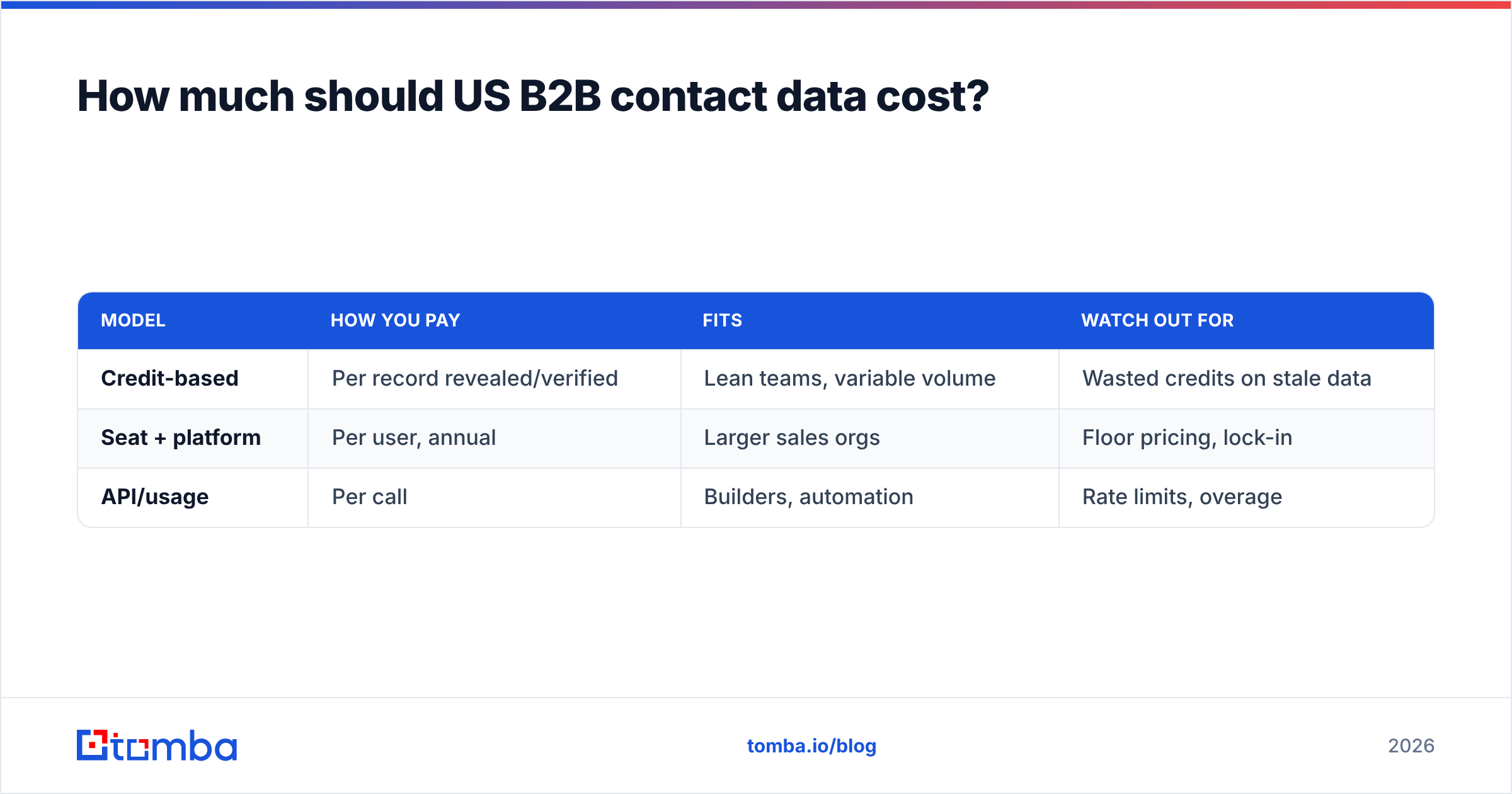
Price the data on cost per verified, usable record, not on the sticker plan. A $99/month plan that yields 1,000 confirmed US contacts is cheaper per meeting than a $20,000/year contract whose records are 60% stale by the time you call.
Three buying models dominate:
| Model | How you pay | Fits | Watch out for |
|---|---|---|---|
| Credit-based | Per record revealed/verified | Lean teams, variable volume | Wasted credits on stale data |
| Seat + platform | Per user, annual | Larger sales orgs | Floor pricing, lock-in |
| API/usage | Per call | Builders, automation | Rate limits, overage |
For most teams scaling US outbound without an enterprise budget, a credit or API model wins because you only pay for records you actually pull. Tomba's tiers—Free (25 searches/month), Starter at $49/month, Growth at $99/month, and Pro at $249/month—map cleanly to that motion, and the email finder API lets you wire verification straight into your enrichment workflow. If you're comparing platforms head-to-head, evaluating an Apollo alternative or Clearbit alternative on cost-per-verified-record will usually reshape your shortlist.
How do you build a US contact list the right way?#
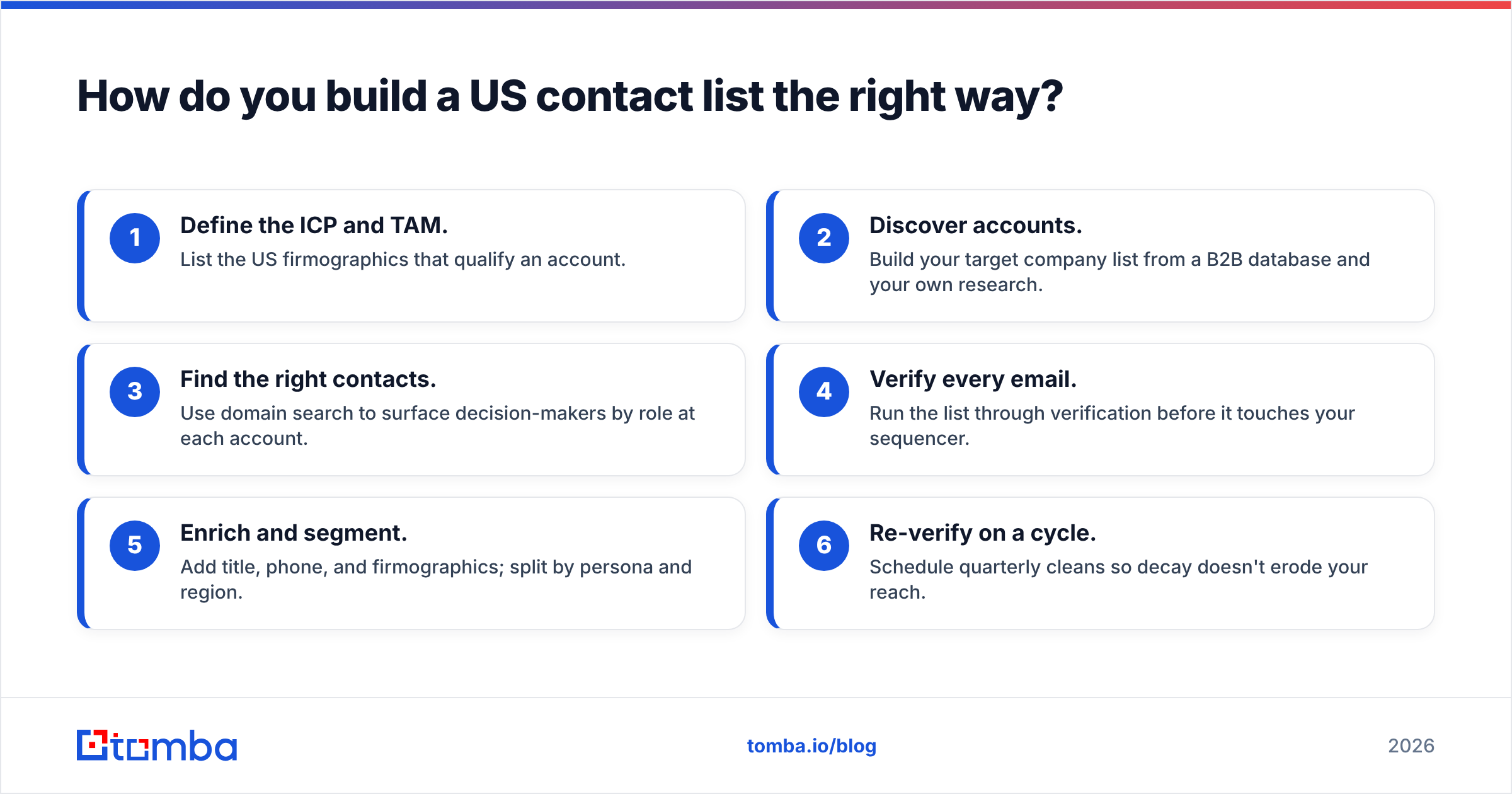
Start from the account, not the contact. Define your ICP—industry, US region, headcount, revenue—then use domain search to pull the right people at each target company instead of buying a generic mega-list. This account-first approach keeps your list tight, relevant, and far easier to keep fresh.
A simple, repeatable workflow:
- Define the ICP and TAM. List the US firmographics that qualify an account.
- Discover accounts. Build your target company list from a B2B database and your own research.
- Find the right contacts. Use domain search to surface decision-makers by role at each account.
- Verify every email. Run the list through verification before it touches your sequencer.
- Enrich and segment. Add title, phone, and firmographics; split by persona and region.
- Re-verify on a cycle. Schedule quarterly cleans so decay doesn't erode your reach.
This beats the "buy 50k and blast" approach on every metric that matters: bounce rate, reply rate, and sender reputation.
The bottom line#
For US B2B contact data in 2026, freshness and verification beat raw volume every time. The provider that hands you 8,000 confirmed, compliant, well-segmented contacts will out-perform the one that dumps 50,000 unverified rows—on deliverability, on cost-per-meeting, and on the patience of your sales team. Pick tools that show their work, verify before you send, and re-check on a schedule.
Ready to build a US contact list you can actually trust? Use the Tomba Email Finder to find and verify professional emails by domain, name, or company—start free with 25 searches a month, then scale on a plan that charges for accuracy, not noise.
// get started
Find, verify and enrich your first contacts today
Start on the free plan with 25 searches a month, then scale when your team is ready.
Free plan · No credit card required · GDPR & CCPA
// about the author