35 B2B Content Ideas That Drive Real Pipeline in 2026
A field guide to B2B content ideas that actually book meetings — formats, examples, and a framework to map each idea to a funnel stage.
placeholder
TL;DR
- The best B2B content ideas are not "topics" — they are assets tied to a buyer's job-to-be-done and a specific funnel stage.
- Use the three-bucket model below: attract (top), convince (middle), and convert (bottom). Most teams over-produce top and starve the middle.
- Original data, comparison content, and customer-proof formats consistently out-pull generic listicles in B2B.
- Distribution beats volume. One repurposed idea hitting five channels outperforms five one-off posts.
- Pair your content with clean contact data so the people who engage actually become reachable pipeline.
If your content calendar is a graveyard of "10 tips" posts that nobody reads, the problem usually is not your writing. It is that the ideas were never connected to a buyer, a stage, or a next action. Below are 35 B2B content ideas organized by what they are supposed to do, plus a framework to pick the right one instead of guessing.
What makes a B2B content idea actually work?#
A good B2B content idea answers a real question your buyer is already asking, in a format they will actually consume, at a moment when they can act on it. That is three constraints, not one — and most content fails because it satisfies only the first.
Think of content like a restaurant menu. A great dish (your topic) still flops if it is the wrong course (stage) served at the wrong time (intent). You would not hand someone a dessert menu before they have ordered an entrée. Yet B2B teams routinely push bottom-funnel demo CTAs at first-touch readers, then wonder why conversion is flat.
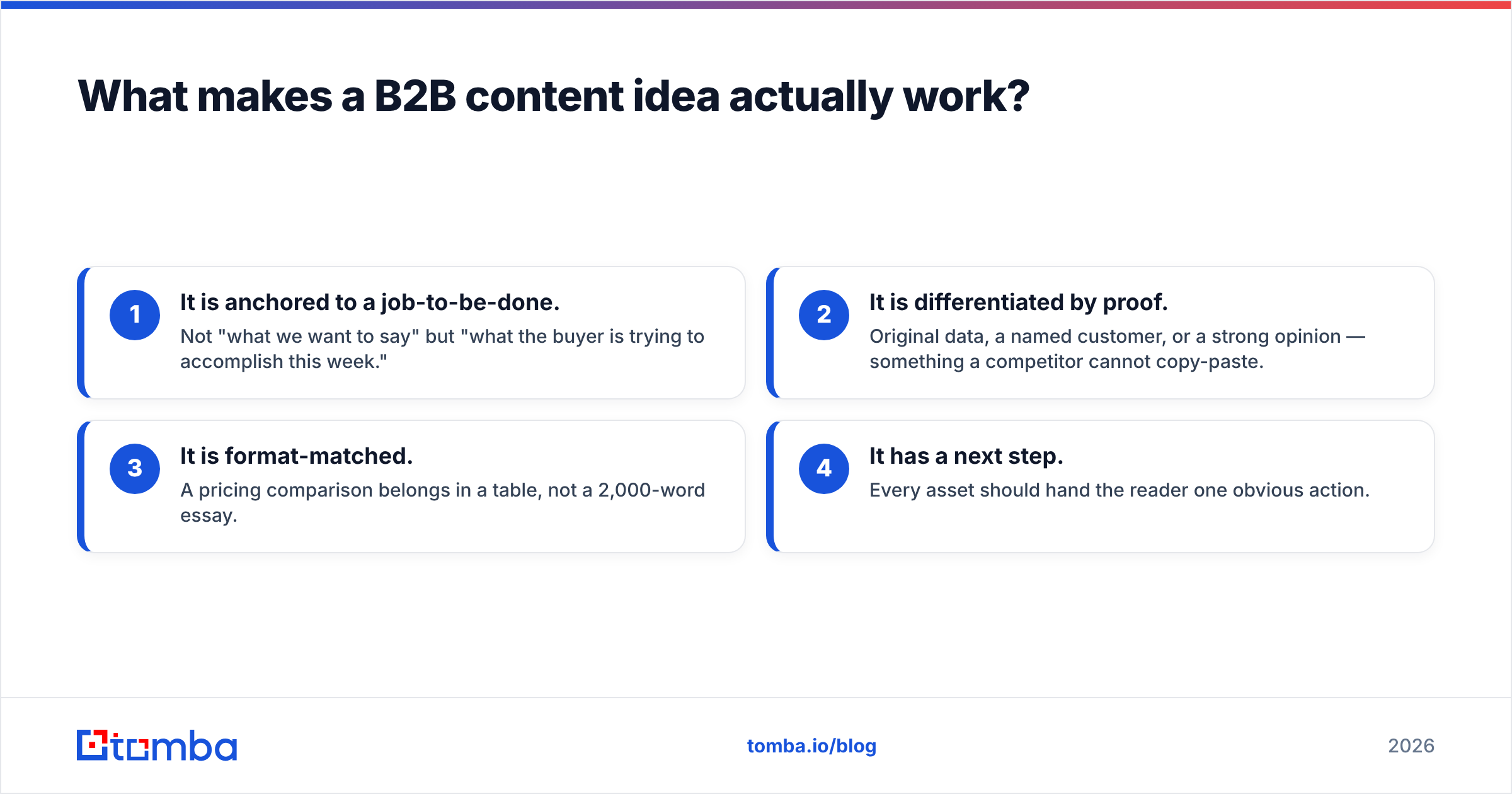
The four traits shared by content that drives pipeline:
- It is anchored to a job-to-be-done. Not "what we want to say" but "what the buyer is trying to accomplish this week."
- It is differentiated by proof. Original data, a named customer, or a strong opinion — something a competitor cannot copy-paste.
- It is format-matched. A pricing comparison belongs in a table, not a 2,000-word essay.
- It has a next step. Every asset should hand the reader one obvious action.
How should you organize B2B content ideas by funnel stage?#
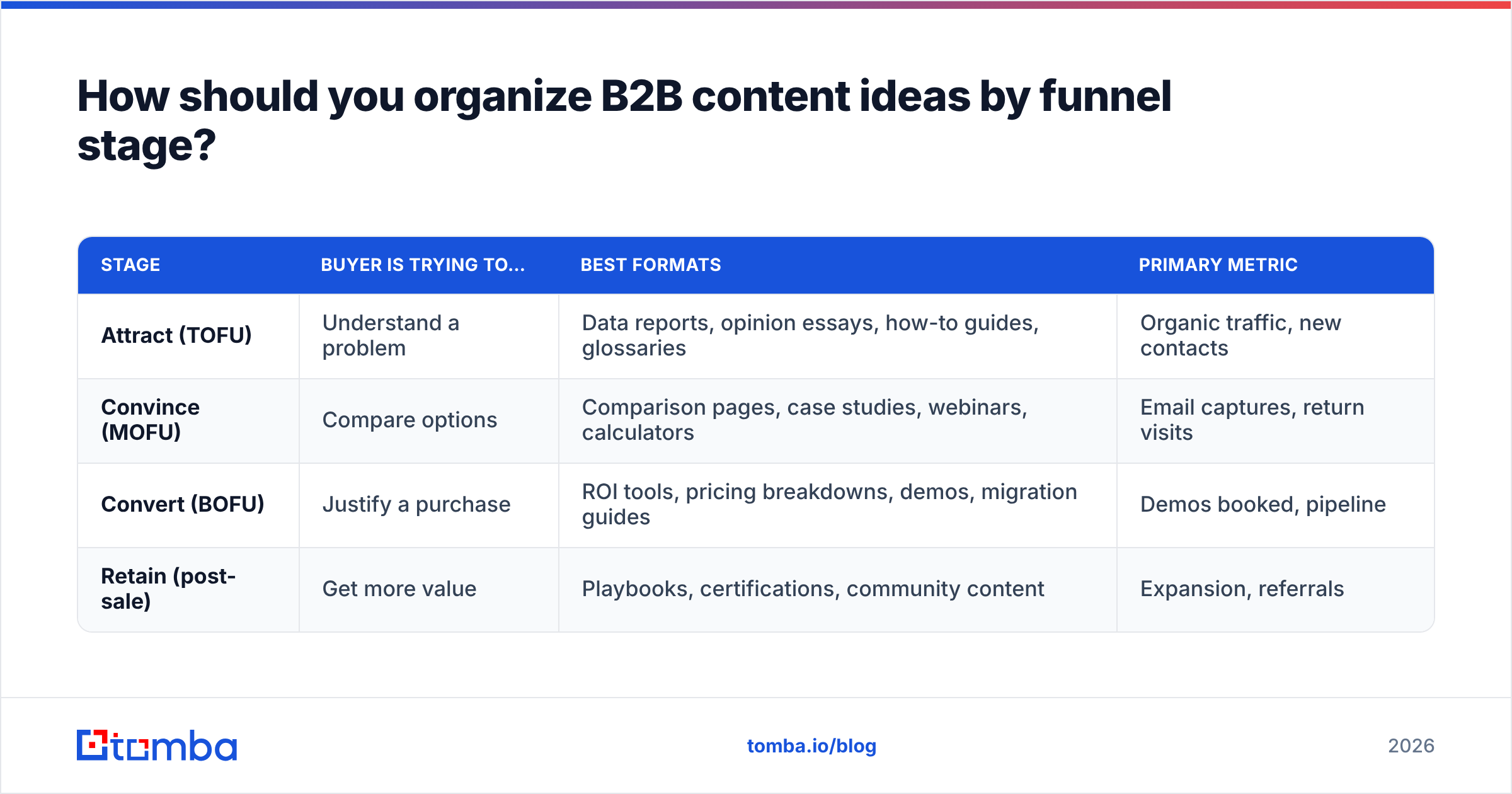
Map every idea to one of three buckets before you write a word. This single habit fixes the most common B2B content problem: a top-heavy library that attracts traffic but never converts it.
| Stage | Buyer is trying to… | Best formats | Primary metric |
|---|---|---|---|
| Attract (TOFU) | Understand a problem | Data reports, opinion essays, how-to guides, glossaries | Organic traffic, new contacts |
| Convince (MOFU) | Compare options | Comparison pages, case studies, webinars, calculators | Email captures, return visits |
| Convert (BOFU) | Justify a purchase | ROI tools, pricing breakdowns, demos, migration guides | Demos booked, pipeline |
| Retain (post-sale) | Get more value | Playbooks, certifications, community content | Expansion, referrals |
The mistake nearly every team makes: they pour 80% of effort into the Attract row because it is the easiest to brainstorm, then starve the Convince row that actually moves deals. If you only fix one thing this quarter, build the middle.
What are the best top-of-funnel B2B content ideas?#
Top-of-funnel content earns attention from people who do not yet know you exist. Lead with originality, because generic "ultimate guides" are now a commodity.
- Original data study. Survey 200+ people in your category and publish the benchmarks. Proprietary numbers get cited, linked, and quoted — the single highest-leverage TOFU play in B2B.
- Contrarian opinion essay. Take a defensible stance against a popular practice. "Stop A/B testing your subject lines" pulls more than "subject line best practices."
- Annual state-of-the-industry report. Become the source people wait for each year.
- Glossary and definition hub. Definitional content captures high-intent search and is easy to interlink — see how a structured B2B glossary compounds over time.
- Teardown of a real example. Publicly analyze a campaign, landing page, or cold email and explain what works.
- Trend prediction with a timeline. Forecasts are shareable and give you a reason to follow up when they come true.
- "How [role] actually spends their week" day-in-the-life. Empathy content that signals you understand the buyer.
- Free interactive tool. A calculator or checker earns links and repeat visits — for example, an email warmup calculator gives readers a reason to bookmark you.
- Curated roundup of expert quotes. Source contributors and they will distribute it for you.
- Visual explainer or framework diagram. A named model ("the 3-bucket content method") gets reused and credited.
The throughline: every one of these is hard for a competitor to clone, because it depends on your data, your opinion, or your tool — not a topic anyone can rewrite.
What mid-funnel content ideas convince buyers to shortlist you?#
This is the row most teams neglect, and it is where deals are won or lost. Mid-funnel content helps a buyer who already has a problem decide whose solution to evaluate.
- Head-to-head comparison page. "Tool A vs Tool B" captures buyers in active evaluation. Be honest — credibility is the conversion lever.
- "Best alternatives to X" roundup. Buyers searching for alternatives are hand-raisers; an honest Apollo alternative breakdown meets them at decision time.
- Customer case study with numbers. "How [Company] cut prospecting time 60%" — specifics beat adjectives every time.
- Use-case landing pages. One page per persona or industry so each segment sees itself.
- Webinar or recorded workshop. Live teaching builds trust faster than text and produces a reusable asset.
- Buyer's guide / RFP template. Help them evaluate the category, and you frame the criteria in your favor.
- Migration guide. "Switching from X to Y" removes the biggest BOFU objection: effort.
- ROI or savings calculator. Let the buyer build their own business case.
- Objection-handling FAQ hub. Answer the awkward questions competitors dodge.
- Integration deep-dives. Show exactly how you fit their existing stack, like a step-by-step HubSpot integration walkthrough.
A note on comparison content: write it the way a fair analyst would. Per G2 and Gartner, buyers trust peer-style, neutral comparisons far more than vendor brochures. Win on honesty and the favorable conclusions land harder.

Which bottom-funnel content ideas turn interest into pipeline?#
Bottom-funnel content removes the final friction between "interested" and "booked." Keep it concrete, fast, and proof-heavy.
- Transparent pricing breakdown. Buyers research budget early; clear Tomba pricing detail builds trust and pre-qualifies.
- Live or self-serve product demo. Let them touch the product before talking to sales.
- Free trial walkthrough. Reduce time-to-value with a guided first-run.
- Implementation / onboarding checklist. Show that going live is easy.
- Security and compliance one-pager. Unblocks enterprise deals fast.
- Comparison-with-pricing matrix. Combine features and cost in one scannable table.
What content formats should you produce in 2026?#
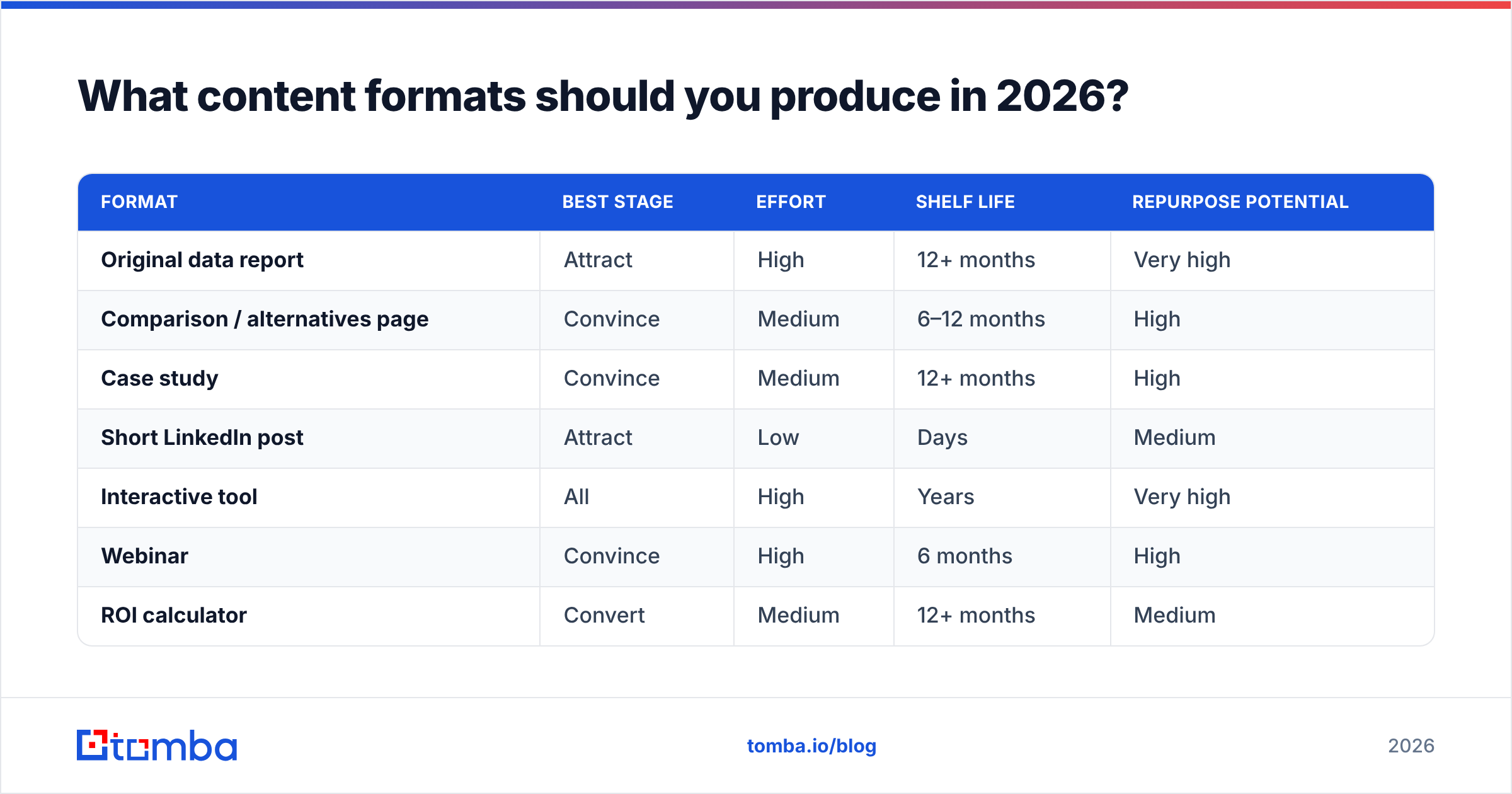
Format is a strategic choice, not an afterthought. Match the format to the stage and the buyer's available attention.
| Format | Best stage | Effort | Shelf life | Repurpose potential |
|---|---|---|---|---|
| Original data report | Attract | High | 12+ months | Very high |
| Comparison / alternatives page | Convince | Medium | 6–12 months | High |
| Case study | Convince | Medium | 12+ months | High |
| Short LinkedIn post | Attract | Low | Days | Medium |
| Interactive tool | All | High | Years | Very high |
| Webinar | Convince | High | 6 months | High |
| ROI calculator | Convert | Medium | 12+ months | Medium |
If you are resource-constrained, prioritize the high-shelf-life, high-repurpose rows. One original data report can become ten LinkedIn posts, three webinars, a slide deck, and an email course. That is leverage; a one-off blog post is not.
How do you turn one content idea into ten?#
Stop thinking in posts and start thinking in campaigns. Atomization — breaking one anchor asset into many channel-native pieces — is how lean teams out-publish big ones.
- Anchor asset: a 3,000-word data report.
- Derivatives: 8–10 LinkedIn posts (one per stat), a newsletter, a Twitter/X thread, a webinar, a SlideShare, a short video, three guest-post pitches, and an internal sales one-pager.
- Distribution rhythm: publish the anchor, then drip derivatives over 4–6 weeks so the idea stays alive instead of dying on launch day.
A simple repurposing rule of thumb: every hour spent creating should be matched by at least an hour spent distributing. Most B2B teams invert that ratio and wonder why great content gets no reach. HubSpot's own marketing research repeatedly shows that repurposing and distribution — not raw output — separate the teams that grow.
How do you make sure content actually generates pipeline?#
Conclusion first: content only becomes pipeline when the people who engage become reachable and routable. A reader who downloads your report but never enters a workflow is a vanity metric.
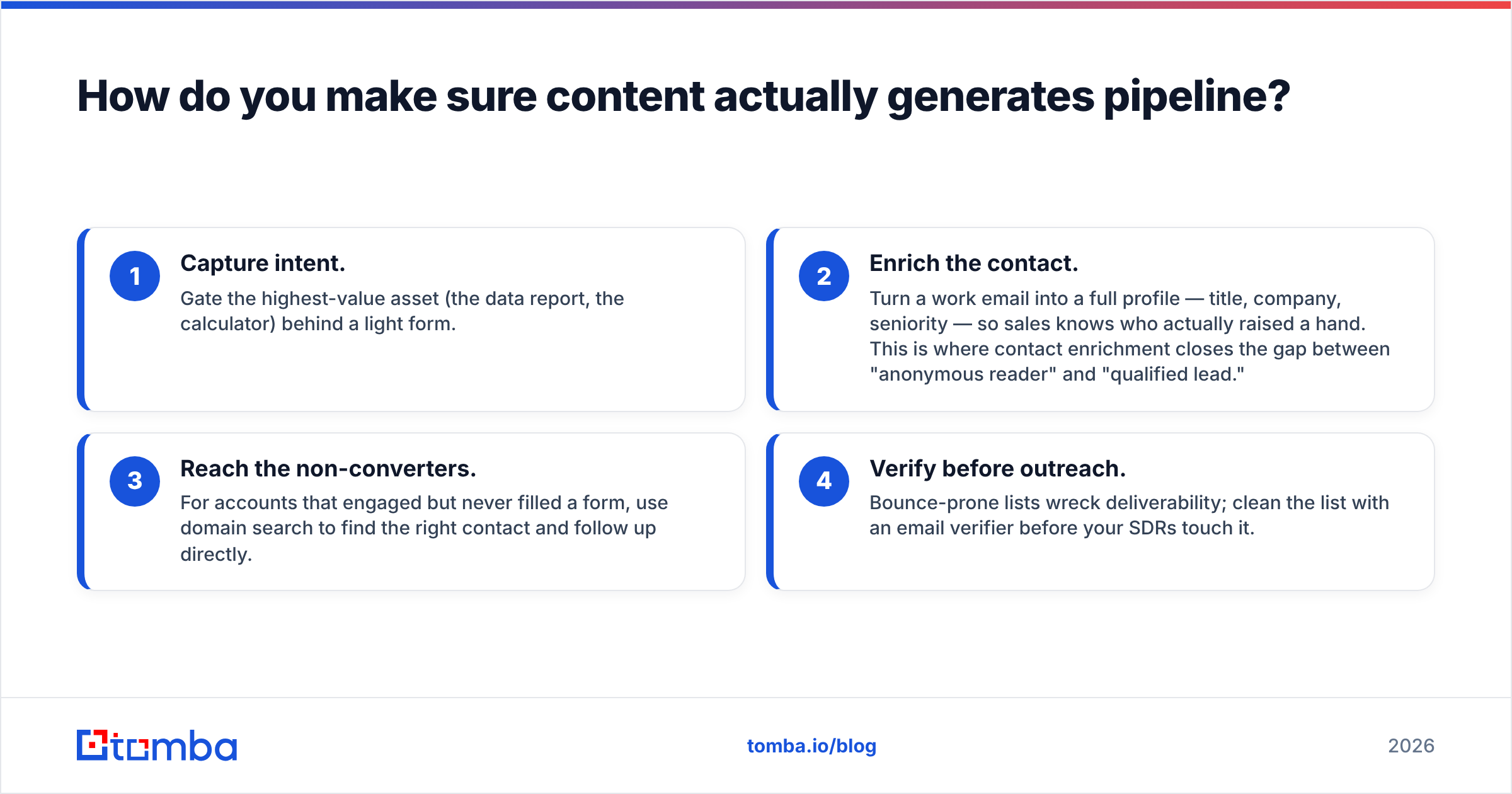
That handoff is a data problem as much as a content one. The sequence that works:
- Capture intent. Gate the highest-value asset (the data report, the calculator) behind a light form.
- Enrich the contact. Turn a work email into a full profile — title, company, seniority — so sales knows who actually raised a hand. This is where contact enrichment closes the gap between "anonymous reader" and "qualified lead."
- Reach the non-converters. For accounts that engaged but never filled a form, use domain search to find the right contact and follow up directly.
- Verify before outreach. Bounce-prone lists wreck deliverability; clean the list with an email verifier before your SDRs touch it.
Content earns the attention. Data converts it. Skip the second half and your best ideas just become someone else's free education.
A 30-day plan to ship better B2B content ideas#
- Week 1 — Audit. Map your existing library to the three buckets. You will almost certainly find a starved middle.
- Week 2 — Anchor. Pick one high-leverage idea (a data study or a comparison page) and build it properly.
- Week 3 — Atomize. Break the anchor into 8–10 channel-native derivatives and schedule them.
- Week 4 — Connect. Wire capture, enrichment, and verification so engagement turns into routable pipeline.
Repeat monthly. Four anchors a year, fully atomized and connected, will out-produce a team grinding out two thin blog posts a week.
Where should you start?#
Start where the gap is biggest, then make sure the leads your content attracts actually become contactable. The ideas above bring the right people to your site; turning their interest into booked meetings depends on reaching them with the correct, verified email at the right moment.
That is exactly what the Tomba Email Finder is built for. Find verified professional emails by name, company, or domain, enrich every inbound contact, and hand your sales team a list that actually connects. Start free with 25 searches a month, and scale up only when your content engine proves it deserves to — no guesswork, just reachable pipeline.
Ready to find emails that actually work?
Join 150,000+ professionals who stopped guessing and started sending. Free credits on signup — no credit card required.
Get the Tomba newsletter
Practical outbound tactics and product updates — once every two weeks.
About the author