The B2B Content Marketing Funnel: A 2026 Playbook That Converts
Most B2B content gets clicks but no pipeline. Here's how to build a content marketing funnel in 2026 that moves strangers to buyers — stage by stage.
TL;DR
- A b2b content marketing funnel is the staged path that turns an anonymous reader into a sales-qualified opportunity — top (awareness), middle (consideration), and bottom (decision).
- Most teams over-invest in top-of-funnel blog traffic and starve the middle and bottom, which is where revenue actually closes.
- Each stage needs its own content format, call to action, and success metric. Mixing them is why "great content" produces zero pipeline.
- Distribution and lead capture matter as much as the writing. A post nobody finds, or a lead you can't reach, is wasted spend.
- Pair content with accurate contact data so marketing-qualified leads become real conversations — not bounced emails.
What is a B2B content marketing funnel?#
A b2b content marketing funnel is the structured journey a buyer takes from first hearing about you to signing a contract, mapped to the content that nudges them forward at each step. Think of it like a restaurant: the smell from the street pulls people in (awareness), the menu and reviews help them decide what to order (consideration), and the waiter's recommendation closes the order (decision). Skip any step and the table stays empty.
In B2B, that journey is longer and involves more people than B2C. Gartner's research puts the typical buying group at six to ten stakeholders, each consuming three to seven pieces of content before a vendor conversation even starts. So your funnel is not one path — it's several overlapping paths for the champion, the economic buyer, and the skeptical technical reviewer.
The funnel is usually split into three layers:
- Top of funnel (TOFU) — Awareness. The buyer knows they have a problem but not the solutions. Content educates broadly: blog posts, SEO guides, short videos, social posts.
- Middle of funnel (MOFU) — Consideration. The buyer is comparing approaches and vendors. Content goes deeper: comparison guides, webinars, case studies, gated reports.
- Bottom of funnel (BOFU) — Decision. The buyer is ready to choose. Content de-risks the purchase: demos, ROI calculators, pricing pages, free trials, customer proof.
The mistake almost everyone makes is treating the funnel as a content-volume problem ("publish more") instead of a content-fit problem ("publish the right thing for the right stage"). More TOFU blog posts will not fix a leaky MOFU.

Why do most B2B content funnels fail to drive pipeline?#
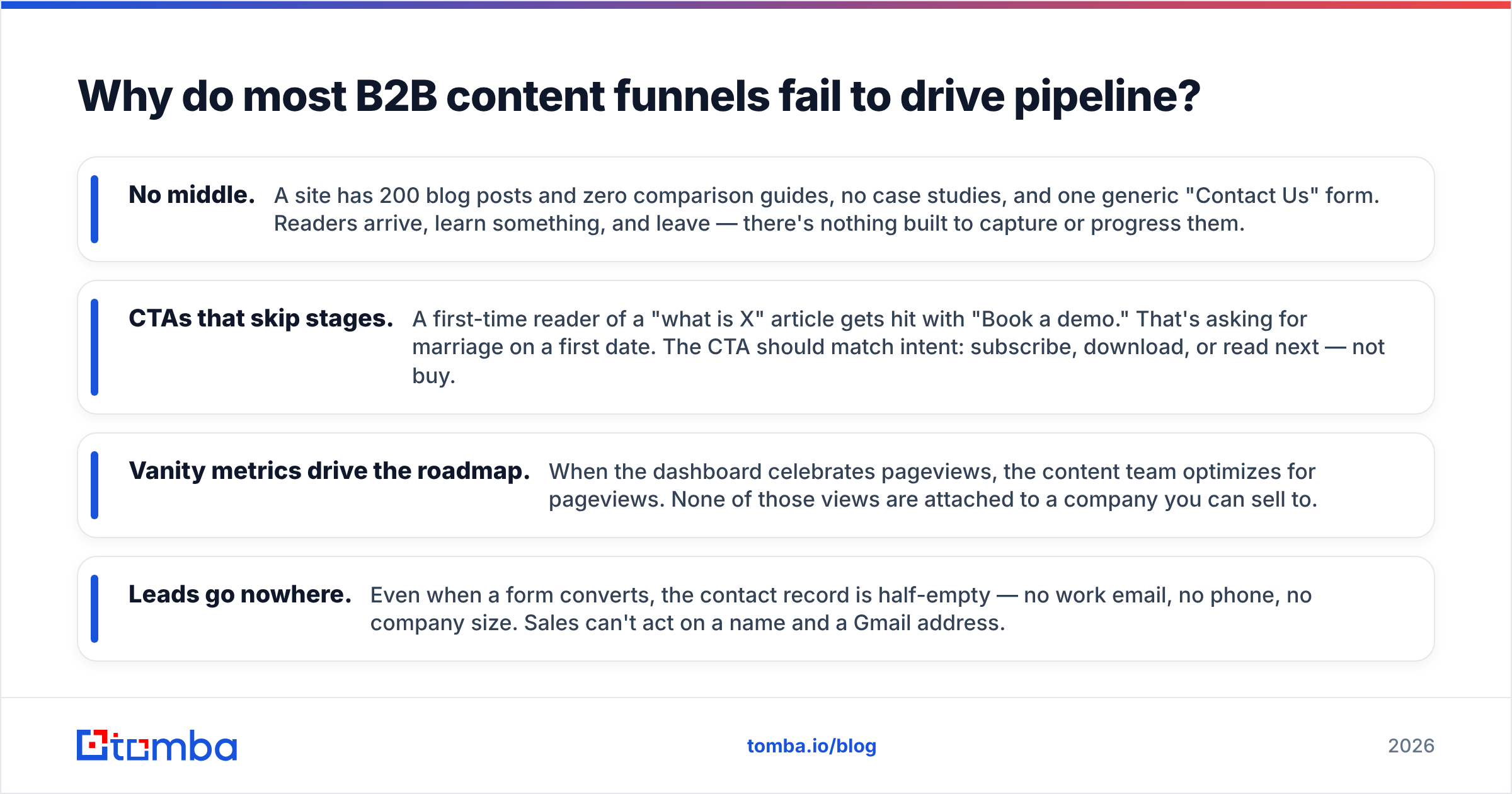
They fail because the funnel is top-heavy. Conclusion first: teams measure what's easy (traffic, impressions, rankings) instead of what pays (pipeline, sourced revenue), so they keep producing the content that inflates the easy numbers.
Here's the chain of failure I see repeatedly:
- No middle. A site has 200 blog posts and zero comparison guides, no case studies, and one generic "Contact Us" form. Readers arrive, learn something, and leave — there's nothing built to capture or progress them.
- CTAs that skip stages. A first-time reader of a "what is X" article gets hit with "Book a demo." That's asking for marriage on a first date. The CTA should match intent: subscribe, download, or read next — not buy.
- Vanity metrics drive the roadmap. When the dashboard celebrates pageviews, the content team optimizes for pageviews. None of those views are attached to a company you can sell to.
- Leads go nowhere. Even when a form converts, the contact record is half-empty — no work email, no phone, no company size. Sales can't act on a name and a Gmail address.
That last point is where content and data intersect. A marketing-qualified lead is only as useful as your ability to reach the right person. If your gated report captures "john@gmail.com" with no enrichment, your SDR is stuck. This is why mature teams wire data enrichment into the funnel — turning a thin form-fill into a complete, reachable contact record.
How do the funnel stages map to content and metrics?#
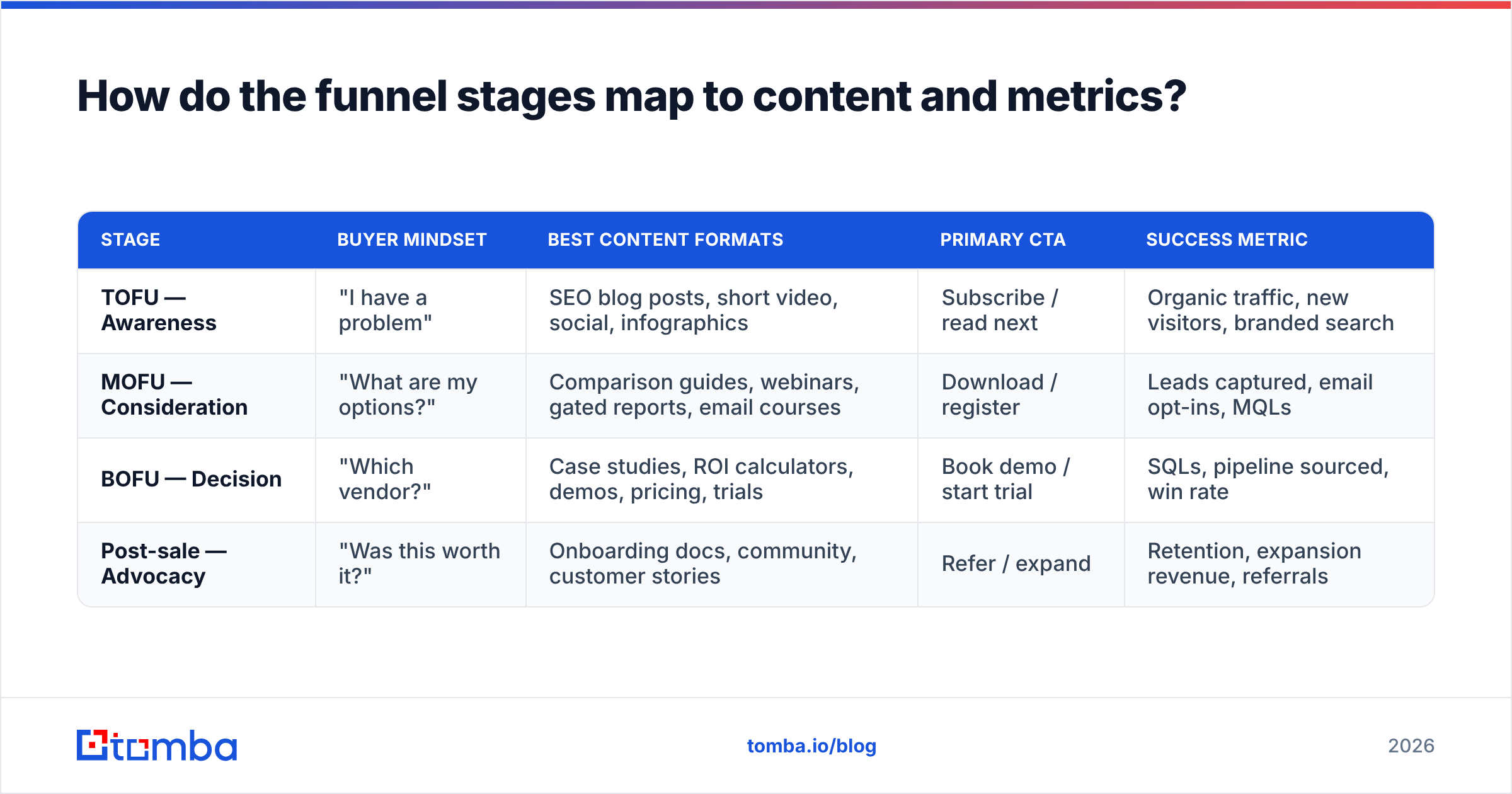
Each stage has a distinct job, format, CTA, and metric. Here's the map I hand to every B2B content team.
| Stage | Buyer mindset | Best content formats | Primary CTA | Success metric |
|---|---|---|---|---|
| TOFU — Awareness | "I have a problem" | SEO blog posts, short video, social, infographics | Subscribe / read next | Organic traffic, new visitors, branded search |
| MOFU — Consideration | "What are my options?" | Comparison guides, webinars, gated reports, email courses | Download / register | Leads captured, email opt-ins, MQLs |
| BOFU — Decision | "Which vendor?" | Case studies, ROI calculators, demos, pricing, trials | Book demo / start trial | SQLs, pipeline sourced, win rate |
| Post-sale — Advocacy | "Was this worth it?" | Onboarding docs, community, customer stories | Refer / expand | Retention, expansion revenue, referrals |
Notice that the metric changes at every stage. Judging a TOFU blog post by demo bookings is unfair — its job is to fill the top. Judging a BOFU case study by traffic is equally wrong — its job is to convert a small, high-intent audience.
A practical rule: every piece of content should have one stage, one CTA, and one metric. If you can't name all three for an asset, it's probably doing nothing.
A worked example of the path#
- A SaaS buyer searches "how to reduce email bounce rate" and lands on your TOFU guide. CTA: subscribe to the newsletter.
- Three weeks later they open your email course on deliverability and click into a MOFU comparison: "Top email verification tools compared." CTA: download the full benchmark (gated).
- They fill the form. You enrich the record, confirm they're a 200-person company, and route a verified contact to sales.
- An SDR sends a relevant BOFU case study. The buyer books a demo. Pipeline created.
No single asset closed the deal. The funnel did.
What content belongs at the top of the funnel?#
Top-of-funnel content earns attention from people who don't know you yet, so it has to be discoverable and genuinely useful without asking for anything. Conclusion first: win TOFU with search-driven, ungated educational content and ruthless distribution.
What works in 2026:
- Search-intent blog posts targeting problem-aware queries ("why are my cold emails landing in spam"). These are your traffic engine. Build them around questions real buyers type.
- Original data and benchmarks. A small proprietary study ("we analyzed 1M outbound emails") earns links and shares that generic listicles never will.
- Short-form video and social. LinkedIn remains the B2B default; a 60-second clip explaining one tactic outperforms a 2,000-word essay nobody scrolls.
- Free tools. A calculator or checker pulls in qualified strangers and gives them a reason to return. Tomba's free utilities like the email warmup calculator and spam checker are TOFU magnets — useful, no signup, brand-adjacent.
The discipline at TOFU is restraint. Don't gate it, don't pitch hard, and don't measure it by leads. Its only job is to grow a relevant audience and feed the middle. According to HubSpot's research, companies that prioritize blogging and SEO see materially higher inbound lead volume — but only when that traffic is captured downstream.
What content moves buyers through the middle of the funnel?#
Middle-of-funnel content converts anonymous traffic into known leads by trading depth for contact info. This is the stage most teams neglect, and it's the highest-leverage fix available to almost any B2B program.
The formats that earn an email address:
- Comparison and "best of" guides. Buyers in evaluation mode actively search "X vs Y" and "best [category] tools." These pages have commercial intent and convert far better than awareness posts.
- Gated reports and templates. A benchmark report, a swipe file of cold email templates, or a teardown — anything worth an email in exchange.
- Webinars and email courses. Multi-touch formats that let you nurture over days, not seconds.
- Case studies framed by problem. Not "look how great we are," but "here's how a company like yours solved this."
The MOFU mechanic that matters is the handoff. When someone converts, you need a complete contact record to act on. A name plus a personal email isn't enough for B2B sales. This is where you connect content to your data stack: enrich the lead, verify the email so it doesn't bounce, and confirm it belongs to a real decision-maker before routing to sales. A clean MOFU-to-sales handoff is the difference between an MQL that converts and one that rots in a CRM.
What does bottom-of-funnel content need to close?#
Bottom-of-funnel content removes risk and friction for a buyer who has already decided they need a solution and is choosing between finalists. Conclusion first: BOFU is about proof and ease, not persuasion.
The assets that close:
- Customer case studies with numbers. Specific outcomes ("cut prospecting time 40%") beat adjectives.
- ROI calculators and pricing transparency. Buyers self-disqualify or self-sell when they can model the value. A clear, public pricing page shortens cycles by filtering out poor fits early.
- Free trials and demos. Let the product sell itself. The friction-killer here is fast time-to-value.
- Comparison pages against named competitors. "Tomba vs [Competitor]" pages catch buyers in final evaluation and let you frame the criteria on your terms.
BOFU content is low-volume and high-stakes. You don't need many assets, but each one must be sharp, honest, and easy to find from your demo and pricing flows.
How do you measure a B2B content marketing funnel?#
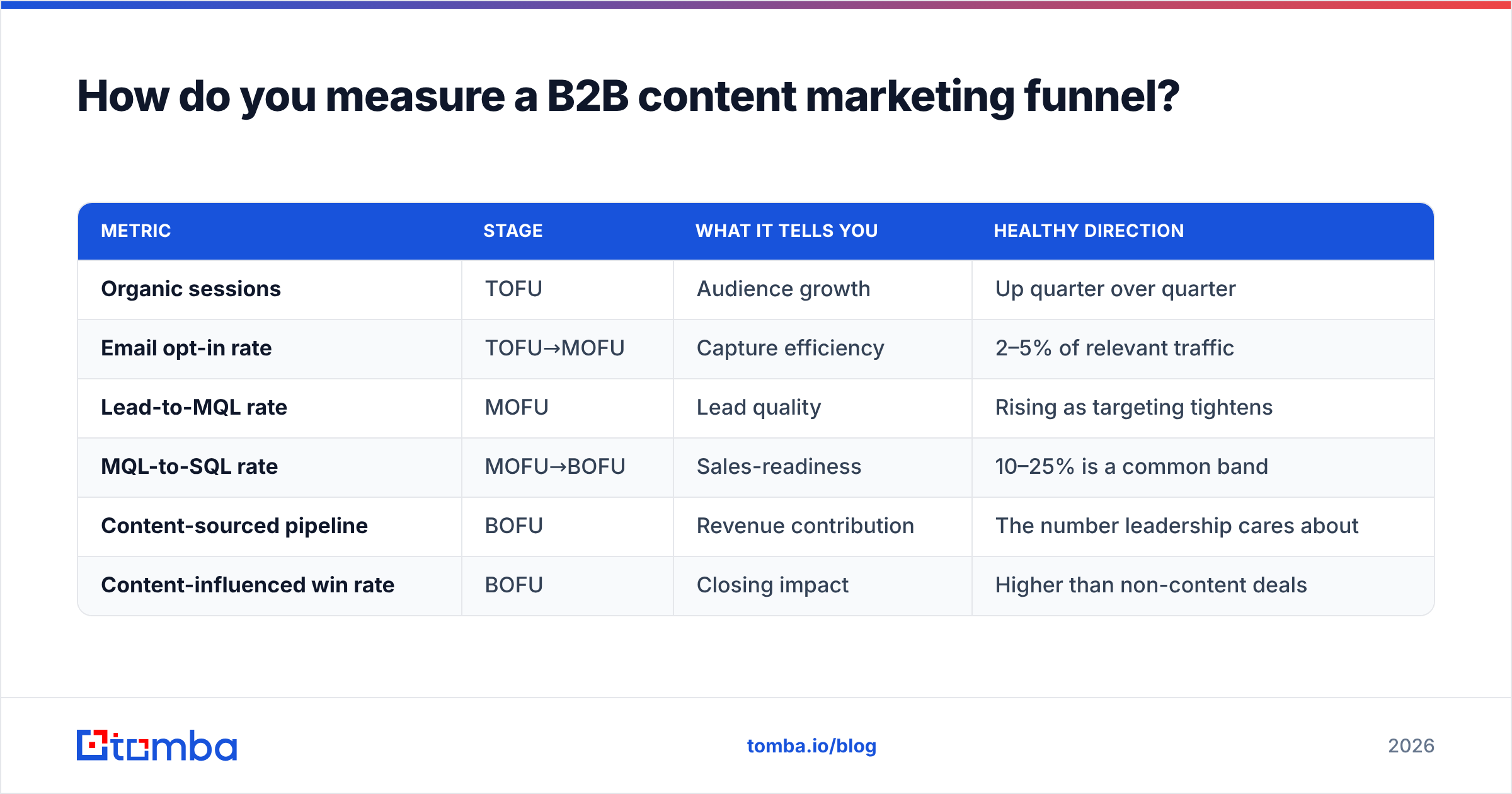
Measure each stage by its own job, then tie the whole funnel to pipeline and revenue — not traffic. The biggest analytics upgrade most teams can make is to stop reporting blended "content performance" and start reporting stage-by-stage conversion rates.
A funnel scorecard worth tracking:
| Metric | Stage | What it tells you | Healthy direction |
|---|---|---|---|
| Organic sessions | TOFU | Audience growth | Up quarter over quarter |
| Email opt-in rate | TOFU→MOFU | Capture efficiency | 2–5% of relevant traffic |
| Lead-to-MQL rate | MOFU | Lead quality | Rising as targeting tightens |
| MQL-to-SQL rate | MOFU→BOFU | Sales-readiness | 10–25% is a common band |
| Content-sourced pipeline | BOFU | Revenue contribution | The number leadership cares about |
| Content-influenced win rate | BOFU | Closing impact | Higher than non-content deals |
Two cautions. First, attribution in B2B is messy because buying groups are large and cycles are long — treat content-sourced and content-influenced as directional, not gospel. Forrester and Gartner both note that self-guided buyers complete most of their journey before talking to sales, so a lot of influence happens invisibly. Second, don't let a single channel report hide a broken stage. If MQL-to-SQL is 4%, no amount of TOFU traffic will fix your pipeline.
What tools and data does the funnel actually need?#
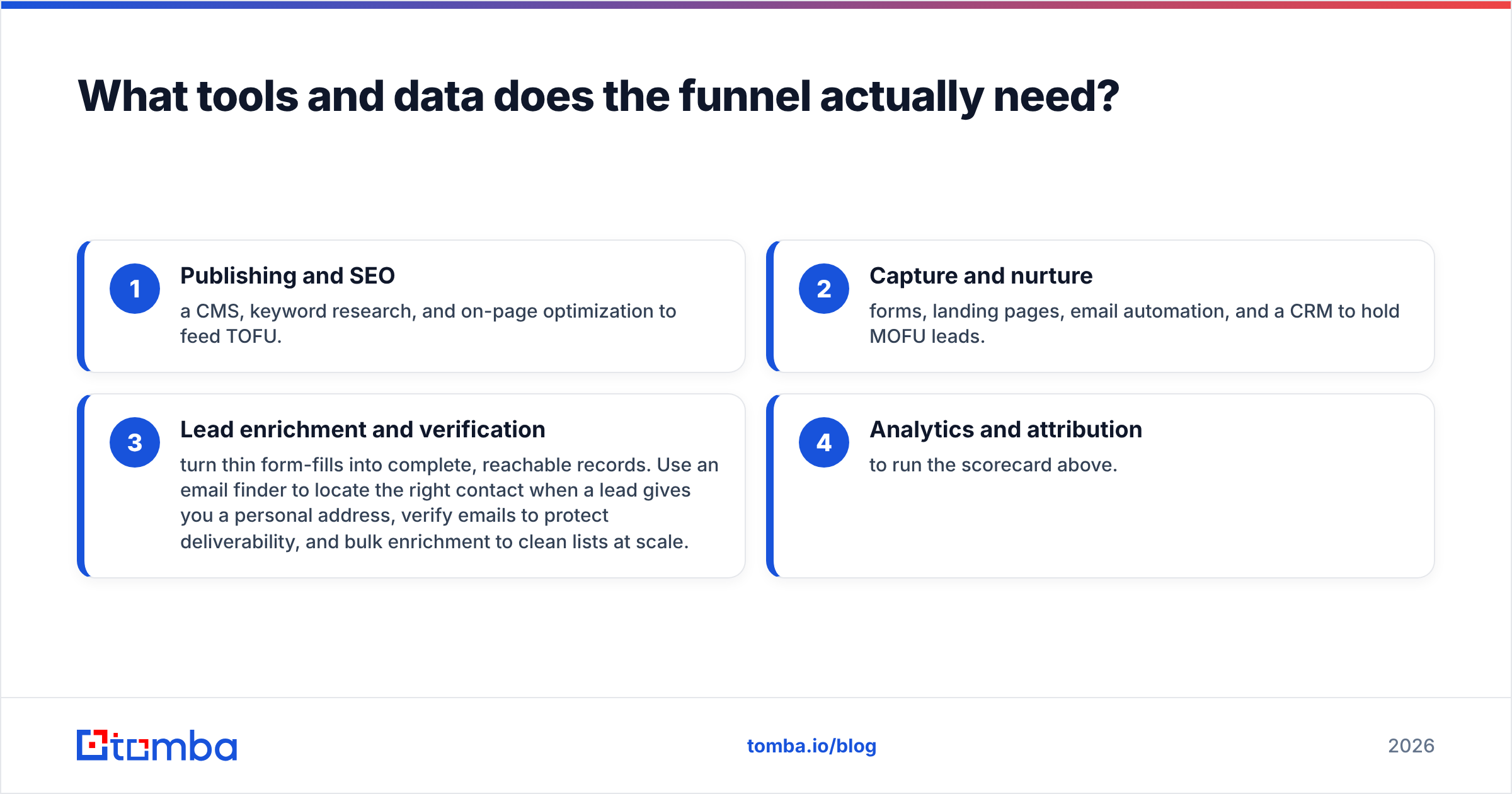
You need a content engine, a capture layer, and a data layer — and the data layer is the one teams forget. Here's the minimum viable stack and where data fits.
- Publishing and SEO — a CMS, keyword research, and on-page optimization to feed TOFU.
- Capture and nurture — forms, landing pages, email automation, and a CRM to hold MOFU leads.
- Lead enrichment and verification — turn thin form-fills into complete, reachable records. Use an email finder to locate the right contact when a lead gives you a personal address, verify emails to protect deliverability, and bulk enrichment to clean lists at scale.
- Analytics and attribution — to run the scorecard above.
The data layer is what makes the rest pay off. You can run a flawless content funnel and still generate zero revenue if the leads you capture aren't reachable. Verifying and enriching at the MOFU handoff protects your sender reputation and ensures sales spends time on real people, not bounced inboxes. For teams comparing data vendors, Tomba's data sources page explains where the contact data comes from — worth reviewing against alternatives on G2 before you commit.
How long does a B2B content funnel take to work?#
Expect six to twelve months before content drives meaningful, compounding pipeline — and treat anyone promising faster with suspicion. SEO-driven TOFU needs time to rank; MOFU nurture needs repeat touches; BOFU proof needs real customers to point to.
What you can accelerate:
- Start with MOFU and BOFU, not TOFU. If you have any existing traffic, the fastest pipeline win is adding comparison guides, case studies, and a capture mechanism — not publishing more awareness posts.
- Repurpose aggressively. One webinar becomes a blog post, five social clips, an email course, and a gated transcript. Volume without new writing.
- Fix the leak before scaling the top. Pouring traffic into a funnel with no middle is lighting money on fire.
Bringing it together#
A b2b content marketing funnel works when every stage has a clear job, a matching CTA, a real metric, and a clean data handoff between marketing and sales. Build the middle, measure by pipeline, and never let a captured lead die because you couldn't reach the right person.
That last mile — turning a form-fill into a verified, reachable decision-maker — is where most funnels quietly break. The Tomba Email Finder closes that gap: find the right professional email by name, domain, or company, verify it before you send, and hand sales a contact they can actually convert. Start on the free tier (25 searches a month), scale to Starter at $49/mo when your funnel is humming, and stop losing pipeline to bad data. Your content earned the lead — make sure you can reach them.
Ready to find emails that actually work?
Join 150,000+ professionals who stopped guessing and started sending. Free credits on signup — no credit card required.
Get the Tomba newsletter
Practical outbound tactics and product updates — once every two weeks.
About the author