B2B Content Marketing Trends 2026: What Actually Works
The 7 B2B content marketing trends that move pipeline in 2026 — from AI-assisted production to intent-led distribution — plus what to quietly retire.
TL;DR
- B2B content marketing in 2026 is less about publishing volume and more about distribution, proof, and matching content to buying intent.
- AI now handles drafting and repurposing, but the differentiator is proprietary data and original research — not faster blog spam.
- "Dark social" (Slack, LinkedIn DMs, private communities) drives more pipeline than your last-touch attribution model admits.
- Account-based content and self-serve product content are converging: buyers want to evaluate before they ever talk to sales.
- The teams winning are pairing content with accurate contact data so the right asset reaches the right buyer at the right account.
What are the biggest B2B content marketing trends in 2026?#
Short answer: the center of gravity moved from creation to distribution and proof. Producing a competent blog post is now a solved problem — anyone with a budget and an AI tool can do it. What separates pipeline-driving programs from content graveyards is whether you can get the right asset in front of an in-market buyer and back it with evidence they trust.
Think of content marketing like opening a restaurant. In 2018 the trend was "open more locations" — publish constantly, rank for everything. In 2026 the locations are saturated. The winning move is a great location with a line out the door (distribution), food people actually rave about to friends (word of mouth in private channels), and a reputation that precedes you (proof and original data). Cooking faster with a robot doesn't help if nobody knows the door is open.
Here are the seven shifts that matter, ranked by how directly they affect revenue.
- AI-assisted production, human-owned strategy — AI drafts, outlines, and repurposes; humans own the angle, the data, and the point of view.
- Original research as the moat — surveys, benchmarks, and proprietary data are the content competitors can't clone with a prompt.
- Distribution-first publishing — the asset is designed for the channel (LinkedIn, newsletter, podcast) before it's designed for your CMS.
- Dark social and community — buyers research in private channels you can't track; you win by being mentioned there, not by chasing the click.
- Account-based content — content tailored to named accounts and personas, not generic top-of-funnel bait.
- Self-serve and product-led content — interactive tools, calculators, and docs that let buyers evaluate before a sales call.
- Zero-click and AEO — answer-engine optimization for LLMs and featured snippets, where the goal is being the cited source, not the click.
)
Is AI killing B2B content marketing or fixing it?#
It's fixing the boring parts and exposing the lazy ones. AI is not replacing strategy — it's collapsing the cost of mediocre content to near zero, which means mediocre content no longer ranks, converts, or earns links. The bar for "good enough" jumped.
The teams getting value from AI in 2026 use it as a production multiplier inside a human-defined system: research synthesis, first drafts, turning one webinar into twelve LinkedIn posts, translating a pillar page into five languages. The teams getting punished use it to mass-produce keyword pages with no original insight — exactly the pattern search engines and answer engines now demote.
According to Gartner, B2B buyers spend only a small fraction of their journey with any single vendor's sales team, doing most of their evaluation independently. That independent research is increasingly mediated by AI summaries. If your content is generic, the model paraphrases it without attribution. If your content contains a unique statistic, a named framework, or proprietary data, you get cited — and cited sources get the trust and the traffic that's left.
This is why original research has become the real moat. You can prompt an AI to write about email deliverability; you cannot prompt it to produce your own dataset of 50,000 send results. The proprietary angle is the one thing that survives commoditization.
Which B2B content formats actually convert in 2026?#
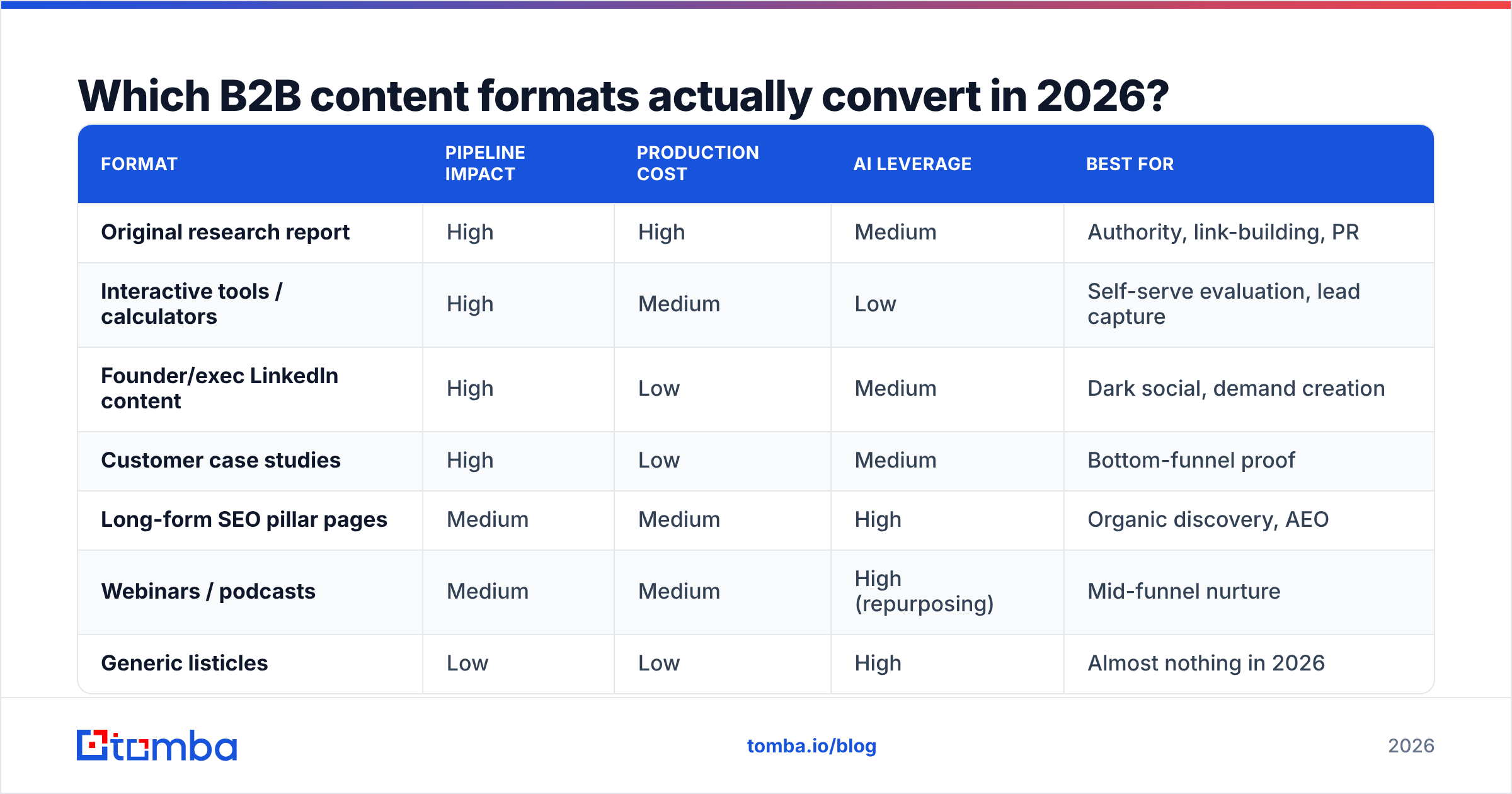
The honest answer: it depends on where the buyer is, but a few formats consistently punch above their weight. Below is how the major formats stack up on the metrics that matter for a B2B program.
| Format | Pipeline impact | Production cost | AI leverage | Best for |
|---|---|---|---|---|
| Original research report | High | High | Medium | Authority, link-building, PR |
| Interactive tools / calculators | High | Medium | Low | Self-serve evaluation, lead capture |
| Founder/exec LinkedIn content | High | Low | Medium | Dark social, demand creation |
| Customer case studies | High | Low | Medium | Bottom-funnel proof |
| Long-form SEO pillar pages | Medium | Medium | High | Organic discovery, AEO |
| Webinars / podcasts | Medium | Medium | High (repurposing) | Mid-funnel nurture |
| Generic listicles | Low | Low | High | Almost nothing in 2026 |
Notice the pattern: the high-impact formats are either expensive to fake (research, tools, case studies) or rooted in a real human voice (exec content). The low-impact formats are precisely the ones AI floods the zone with. If a competitor can recreate your asset in an afternoon with a prompt, it won't move pipeline.
Interactive tools deserve special attention. A free email warmup calculator or a subject line tester does what a blog post can't: it gives the buyer a reason to engage, demonstrates competence, and captures intent at the exact moment of need. Tools are content that does something, and they age far slower than a trends post.
How do you distribute B2B content when buyers hide in dark social?#
You stop optimizing for the click and start optimizing for the mention. "Dark social" — the private Slack groups, LinkedIn DMs, WhatsApp threads, and niche communities where buyers actually swap recommendations — is where a large share of B2B discovery now happens, and none of it shows up in your analytics as anything but "direct."
The practical implications:
- Build for screenshots, not just sessions. A LinkedIn post or a single strong chart gets pasted into a Slack channel and seen by people who never visit your site. Design the standalone asset to carry your name.
- Invest in the people, not just the brand. Exec and employee posting consistently outperforms branded channels because dark social runs on personal trust. A founder's take gets forwarded; a company newsletter rarely does.
- Measure with surveys, not just attribution. Add a "How did you hear about us?" field. The gap between that answer and your attribution dashboard is the size of your dark-social engine.
This is also where LinkedIn outreach and content blur together. The content earns the warm reply; the data tells you who to send it to. According to LinkedIn's own B2B research, the brands that stay visible across the long, mostly-invisible buying cycle are the ones bought when the buyer finally enters the market — and most of that visibility happens in feeds and private shares, not on landing pages.
)
What is account-based content and why does it matter now?#
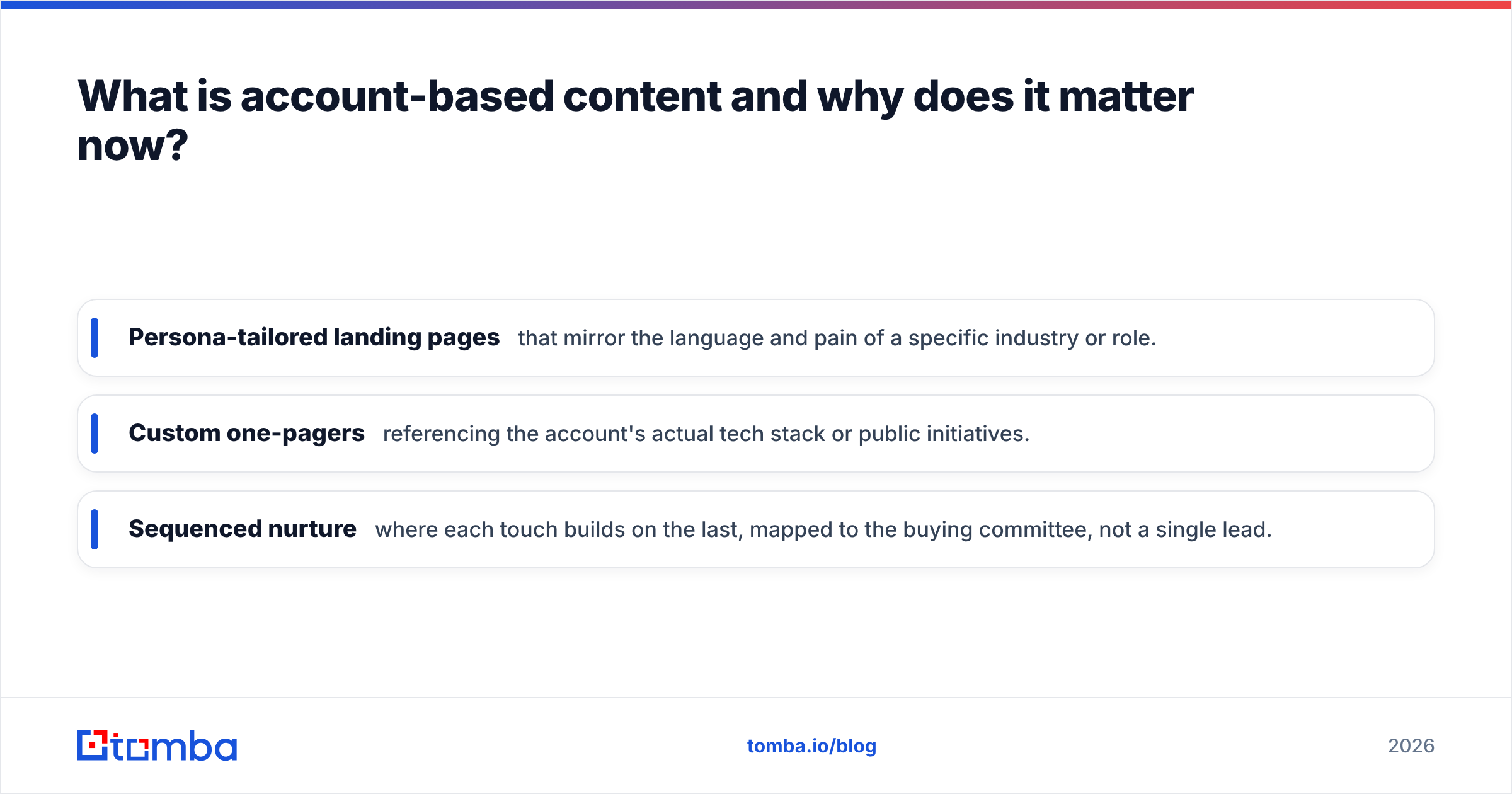
Account-based content is content built for specific named accounts and personas rather than an anonymous audience — and it matters now because generic top-of-funnel content has been commoditized into irrelevance. When everyone can produce a "Ultimate Guide to X," the only way to stand out in a target account's inbox is relevance to their situation.
In practice, account-based content looks like:
- Persona-tailored landing pages that mirror the language and pain of a specific industry or role.
- Custom one-pagers referencing the account's actual tech stack or public initiatives.
- Sequenced nurture where each touch builds on the last, mapped to the buying committee, not a single lead.
The bottleneck here is rarely the creative — it's the data. You can't personalize content for an account you can't reach, and you can't sequence a buying committee you haven't mapped. This is where content strategy and contact data become a single workflow. You identify the target accounts, find the decision-makers, verify their contact details, and then deliver the tailored asset. A scattershot blast to a purchased list is the opposite of account-based — and it's exactly the tactic that tanks your email deliverability.
Getting the contact layer right means using accurate, verified data. Tools like a domain search to map everyone at a target company, paired with an email verifier to keep bounce rates low, turn an account list into a reachable, segmentable audience. Content without distribution data is a message in a bottle.
How does B2B content marketing compare to three years ago?#
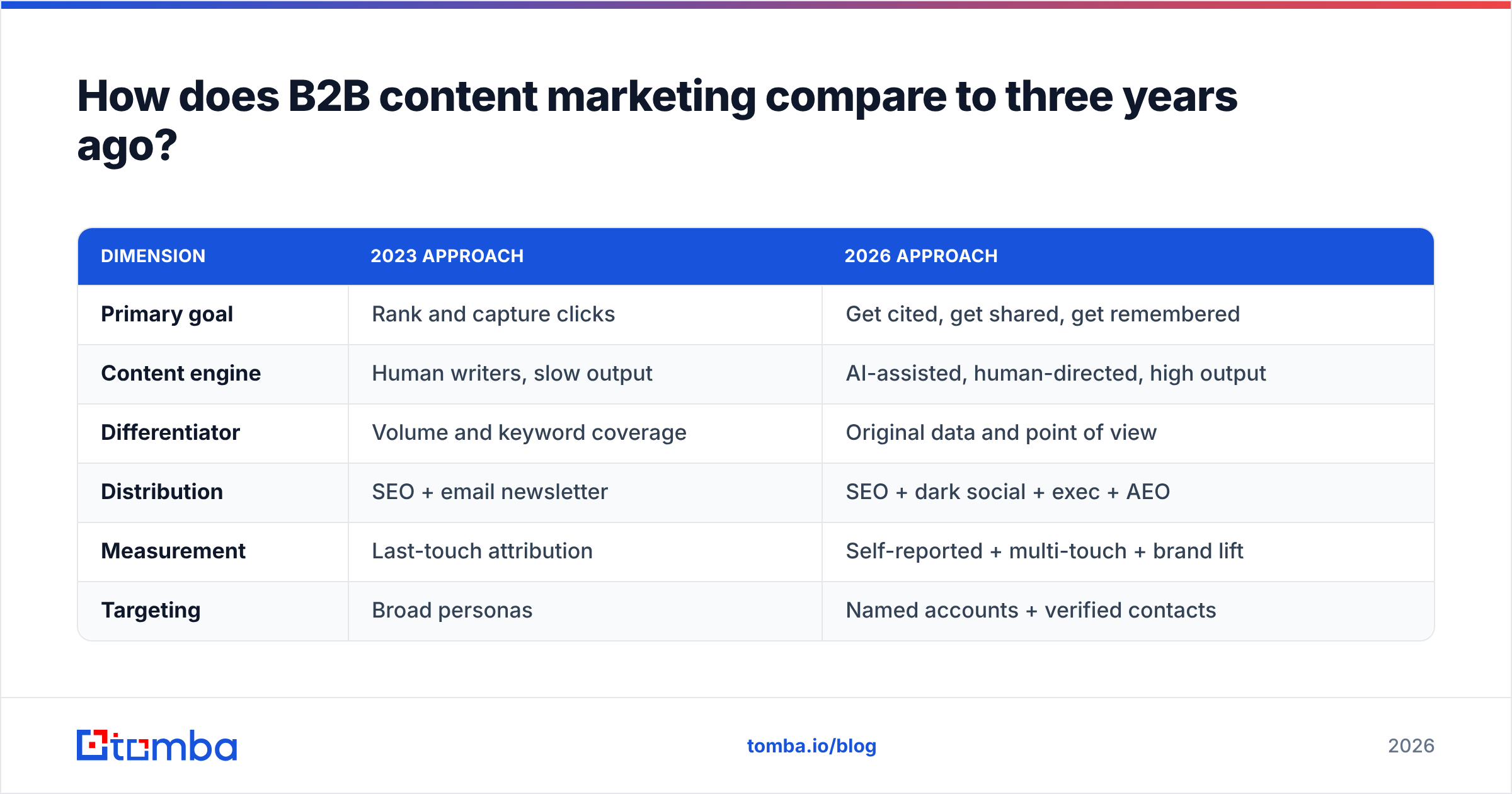
The shift is stark enough that running a 2023 playbook in 2026 actively loses ground. Here's the before-and-after on the dimensions that changed most.
| Dimension | 2023 approach | 2026 approach |
|---|---|---|
| Primary goal | Rank and capture clicks | Get cited, get shared, get remembered |
| Content engine | Human writers, slow output | AI-assisted, human-directed, high output |
| Differentiator | Volume and keyword coverage | Original data and point of view |
| Distribution | SEO + email newsletter | SEO + dark social + exec + AEO |
| Measurement | Last-touch attribution | Self-reported + multi-touch + brand lift |
| Targeting | Broad personas | Named accounts + verified contacts |
The teams that struggle are usually still optimizing the 2023 column — chasing keyword volume, measuring with last-touch, and treating distribution as an afterthought. The teams that win treat content as one half of a system whose other half is data: knowing exactly who to reach and being able to reach them reliably.
What should B2B marketers stop doing in 2026?#
Conclusion first: stop publishing on autopilot, and stop treating content and contact data as separate budgets. Specifically:
- Stop mass-producing thin AI articles. They don't rank, they don't get cited, and they dilute your brand. One researched piece beats ten generic ones.
- Stop ignoring distribution until after you hit publish. If you don't know which channel and which accounts a piece is for before you write it, you've already lost.
- Stop trusting last-touch attribution blindly. It systematically undervalues dark social and brand content. Add self-reported attribution and act on it.
- Stop buying stale contact lists. Outdated data destroys deliverability and wastes the great content you worked hard to produce. Verify before you send.
- Stop separating "marketing content" from "sales outreach." In 2026 the same insight powers a LinkedIn post, a nurture email, and a 1:1 SDR message — the only variable is the contact data routing it.
A useful gut check: for every new piece, you should be able to name the account or segment it's for, the channel it'll travel through, and the proprietary insight that makes it un-copyable. If you can't answer all three, it's filler.
How do content and contact data work together?#
They're two halves of the same machine. Content earns attention and trust; contact data converts that attention into a conversation with a real, reachable buyer. A brilliant case study is worthless if it sits on a page no target buyer ever sees, and a perfectly targeted outreach email is worthless if it has nothing valuable to say.
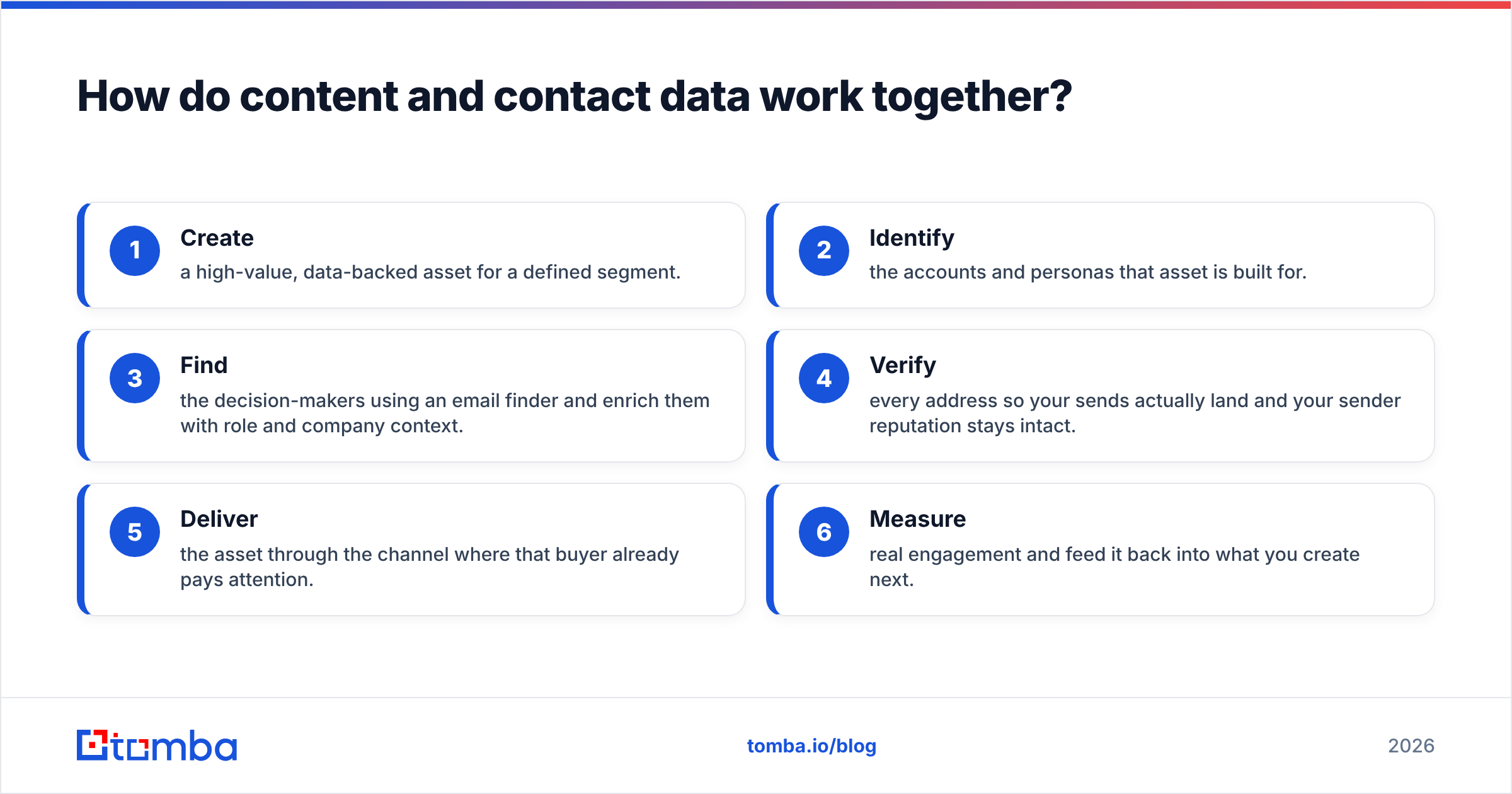
The modern workflow looks like this:
- Create a high-value, data-backed asset for a defined segment.
- Identify the accounts and personas that asset is built for.
- Find the decision-makers using an email finder and enrich them with role and company context.
- Verify every address so your sends actually land and your sender reputation stays intact.
- Deliver the asset through the channel where that buyer already pays attention.
- Measure real engagement and feed it back into what you create next.
That loop is where 2026's best programs live. Content quality gets you in the door; data quality determines how many doors you can knock on without getting blocked. You can compare plans and credit volumes on the Tomba pricing page to size it against your outreach volume.
Frequently asked questions#
Is SEO dead for B2B content in 2026? No, but it changed. Ranking still matters for discovery, but the goal has expanded to answer-engine optimization — being the source LLMs cite. Original data and clear structure win; thin keyword pages lose.
How much content should a B2B team publish? Fewer, better pieces. One researched, well-distributed asset per week outperforms daily filler. Volume only matters when each piece is genuinely useful and reaches the right audience.
Does AI-generated content hurt rankings? Generic AI content does, because it adds nothing original. AI-assisted content with human strategy, proprietary data, and a real point of view performs fine. The issue is quality and originality, not the tool.
Put your content in front of the right buyers#
Great B2B content in 2026 is only half the job — the other half is making sure it reaches verified, in-market decision-makers at the accounts you care about. That's the gap between a busy content calendar and a content engine that drives pipeline.
Start by turning your target account list into reachable contacts. Use the Tomba Email Finder to find professional email addresses by domain, name, or company, then verify them before you send so your best assets actually land in the inbox. Pair the content you're proud of with data you can trust, and the trends above stop being abstract — they start showing up in your pipeline.
// get started
Find, verify and enrich your first contacts today
Start on the free plan with 25 searches a month, then scale when your team is ready.
Free plan · No credit card required · GDPR & CCPA
// about the author