B2B Data in 2026: Sources, Accuracy, and Buyer's Guide
Most B2B data decays about 30% a year. Here's how to source, score, and maintain records that actually convert in 2026 — plus a provider comparison.
TL;DR
- B2B data is the set of facts about companies and the people inside them — firmographics, contact details, technographics, and intent — that powers targeting, routing, and outreach.
- It decays fast: roughly 30% of a typical contact database goes stale every year as people change jobs and companies restructure.
- Accuracy beats volume. A 5,000-record list verified at 95% deliverability outperforms a 50,000-record list at 60%.
- Buy data for coverage and enrichment; build it through self-service finders and verification for freshness and control.
- The smart stack in 2026 pairs a broad provider with a real-time email finder and verifier so records are checked at the moment of use, not six months after purchase.
What is B2B data?#
B2B data is structured information about businesses and the professionals who work at them, used to find, qualify, and reach buyers. Think of it like the contact book behind every sales and marketing motion: without accurate entries, every call, email, and ad is aimed at a moving target.
It falls into four practical buckets:
- Firmographic data — company-level attributes: industry, employee count, revenue, location, funding stage. This is how you define a total addressable market.
- Contact data — person-level records: name, title, work email, direct dial, LinkedIn URL. This is what actually lets you reach a human.
- Technographic data — the tools a company runs (CRM, cloud, payment stack). Useful for "you use X, we integrate with X" plays.
- Intent data — behavioral signals that a company is researching a problem you solve, sourced from content consumption and bidstream activity.
Most teams over-index on volume and under-invest in the one attribute that determines outcomes: whether the record is still true today. A title from 2023 attached to an inbox that bounced is not data — it's noise with a name.
Where does B2B data come from?#
B2B data is sourced four ways, and most providers blend several. Knowing the source tells you how fresh and how legal the record is likely to be.
- Public web crawling — company sites, team pages, press releases, and job boards. Cheap, broad, and the backbone of domain search tools that map every email pattern at a company.
- User contributions and community data — networks where members share contacts in exchange for credits. High coverage on common roles, uneven on quality.
- Licensed and partner feeds — purchased from data aggregators, business registries, and CRM partners. Strong on firmographics, weaker on direct contact freshness.
- Real-time verification — SMTP checks, catch-all detection, and pattern validation performed at the moment of lookup. This is what separates a guess from a deliverable address.
The providers worth paying for don't just collect — they reconcile. The same person shows up across LinkedIn, a company team page, and a conference speaker list with three slightly different titles. Good data sources merge those into one canonical record and timestamp it, so you know how old the underlying signal is.
A quick analogy: raw scraped data is like grocery produce with no date on it. Verification is the sell-by sticker. You can still sell undated produce, but nobody knows what they're getting until it's on the plate — or in this case, until the email bounces.
How do you measure B2B data quality?#
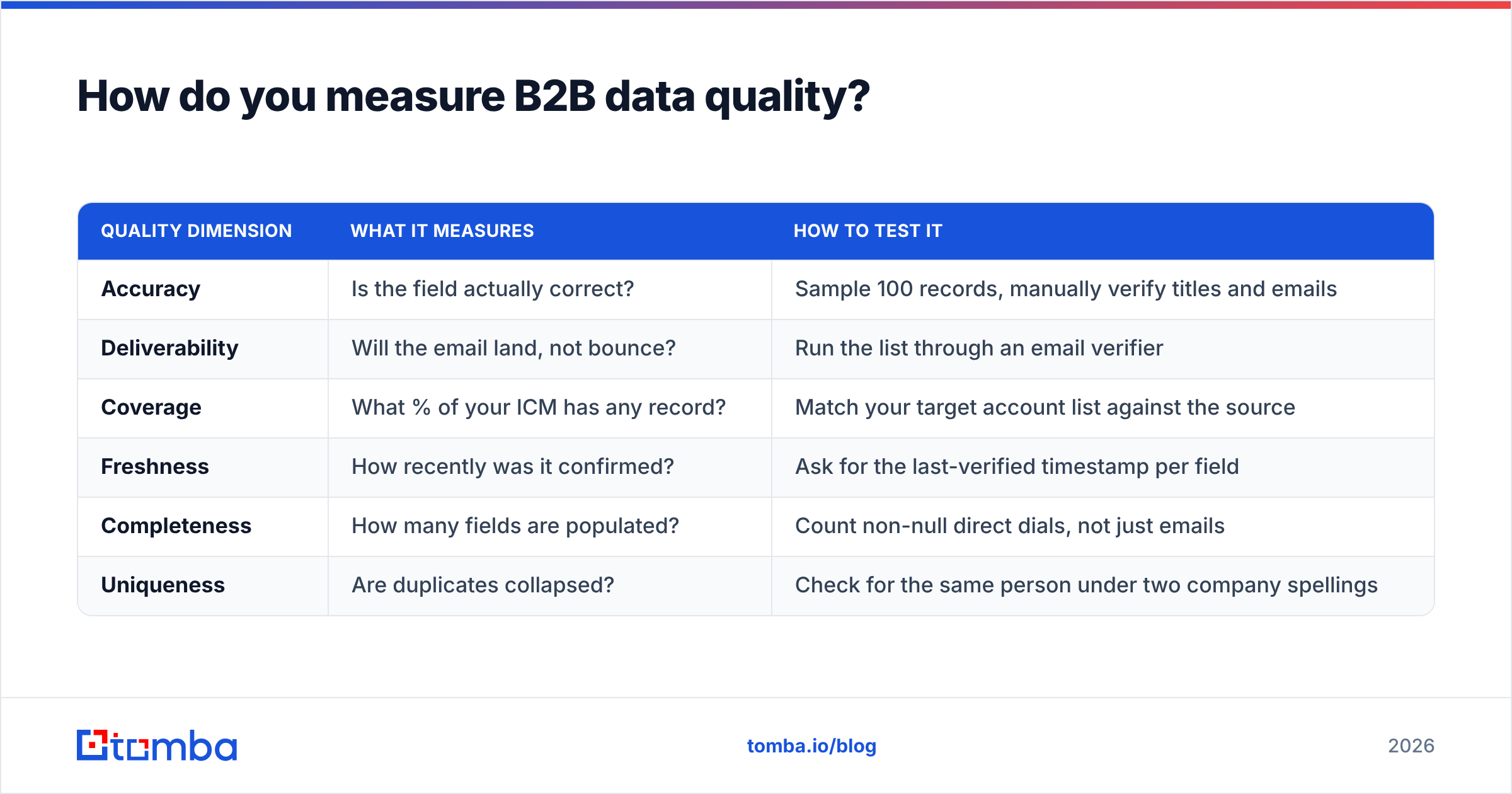
Score every dataset on six dimensions before you trust it. Don't accept a vendor's headline "95% accuracy" claim without knowing which of these it refers to.
| Quality dimension | What it measures | How to test it |
|---|---|---|
| Accuracy | Is the field actually correct? | Sample 100 records, manually verify titles and emails |
| Deliverability | Will the email land, not bounce? | Run the list through an email verifier |
| Coverage | What % of your ICM has any record? | Match your target account list against the source |
| Freshness | How recently was it confirmed? | Ask for the last-verified timestamp per field |
| Completeness | How many fields are populated? | Count non-null direct dials, not just emails |
| Uniqueness | Are duplicates collapsed? | Check for the same person under two company spellings |
Deliverability is the dimension that quietly destroys campaigns. A bounce rate above 3% signals mailbox providers that you may be a spammer, and your sender reputation drops for every recipient — including the good addresses. This is why verification isn't optional housekeeping; it's deliverability insurance. Mailbox providers like Google publish reputation signals through tools such as Postmaster Tools, and a clean list is the cheapest way to keep that number green.
The uncomfortable math: a 50,000-record list at 60% deliverability gives you 30,000 reachable contacts and a bounce rate that throttles your domain. A 5,000-record list verified to 97% gives you 4,850 reachable contacts and a domain that keeps landing in the inbox. Volume is vanity; deliverable volume is the metric.
Why does B2B data decay so fast?#
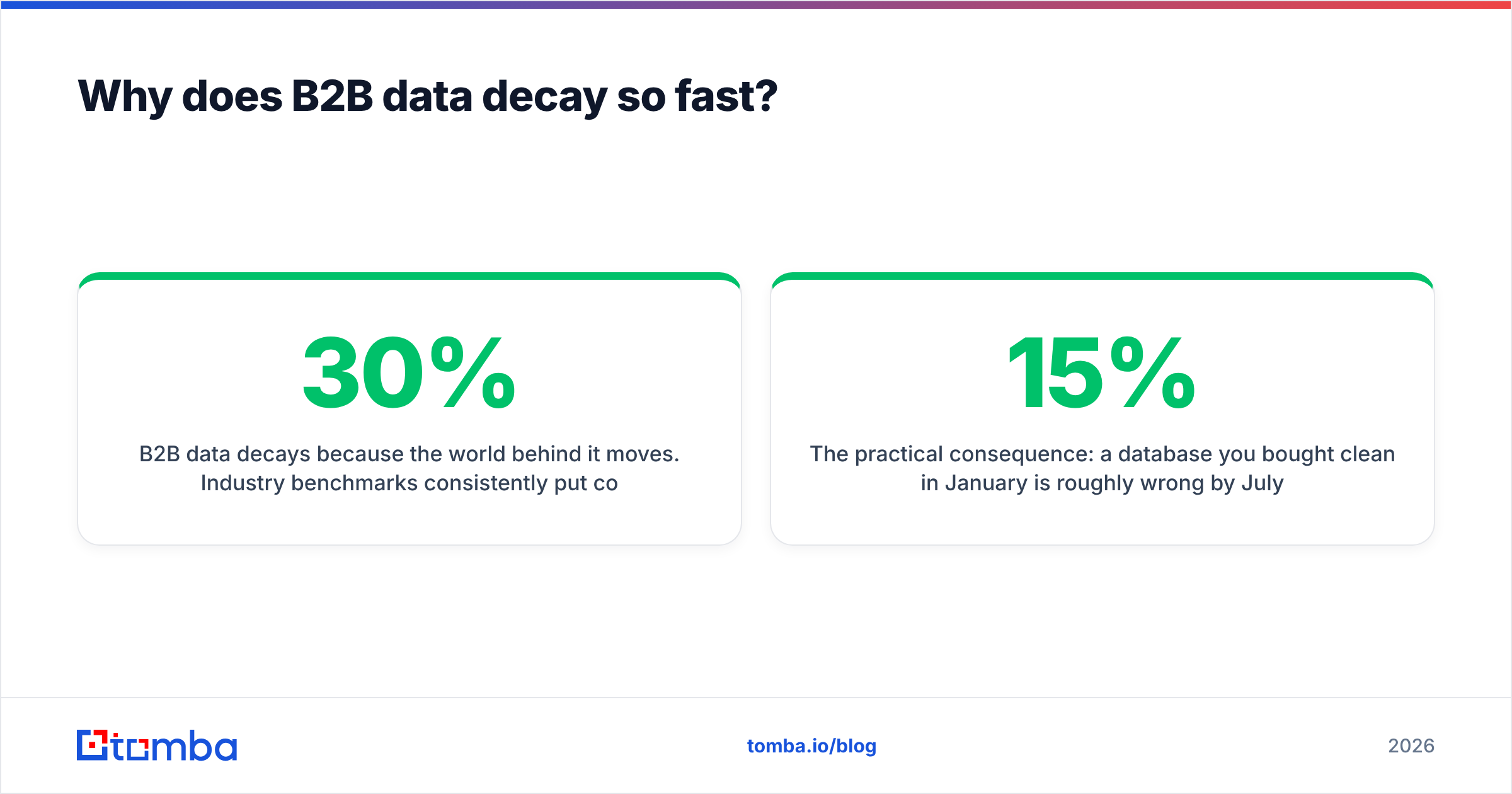
B2B data decays because the world behind it moves. Industry benchmarks consistently put contact-data decay around 30% per year — and in volatile sectors, higher. People are promoted, laid off, or poached; companies merge, rebrand, and shut down; email formats change after acquisitions.
Break the decay down by field and the pattern is obvious:
- Job title — changes on average every 2–3 years, faster for sales and marketing roles.
- Work email — dies the day someone leaves; a new one appears at the next employer.
- Phone numbers — direct dials churn with desk reassignments and remote-work shifts.
- Company firmographics — the slowest-moving, but funding rounds and headcount swings still age them.
The practical consequence: a database you bought clean in January is roughly 15% wrong by July and 30% wrong by next January if you never touch it. Static lists are a depreciating asset. Treat them like one — re-verify on a schedule, and check records at the point of use rather than trusting the purchase date.
Should you buy B2B data or build it?#
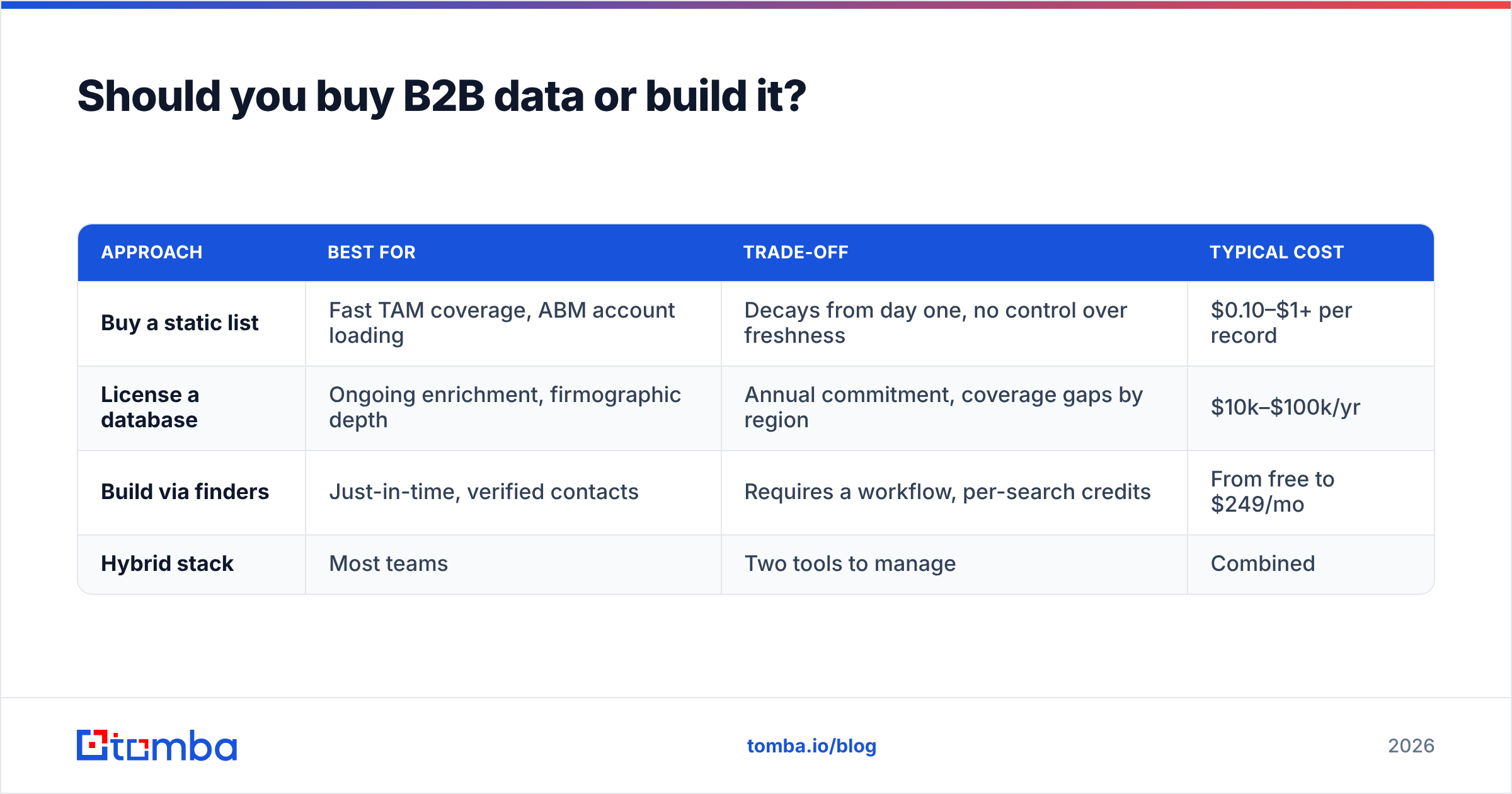
Buy for breadth, build for freshness — and in 2026, most teams do both. The question isn't either/or; it's which job each approach is best at.
| Approach | Best for | Trade-off | Typical cost |
|---|---|---|---|
| Buy a static list | Fast TAM coverage, ABM account loading | Decays from day one, no control over freshness | $0.10–$1+ per record |
| License a database | Ongoing enrichment, firmographic depth | Annual commitment, coverage gaps by region | $10k–$100k/yr |
| Build via finders | Just-in-time, verified contacts | Requires a workflow, per-search credits | From free to $249/mo |
| Hybrid stack | Most teams | Two tools to manage | Combined |
Buying makes sense when you need to load 2,000 target accounts into an ABM platform this week. Building makes sense when a rep is about to email a specific prospect and needs an address that's confirmed live right now. A self-service email finder closes that last-mile gap: you give it a name and a domain, it returns a verified address with a confidence score, and you never inherit someone else's six-month-old export.
The teams that struggle are the ones treating a one-time purchase as a permanent asset. The teams that win wire enrichment into the workflow — every new lead gets enriched and verified on entry, and the CRM stays clean because freshness is built into the pipe, not bolted on quarterly.
How do you keep a B2B database clean?#
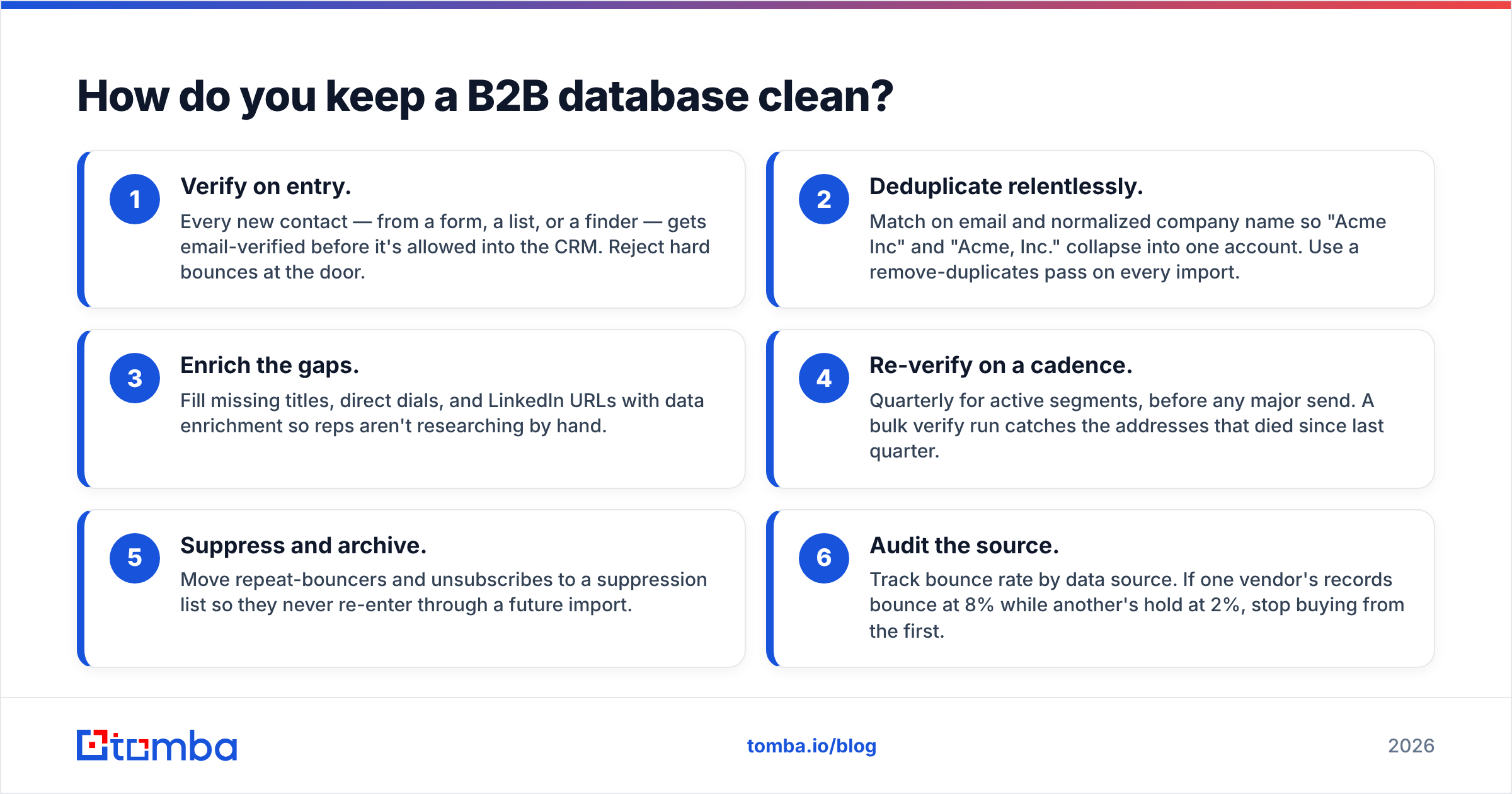
Clean data is a process, not a purchase. Run this loop continuously rather than as an annual fire drill:
- Verify on entry. Every new contact — from a form, a list, or a finder — gets email-verified before it's allowed into the CRM. Reject hard bounces at the door.
- Deduplicate relentlessly. Match on email and normalized company name so "Acme Inc" and "Acme, Inc." collapse into one account. Use a remove-duplicates pass on every import.
- Enrich the gaps. Fill missing titles, direct dials, and LinkedIn URLs with data enrichment so reps aren't researching by hand.
- Re-verify on a cadence. Quarterly for active segments, before any major send. A bulk verify run catches the addresses that died since last quarter.
- Suppress and archive. Move repeat-bouncers and unsubscribes to a suppression list so they never re-enter through a future import.
- Audit the source. Track bounce rate by data source. If one vendor's records bounce at 8% while another's hold at 2%, stop buying from the first.
This is the difference between a database that compounds in value and one that quietly rots. The mechanics aren't glamorous, but they're the reason one team's outreach lands and another's gets filtered.
How accurate is B2B contact data, really?#
Realistic accuracy for verified B2B contact data in 2026 sits in the 90–97% deliverability range when records are checked at the time of use, and noticeably lower for static purchased lists left untouched. The honest answer is that no provider is 100%, and any vendor claiming it is measuring something other than real-world bounces.
Two factors set the ceiling:
- Catch-all domains. Many companies accept mail to any address at their domain, which makes binary "valid/invalid" verification impossible. A catch-all verifier uses pattern confidence and historical signals to grade these rather than guessing.
- Verification timing. An address verified at lookup is far more reliable than one verified at the data vendor's last crawl. This is the single biggest lever, and it's why point-of-use verification beats point-of-purchase every time.
Independent reviews on platforms like G2 and Capterra are useful for sanity-checking vendor claims, because they aggregate real customer bounce experiences rather than marketing numbers. Cross-reference a provider's self-reported accuracy with what actual users report under load.
What should a B2B data stack look like in 2026?#
The modern stack has three layers, each doing one job well:
- Discovery layer — a database or finder that turns a target account into a list of named people with roles. This is where domain search and intent signals live.
- Verification layer — real-time checks that confirm an address is deliverable before it's used, including catch-all grading.
- Activation layer — the CRM, sequencer, and enrichment pipes that keep records fresh through their lifecycle, wired together through integrations with HubSpot, Salesforce, Pipedrive, and Sheets.
The mistake teams make is buying a single mega-platform and assuming it covers all three equally. In practice, the discovery layer is strong and the verification layer is an afterthought — which is exactly the layer that protects deliverability. Pairing a broad data source with a dedicated finder-and-verifier gives you both coverage and freshness without betting your domain on one vendor's verification quality. Compare what each layer costs against your volume on the Tomba pricing page before committing to an annual platform contract.
The bottom line#
B2B data is only as valuable as it is true today. Volume looks impressive in a dashboard and burns your domain in production. The teams that win in 2026 score data on deliverability and freshness, verify at the point of use, and treat their database as a living system that's cleaned continuously — not a list bought once and trusted forever.
Start where the leverage is highest: stop sending to addresses you haven't confirmed. Use the Tomba Email Finder to pull verified, deliverable contacts by name or domain, complete with a confidence score on every record — and keep your sender reputation green while your competitors are still bouncing off stale lists. The free tier gives you 25 searches a month to test it against your own target accounts before you scale to a paid plan.
// get started
Find, verify and enrich your first contacts today
Start on the free plan with 25 searches a month, then scale when your team is ready.
Free plan · No credit card required · GDPR & CCPA
// about the author