How to Choose a B2B Data Partner in 2026: A Buyer's Guide
Picking a B2B data partner decides whether your pipeline runs on fresh, accurate contacts or stale junk. Here's how to evaluate vendors on coverage, accuracy, compliance, and price in 2026.
Your outbound engine is only as good as the data feeding it. Pick the wrong B2B data partner and you pay — in bounced emails, burned sender reputation, reps chasing dead numbers, and a CRM that quietly rots. Pick the right one and every other tool in your stack works harder. This guide breaks down how to actually evaluate a B2B data partner in 2026, what to test before you sign, and where the real cost hides.
TL;DR#
- A B2B data partner is the vendor (or stack of vendors) that supplies and refreshes the contact and company data your sales and marketing teams run on — emails, phones, firmographics, intent, and enrichment.
- The four things that separate good partners from expensive ones: accuracy, coverage in your ICP, compliance, and refresh cadence. Price is fifth, not first.
- Never buy on a vendor's self-reported accuracy number. Run a blind sample against your own known-good records first.
- Buying one giant "all-in-one" database is rarely the answer. A waterfall — primary provider plus a verification and enrichment layer — beats a single source on both cost and quality.
- For email-led outbound, a focused finder-and-verifier like Tomba plugs into that waterfall cleanly without locking you into a six-figure seat-based contract.
What is a B2B data partner?#
A B2B data partner is the supplier behind your go-to-market data. Think of it like the wholesaler behind a restaurant. The diners (your prospects) never see them, but if the wholesaler ships wilted produce, every dish on the menu suffers no matter how good your chef is. Your reps are the chef; the data partner is the supply chain.
In practice the term covers a few overlapping jobs:
- Contact data — verified business emails, direct-dial and mobile phone numbers, job titles.
- Company data (firmographics) — industry, headcount, revenue, tech stack, location.
- Enrichment — taking a thin record (just a name and company) and filling in the rest. This is where data enrichment lives.
- Intent and signals — who is researching your category right now, hiring signals, funding events.
- Hygiene — ongoing verification so the data you bought last quarter is still true this quarter.
Some vendors try to do all five. Most do one or two well and the rest poorly. Knowing which job you actually need solved is the first decision, and it's the one most teams skip.
Why does choosing the right B2B data partner matter so much?#
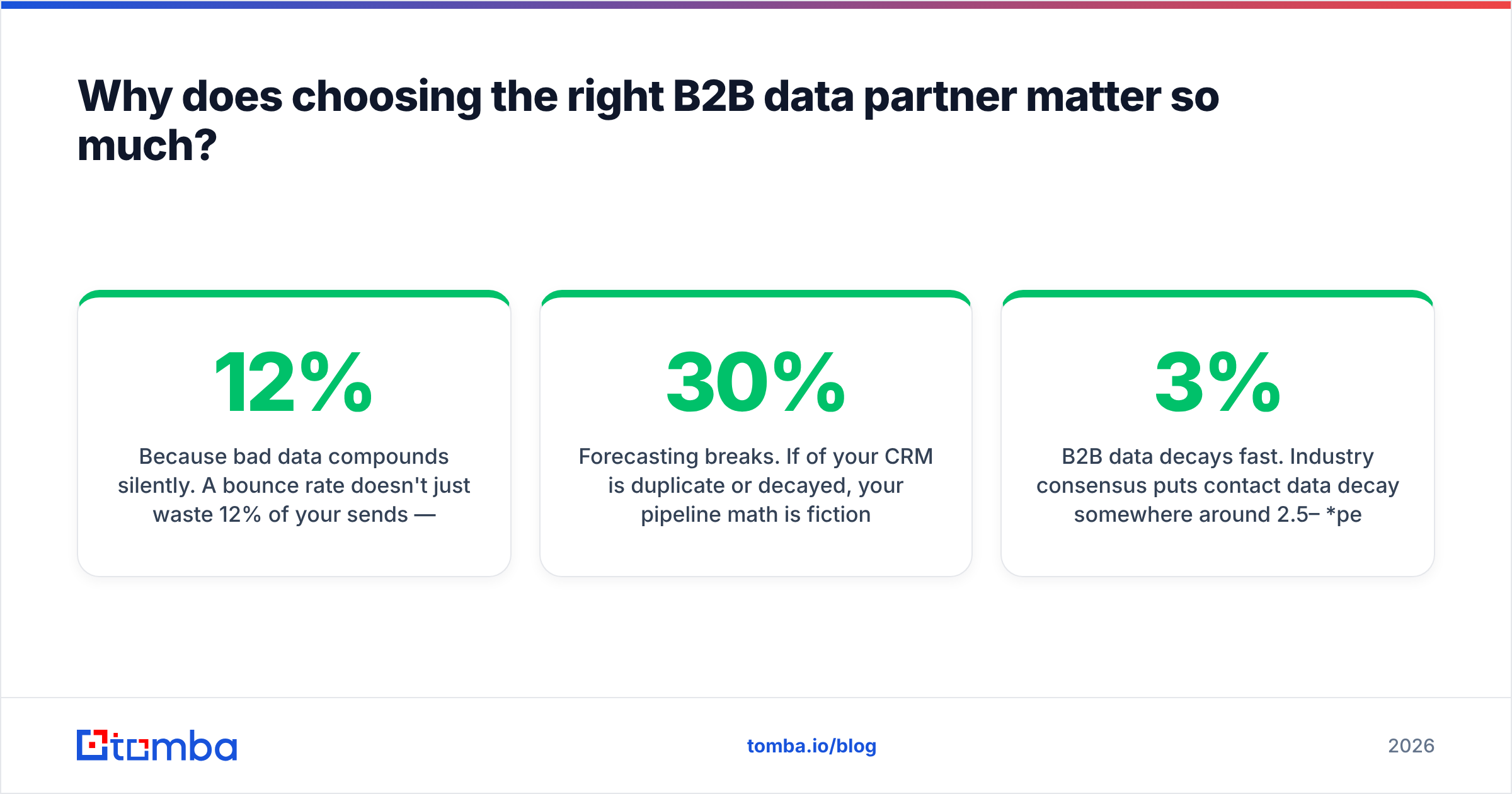
Because bad data compounds silently. A 12% bounce rate doesn't just waste 12% of your sends — it drags your sender reputation down so your good emails land in spam too. One stale field poisons the whole campaign.
Here's the chain reaction when your data partner underdelivers:
- Deliverability craters. High bounce rates signal mailbox providers that you're not maintaining your list. Inbox placement drops across the board.
- Rep trust evaporates. When two of every five dials are wrong numbers, reps stop trusting the data and go back to manual LinkedIn scraping — and you're paying for a database nobody uses.
- Forecasting breaks. If 30% of your CRM is duplicate or decayed, your pipeline math is fiction.
- Compliance exposure grows. Data sourced without a lawful basis isn't a discount — it's a liability waiting for a GDPR or CCPA complaint.
B2B data decays fast. Industry consensus puts contact data decay somewhere around 2.5–3% per month as people change jobs, which means roughly 30% of a list is stale within a year. A partner that doesn't re-verify continuously is selling you a melting ice cube.
/blog/generated/memes/2026-06-16/b2b-data-partner-meme-1.png
Wait — that's the whole point. The data you buy isn't a one-time asset. It's a subscription to freshness. Evaluate partners on how they keep data true, not just how much of it they have.
How do you evaluate a B2B data partner in 2026?#
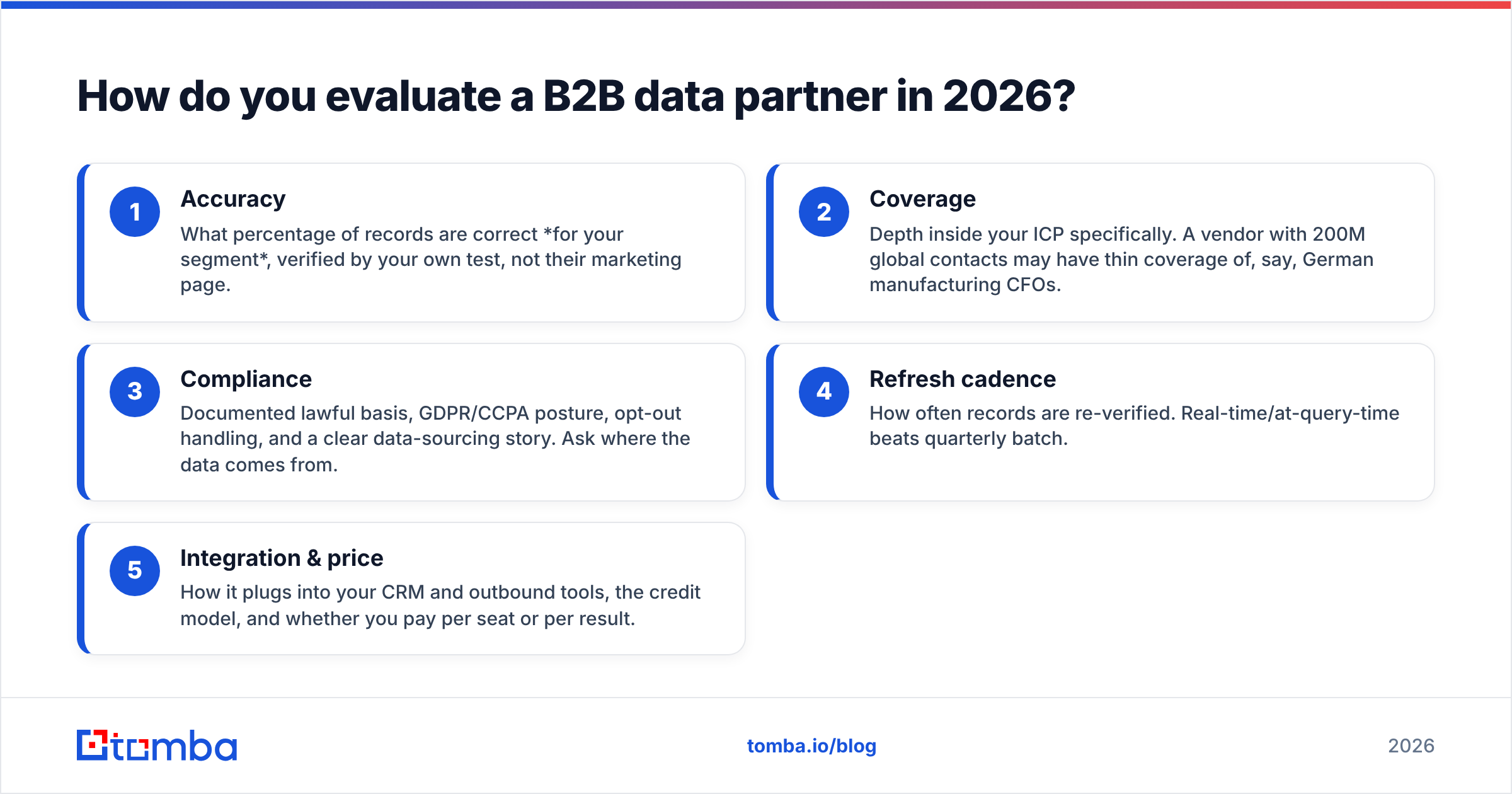
Score every vendor on the same five dimensions, in this order. The order matters: a cheap partner with bad accuracy is the most expensive option you can choose.
- Accuracy — What percentage of records are correct for your segment, verified by your own test, not their marketing page.
- Coverage — Depth inside your ICP specifically. A vendor with 200M global contacts may have thin coverage of, say, German manufacturing CFOs.
- Compliance — Documented lawful basis, GDPR/CCPA posture, opt-out handling, and a clear data-sourcing story. Ask where the data comes from.
- Refresh cadence — How often records are re-verified. Real-time/at-query-time beats quarterly batch.
- Integration & price — How it plugs into your CRM and outbound tools, the credit model, and whether you pay per seat or per result.
For an external sanity check on any vendor, read verified buyer reviews on G2 and cross-reference how analysts like Gartner frame the category — but treat both as inputs, not verdicts. Your blind sample test outranks every star rating.
The one test that beats every sales demo#
Take 100 records you already know are correct — pulled from closed-won accounts, ideally. Strip them down to name + company. Hand that list to each prospective partner and have them enrich it. Then measure:
- Match rate — how many of the 100 they returned anything for.
- Accuracy — of the returned records, how many matched your known-good values.
- Verification honesty — did they flag risky records (catch-all domains, unverifiable emails) or pass them off as valid?
That last point separates honest partners from inflated ones. A vendor that returns a confidently "valid" email for a catch-all domain is padding its match rate at the expense of your bounce rate.
What should a B2B data partner comparison table actually include?#
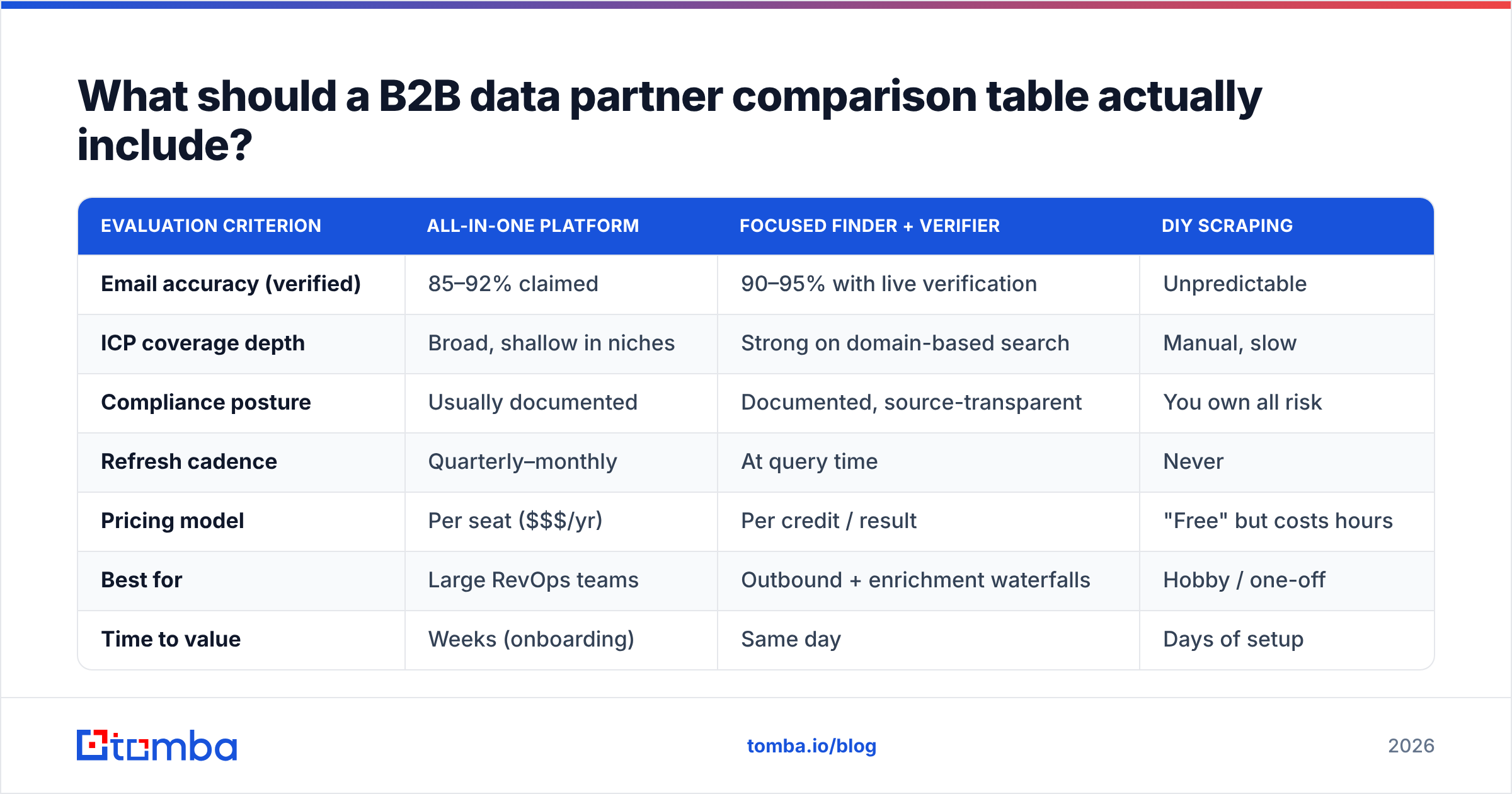
Skip the feature-checkbox bingo. Compare on outcomes your revenue team feels. Here's the shape of a comparison that matters:
| Evaluation criterion | All-in-one platform | Focused finder + verifier | DIY scraping |
|---|---|---|---|
| Email accuracy (verified) | 85–92% claimed | 90–95% with live verification | Unpredictable |
| ICP coverage depth | Broad, shallow in niches | Strong on domain-based search | Manual, slow |
| Compliance posture | Usually documented | Documented, source-transparent | You own all risk |
| Refresh cadence | Quarterly–monthly | At query time | Never |
| Pricing model | Per seat ($$$/yr) | Per credit / result | "Free" but costs hours |
| Best for | Large RevOps teams | Outbound + enrichment waterfalls | Hobby / one-off |
| Time to value | Weeks (onboarding) | Same day | Days of setup |
The pattern most high-performing teams land on: a broad provider for firmographics and intent, plus a sharp, pay-for-what-you-use finder-and-verifier layered on top to catch the contact gaps and keep emails clean. You don't have to marry one vendor.
Should you use one B2B data partner or a waterfall?#
Use a waterfall. A single source — no matter how big — has blind spots, and you pay full price for the records it gets wrong.
A data waterfall works like getting a second and third medical opinion before surgery. You ask provider A first; if it can't return a confident, verified record, the request cascades to provider B, then a verification pass cleans whatever comes back. You only pay each provider for what it actually delivers, and the final record is the best of all sources.
A practical, cost-aware waterfall looks like this:
- Firmographic + intent layer — your broad database for account selection and signals (pull from a B2B database sized to your market).
- Contact-find layer — a domain search and email finder to get the actual person's address when the broad provider comes up empty.
- Verification layer — an email verifier to drop catch-alls, dead boxes, and risky sends before they hit your sequencer.
- Enrichment layer — fill remaining gaps (phone, title, LinkedIn) right before the record enters your CRM.
This structure is why where a vendor gets its data matters more than its headline contact count. Transparent sourcing lets you trust the waterfall; a black box forces you to verify everything anyway.
/blog/generated/memes/2026-06-16/b2b-data-partner-meme-2.png
What does a B2B data partner cost in 2026?#
Real cost has three layers, and the sticker price is the smallest one.
- Subscription / credits — what you pay the vendor. Per-seat models punish growing teams; per-credit or per-result models scale with usage.
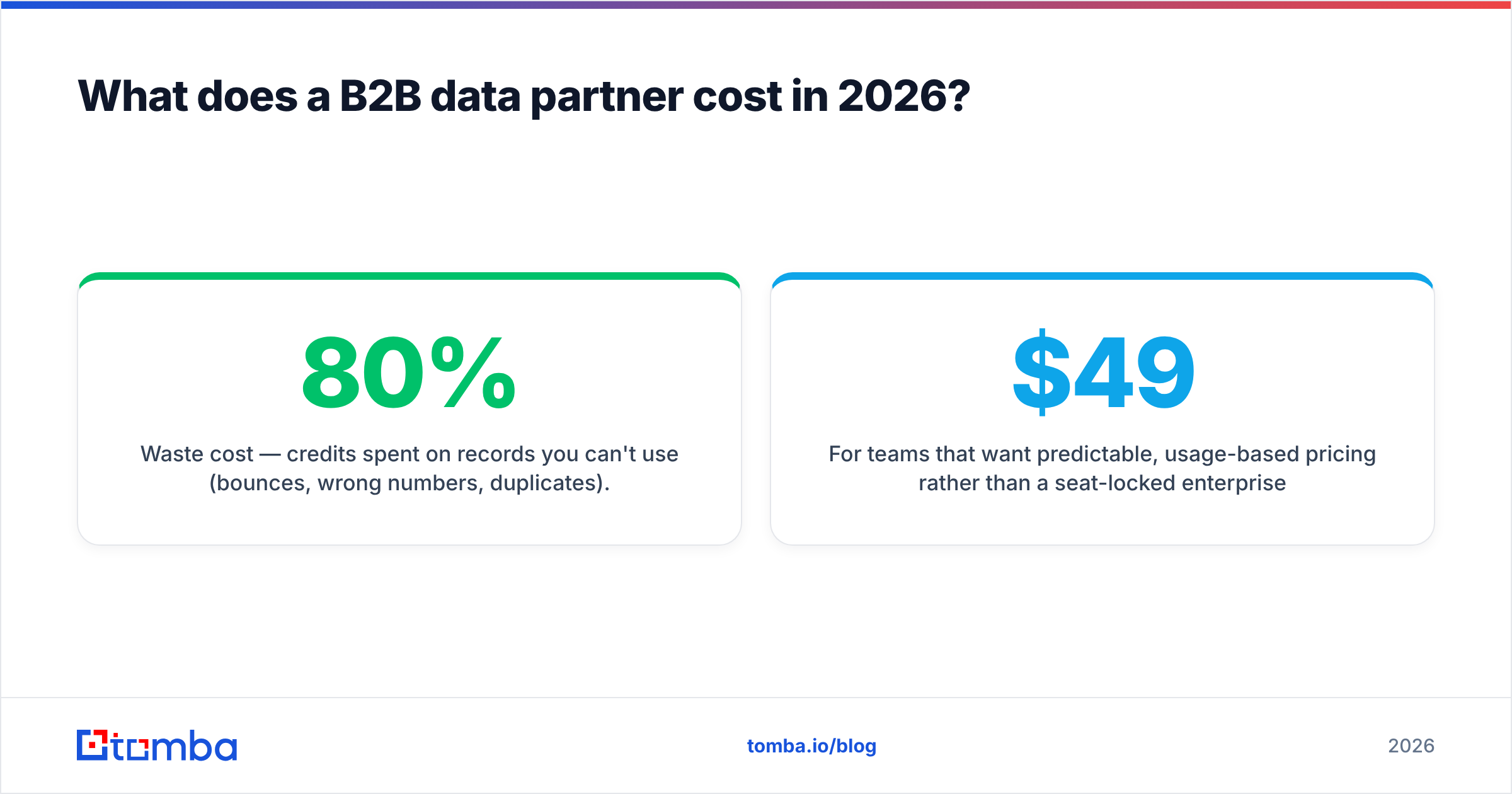
- Waste cost — credits spent on records you can't use (bounces, wrong numbers, duplicates). A "cheaper" provider with 80% accuracy costs more per usable record than a pricier one at 95%.
- Labor cost — the rep and RevOps hours spent cleaning, deduping, and re-verifying. This is the invisible line item that dwarfs the others.
Do the math on cost-per-usable-record, not cost-per-record. A provider charging more per credit but delivering verified, deliverable contacts almost always wins on the metric that touches revenue.
For teams that want predictable, usage-based pricing rather than a seat-locked enterprise contract, Tomba's plans start with a free tier (25 searches/month), then Starter at $49/mo, Growth at $99/mo, and Pro at $249/mo — so you can run the blind-sample test before committing real budget.
How do you onboard a new B2B data partner without breaking your stack?#
Treat it as a migration, not a switch-flip. Run the new partner in parallel with your current source for one full cycle before you cut over.
- Sandbox first. Point the new partner at a test segment and a duplicate CRM view. Never enrich your production database on day one.
- Dedupe before import. New data plus old data equals duplicate chaos unless you remove duplicates and standardize formats on the way in.
- Verify in bulk, then sequence. Push the new contacts through bulk verification before a single one enters an active campaign.
- Connect natively. Use real integrations with HubSpot, Salesforce, or Pipedrive rather than CSV exports — every manual export is a re-introduction of decay and human error. (HubSpot's own data quality guidance is a good baseline for what "clean" should mean.)
- Measure against the old source. Compare bounce rate, connect rate, and reply rate side by side for 30 days. Let the numbers, not the demo, make the call.
What are the red flags that a B2B data partner will disappoint you?#
Walk away — or at least dig harder — if you see any of these:
- No way to test before buying. A confident vendor lets you run a sample. A nervous one hides behind an annual contract.
- Accuracy claims with no methodology. "95% accurate" means nothing without "verified how, on what segment, when."
- Opaque sourcing. If they can't or won't tell you where the data comes from, you can't assess your compliance exposure.
- Catch-all records sold as valid. A telltale sign they're optimizing for match-rate marketing over your deliverability.
- Seat-based lock-in with no usage flexibility. You end up paying for capacity you don't use and getting throttled exactly when you scale.
- No continuous re-verification. Static databases are decaying databases.
The bottom line#
The best B2B data partner isn't the one with the biggest number on its homepage — it's the one whose data is still true when your rep hits send. Score vendors on accuracy, ICP coverage, compliance, and refresh cadence before you ever look at price, run a blind sample against records you already trust, and build a waterfall instead of betting everything on one source.
If your priority is finding and verifying the right business emails — the contact layer where most "big database" vendors quietly fall down — start with the Tomba Email Finder. Search by domain, name, or company, verify every result before it touches your sequencer, and run the free tier against your own known-good list first. Prove the accuracy on your data, then scale the plan to match your volume. That's how you turn a data partner from a line item into a pipeline advantage.
// get started
Find, verify and enrich your first contacts today
Start on the free plan with 25 searches a month, then scale when your team is ready.
Free plan · No credit card required · GDPR & CCPA
// about the author