B2B Data Provider Guide 2026: How to Choose the Right One
Most B2B data providers sell you the same recycled records at very different prices. Here's how to compare accuracy, coverage, compliance, and cost in 2026 — and pick the one that actually fits your motion.
(title rendered separately)
Choosing a B2B data provider in 2026 is less about who has "the most contacts" and more about who has accurate, compliant, and affordable contacts for your market. Vendors love big numbers — 200M, 700M, a billion records — but a list you can't email or call is just storage cost. This guide gives you a buyer's framework, a side-by-side comparison, and a way to test any provider before you sign a contract.
TL;DR#
- A B2B data provider sells contact and company information (emails, phone numbers, firmographics, technographics, intent) so your sales and marketing teams can find and reach buyers.
- Accuracy and recency beat raw volume. A 90M-record database with 95% deliverable emails outperforms a 700M database that's half stale.
- The four buying criteria that matter: coverage for your region/industry, verified accuracy, compliance (GDPR/CCPA), and real cost per usable record.
- Enterprise platforms (ZoomInfo, Apollo, Cognism) bundle data with workflow; focused tools like Tomba let you pull verified contact data on demand via API without a five-figure annual seat.
- Always run a free accuracy test on your ICP before committing. Bounce rates lie less than sales decks do.
What is a B2B data provider?#
A B2B data provider is a company that collects, cleans, and sells business contact and company data so you can build pipeline. Think of it like a wholesale grocer for sales teams: instead of foraging for every email and phone number yourself, you buy structured, ready-to-use records and spend your time selling.
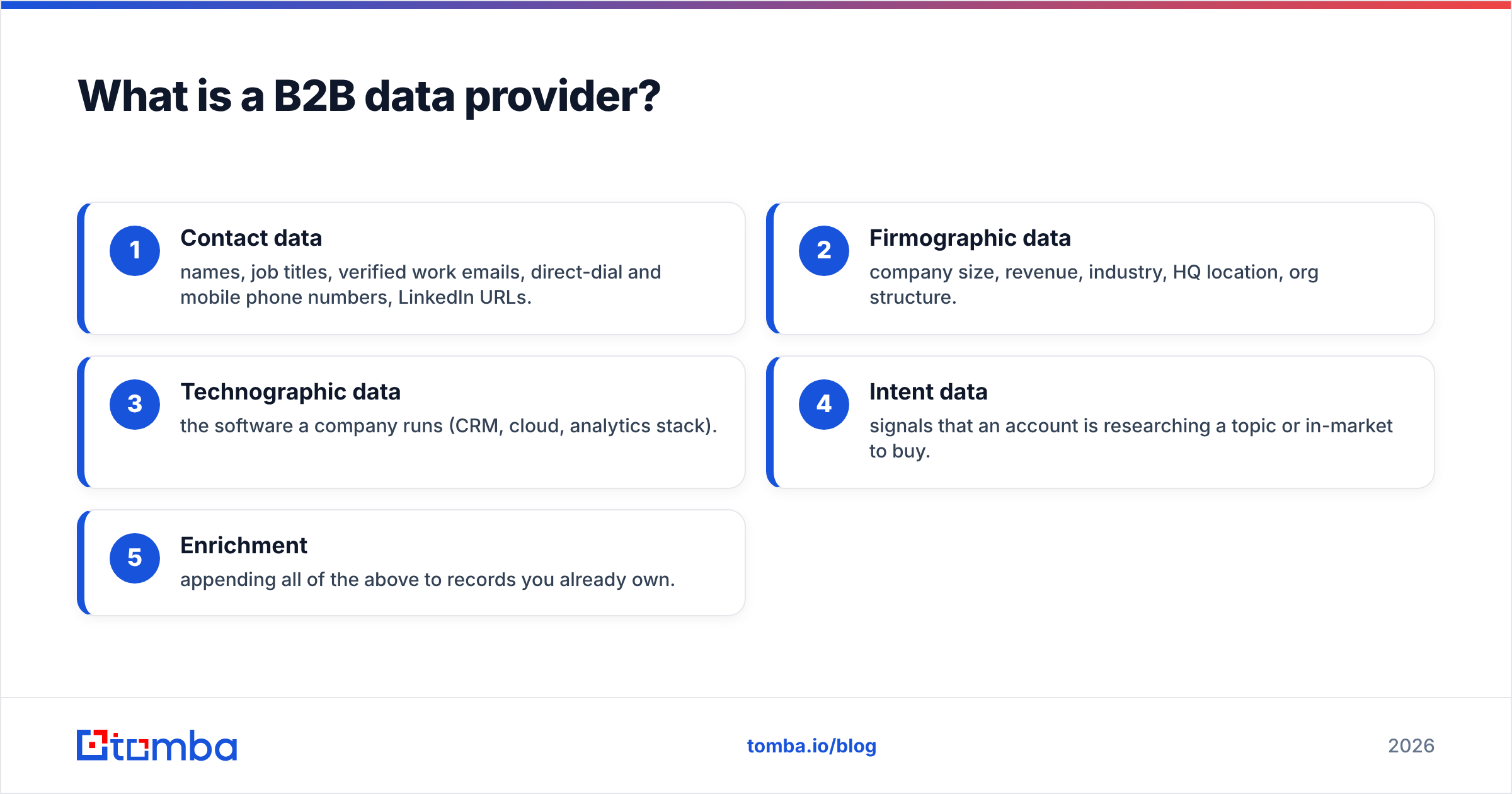
The data usually falls into a few buckets:
- Contact data — names, job titles, verified work emails, direct-dial and mobile phone numbers, LinkedIn URLs.
- Firmographic data — company size, revenue, industry, HQ location, org structure.
- Technographic data — the software a company runs (CRM, cloud, analytics stack).
- Intent data — signals that an account is researching a topic or in-market to buy.
- Enrichment — appending all of the above to records you already own.
Most providers pull from a blend of public web crawling, user-contributed data, licensed partnerships, and verification layers. The differentiator is rarely the source — it's how aggressively they verify and how often they refresh. You can read more about where good contact data comes from before you trust any single vendor's claims.
Why does data quality matter more than database size?#
Conclusion first: a bigger database does not mean better outreach — it usually means more decayed records you'll pay to store and bounce against.
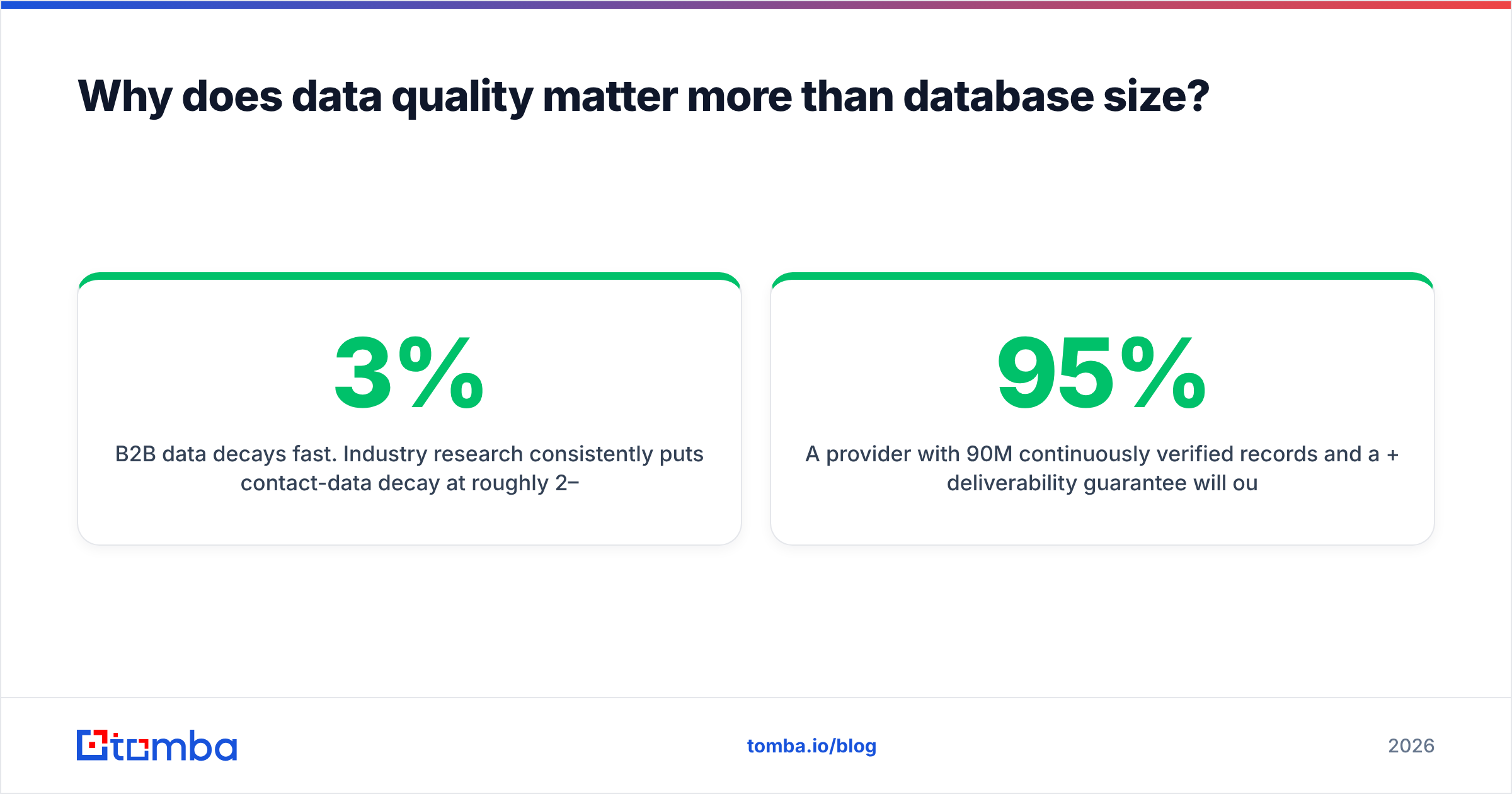
B2B data decays fast. Industry research consistently puts contact-data decay at roughly 2–3% per month, which compounds to about 25–30% of a database going stale every year as people change jobs, titles, and companies. That means a vendor's "700 million contacts" headline tells you nothing unless you also know:
- What percentage was verified in the last 90 days?
- What's the guaranteed deliverability or accuracy rate?
- How is the data refreshed — continuously, or in quarterly batches?
A provider with 90M continuously verified records and a 95%+ deliverability guarantee will out-convert a 700M dump every time, because every bounce hurts your sender reputation and every wrong number wastes a rep's afternoon. If you're emailing at scale, pair any provider with an email verifier so you catch decay between refresh cycles.
How do the main B2B data provider types compare?#
There are three broad categories of provider, and they suit very different teams.
| Criteria | All-in-one platform (
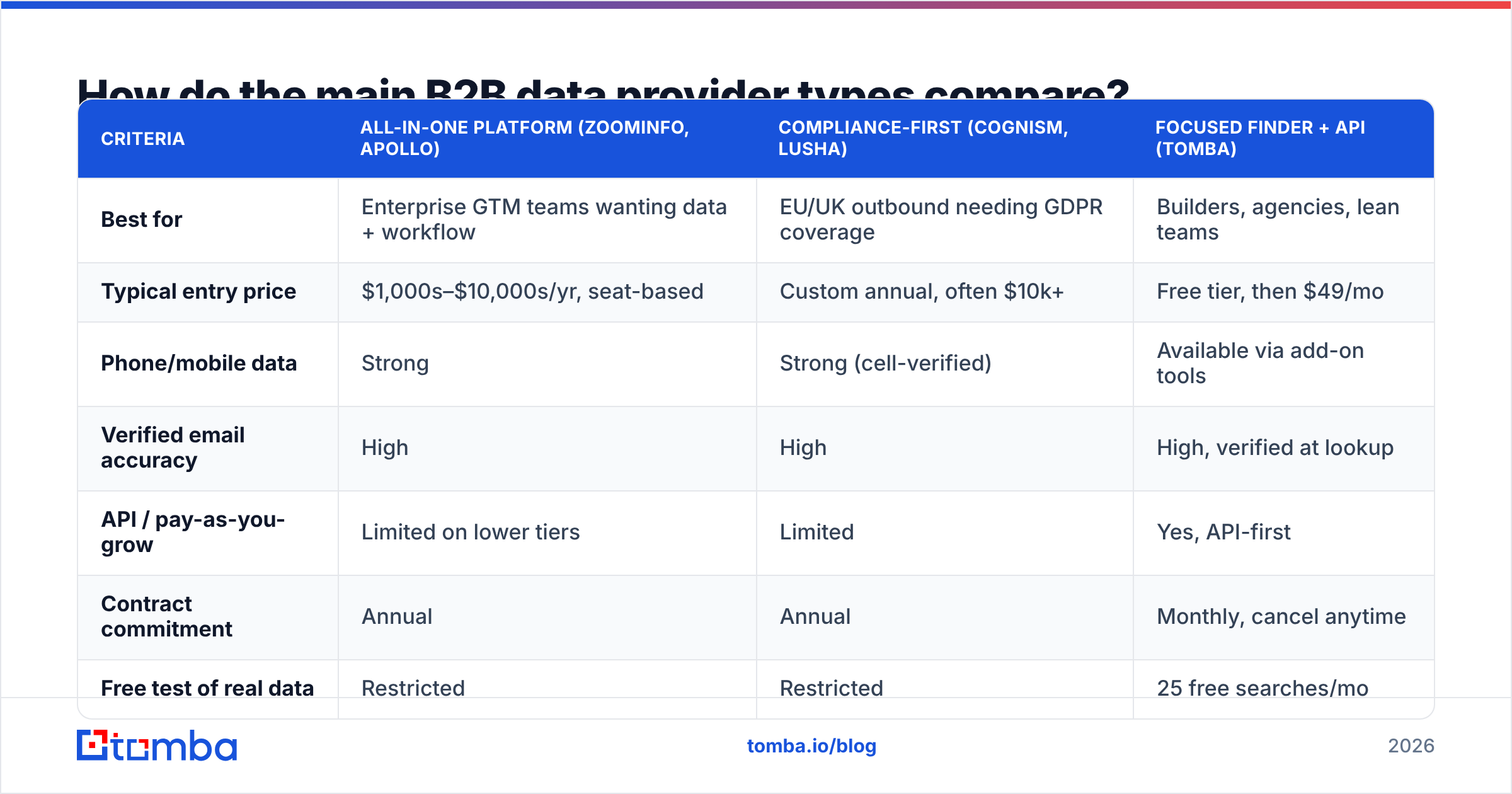
ZoomInfo, Apollo) | Compliance-first (Cognism, Lusha) | Focused finder + API (Tomba) | |---|---|---|---| | Best for | Enterprise GTM teams wanting data + workflow | EU/UK outbound needing GDPR coverage | Builders, agencies, lean teams | | Typical entry price | $1,000s–$10,000s/yr, seat-based | Custom annual, often $10k+ | Free tier, then $49/mo | | Phone/mobile data | Strong | Strong (cell-verified) | Available via add-on tools | | Verified email accuracy | High | High | High, verified at lookup | | API / pay-as-you-grow | Limited on lower tiers | Limited | Yes, API-first | | Contract commitment | Annual | Annual | Monthly, cancel anytime | | Free test of real data | Restricted | Restricted | 25 free searches/mo |
The pattern: enterprise platforms are excellent if you'll use the workflow, sequencing, and intent layers and have the budget. But many teams pay enterprise prices and only use the data lookup — at which point a focused, API-first provider does the same job for a fraction of the cost. The Apollo alternative and Clearbit alternative breakdowns walk through exactly where the savings come from.

What should you evaluate before buying?#
Use these six criteria as a scorecard. Rate every shortlisted B2B data provider 1–5 on each and the winner usually becomes obvious.
- Coverage for your ICP. Global headcount means nothing if the vendor is thin in your region or vertical. Test against 50 accounts you already know.
- Verified accuracy. Ask for the guaranteed deliverable-email and connect-rate numbers in writing, then verify them yourself with a sample.
- Compliance. Confirm GDPR, CCPA, and (for EU calling) DNC-screening support. Get their data-processing terms before legal does.
- Data freshness. Continuous re-verification beats quarterly batch refresh. Ask how a job change propagates.
- Delivery and integration. API, CSV, CRM sync, browser extension, spreadsheet add-on — match it to how your team actually works.
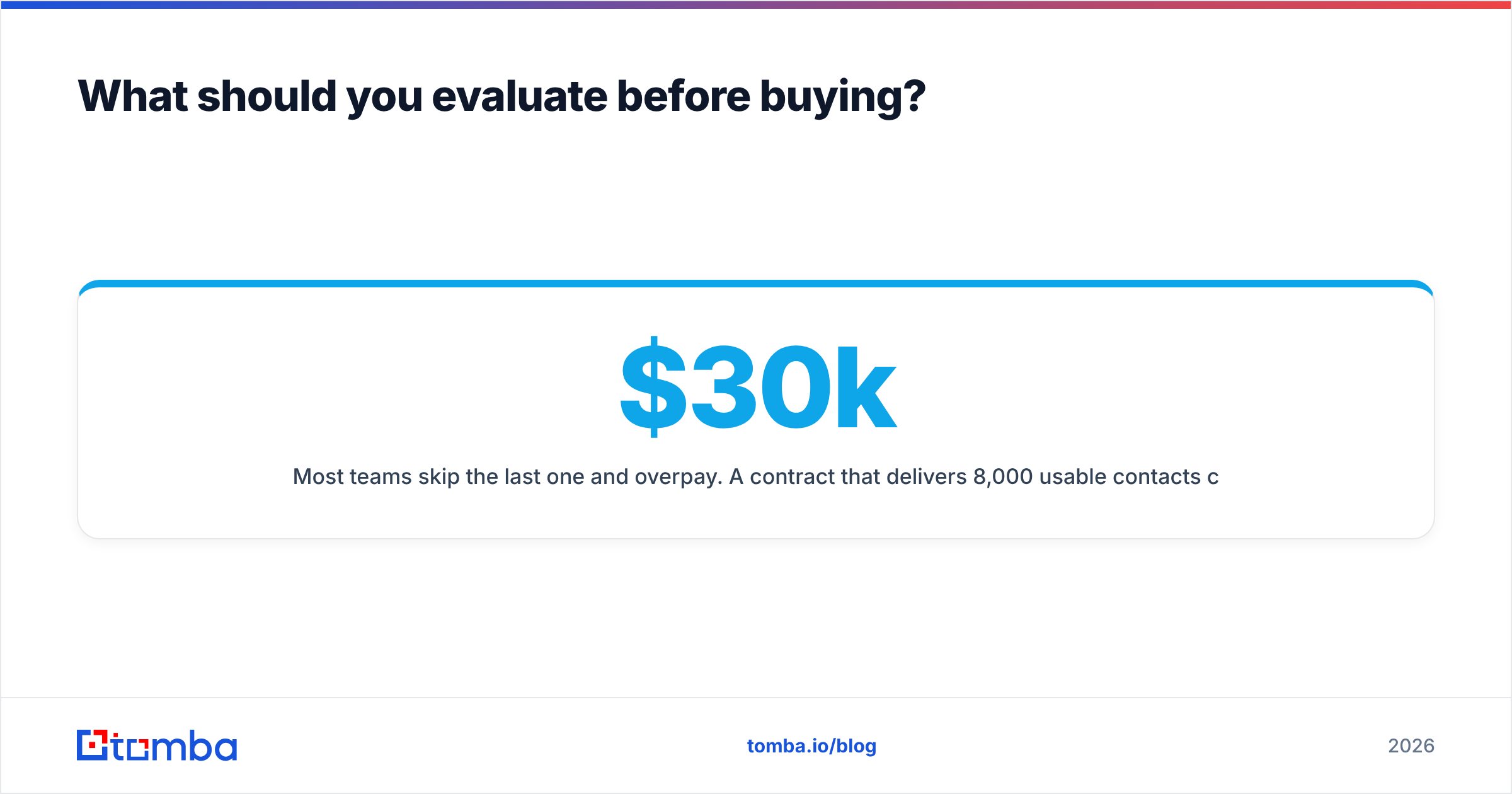
- True cost per usable record. Divide annual cost by verified, in-ICP records you'll realistically use — not the headline database size.
Most teams skip the last one and overpay. A $30k contract that delivers 8,000 usable contacts costs $3.75 each; a $99/mo plan delivering 1,500 usable contacts a month costs about $0.79 each. Run the math on your volume. The Tomba pricing page lays out exactly how credits map to searches so you can model it honestly.
How do you find and verify B2B contacts day to day?#
Buying a static list is the old model. The 2026 model is on-demand: you identify an account, then pull the verified contact at the moment you need it.
A typical workflow looks like this:
- Find the company's email pattern. Use domain search to pull every public email on a company domain and see the format (first.last@, finitial@, etc.).
- Find the specific person. Use an email finder with a name + domain to return the verified address.
- Verify before you send. Run it through an email verifier and screen catch-all domains with a catch-all verifier.
- Enrich the record. Append title, company size, and phone with data enrichment so reps have context.
- Scale it. For lists, run bulk email finder jobs or wire the email finder API into your own stack.
This approach keeps your data fresh by definition — you're pulling at lookup time, not trusting a six-month-old export. It also keeps spend proportional to activity, which is exactly what lean teams and agencies need.
Are free or cheap B2B data providers good enough?#
Sometimes — it depends on your volume and your tolerance for manual work. A free tier or a $49/mo plan is genuinely enough for founders, recruiters, agencies, and small sales teams running targeted outbound. You don't need a billion-record platform to email 300 carefully chosen prospects a month.
You'll outgrow the cheap option when you need: enrichment on tens of thousands of records monthly, deep intent signals, mobile-number coverage at scale, or a single platform your whole RevOps team lives in. At that point the enterprise providers earn their price — but only if you'll use the surrounding workflow, not just the lookup.
A sane middle path: start on a free or low-cost provider, prove the channel works, and scale the plan as pipeline justifies it. Tomba's free tier (25 searches/mo) and $49/mo Starter exist precisely so you can validate before you commit — no annual contract, cancel anytime.
How do you test a provider before committing?#
Never buy on the demo numbers. Run this 30-minute test on every shortlisted provider:
- Pull 50 contacts from accounts in your real ICP.
- Send those emails through a neutral email verifier (not the provider's own).
- Measure: deliverable rate, catch-all rate, missing-data rate.
- Spot-check 10 phone numbers by dialing.
- Compare cost-per-verified-record across the providers.
Whichever provider gives you the highest verified, in-ICP yield per dollar wins — regardless of database size or brand recognition. According to peer-review sites like G2 and Capterra, accuracy and ease of use, not raw volume, are what actually move buyers' ratings. Trust your own bounce report over any leaderboard.
Frequently asked questions#
What is the most accurate B2B data provider? There's no single winner — accuracy varies by region and industry. The most accurate provider for you is the one that scores highest on a sample test of your own ICP. Always verify a 50-record sample before signing.
Is buying B2B data legal? Yes, when the provider is compliant with GDPR, CCPA, and local regulations, and you have a lawful basis (typically legitimate interest for B2B outreach) plus a clear opt-out. Confirm the vendor's data-processing terms and DNC handling before you buy.
How much should a B2B data provider cost? Judge cost per usable record, not the sticker price. Focused tools start free or around $49/mo; enterprise platforms run into five figures annually. Match the spend to your real monthly volume.
Can I just use LinkedIn instead? LinkedIn is great for research but doesn't give you verified work emails or direct dials at scale. Pair it with a LinkedIn finder to turn profiles into reachable contacts.
The bottom line#
The best B2B data provider is the one that delivers the most verified, in-ICP contacts per dollar for the way your team actually works — not the one with the biggest headline number. Score your shortlist on coverage, accuracy, compliance, freshness, delivery, and true cost, then prove it with a 50-record sample test.
If you want to test data quality with zero risk, start with the Tomba Email Finder. The free tier gives you 25 searches a month, every email is verified at lookup, and you can scale to the $49/mo Starter or wire the Tomba API into your stack — no annual contract, cancel anytime. Run it against your own ICP today and let the bounce rate make the decision for you.
// get started
Find, verify and enrich your first contacts today
Start on the free plan with 25 searches a month, then scale when your team is ready.
Free plan · No credit card required · GDPR & CCPA
// about the author