B2B Data Providers in 2026: How to Choose the Right One
A practical, vendor-neutral guide to B2B data providers in 2026 — how they source data, what to pay, and how to pick one that actually keeps your pipeline clean.
TL;DR
- B2B data providers sell contact and company records — emails, phones, firmographics, technographics, and intent — so your sales and marketing teams can find and reach the right buyers.
- The four things that actually separate vendors: data accuracy, coverage depth, compliance (GDPR/CCPA), and pricing model. Everything else is marketing.
- Enterprise suites (ZoomInfo, Cognism, Apollo) bundle data with workflow tooling and price accordingly — often $15K–$40K+ per year.
- Pay-as-you-go finders and verifiers (like Tomba) win when you need accurate emails on demand without locking into a five-figure annual seat contract.
- The smartest setup in 2026 is usually a hybrid: one broad database plus a precise, verifiable email finder you trust at the point of outreach.
What is a B2B data provider?#
A B2B data provider is a company that collects, structures, and sells information about businesses and the people who work at them. Think of it like a phone book that never stops updating itself — except instead of just names and numbers, you get job titles, company size, tech stack, funding rounds, and verified work emails.
You use that data to build target lists, enrich your CRM, score leads, and route the right accounts to the right reps. Without it, your team spends hours manually researching prospects on LinkedIn instead of selling.
Providers generally fall into a few buckets:
- Full-suite intelligence platforms —
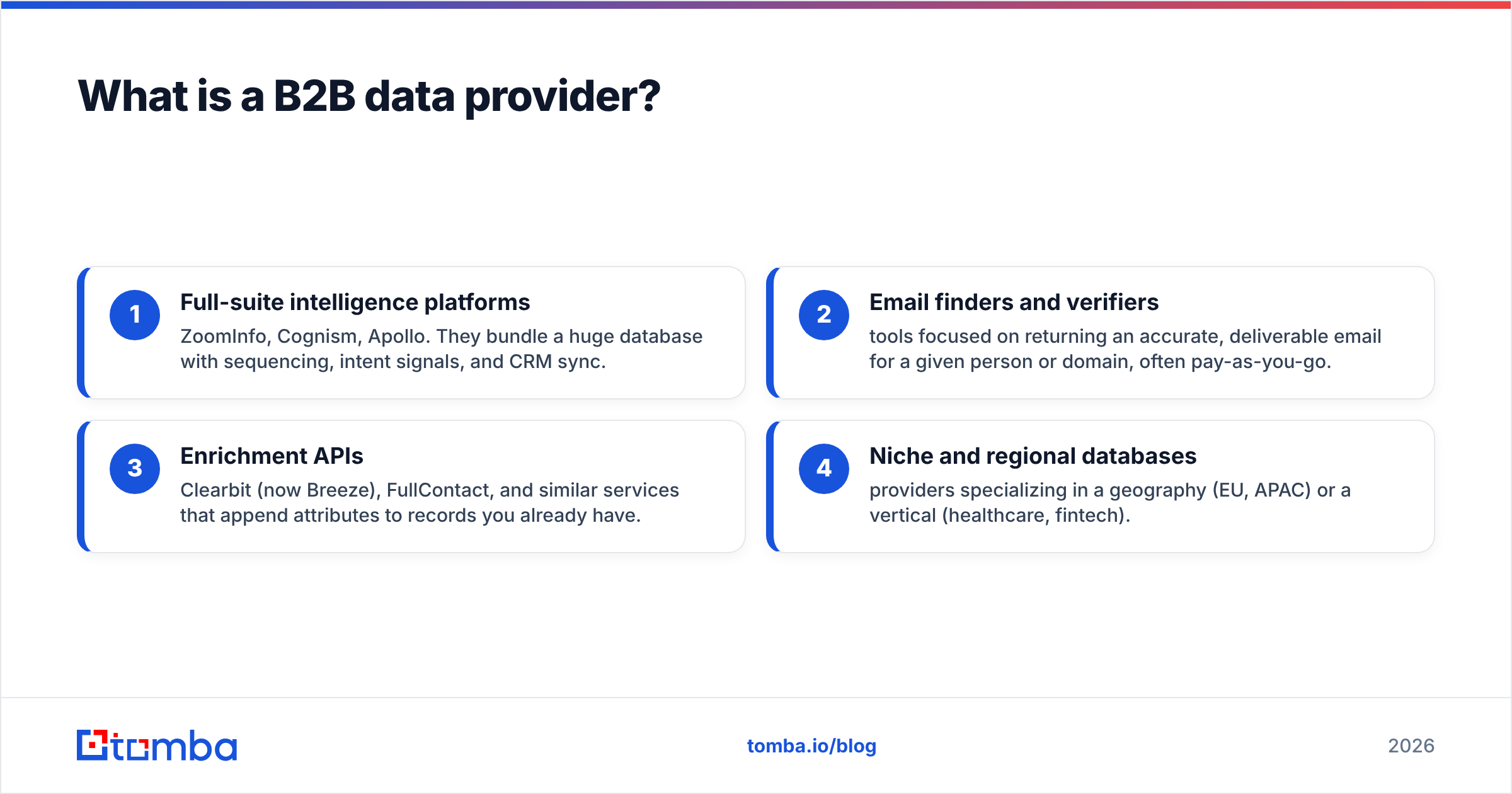
ZoomInfo, Cognism, Apollo. They bundle a huge database with sequencing, intent signals, and CRM sync. 2. Email finders and verifiers — tools focused on returning an accurate, deliverable email for a given person or domain, often pay-as-you-go. 3. Enrichment APIs — Clearbit (now Breeze), FullContact, and similar services that append attributes to records you already have. 4. Niche and regional databases — providers specializing in a geography (EU, APAC) or a vertical (healthcare, fintech).
Most teams end up using two or three of these together, because no single vendor is best at everything.
How do B2B data providers source their data?#
Conclusion first: the source determines the accuracy, and the accuracy determines whether your emails bounce. Ask every vendor where their records come from before you ask about price.
There are four common sourcing methods, and each has a tradeoff:
- Public web crawling — scraping company sites, press releases, and directories. Broad but goes stale fast.
- Community/contributory data — users share their contacts (often via a browser extension) in exchange for credits. High volume, variable quality, and a compliance question mark.
- Partnerships and licensed datasets — buying records from other data companies. Convenient but you inherit their staleness.
- Real-time verification — pinging the mail server (SMTP) at search time to confirm an address actually exists right now.
The best providers combine sourcing with continuous verification. A database of 200 million contacts means nothing if 30% of the emails bounce. This is why a standalone email verifier is still part of most mature data stacks — it's the quality-control gate before you hit send. If you want to understand how a vendor builds and refreshes its records, check whether they publish their data sources openly; transparency here is a strong quality signal.
)
What should you look for in a B2B data provider?#
Use these six criteria as a scorecard. Rank each vendor 1–5 and the winner usually becomes obvious.
- Accuracy — What's the verified bounce rate? Demand a real number, not "industry-leading."
- Coverage — Does the database cover your target geographies, company sizes, and roles? EU coverage in particular varies wildly between US-built and EU-built providers.
- Compliance — Are they GDPR and CCPA compliant? Do they honor a do-not-contact list and offer notification at scale where required?
- Freshness — How often is data re-verified? Records older than 90 days decay quickly.
- Pricing model — Annual seat license, credits, or pay-as-you-go? Match this to how spiky your usage is.
- Integrations — Does it push cleanly into your CRM, your sequencer, and your spreadsheet of choice?
Independent review sites like G2 and analyst coverage from Gartner are useful for sanity-checking vendor claims against real user feedback — but read the one- and two-star reviews, because that's where the bounce-rate and billing complaints live.
Which B2B data providers should you compare in 2026?#
Here's a side-by-side look at the most common providers teams evaluate. Prices are approximate published or widely reported figures and change often — always confirm with the vendor.
| Provider | Best for | Sourcing strength | Pricing model | Entry price |
|---|---|---|---|---|
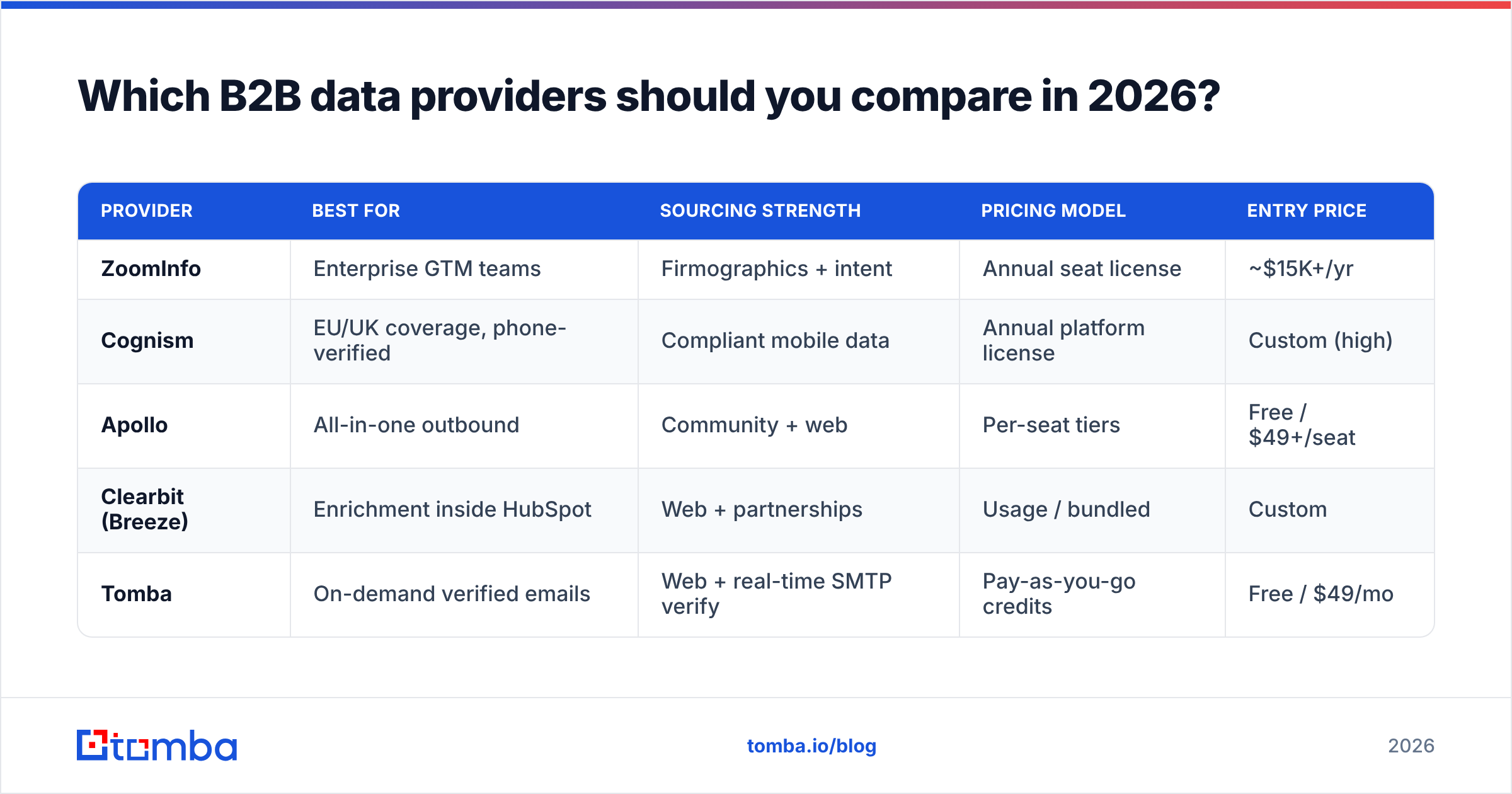
ZoomInfo | Enterprise GTM teams | Firmographics + intent | Annual seat license | ~$15K+/yr | | Cognism | EU/UK coverage, phone-verified | Compliant mobile data | Annual platform license | Custom (high) | | Apollo | All-in-one outbound | Community + web | Per-seat tiers | Free / $49+/seat | | Clearbit (Breeze) | Enrichment inside HubSpot | Web + partnerships | Usage / bundled | Custom | | Tomba | On-demand verified emails | Web + real-time SMTP verify | Pay-as-you-go credits | Free / $49/mo |
The pattern is clear: the heavyweight suites charge for the whole platform whether you use all of it or not, while credit-based tools let you scale spend with actual usage. Neither is "better" in the abstract — it depends on volume and predictability.
For deeper one-to-one breakdowns, Tomba maintains neutral comparisons such as the Apollo alternative and Clearbit alternative pages, which lay out where each tool genuinely wins.
Is an all-in-one suite better than a dedicated email finder?#
It depends on what's breaking in your funnel. If your problem is orchestration — managing intent signals, sequences, and account scoring across a large team — an all-in-one suite earns its price. If your problem is deliverability — emails bouncing, reps reaching dead inboxes — you don't need a $30,000 platform. You need accurate, verified contact data at the moment of outreach.
This is where buyers get distracted. They sign a six-figure suite contract to solve a problem a focused email finder and verifier would have solved for a fraction of the cost.
)
A quick decision guide:
- Choose a full suite if you have 10+ reps, need native intent data, and want a single billing relationship.
- Choose a dedicated finder/verifier if you value cost control, run spiky campaigns, or need an API to enrich on demand.
- Choose both if a suite covers discovery but you still see bounces — layer a verifier on top before send.
How much should B2B data cost in 2026?#
Conclusion: expect to pay either a high annual commitment (suites) or a transparent per-credit rate (finders) — and be suspicious of anything in between that hides its pricing entirely.
Enterprise platforms commonly land between $15,000 and $40,000+ per year once you add seats and modules. That can be worth it at scale, but it punishes small teams and unpredictable usage.
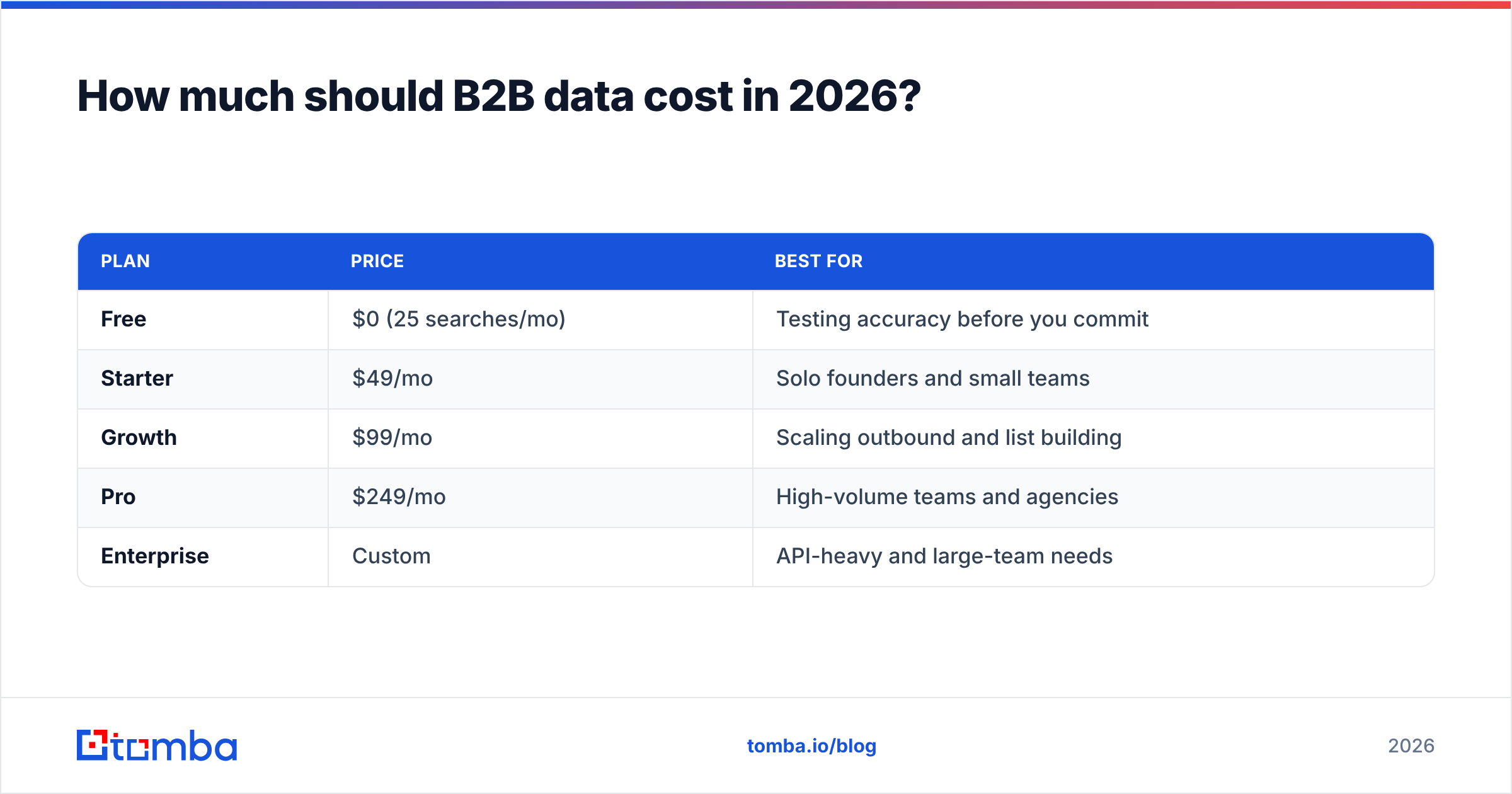
Credit and subscription models are far friendlier to most teams. For reference, transparent Tomba pricing runs:
| Plan | Price | Best for |
|---|---|---|
| Free | $0 (25 searches/mo) | Testing accuracy before you commit |
| Starter | $49/mo | Solo founders and small teams |
| Growth | $99/mo | Scaling outbound and list building |
| Pro | $249/mo | High-volume teams and agencies |
| Enterprise | Custom | API-heavy and large-team needs |
The principle to hold onto: never pay for coverage you won't use. A 250-million-record database is irrelevant if you only prospect into 4,000 accounts a quarter. Match the spend to the motion.
How do you keep B2B data clean over time?#
Data decays — roughly 2–3% of B2B contacts go stale every month as people change jobs. A provider is only half the solution; the other half is hygiene.
Build these habits into your workflow:
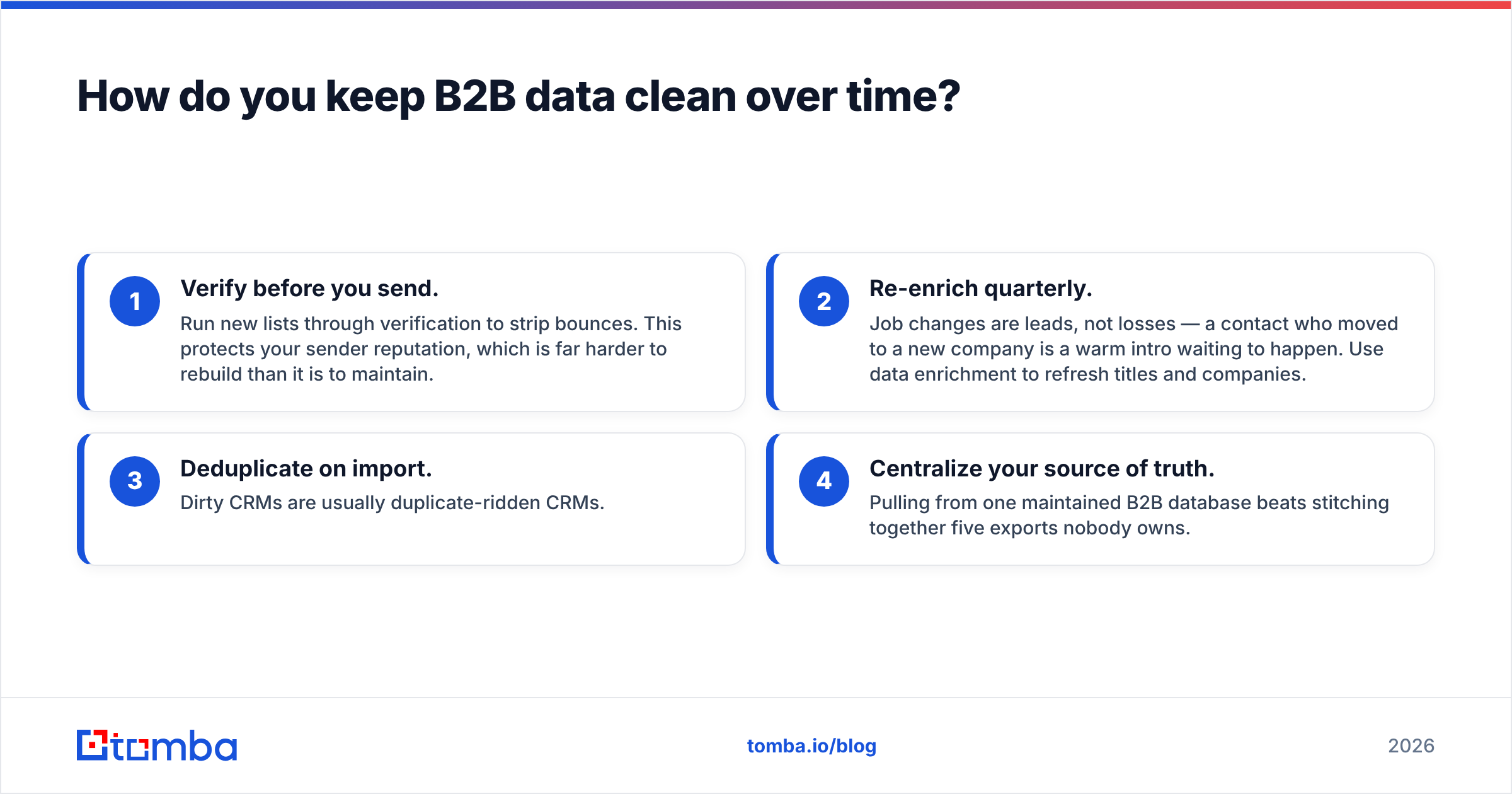
- Verify before you send. Run new lists through verification to strip bounces. This protects your sender reputation, which is far harder to rebuild than it is to maintain.
- Re-enrich quarterly. Job changes are leads, not losses — a contact who moved to a new company is a warm intro waiting to happen. Use data enrichment to refresh titles and companies.
- Deduplicate on import. Dirty CRMs are usually duplicate-ridden CRMs.
- Centralize your source of truth. Pulling from one maintained B2B database beats stitching together five exports nobody owns.
Skip this and even the most accurate provider's data rots in your CRM within a year.
What does the future of B2B data look like?#
Two shifts are reshaping the category in 2026. First, compliance is now a product feature, not a footnote — EU-focused providers compete openly on consent and notification, and US buyers selling into Europe increasingly need it. Second, real-time beats stockpiled. The advantage is moving from "who has the biggest database" to "who can verify a contact is correct at the exact second you query it." Static dumps of millions of records are losing to live, on-demand verification.
For practical context on email-side hygiene, vendor documentation like ZoomInfo's own resources and broad references such as Wikipedia's overview of email deliverability are reasonable starting points before you commit budget.
Which B2B data provider is right for you?#
If you need orchestration at enterprise scale, evaluate the suites with eyes open about the annual commitment. If you need accurate, deliverable contact data without a five-figure contract — and most teams do — start lean and prove accuracy first.
That's exactly where the Tomba Email Finder fits. Find professional emails by name, company, or domain, verify them in real time against the mail server, and pull them into your CRM through native integrations — all on a pay-as-you-go model that starts free with 25 searches a month. Test it against your hardest 25 contacts, measure the bounce rate yourself, and let the numbers pick your provider. You'll know within an afternoon whether you ever needed the $30,000 suite at all.
// get started
Find, verify and enrich your first contacts today
Start on the free plan with 25 searches a month, then scale when your team is ready.
Free plan · No credit card required · GDPR & CCPA
// about the author