B2B Direct Sales in 2026: A Complete Strategy Guide
B2B direct sales means selling straight to the buyer with no middleman. Here's the 2026 playbook: model, process, metrics, and the data stack that feeds it.
TL;DR
- B2B direct sales means a vendor sells straight to the business buyer — no distributor, reseller, or marketplace in the middle. You own the relationship, the margin, and the data.
- It wins on complex, high-ticket deals where buyers need consultation, customization, and a human who can navigate procurement.
- The process is a repeatable funnel: prospect → qualify → discover → demo → propose → close → expand. Each stage has its own metric.
- Direct selling lives or dies on contact data. Bad lists wreck your email deliverability and burn rep hours on bounces.
- A lean 2026 stack pairs a CRM, a sequencer, and a verified data source like the Tomba Email Finder so reps spend time selling, not guessing addresses.
What is B2B direct sales?#
B2B direct sales is a go-to-market model where your company sells its product or service directly to another business, with no intermediary taking a cut or owning the customer. Think of it like a farmer selling at their own stall instead of shipping crates to a supermarket chain. The farmer keeps the full price, hears every customer complaint firsthand, and decides exactly how the produce is presented. That direct line is the whole point.
Technically, "direct" describes the channel, not the tactic. You can run direct sales through field reps, inside sales teams, or a hybrid of both. What unites them is that a salesperson — not a partner, not a self-serve checkout — carries the deal from first touch to signed contract.
This model dominates in markets where deals are large, sales cycles are long, and buyers expect a guided purchase. Enterprise software, industrial equipment, managed services, and most six-figure contracts are sold this way. The trade-off is cost: direct teams are expensive to staff and train, so the deal economics have to justify a human in the loop.

How is direct sales different from channel and indirect sales?#
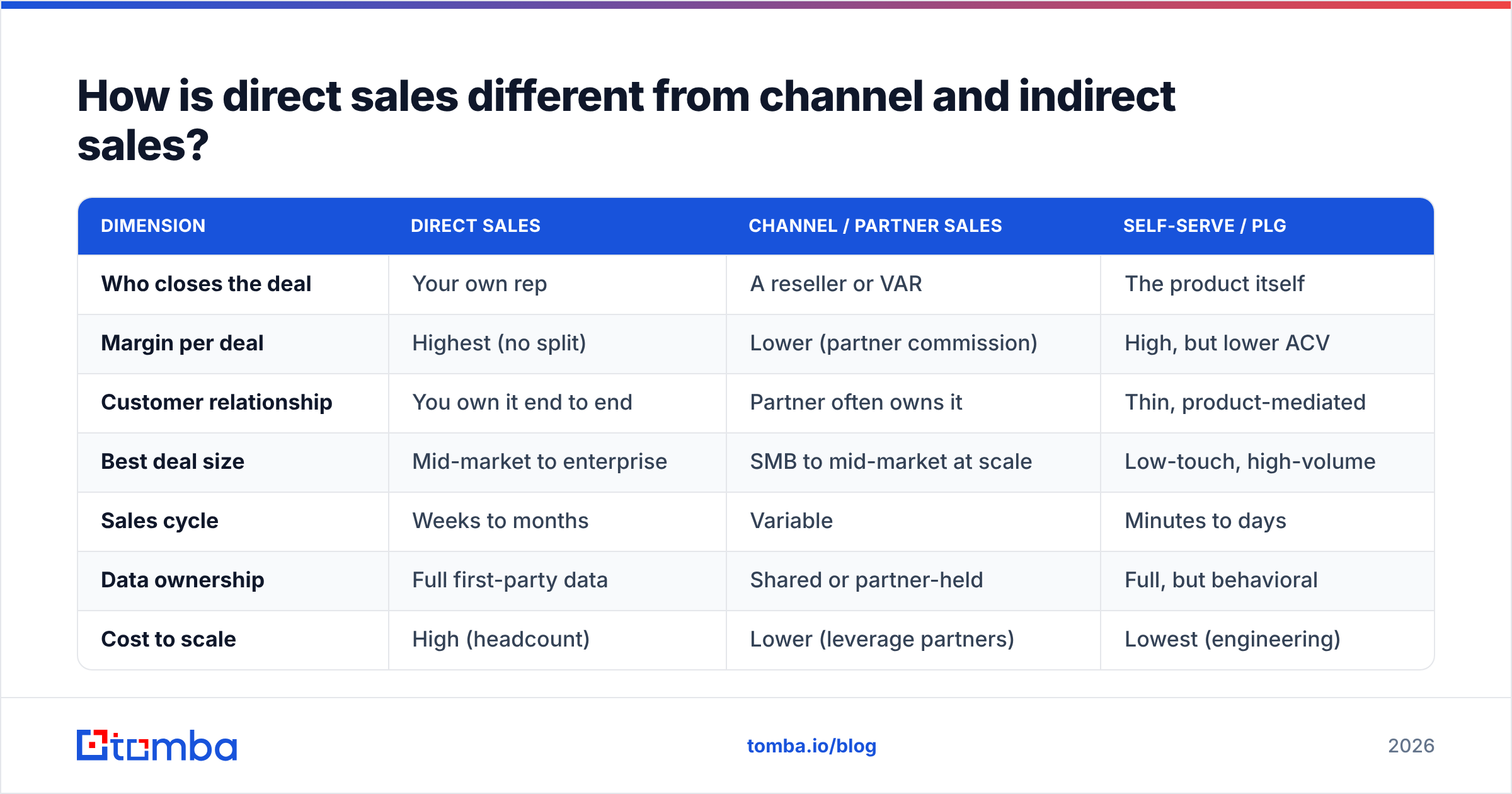
The fastest way to understand direct sales is to put it next to the alternatives. Most companies eventually run a mix, but the core trade-offs are clear.
| Dimension | Direct sales | Channel / partner sales | Self-serve / PLG |
|---|---|---|---|
| Who closes the deal | Your own rep | A reseller or VAR | The product itself |
| Margin per deal | Highest (no split) | Lower (partner commission) | High, but lower ACV |
| Customer relationship | You own it end to end | Partner often owns it | Thin, product-mediated |
| Best deal size | Mid-market to enterprise | SMB to mid-market at scale | Low-touch, high-volume |
| Sales cycle | Weeks to months | Variable | Minutes to days |
| Data ownership | Full first-party data | Shared or partner-held | Full, but behavioral |
| Cost to scale | High (headcount) | Lower (leverage partners) | Lowest (engineering) |
The strategic question is not "which is best" — it's "which matches your deal." A $90k annual contract with a six-person buying committee needs a direct rep. A $19/month tool does not. Many companies layer all three: self-serve for the long tail, direct for enterprise, and channel to reach geographies they can't staff.
For a refresher on where direct selling sits inside broader go-to-market motions, the revenue operations discipline is what stitches these channels together so they don't cannibalize each other.
What does the B2B direct sales process look like?#
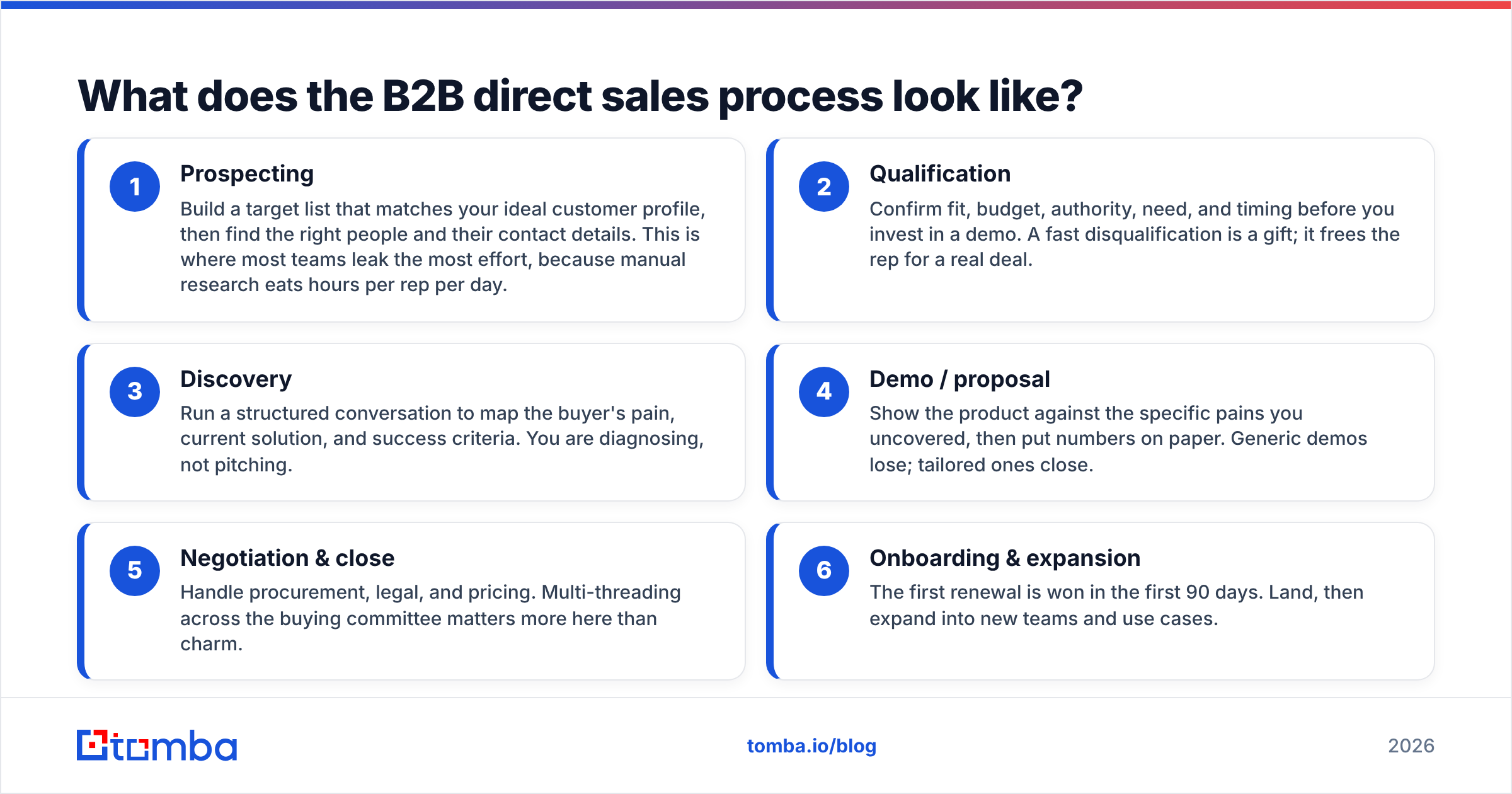
A direct sale is not one conversation — it's a sequence of stages, each with an exit criterion. Treat it like a relay race: a lead only advances when the current stage is genuinely complete, or your forecast turns into fiction.
- Prospecting — Build a target list that matches your ideal customer profile, then find the right people and their contact details. This is where most teams leak the most effort, because manual research eats hours per rep per day.
- Qualification — Confirm fit, budget, authority, need, and timing before you invest in a demo. A fast disqualification is a gift; it frees the rep for a real deal.
- Discovery — Run a structured conversation to map the buyer's pain, current solution, and success criteria. You are diagnosing, not pitching.
- Demo / proposal — Show the product against the specific pains you uncovered, then put numbers on paper. Generic demos lose; tailored ones close.
- Negotiation & close — Handle procurement, legal, and pricing. Multi-threading across the buying committee matters more here than charm.
- Onboarding & expansion — The first renewal is won in the first 90 days. Land, then expand into new teams and use cases.
Notice that stages one and two are pure data problems. You cannot qualify a contact you can't reach, and you can't reach a contact whose email bounces. That's why the front of the funnel deserves as much tooling investment as the close.
Why does data quality decide direct-sales outcomes?#
Conclusion first: in direct sales, your contact data is the raw material, and bad raw material caps your ceiling no matter how good your reps are.
Here's the chain reaction. A rep pulls a list from an unverified source. Twenty percent of the emails are dead. Those bounces drag down sender reputation, which pushes more of your good emails into spam folders. Now even your reachable prospects never see your message. One bad list quietly degrades every campaign that follows it.
The fix is upstream, not downstream. Verify before you send, not after you bounce. A solid email verifier catches dead addresses, role accounts, and risky catch-all domains before they ever touch your sequencer. Pair that with a data enrichment step to fill in titles, company size, and phone numbers, and your reps walk into every call already knowing who they're talking to.

According to HubSpot's sales research, prospecting and research are consistently rated among the hardest parts of the job by sales reps — and most of that difficulty is contact-data friction that tooling can remove. Industry analysts at Gartner reach a similar conclusion: B2B buying is getting more complex, and sellers who waste cycles on bad data lose the few human touchpoints buyers allow them.
What metrics should a direct-sales team track?#
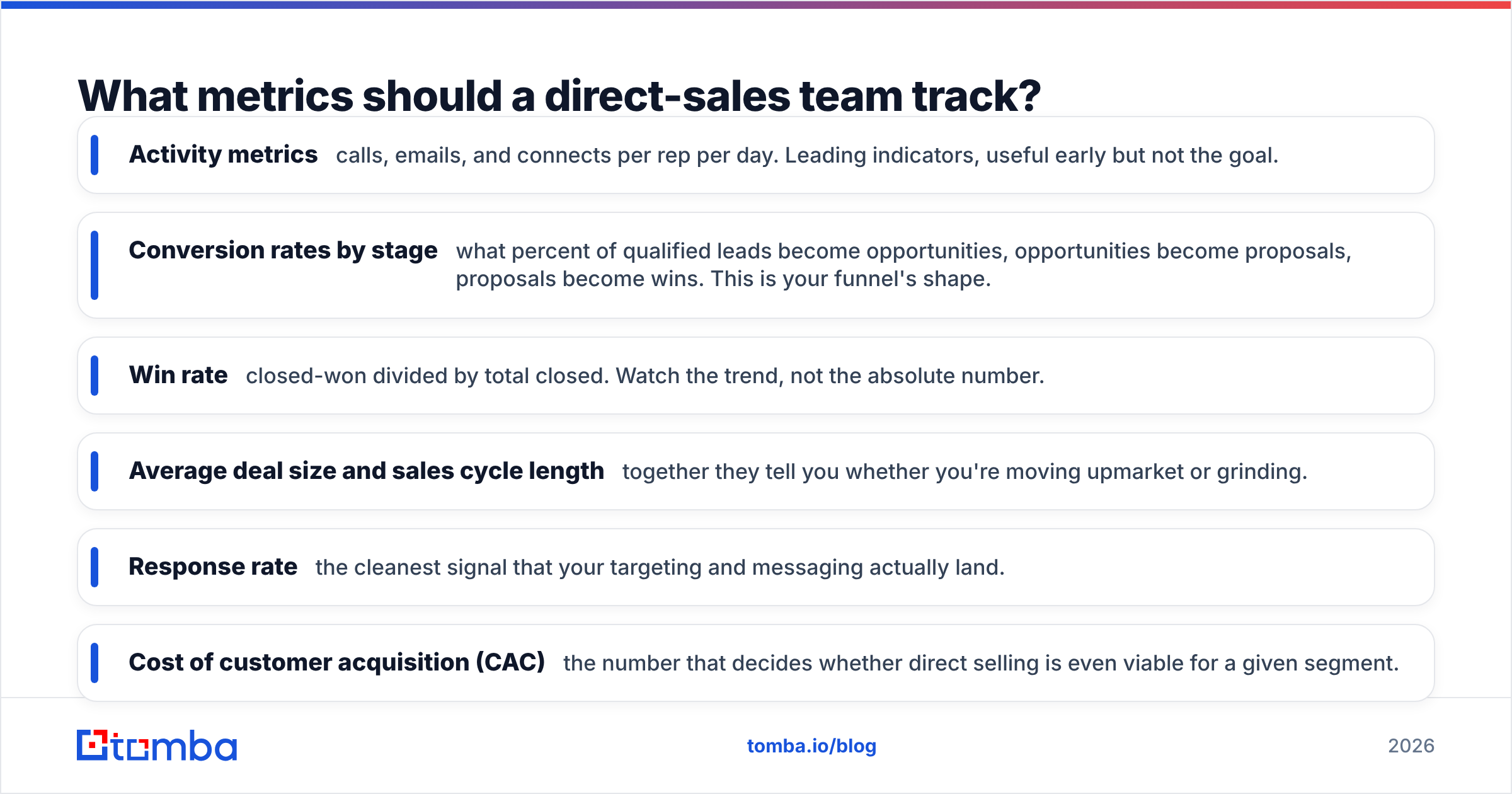
Direct sales is measurable end to end, which is its biggest advantage over channel selling. Track these and you can diagnose exactly where deals stall.
- Activity metrics — calls, emails, and connects per rep per day. Leading indicators, useful early but not the goal.
- Conversion rates by stage — what percent of qualified leads become opportunities, opportunities become proposals, proposals become wins. This is your funnel's shape.
- Win rate — closed-won divided by total closed. Watch the trend, not the absolute number.
- Average deal size and sales cycle length — together they tell you whether you're moving upmarket or grinding.
- Response rate — the cleanest signal that your targeting and messaging actually land.
- Cost of customer acquisition (CAC) — the number that decides whether direct selling is even viable for a given segment.
The trap is over-indexing on activity. A rep sending 200 emails a day to an unverified list looks busy and produces nothing. A rep sending 60 emails a day to a verified, well-researched list books meetings. Measure outputs, then work backward to the inputs that drive them.
What tools power a modern B2B direct sales stack?#
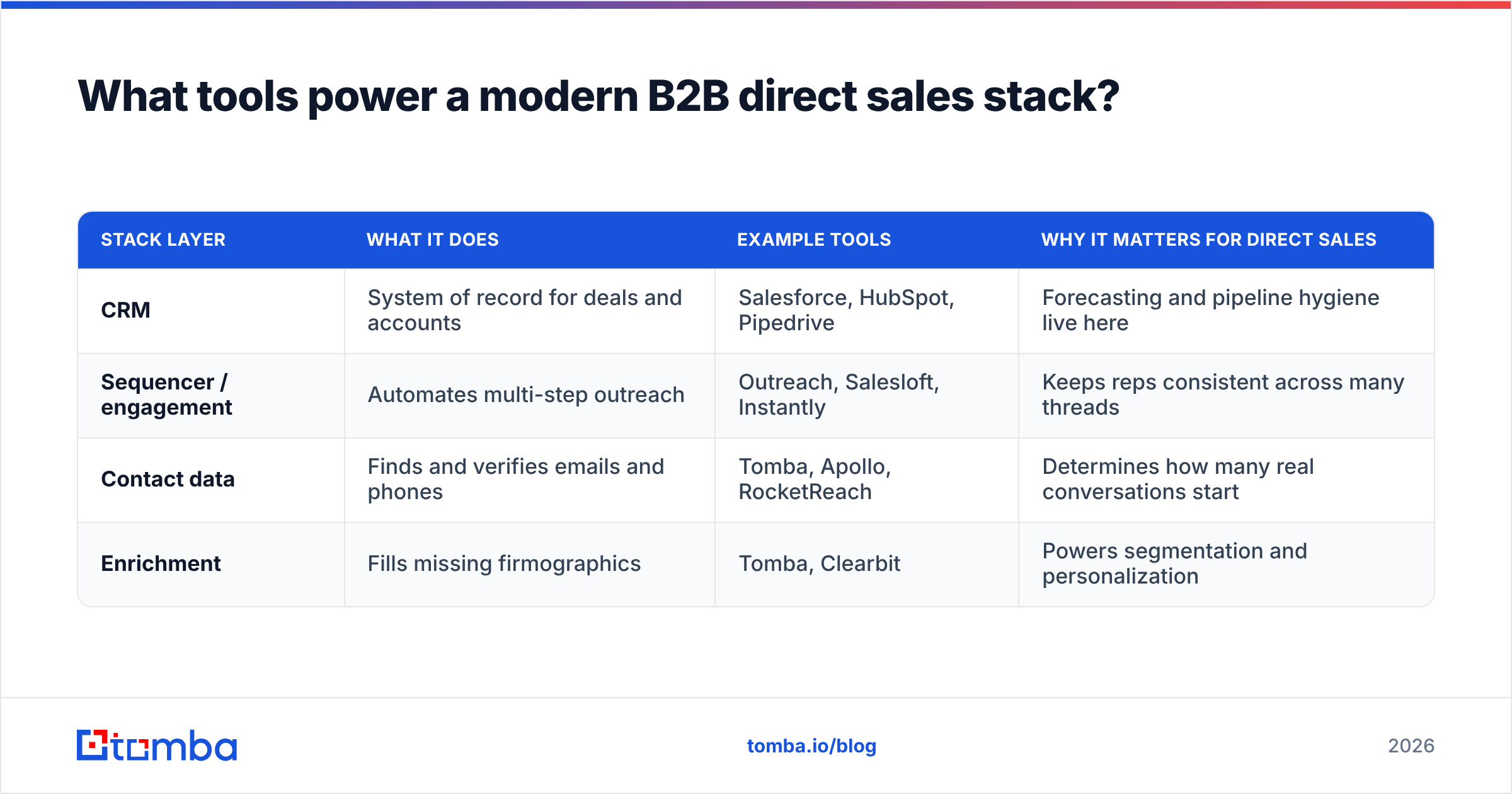
You don't need 20 tools. You need three jobs covered well: store the relationship (CRM), run the outreach (sequencer), and feed it accurate contacts (data). Here's how the core categories compare.
| Stack layer | What it does | Example tools | Why it matters for direct sales |
|---|---|---|---|
| CRM | System of record for deals and accounts | Salesforce, HubSpot, Pipedrive | Forecasting and pipeline hygiene live here |
| Sequencer / engagement | Automates multi-step outreach | Outreach, Salesloft, Instantly | Keeps reps consistent across many threads |
| Contact data | Finds and verifies emails and phones | Tomba, Apollo, RocketReach | Determines how many real conversations start |
| Enrichment | Fills missing firmographics | Tomba, Clearbit | Powers segmentation and personalization |
The data layer is where direct teams either compound or stall. Tomba sits in that layer with a focused job: turn a name and a company domain into a verified, ready-to-contact email. You can find emails one at a time, run a domain search to map an entire company, or push thousands through the bulk email finder when you're building a new territory.
On pricing, the model is built for teams that scale outreach without scaling waste. The free tier covers 25 searches a month for testing, and paid plans start at $49/month (Starter), with Growth at $99/month and Pro at $249/month. Full Tomba pricing is public, so you can match the plan to your team's volume rather than guessing. For reps who live in Salesforce or HubSpot, the native integrations mean verified contacts land directly in the CRM instead of a spreadsheet.
If you're currently evaluating heavier all-in-one platforms, it's worth comparing the focused approach — see the Apollo alternative breakdown for how a dedicated data tool stacks up against a do-everything suite.
How do you build a direct-sales motion from scratch?#
If you're standing up direct sales for the first time, resist the urge to hire a big team before the motion works. Prove repeatability with one or two reps, then scale.
Step one: define the ICP narrowly. "Mid-market SaaS companies in North America with 50–500 employees" beats "any business that might need us." A tight ICP makes every downstream step easier.
Step two: build the target list. Use your ICP filters to assemble named accounts, then identify the actual decision-makers. This is where a LinkedIn finder earns its keep — you turn a LinkedIn profile into a verified work email instead of guessing the format.
Step three: instrument the funnel. Set up CRM stages with clear exit criteria before the first call. You cannot improve a funnel you don't measure.
Step four: write a sequence, not a blast. Combine email, calls, and LinkedIn touches over two to three weeks. Personalize the first line using the enrichment data you collected, not a mail-merge token.
Step five: review weekly and cut what doesn't convert. The first version of any direct motion is wrong somewhere. Find the leaky stage from your conversion data and fix that one thing.
The companies that win at direct sales in 2026 aren't the ones with the biggest teams. They're the ones whose reps spend the most minutes per day in actual conversations — and that number is set almost entirely by how clean the data feeding the top of the funnel is.
Get the data layer right first#
Every other part of a direct-sales motion — the CRM hygiene, the sequencing, the discovery calls — only pays off if your reps are talking to real, reachable people. That starts with accurate contact data.
Start with the Tomba Email Finder to turn your target accounts into verified, ready-to-contact emails. Run the free tier first, confirm the accuracy against accounts you already know, then scale to a paid plan as your pipeline grows. Get the data layer right, and the rest of your direct-sales process finally has something solid to stand on.
// get started
Find, verify and enrich your first contacts today
Start on the free plan with 25 searches a month, then scale when your team is ready.
Free plan · No credit card required · GDPR & CCPA
// about the author