B2B Email Lead Generation: The 2026 Playbook That Works
A practical 2026 framework for B2B email lead generation: how to source verified contacts, build offers, and turn cold inboxes into booked meetings without buying junk lists.
TL;DR
- B2B email lead generation in 2026 is won by data quality first, copy second — a verified list of 500 fits-your-ICP contacts beats 50,000 scraped emails every time.
- The repeatable loop is: define ICP → source contacts by domain → verify before send → segment → write a relevant offer → measure replies, not opens.
- Deliverability is now the gatekeeper. Bounces above 2-3% and spam complaints quietly kill your domain reputation before a campaign even ramps.
- Buying static lists is dead money. Sourcing fresh, on-demand contacts with an email finder and a email verifier is cheaper and far more accurate.
- Tools matter, but a process you run weekly matters more. This guide gives you both.
What is B2B email lead generation?#
B2B email lead generation is the process of finding business contacts who match your ideal customer, reaching them by email, and converting that contact into a qualified sales conversation. Think of it like fishing: buying a generic email list is dumping a net in a random lake, while modern lead gen is choosing the right lake, baiting for one species, and casting where the fish actually are.
The difference between teams that struggle and teams that book meetings is almost never the email-sending tool. It's the inputs: who you contact, whether the address is real, and whether the message speaks to a problem that person has this quarter. Get those three right and a plain-text email outperforms any fancy sequence.
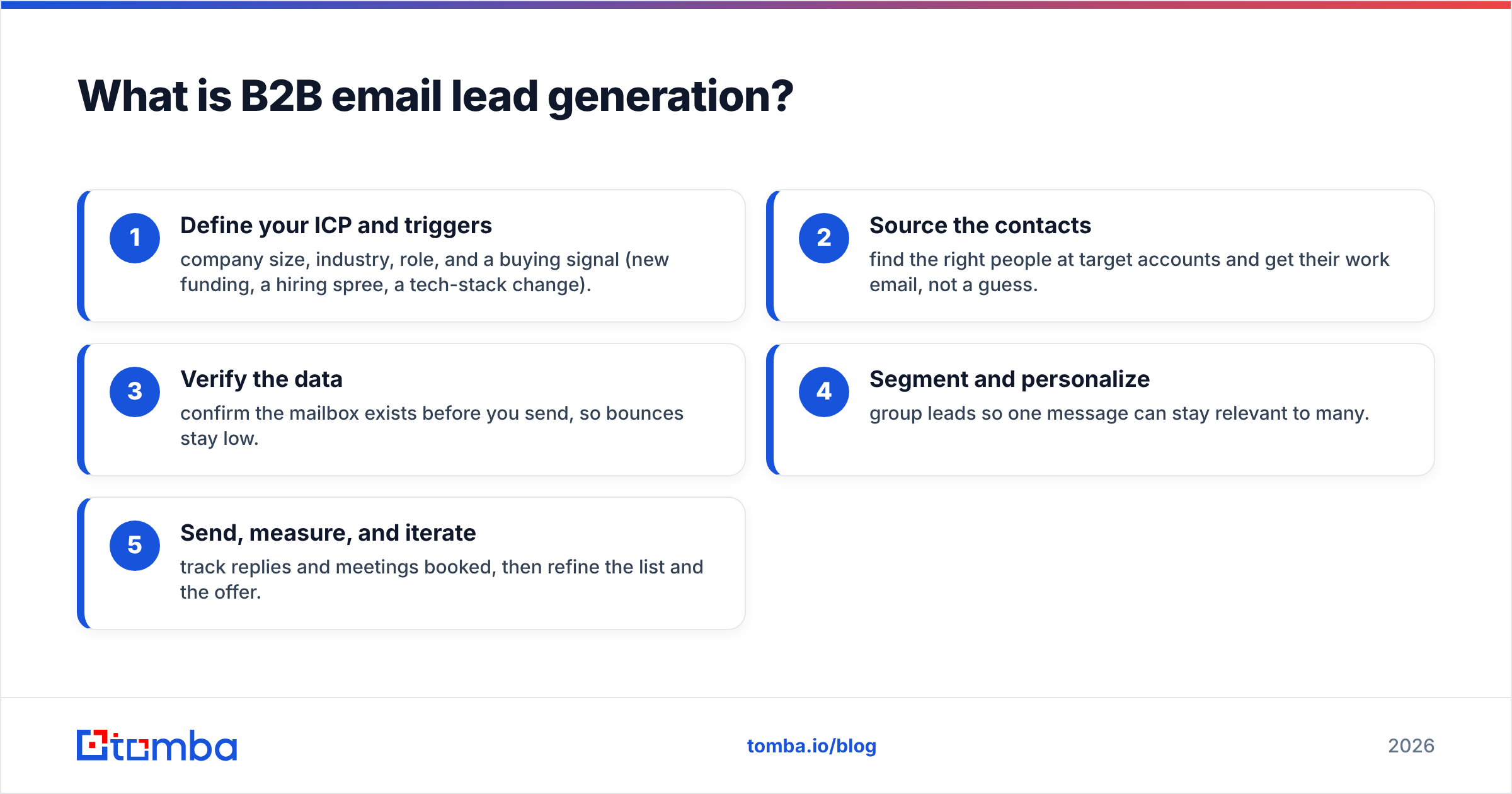
In practice, B2B email lead generation breaks into five jobs you have to do in order. Skip one and the whole chain weakens.
- Define your ICP and triggers — company size, industry, role, and a buying signal (new funding, a hiring spree, a tech-stack change).
- Source the contacts — find the right people at target accounts and get their work email, not a guess.
- Verify the data — confirm the mailbox exists before you send, so bounces stay low.
- Segment and personalize — group leads so one message can stay relevant to many.
- Send, measure, and iterate — track replies and meetings booked, then refine the list and the offer.
)
Why do most B2B email lead generation campaigns fail?#
Most campaigns fail at the data layer, not the copy layer. You can A/B test subject lines forever, but if 30% of your list bounces, your domain reputation tanks and even your good emails land in spam.
Here are the failure modes that show up again and again:
- Stale purchased lists. B2B data decays roughly 22-30% per year as people change jobs. A list bought in 2024 is mostly fiction by 2026.
- No verification step. Sending to unverified addresses spikes your bounce rate. Mailbox providers treat high bounces as a spam signal.
- Generic blasts. One message to 10,000 unsegmented contacts gets the response rate of a coin found on the sidewalk — technically value, practically ignored.
- Ignoring deliverability hygiene. Missing SPF, DKIM, or DMARC records send your mail straight to the junk folder. You can sanity-check one with a free SPF checker.
- Chasing opens instead of replies. Open tracking is unreliable in 2026 thanks to privacy proxies. The only metrics that pay rent are replies and meetings.
The fix for nearly all of these is the same discipline: source fresh, verify hard, segment tight. That's where your effort compounds.
How do you build a B2B email lead list the right way?#
Build the list on demand from a clear ICP rather than buying a frozen database. The workflow is faster than it sounds once you wire it up, and the data is dramatically more accurate because you're pulling it fresh.
Here's the loop teams run weekly:
- List your target accounts. Start from a defined ICP — say, Series A-C SaaS companies in North America with 50-500 employees. Pull the company domains.
- Find the right people per account. Use domain search to surface the contacts and email patterns at each company, then narrow to the roles that own the problem you solve.
- Get verified work emails. Run names and domains through an email finder, then push everything through verification so only deliverable addresses make the cut.
- Enrich for personalization. Add role, seniority, and company signals via data enrichment so your copy can reference something real.
- Deduplicate and clean. Strip duplicates and role-based catch-alls before they pollute your send. A quick catch-all verifier pass saves you from risky sends.
For volume, a bulk email finder lets you process hundreds of accounts at once instead of one at a time. The point is repeatability — you should be able to produce a fresh, clean 500-lead segment in an afternoon, not buy a stale 50k list and hope.

Accuracy is the metric that quietly decides everything downstream. A finder that's 95% accurate versus one that's 75% accurate is the difference between a 2% bounce rate and a flagged domain. Verify your sender data the same way you'd verify a wire transfer — before, not after.
Which tools do you actually need for B2B email lead generation?#
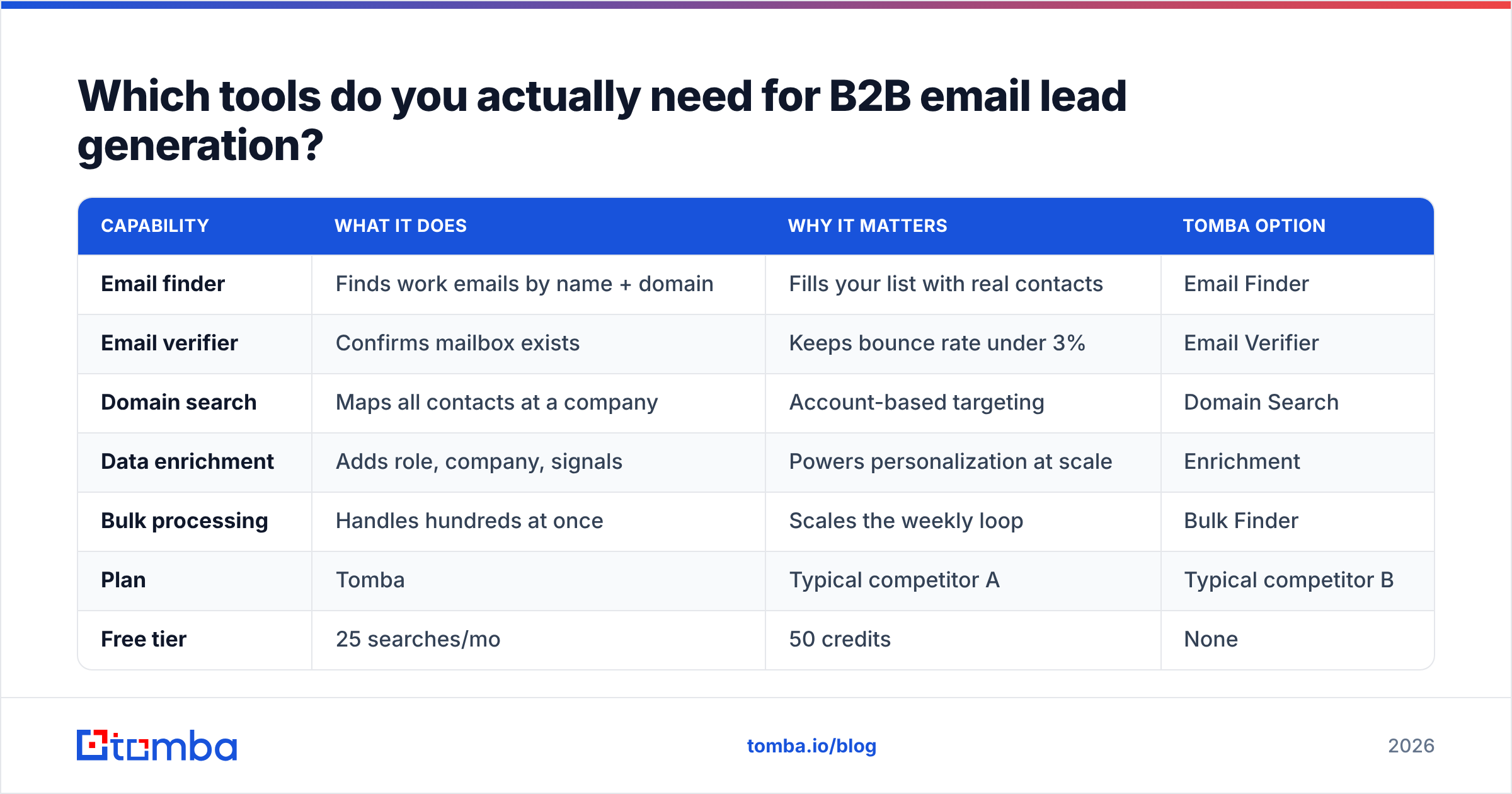
You need four capabilities, and many platforms bundle them: a finder, a verifier, an enrichment layer, and a sending/sequencing tool. You don't need ten subscriptions. Below is how the core categories compare so you can decide what to consolidate.
| Capability | What it does | Why it matters | Tomba option |
|---|---|---|---|
| Email finder | Finds work emails by name + domain | Fills your list with real contacts | Email Finder |
| Email verifier | Confirms mailbox exists | Keeps bounce rate under 3% | Email Verifier |
| Domain search | Maps all contacts at a company | Account-based targeting | Domain Search |
| Data enrichment | Adds role, company, signals | Powers personalization at scale | Enrichment |
| Bulk processing | Handles hundreds at once | Scales the weekly loop | Bulk Finder |
Now compare the typical pricing models you'll run into when shopping for the sourcing layer. Prices change, so treat this as a shape, not a quote, and always check the vendor's own page.
| Plan | Tomba | Typical competitor A | Typical competitor B |
|---|---|---|---|
| Free tier | 25 searches/mo | 50 credits | None |
| Starter | $49/mo | $59/mo | $79/mo |
| Growth | $99/mo | $149/mo | $199/mo |
| Pro | $249/mo | $399/mo | Custom only |
| API access | Yes, all plans | Higher tiers | Add-on |
You can see full Tomba pricing for current numbers. The thing to weigh isn't the sticker price — it's cost per verified, deliverable contact. A cheaper tool with poor accuracy costs more once you factor in wasted sends and reputation damage. For deeper benchmarking, third-party review sites like G2 are useful for filtering by real user feedback rather than vendor claims.
)
How do you write B2B emails that actually get replies?#
Write to one person about one problem with one clear ask. The biggest lever after data quality is relevance, and relevance comes from segmentation plus a single sharp offer — not from clever wordplay.
A reply-getting cold email in 2026 follows a tight structure:
- Subject line: specific, lowercase-feeling, no hype. Test variants with a subject line generator if you're stuck.
- Opening line: about them, not you. Reference a trigger — funding, a job post, a product launch.
- The problem: name the pain your ICP feels, in their words.
- The proof: one concrete result, ideally with a number.
- The ask: a low-friction question, not a demo demand. "Worth a quick look?" beats "Book a 30-minute call."
- The signature: clean, human, with a real name and a professional email signature.
Keep it under 120 words. If a busy VP can't read it at a stoplight, it's too long. And resist the urge to personalize the wrong thing — mentioning someone's alma mater is creepy; mentioning their recent Series B is relevant.
For follow-ups, two or three spaced messages add the bulk of replies. Don't just "bump" the thread — add a new angle or a new piece of proof each time. You can study proven structures in HubSpot's library of cold email templates and adapt them to your voice.
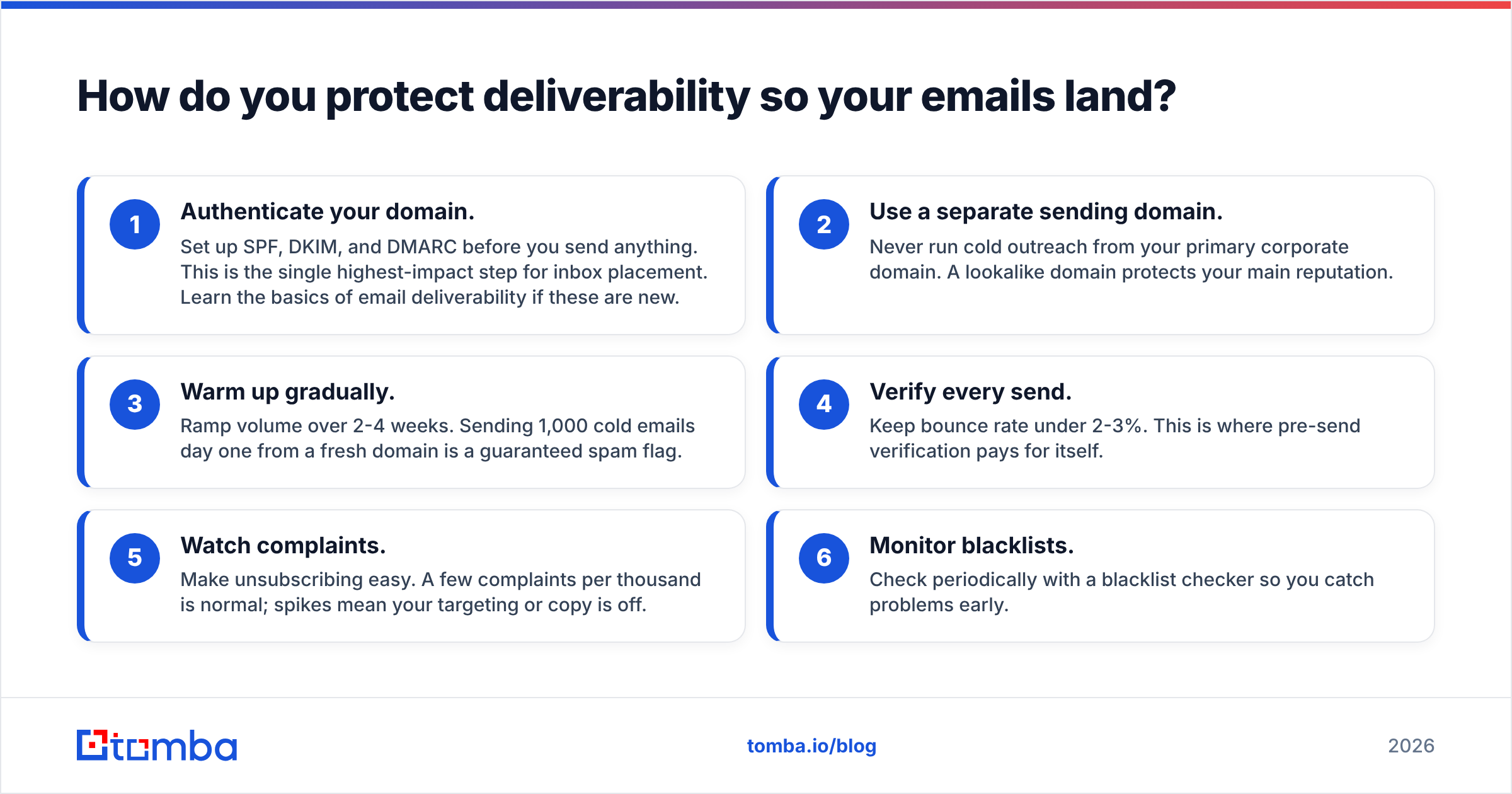
How do you protect deliverability so your emails land?#
Protect deliverability by sending verified mail from a warmed, authenticated domain at a controlled pace. Your domain reputation is a bank account: every bounce and complaint is a withdrawal, and there's no overdraft.
The non-negotiable checklist:
- Authenticate your domain. Set up SPF, DKIM, and DMARC before you send anything. This is the single highest-impact step for inbox placement. Learn the basics of email deliverability if these are new.
- Use a separate sending domain. Never run cold outreach from your primary corporate domain. A lookalike domain protects your main reputation.
- Warm up gradually. Ramp volume over 2-4 weeks. Sending 1,000 cold emails day one from a fresh domain is a guaranteed spam flag.
- Verify every send. Keep bounce rate under 2-3%. This is where pre-send verification pays for itself.
- Watch complaints. Make unsubscribing easy. A few complaints per thousand is normal; spikes mean your targeting or copy is off.
- Monitor blacklists. Check periodically with a blacklist checker so you catch problems early.
Google and Microsoft tightened bulk-sender rules through 2024-2025, and enforcement has only gotten stricter. The teams that win in 2026 treat deliverability as an ongoing operations task, not a one-time setup. Google's own Postmaster guidelines are worth reading directly.
How do you measure and scale B2B email lead generation?#
Measure replies and meetings booked, then scale only the segments that produce them. Vanity metrics like opens and "delivered" tell you almost nothing about pipeline.
Track these per segment:
- Reply rate — your north star. Healthy cold campaigns land 3-8% positive reply rates when data and targeting are tight.
- Positive reply rate — replies that show interest, separate from "not interested."
- Meetings booked — the only number your revenue team cares about.
- Bounce rate — keep it under 3% or pause and re-verify.
- Cost per meeting — the true efficiency metric across tools and time.
To scale, double down on the ICP segments with the best meetings-booked rate and clone the offer that worked. Resist the temptation to just send more — sending more bad email scales your problems, not your pipeline. Increase volume only within deliverability limits, and add new sending domains rather than overloading one. When you're ready to plug results into your CRM, Tomba's integrations connect to tools like HubSpot, Salesforce, and Pipedrive so leads flow without manual exports.
Frequently asked questions#
Is buying B2B email lists a good idea? No. Purchased lists decay fast, often violate consent rules, and tank your deliverability with high bounce rates. Sourcing fresh, verified contacts is cheaper per usable lead and far safer.
What bounce rate is acceptable for cold email? Keep it under 2-3%. Above that, mailbox providers start treating you as a spam risk. Pre-send verification is the simplest way to stay in range.
How many contacts do I need to start? Quality over quantity. A tightly targeted, verified list of 200-500 ICP-fit contacts will outperform a generic list ten times its size.
Do open rates still matter in 2026? Not much. Privacy proxies inflate and obscure opens. Track replies and meetings booked instead.
Start sourcing leads that actually convert#
B2B email lead generation rewards discipline: define your ICP, source fresh contacts, verify before you send, and measure replies — not opens. The tooling exists to make that loop fast, and it doesn't have to cost a fortune.
If you want one place to find and verify the contacts that fill your pipeline, start with the Tomba Email Finder. Pull verified work emails by name, domain, or company, run them through built-in verification, and feed your outreach with data you can actually trust. The free tier gives you 25 searches a month to test the workflow — enough to see the accuracy difference before you scale.
// get started
Find, verify and enrich your first contacts today
Start on the free plan with 25 searches a month, then scale when your team is ready.
Free plan · No credit card required · GDPR & CCPA
// about the author