B2B Email Marketing ROI in 2026: Measure It and Grow It
Email still returns more per dollar than any other B2B channel — but only if you measure it right. Here's how to calculate, benchmark, and grow your B2B email marketing ROI in 2026.
TL;DR
- B2B email marketing ROI is the revenue your email program generates divided by what it costs to run — and email still tops every other channel, with commonly cited returns around $36–$42 per $1 spent.
- The number is only trustworthy if your list is accurate. Bounces, spam traps, and stale contacts quietly drain ROI before a single reply lands.
- Track ROI at the program level (cost vs. attributed pipeline) and the campaign level (revenue per send), not just opens and clicks.
- The biggest ROI levers in 2026 are list hygiene, segmentation, deliverability, and follow-up timing — in that order.
- Verified, well-sourced contact data is the cheapest ROI multiplier you can buy. Tools like Tomba Email Finder and an email verifier keep the denominator low and the numerator high.
What is B2B email marketing ROI?#
B2B email marketing ROI is the return you earn for every dollar you put into email, expressed as a ratio or percentage. The formula is simple:
ROI = (Revenue attributed to email − Cost of email program) ÷ Cost of email program
Think of it like a vending machine. You feed in coins (tooling, data, copywriting, sending infrastructure, staff time) and the machine pays out cans (pipeline and closed revenue). ROI tells you how many cans you get per coin. The trouble in B2B is that the machine is slow — deals take weeks or months — so you have to attribute revenue carefully and patiently rather than judging the channel on a single send.
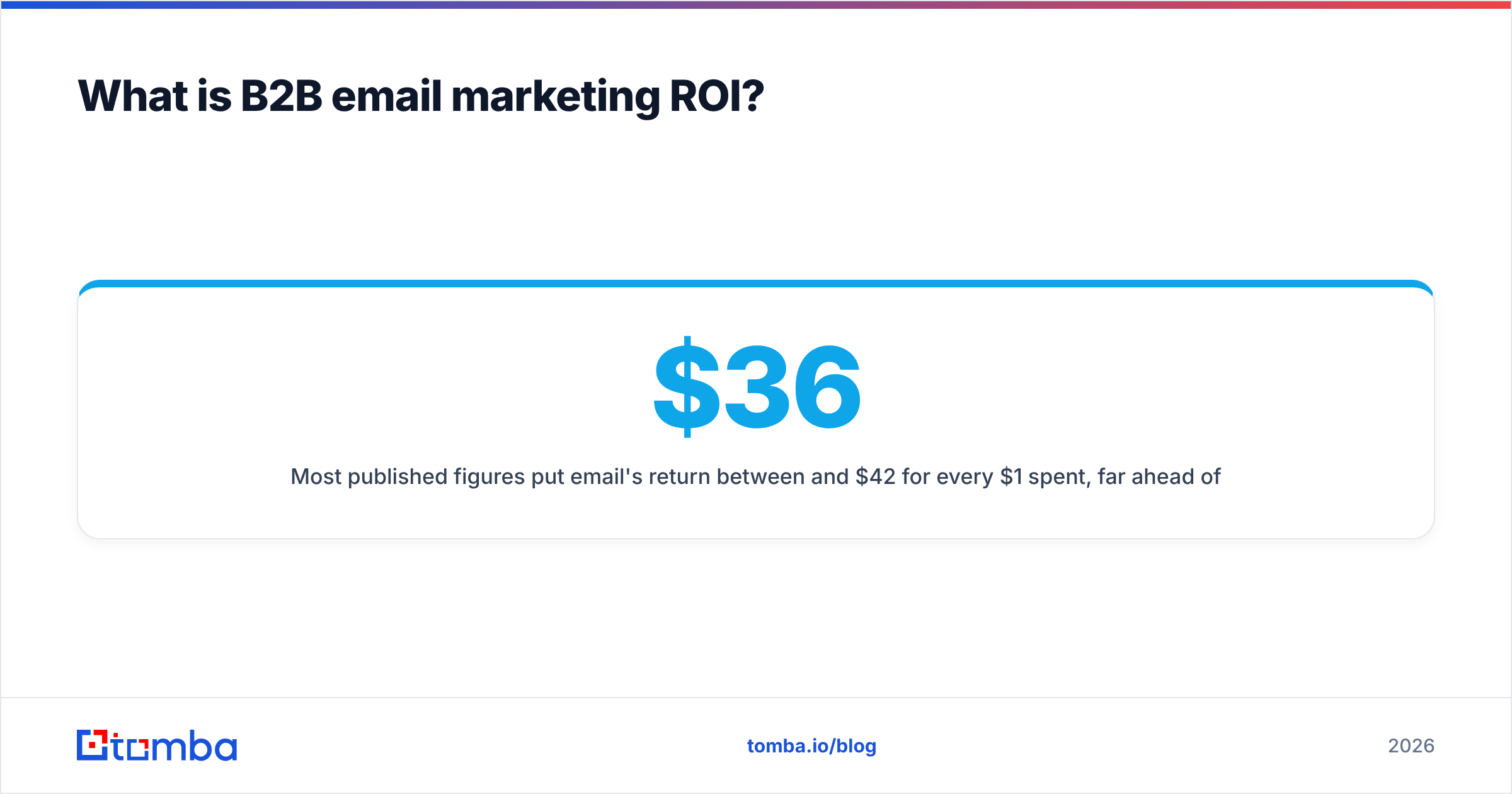
Most published figures put email's return between $36 and $42 for every $1 spent, far ahead of paid social or display. The Data & Marketing Association has popularized numbers in that range for years. But those are blended averages across B2C and B2B. Your actual B2B number depends on deal size, sales cycle, and — more than anything — the quality of the list you're emailing.
)
How do you calculate email marketing ROI accurately?#
Calculate it at two altitudes: the whole program and the individual campaign. Each answers a different question.
Program-level ROI answers "Is email worth funding?" Add up everything email costs over a quarter — platform fees, data and enrichment, design, copy, and a fair slice of salaries — then divide attributed revenue by that total. Use this for budget conversations.
Campaign-level ROI answers "Which sends actually make money?" Here you track revenue (or pipeline) per send, per segment, and per sequence step. Use this to kill losers and scale winners.
Here is a worked example for a mid-market SaaS team running outbound and nurture email in one quarter:
| Input | Value |
|---|---|
| Emails sent | 40,000 |
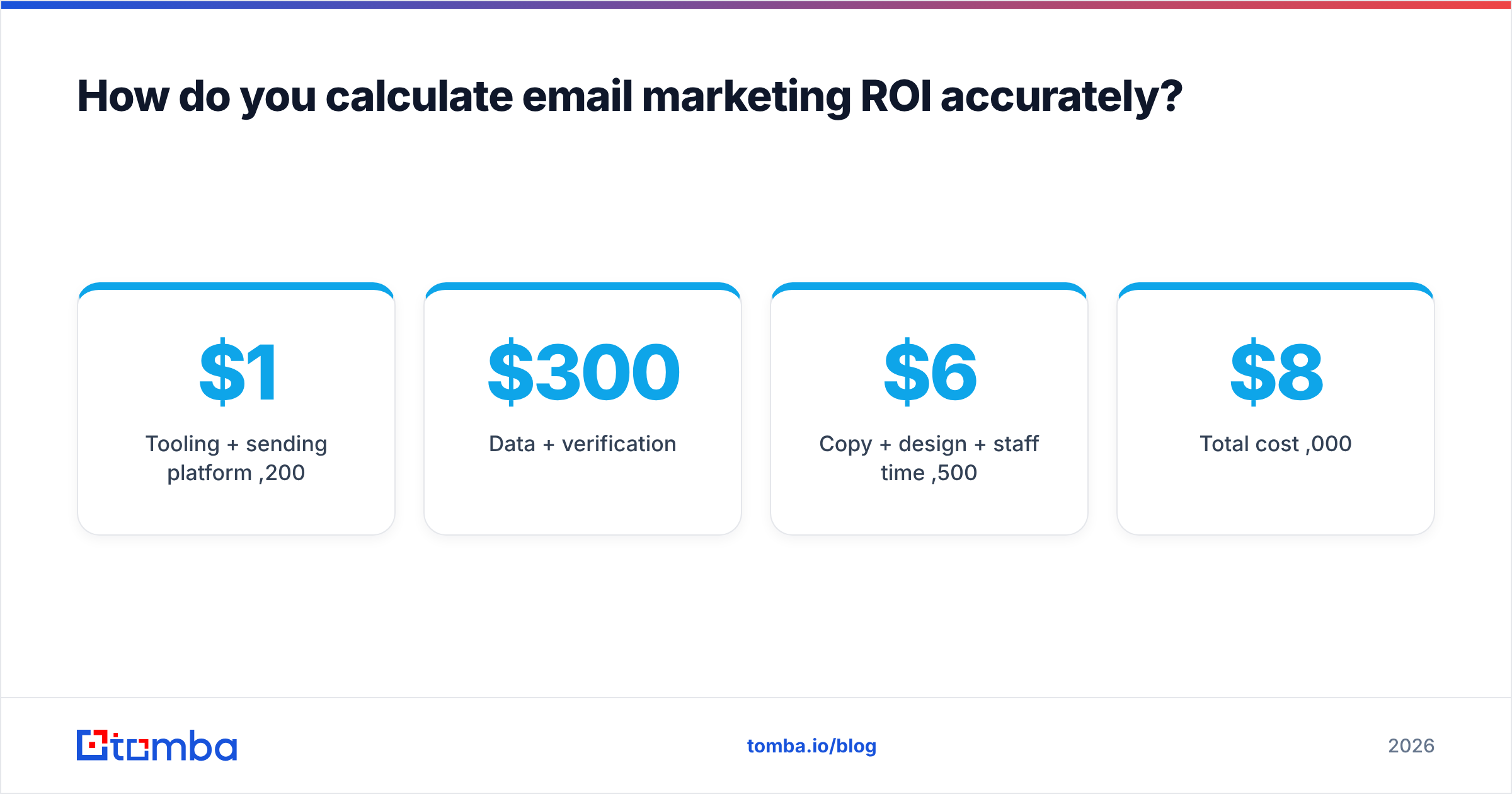
| Tooling + sending platform | $1,200 |
| Data + verification | $300 |
| Copy + design + staff time | $6,500 |
| Total cost | $8,000 |
| Deals attributed to email | 11 |
| Average contract value | $9,000 |
| Attributed revenue | $99,000 |
| ROI | ($99,000 − $8,000) ÷ $8,000 = 11.4x (1,138%) |
That 11.4x is healthy, but notice how sensitive it is to the denominator and to deliverability. If 20% of those 40,000 addresses were invalid, you didn't just waste send volume — you damaged sender reputation, which suppresses the inbox placement of the valid 80%. Bad data attacks ROI from both ends.
A quick attribution note: B2B buying is rarely single-touch. Pick a model you can defend — first-touch for top-of-funnel programs, multi-touch or "email-influenced pipeline" for nurture — and apply it consistently. Switching models mid-quarter is the fastest way to produce a number nobody trusts.
What are good B2B email marketing ROI benchmarks in 2026?#
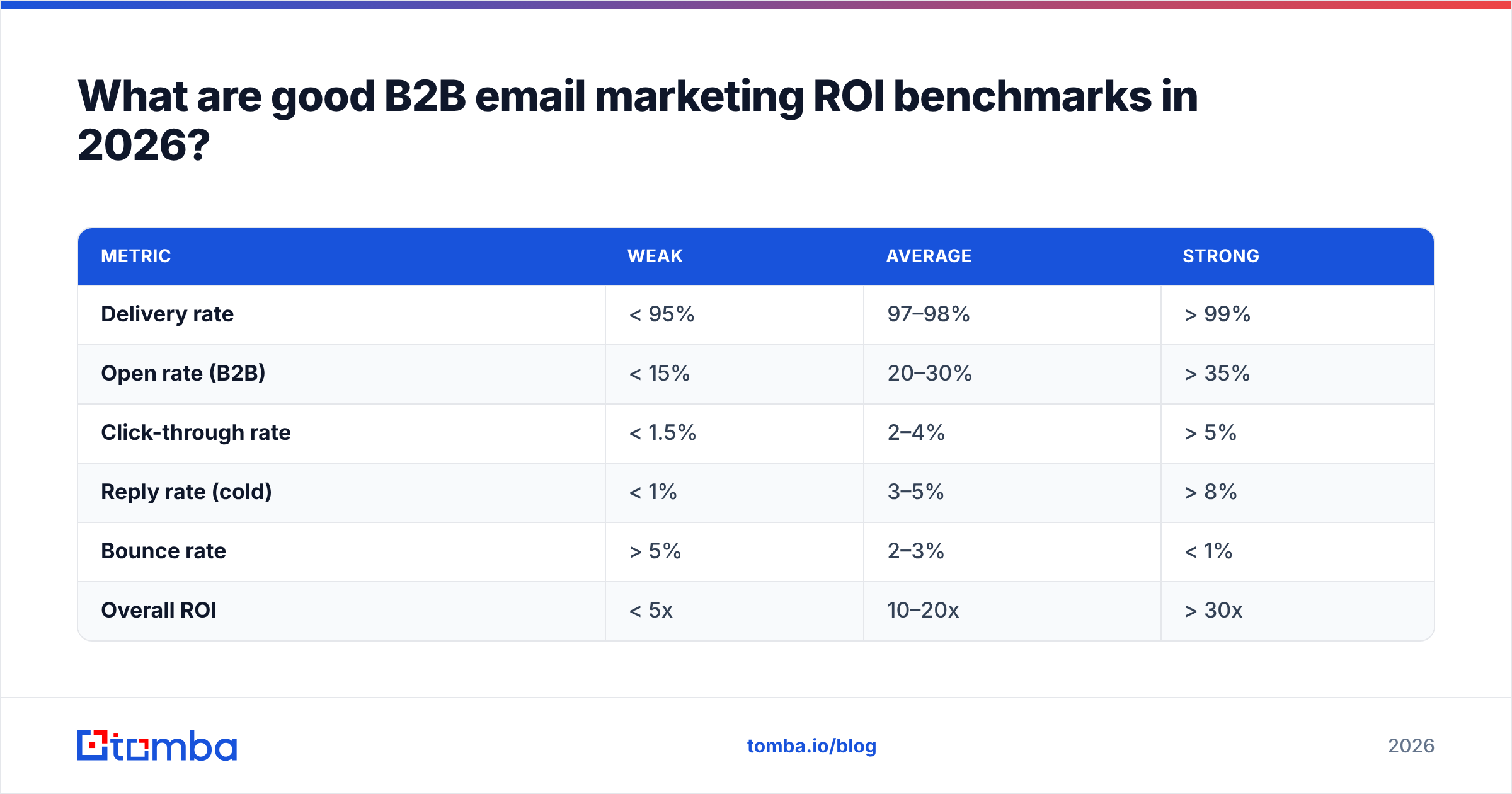
Benchmarks are guardrails, not goals. Your own trend line beats any industry average. Still, you need reference points to know whether a campaign is broken or just average. The figures below reflect commonly reported B2B ranges; treat them as directional.
| Metric | Weak | Average | Strong |
|---|---|---|---|
| Delivery rate | < 95% | 97–98% | > 99% |
| Open rate (B2B) | < 15% | 20–30% | > 35% |
| Click-through rate | < 1.5% | 2–4% | > 5% |
| Reply rate (cold) | < 1% | 3–5% | > 8% |
| Bounce rate | > 5% | 2–3% | < 1% |
| Overall ROI | < 5x | 10–20x | > 30x |
Two things to flag. First, open rate has gotten noisier since Apple Mail Privacy Protection inflates opens; lean on clicks and replies as truer signals. Second, the single metric that quietly governs all the others is bounce rate. Once you cross ~3% hard bounces, mailbox providers start throttling you, and every downstream number sags. Keeping bounces under 1% is the cheapest way to protect the entire funnel — and that starts with verification before you ever hit send.
Why does data quality drive email ROI more than copy?#
Because you can't A/B test your way out of emailing the wrong inbox. Great copy sent to a dead address returns exactly zero. Data quality is the multiplier that sits in front of every other optimization.
Walk through the chain of effects:
- Invalid addresses cause bounces. Bounces tell mailbox providers you don't maintain your list, lowering sender reputation.
- Lower reputation cuts inbox placement. Now your verified contacts land in spam, so opens and replies fall even on a clean subset.
- Wrong-role contacts waste sends. Emailing a junior IC instead of the economic buyer means even "successful" deliveries don't convert.
- Stale data inflates cost. You pay to send, enrich, and follow up with people who left the company months ago.
This is why list hygiene is the first ROI lever, not the last. Run new contacts through an email verifier before import, handle ambiguous domains with a catch-all verifier, and re-validate your active list on a schedule. The goal is a denominator full of real, reachable, role-relevant humans.
)
Sourcing matters as much as cleaning. If you build lists from scraped junk, no amount of verification rescues them — you'll verify your way down to a tiny usable remainder. Pulling contacts from a maintained B2B database or finding them by company with domain search gives you a higher-quality starting pool, which means more usable contacts survive verification and your effective cost-per-valid-lead drops.
Which levers improve B2B email marketing ROI fastest?#
Rank your effort by impact. These are ordered from highest to lowest return on the time you'll spend:
- List hygiene and sourcing (highest impact). Cut bounces below 1% and source role-relevant contacts. This protects deliverability and raises the conversion ceiling for everything else.
- Segmentation. Send fewer, more relevant emails. Segment by industry, role, company size, and behavior. A message that speaks to one persona beats a generic blast every time.
- Deliverability hygiene. Authenticate with SPF, DKIM, and DMARC; warm up new domains; monitor blacklists. Use a free email checker and an SPF checker as part of pre-send QA.
- Follow-up cadence. Most B2B replies come from follow-ups, not the first touch. A disciplined 3–5 step sequence often doubles reply rate at near-zero marginal cost.
- Copy and offer (still matters, just later). Subject lines, personalization, and a single clear CTA. Optimize this once the four levers above are solid.
Notice that copy is last, not because it's unimportant, but because it's the lever with the least leverage when the foundation is shaky. Fixing a 10% bounce rate will do more for ROI than rewriting your subject line for the fifth time.
How does Tomba compare to a typical email marketing stack?#
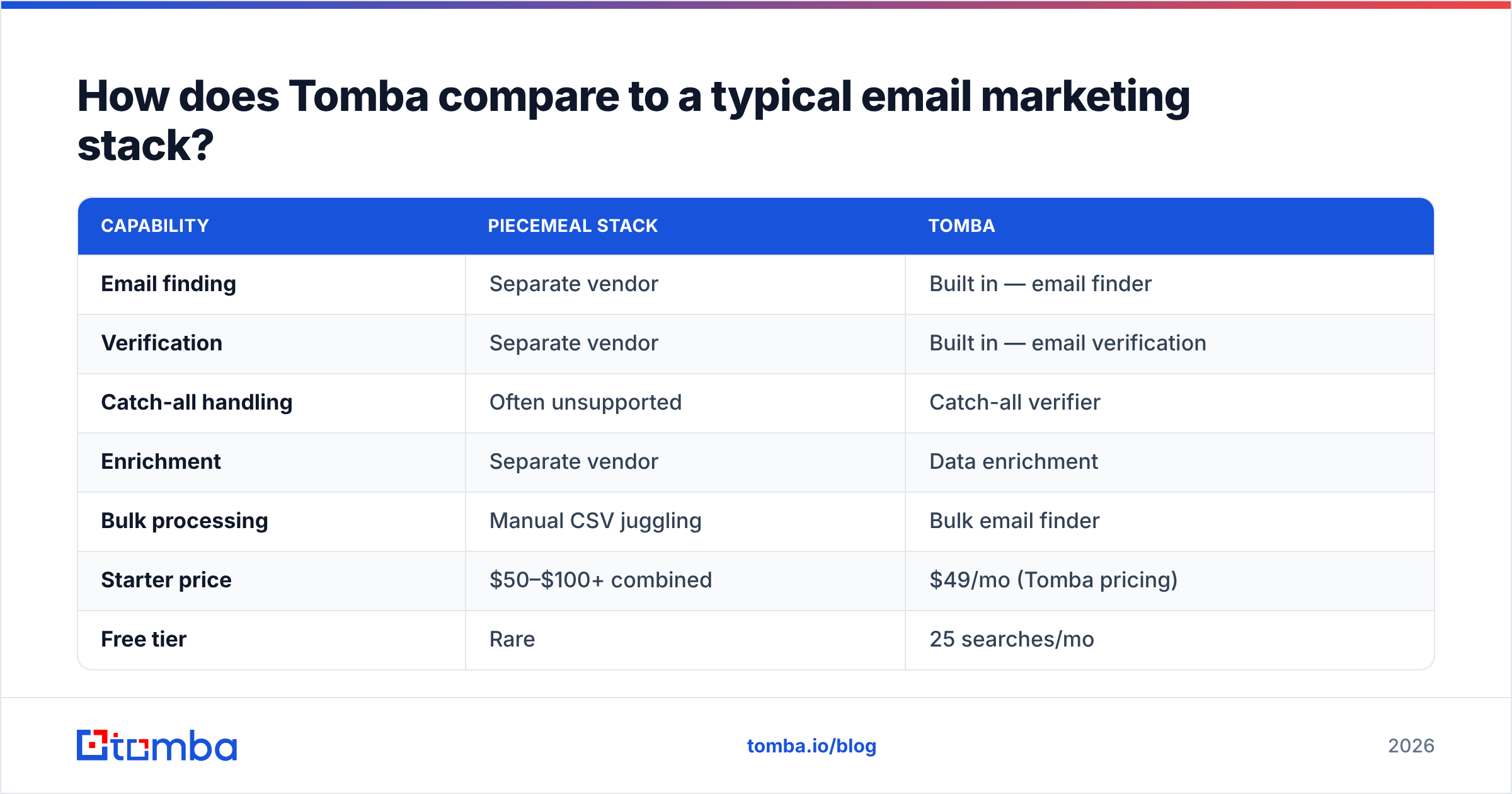
Most teams glue together a finder, a verifier, an enrichment source, and a sending tool. The friction — and the cost — comes from juggling separate vendors and reconciling their data. Here's how a consolidated data layer stacks up against a piecemeal approach for the data half of your program (you still bring your own sending/ESP tool).
| Capability | Piecemeal stack | Tomba |
|---|---|---|
| Email finding | Separate vendor | Built in — email finder |
| Verification | Separate vendor | Built in — email verification |
| Catch-all handling | Often unsupported | Catch-all verifier |
| Enrichment | Separate vendor | Data enrichment |
| Bulk processing | Manual CSV juggling | Bulk email finder |
| Starter price | $50–$100+ combined | $49/mo (Tomba pricing) |
| Free tier | Rare | 25 searches/mo |
The ROI argument for consolidation is straightforward: fewer tools means lower total cost (smaller denominator) and a single, consistent data standard means fewer bounces (larger numerator). Tomba's plans run Free (25 searches/mo), Starter at $49/mo, Growth at $99/mo, Pro at $249/mo, and Enterprise custom — so the data layer for a serious program lands in the $49–$99 range, not the hundreds.
For teams that live in spreadsheets, the Google Sheets add-on and Excel add-in let you find and verify in place, and the Tomba API handles enrichment at scale inside your own pipeline. Independent reviews on G2 and Capterra are a sensible cross-check before you commit to any vendor in this category.
How do you track ROI without overcomplicating it?#
Keep a single dashboard that connects spend to revenue, and resist the urge to drown it in vanity metrics. The minimum viable ROI dashboard has five lines:
- Total program cost (tooling + data + people, monthly).
- Emails sent and delivered (delivery rate visible).
- Replies and meetings booked (your truest mid-funnel signal).
- Pipeline attributed to email (using your chosen attribution model).
- Closed revenue and resulting ROI ratio.
Pipe this into your CRM so attribution isn't a manual export every month. Tomba's HubSpot, Salesforce, and Pipedrive integrations push verified contacts straight into the system of record, so the data you measure ROI against is the same data your reps work. The fewer hops between "found a contact" and "logged a closed deal," the more trustworthy your ROI number becomes.
One discipline that pays off: review campaign-level ROI monthly and program-level ROI quarterly. The monthly view tells you what to cut; the quarterly view tells you what to fund. Mixing the two cadences produces noise.
What mistakes quietly destroy email ROI?#
Most ROI leaks aren't dramatic. They're small, recurring habits:
- Never cleaning the list. Contacts decay roughly 2–3% per month as people change jobs. A list you built a year ago and never re-verified is a slow-motion bounce machine.
- Optimizing opens instead of revenue. Privacy features made opens unreliable. If your reporting still crowns "best open rate" campaigns, you're optimizing a broken compass.
- One-and-done sending. Skipping follow-ups throws away the majority of your potential replies.
- Ignoring deliverability infrastructure. No DMARC, cold domains, shared IPs with bad neighbors — all silent ROI killers that no copy tweak can fix.
- Buying cheap, unverified lists. The lowest sticker price often carries the highest true cost once bounces and reputation damage are counted.
Each of these is preventable with process, not budget. That's what makes email such a high-ROI channel when run well — the improvements are mostly free.
The bottom line on B2B email marketing ROI#
Email keeps winning the ROI race in B2B because the cost floor is low and the ceiling, when your data is clean, is high. The teams posting 20x and 30x returns aren't writing magically better subject lines — they're emailing real people, at the right companies, in the right roles, with bounces under 1% and follow-ups that actually land. Everything else is optimization on top of that foundation.
If you want the single highest-leverage move for next quarter's ROI, it's the boring one: fix your data. Start by sourcing and validating contacts with Tomba Email Finder — find professional emails by domain, name, or company, verify them before they enter your sequences, and enrich them so every send reaches a real, role-relevant buyer. Spin up the free tier (25 searches/mo), prove the lift on one campaign, and scale from there. Clean data is the cheapest ROI multiplier you'll ever buy.
// get started
Find, verify and enrich your first contacts today
Start on the free plan with 25 searches a month, then scale when your team is ready.
Free plan · No credit card required · GDPR & CCPA
// about the author