B2B Growth Marketing in 2026: Playbook, Channels & Metrics
A no-fluff guide to B2B growth marketing in 2026: the channels that compound, the metrics that matter, and the data layer that makes it all work.
B2B growth marketing is the discipline of running repeatable, measurable experiments across the entire funnel — acquisition, activation, retention, and expansion — to compound revenue instead of chasing one-off campaign spikes. It borrows the test-and-iterate mindset of consumer growth teams and applies it to long sales cycles, buying committees, and high-ticket deals.
This guide breaks down how it actually works in 2026: the channels worth your budget, the metrics that predict revenue, how to structure the team, and the data foundation that quietly decides whether any of it works.
TL;DR#
- Growth marketing ≠ demand gen. It owns the full funnel (acquisition → expansion), runs structured experiments, and is judged on pipeline and revenue — not MQLs.
- Channels that compound (SEO, product-led loops, community, referrals) beat channels that decay the moment you stop paying (most paid ads).
- Your data layer is the bottleneck. Bad contact data caps every downstream metric; clean enrichment and verification raise the whole funnel.
- Measure leading + lagging together — reply rate and activation predict the pipeline and revenue you'll book a quarter later.
- Small, cross-functional pods with one north-star metric ship faster than siloed marketing/sales/product orgs.
What is B2B growth marketing?#
Think of traditional marketing as planting a garden once a year and hoping for a harvest. Growth marketing is tending the garden daily — testing which seeds, soil, and watering schedule produce the most yield, then doubling down on what works. Technically, it's a continuous experimentation loop applied across the customer lifecycle, owned by a cross-functional team accountable to revenue.
The core difference from classic B2B demand generation is scope and accountability:
- Full-funnel ownership — Growth touches acquisition, activation, retention, and expansion, not just top-of-funnel lead capture.
- Experiment velocity — Success is measured in tests shipped per week, not campaigns launched per quarter.
- Revenue accountability — The team reports on pipeline and closed revenue, not impressions or raw lead counts.
- Data-first decisions — Every bet is tied to a hypothesis, a metric, and a kill criterion.
- Tight feedback loops — Sales, product, and marketing share dashboards and meet weekly, not at the quarterly review.
If your "growth" team is really just a paid-ads team with a new title, you've renamed the function without changing the operating model.
How is growth marketing different from demand generation?#
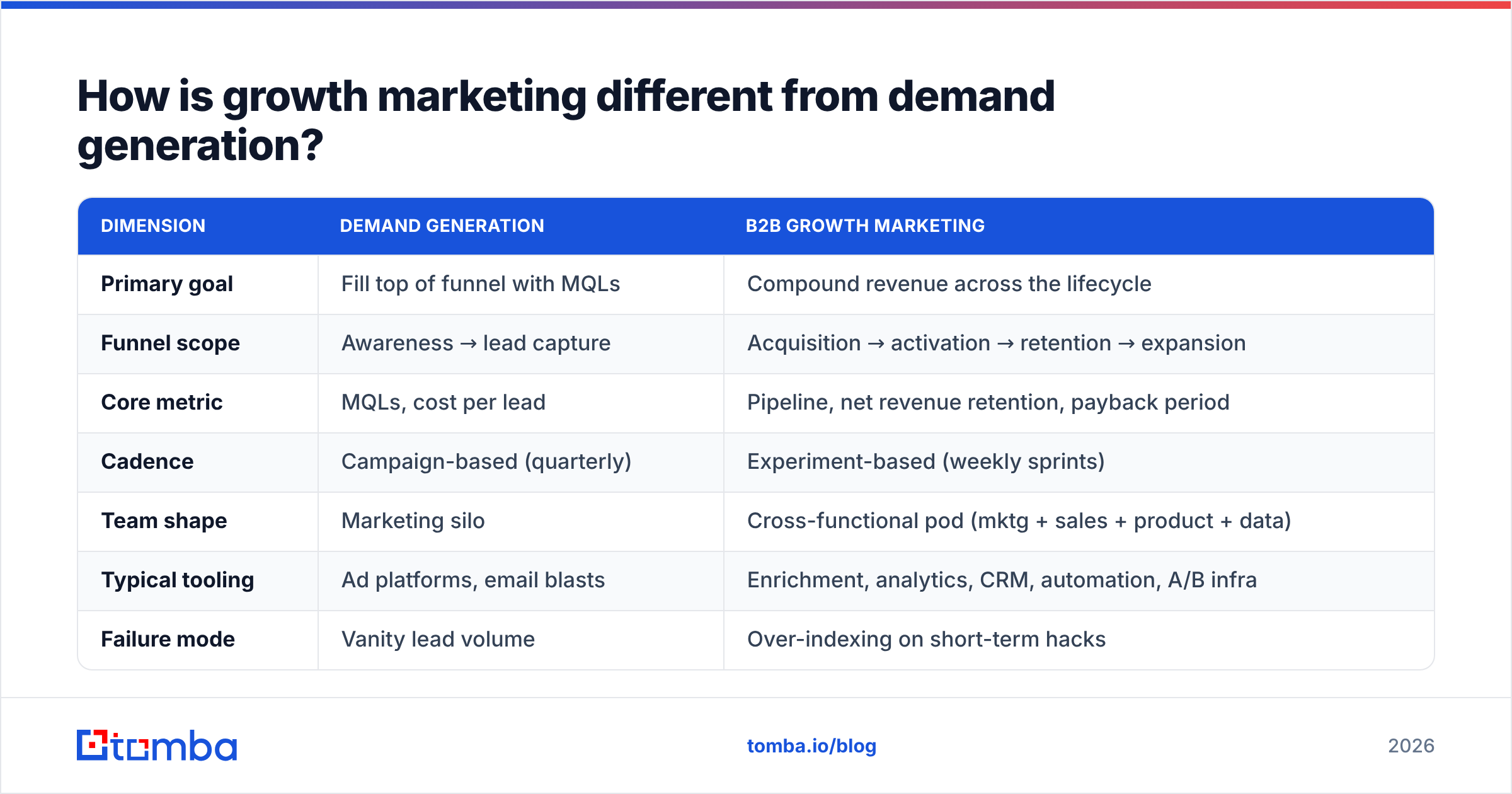
The two overlap, but conflating them leads to misaligned goals. Demand gen is one input into the growth engine; growth marketing orchestrates the whole machine.
| Dimension | Demand Generation | B2B Growth Marketing |
|---|---|---|
| Primary goal | Fill top of funnel with MQLs | Compound revenue across the lifecycle |
| Funnel scope | Awareness → lead capture | Acquisition → activation → retention → expansion |
| Core metric | MQLs, cost per lead | Pipeline, net revenue retention, payback period |
| Cadence | Campaign-based (quarterly) | Experiment-based (weekly sprints) |
| Team shape | Marketing silo | Cross-functional pod (mktg + sales + product + data) |
| Typical tooling | Ad platforms, email blasts | Enrichment, analytics, CRM, automation, A/B infra |
| Failure mode | Vanity lead volume | Over-indexing on short-term hacks |
The practical takeaway: demand gen asks "how do we get more leads?" Growth marketing asks "where in the funnel is revenue leaking, and what experiment closes the gap fastest?" Sometimes the answer is more leads. Often it's better activation, lower churn, or expansion into the existing base — none of which a pure lead-volume team is incentivized to find.
Which channels actually drive B2B growth in 2026?#
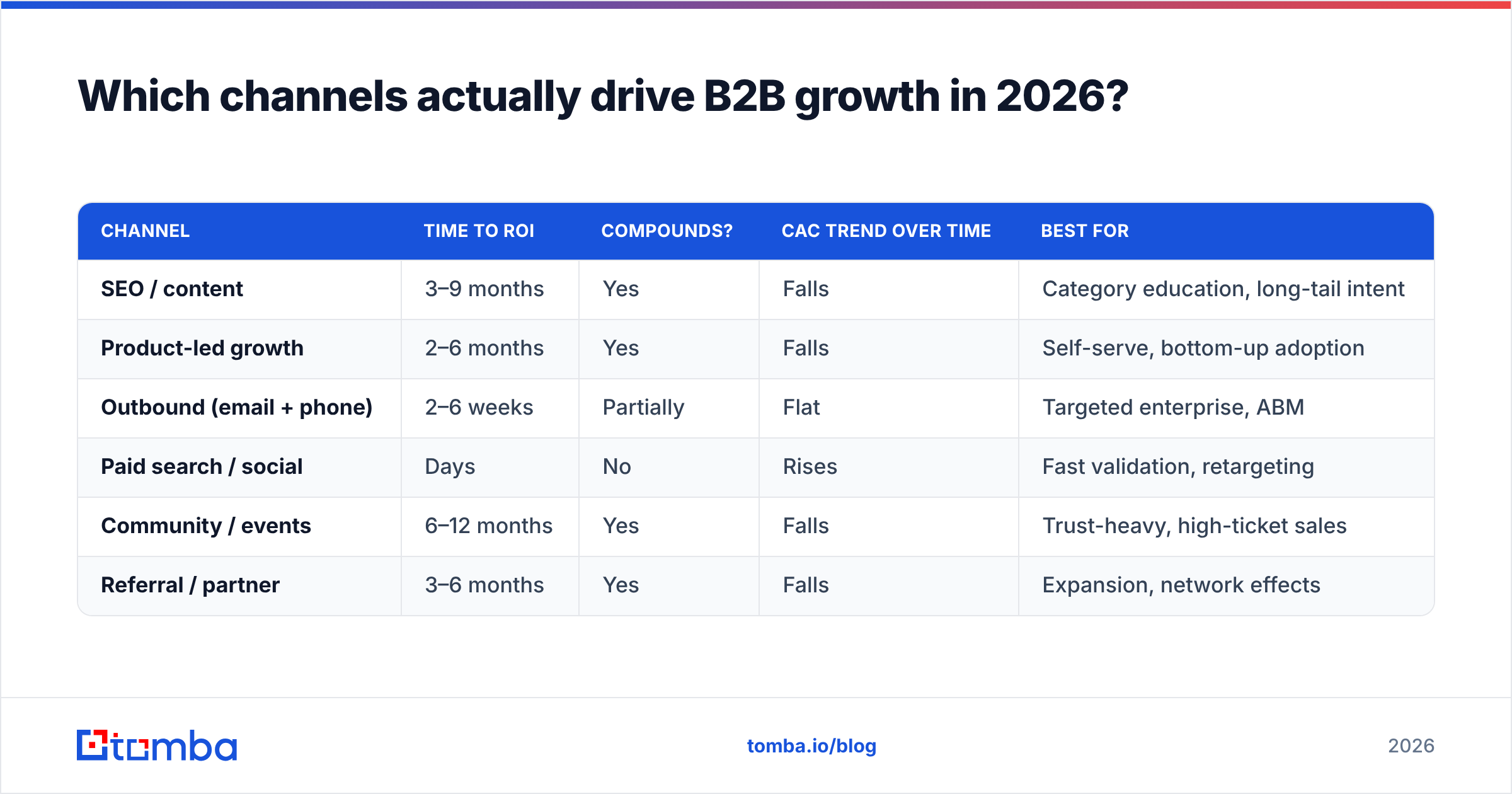
The honest answer: channels that compound beat channels that decay. A paid ad stops working the second you stop paying. A ranking article, a referral loop, or a product that markets itself keeps producing return long after the work is done.
Here's how the main channels stack up on the dimensions growth teams actually care about.
| Channel | Time to ROI | Compounds? | CAC trend over time | Best for |
|---|---|---|---|---|
| SEO / content | 3–9 months | Yes | Falls | Category education, long-tail intent |
| Product-led growth | 2–6 months | Yes | Falls | Self-serve, bottom-up adoption |
| Outbound (email + phone) | 2–6 weeks | Partially | Flat | Targeted enterprise, ABM |
| Paid search / social | Days | No | Rises | Fast validation, retargeting |
| Community / events | 6–12 months | Yes | Falls | Trust-heavy, high-ticket sales |
| Referral / partner | 3–6 months | Yes | Falls | Expansion, network effects |
Most winning 2026 programs blend two compounding channels (SEO + community, or PLG + referrals) with one fast channel (outbound or paid) to validate messaging quickly. Outbound is the bridge: it gives you direct revenue while the compounding channels mature. But outbound only works when your targeting and contact data are sharp — which is exactly where most teams quietly lose.
Why outbound still earns its seat#
A well-run outbound motion is the fastest way to test whether a segment will pay. The catch is precision. Spraying a purchased list torches your sender reputation and your brand. A tight, well-researched list of fitting accounts — with verified contacts and the right buying-committee roles — turns outbound into a predictable pipeline source. That requires a reliable email finder and an email verifier in the stack, not a guesswork spreadsheet.
What metrics matter in B2B growth marketing?#
Conclusion first: track leading and lagging metrics together, because leading metrics let you steer before the quarter is lost. Lagging metrics (revenue, NRR) tell you what already happened; leading metrics (reply rate, activation) predict what's about to.
The leading indicators worth a dashboard:
- Reply rate on outbound — your message-market fit signal, available in days.
- Activation rate — percentage of new users hitting the "aha" action within X days.
- Meeting-to-opportunity rate — qualification quality, not just quantity.
- Content-assisted pipeline — deals that touched a piece of content before closing.
The lagging indicators that pay the bills:
- Pipeline created and pipeline velocity — the speed deals move stage to stage.
- CAC payback period — months to recover acquisition cost; under 12 is healthy for most SaaS.
- Net revenue retention — the quietest growth lever; 110%+ means you grow even with zero new logos.
- Win rate by segment and source — see win rate for how to calculate and benchmark it.
A common mistake is optimizing MQL volume because it's easy to move. You can double MQLs and shrink pipeline if the new leads are worse. Anchor on revenue operations metrics that connect marketing activity to closed revenue, and treat vanity counts as diagnostics, not goals.

Why is data quality the real growth bottleneck?#
Here's the part nobody puts on the conference slide: your growth ceiling is set by your data quality, not your creativity. Every funnel metric is multiplicative. If 30% of your contact data is wrong, you don't lose 30% at one step — you lose a slice at every step, and the compounding loss is brutal.
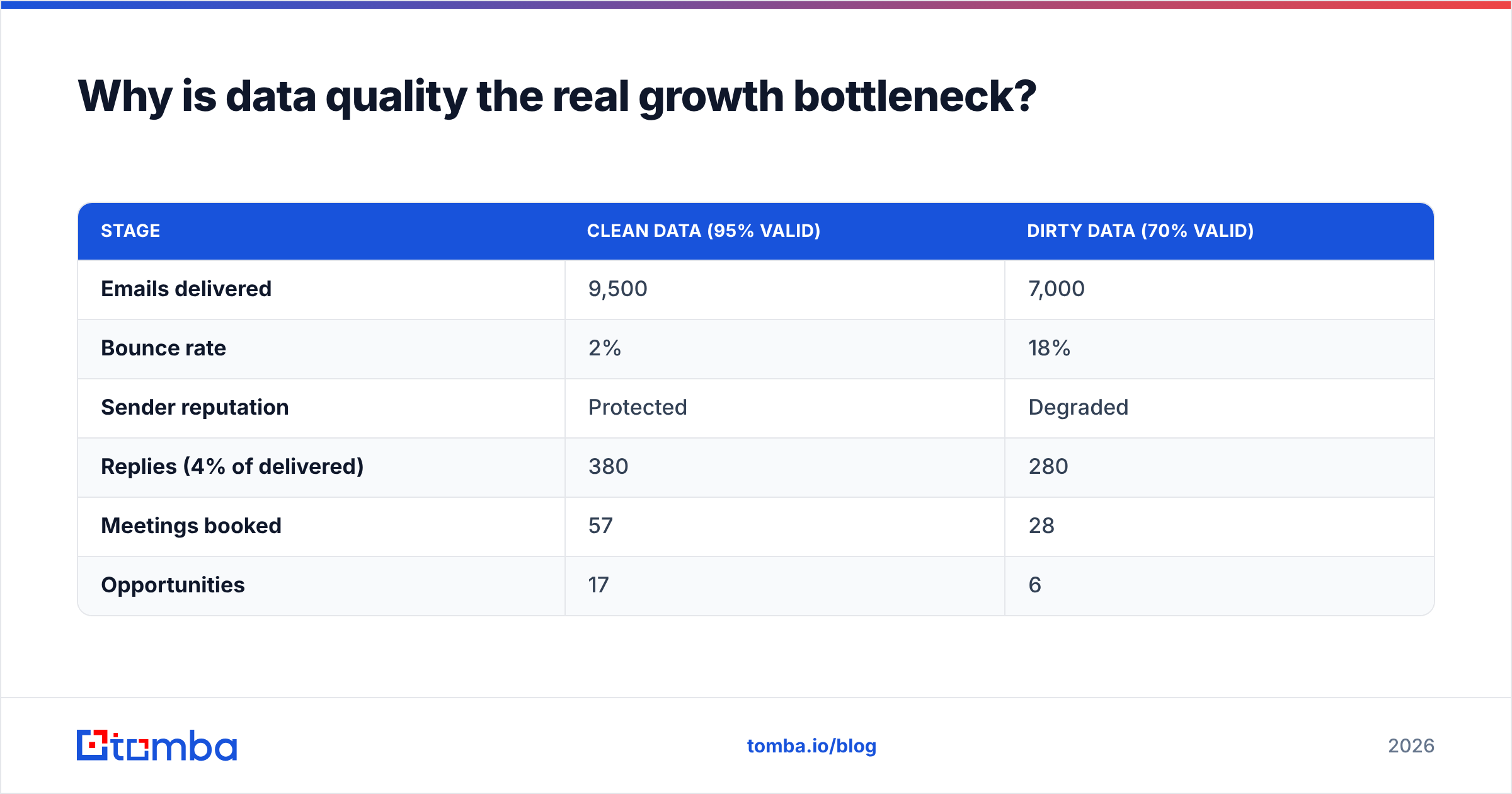
Picture two outbound programs sending the same 10,000 emails with the same copy:
| Stage | Clean data (95% valid) | Dirty data (70% valid) |
|---|---|---|
| Emails delivered | 9,500 | 7,000 |
| Bounce rate | 2% | 18% |
| Sender reputation | Protected | Degraded |
| Replies (4% of delivered) | 380 | 280 |
| Meetings booked | 57 | 28 |
| Opportunities | 17 | 6 |
Same effort, nearly 3x the opportunities — purely from data hygiene. And the dirty-data column understates the damage, because a high bounce rate drags down email deliverability for every future send, not just this campaign.
This is why mature growth teams treat enrichment and verification as infrastructure, not a nice-to-have. Before any sequence goes out, contacts get run through data enrichment to fill role, company, and firmographic gaps, then verified to strip invalid and catch-all addresses. For scaled list-building, a bulk email finder turns a target-account list into verified, sequence-ready contacts without manual lookup.
The lesson: spend on the data layer before you spend on more ad budget. Cleaning the funnel raises every downstream number at once.
How do you structure a B2B growth marketing team?#
The best-performing teams in 2026 are small, cross-functional pods organized around a metric, not a department. A typical growth pod looks like this:
- Growth lead — owns the north-star metric and the experiment backlog.
- Full-stack marketer — runs channels, copy, and campaigns end to end.
- Growth engineer / ops — builds tracking, automations, and the data pipeline.
- Data/analytics partner — defines metrics, runs analysis, calls experiments.
- Embedded SDR or sales partner — closes the loop between message and revenue.
The pod runs weekly experiment sprints: hypothesize, ship, measure, decide. Each experiment has a clear metric and a kill criterion so dead bets die fast and budget rotates to winners. This is closer to how product teams operate than how classic marketing departments do — and that's the point.
Tooling should reinforce the loop, not fragment it. Connect your enrichment and finder tools directly into the CRM so reps and marketers work from the same clean record — Tomba's HubSpot and Salesforce integrations push verified contacts straight into the pipeline, and the Tomba API lets your growth engineer automate enrichment inside any internal workflow.
What does a 90-day B2B growth plan look like?#
A concrete starting sequence beats an abstract framework. Here's a pragmatic first quarter.
Days 1–30 — Instrument and clean. Get tracking right end to end, define your north-star metric, and clean the data layer. Verify your existing contact database, deduplicate it with a tool like remove duplicates, and enrich missing fields. You can't experiment on a funnel you can't measure.
Days 31–60 — Validate channels fast. Run small, parallel tests across one compounding channel (content or PLG) and one fast channel (outbound or paid). Keep budgets small and kill criteria explicit. Use domain search to build tight, verified account lists for the outbound test instead of buying a list.
Days 61–90 — Double down and systematize. Cut the losers, pour budget into the one or two channels showing efficient pipeline, and turn the winning play into a repeatable, documented system. By now you should have leading-indicator data good enough to forecast next quarter's pipeline.
The discipline is in the kill criteria. Teams that can't say "this dies if reply rate is under 2% by day 14" end up funding mediocre channels forever.
Common B2B growth marketing mistakes#
- Chasing hacks over systems. A viral LinkedIn post is nice; a repeatable channel is the business. Hacks don't compound.
- Optimizing vanity metrics. More traffic and more MQLs feel like progress and often aren't. Tie everything to pipeline.
- Ignoring retention and expansion. Acquiring a customer you'll lose in six months is negative growth. NRR is where durable growth lives.
- Skipping data hygiene. Covered above — it caps everything. See where reliable data sources come from before trusting a vendor.
- Siloed teams. When marketing, sales, and product don't share dashboards, the funnel leaks at every handoff.
How does Tomba fit into a growth stack?#
Growth marketing is a numbers game played on the quality of your data. The teams that win in 2026 aren't the ones with the cleverest campaigns — they're the ones whose every email lands, whose every list is verified, and whose CRM holds records they can actually trust.
That's the layer Tomba's Email Finder is built for: find verified professional email addresses by name, domain, or company, enrich them with firmographic context, and push clean contacts straight into your sequences and CRM. Start free with 25 searches a month, then scale on the Starter plan at $49/mo as your experiments prove out — full Tomba pricing runs through Growth ($99/mo) and Pro ($249/mo) tiers. Fix the data layer first, and every channel above it works harder.
For broader context on tooling categories, G2's marketing software grids and HubSpot's marketing statistics are useful neutral benchmarks when you build your own stack.
// get started
Find, verify and enrich your first contacts today
Start on the free plan with 25 searches a month, then scale when your team is ready.
Free plan · No credit card required · GDPR & CCPA
// about the author