B2B IT Marketing in 2026: The Complete Strategy Playbook
IT buyers ignore hype and punish fluff. Here's how B2B IT marketing actually works in 2026 — channels, data, ABM, and the metrics that move pipeline.
Selling software, hardware, or managed services to IT departments is a different sport than selling to marketing or HR. The buyers are skeptical by training, the committees are large, and a single bad data point can torpedo your credibility before the first call. B2B IT marketing rewards precision over volume — and most teams still run it like a consumer funnel.
This playbook is the practical version: who you're actually selling to, which channels move technical buyers, how to build the data layer that makes everything else work, and the metrics that tie effort to closed revenue.
TL;DR#
- B2B IT marketing sells to a committee of 6–10 technical evaluators, not a single persona — your content has to satisfy the skeptic, the security reviewer, and the budget owner at once.
- Accurate contact data is the foundation. Bad emails and stale titles waste your best campaigns; clean enrichment beats clever copy.
- Account-based marketing (ABM) outperforms broad demand gen for IT because deal sizes are large and target accounts are finite.
- Technical buyers reward proof: docs, benchmarks, security pages, and peer reviews convert better than slogans.
- Measure pipeline and influenced revenue, not MQL vanity counts — IT cycles are long, so attribution has to span quarters.
What is B2B IT marketing?#
B2B IT marketing is the practice of generating demand and pipeline for products sold to information-technology buyers — IT directors, CISOs, DevOps leads, infrastructure managers, and the procurement and finance people who sign off with them. Think of it like selling tools to a master carpenter: you don't win with a flashy ad, you win by proving your tool is sharper, safer, and won't break under load.
That audience changes everything. IT buyers research independently, distrust marketing language, and validate claims against documentation and peer opinion before they ever talk to sales. According to Gartner, B2B buyers spend only a small fraction of their journey with any single vendor's sales team — most of the work happens in self-directed research. For technical products, that share is even lower.
So your job isn't to "convince." It's to be discoverable, credible, and easy to evaluate the moment a buying committee starts looking.
Who are you actually marketing to?#
The single biggest mistake in IT marketing is treating "IT" as one persona. A modern buying committee has competing incentives, and your messaging has to land with each.
- The technical evaluator (DevOps, engineer, sysadmin) — cares about how it works, integration effort, and whether your docs are honest. Wins on proof, loses on fluff.
- The economic buyer (IT Director, VP Eng, CIO) — cares about total cost, risk, and whether this advances a roadmap. Wins on ROI and reliability.
- The security reviewer (CISO, security analyst) — cares about compliance, data handling, SOC 2, and breach exposure. Can veto a deal single-handedly.
- The champion — an internal advocate who has to sell your product up the chain. Give them the slides, numbers, and answers to do it.
- Procurement/finance — cares about contract terms, seat counts, and renewal risk.
If a campaign only speaks to one of these, the deal stalls when it hits the others. The practical fix is a content map: at least one credible asset per role, all pointing at the same outcome.
Which channels work for technical buyers?#
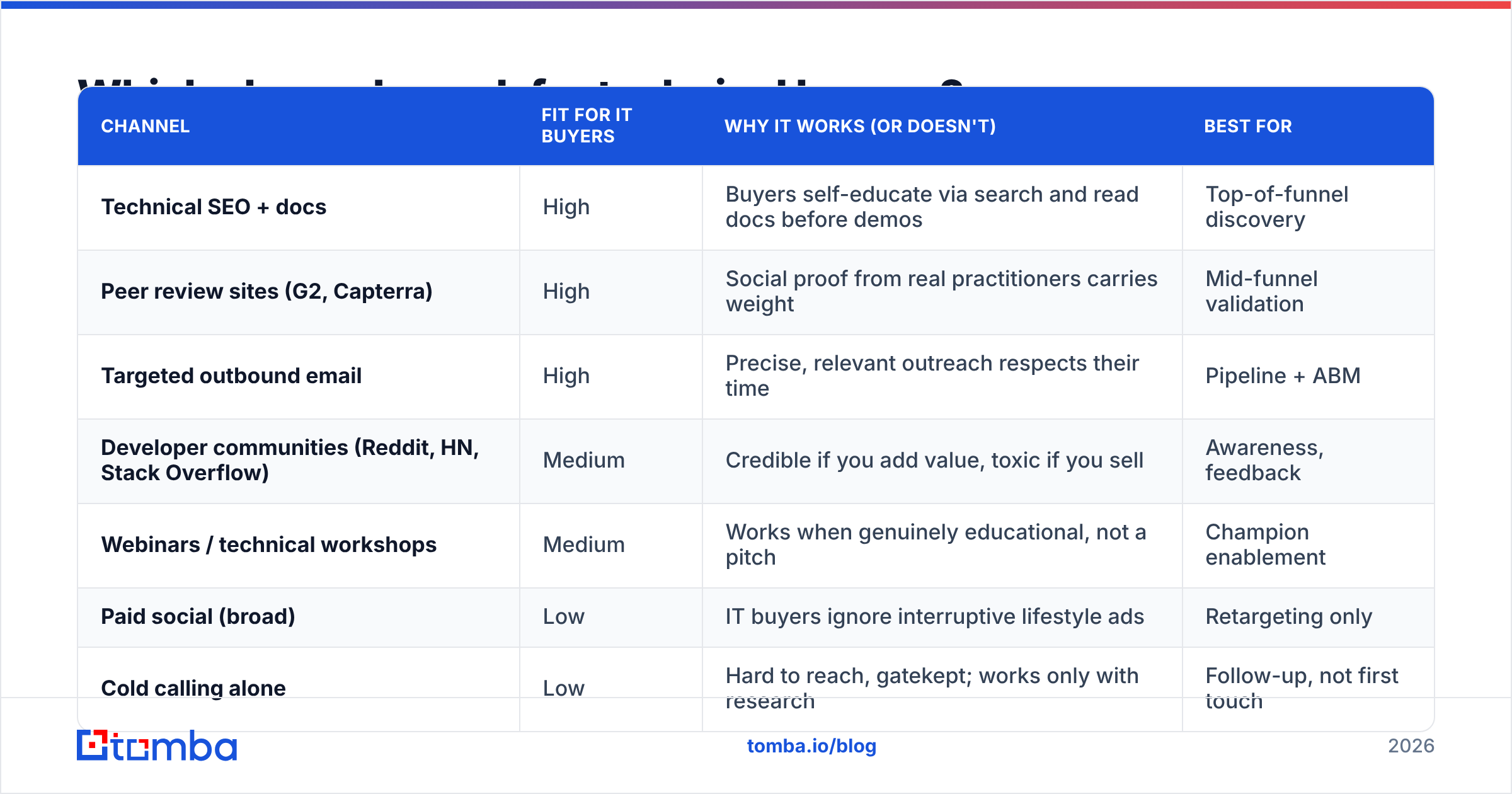
Channels that work for a marketing SaaS often flop with IT. Technical audiences over-index on a few high-trust surfaces and tune out the rest.
| Channel | Fit for IT buyers | Why it works (or doesn't) | Best for |
|---|---|---|---|
| Technical SEO + docs | High | Buyers self-educate via search and read docs before demos | Top-of-funnel discovery |
| Peer review sites (G2, Capterra) | High | Social proof from real practitioners carries weight | Mid-funnel validation |
| Targeted outbound email | High | Precise, relevant outreach respects their time | Pipeline + ABM |
| Developer communities (Reddit, HN, Stack Overflow) | Medium | Credible if you add value, toxic if you sell | Awareness, feedback |
| Webinars / technical workshops | Medium | Works when genuinely educational, not a pitch | Champion enablement |
| Paid social (broad) | Low | IT buyers ignore interruptive lifestyle ads | Retargeting only |
| Cold calling alone | Low | Hard to reach, gatekept; works only with research | Follow-up, not first touch |
The pattern: IT buyers reward channels where you demonstrate competence and respect their time, and punish interruptive, low-context outreach. A useful comparison point is how HubSpot frames inbound — earn attention with helpful content rather than buy it — which maps almost perfectly onto technical audiences.
Why is contact data the foundation of B2B IT marketing?#
Your campaigns are only as good as the data underneath them. You can write the sharpest technical email in your category, but if it lands at jsmith@oldcompany.com after the contact changed jobs, you bounced your domain reputation for nothing.
IT contacts are especially volatile. Titles shift with reorgs, engineers move between companies fast, and generic role inboxes (it@, admin@) hide the real decision-maker. That's why the unglamorous work — finding, verifying, and enriching contacts — quietly determines campaign ROI.
A reliable data layer for IT marketing needs four things:
- Accurate, role-specific emails, not catch-all guesses. Use an email finder to locate the actual person behind a domain, then run an email verifier before any send.
- Company-level coverage so you can map a whole buying committee. Domain search pulls every reachable contact at a target account, not just one.
- Enrichment — title, seniority, department, tech stack — so you can route and personalize. Data enrichment turns a bare email into a usable lead.
- Catch-all handling, because many enterprise IT domains accept everything. A catch-all verifier keeps those from silently wrecking deliverability.
Get this layer right and everything downstream — ABM, outbound, retargeting — gets cheaper and more effective. Get it wrong and you're optimizing copy on top of a broken foundation.
How does ABM fit B2B IT marketing?#
Account-based marketing is the natural model for IT because the math favors it. When a single enterprise infrastructure deal is worth six or seven figures and your realistic target list is a few hundred accounts, spraying broad demand gen is wasteful. You concentrate.
A workable ABM motion for IT looks like this:
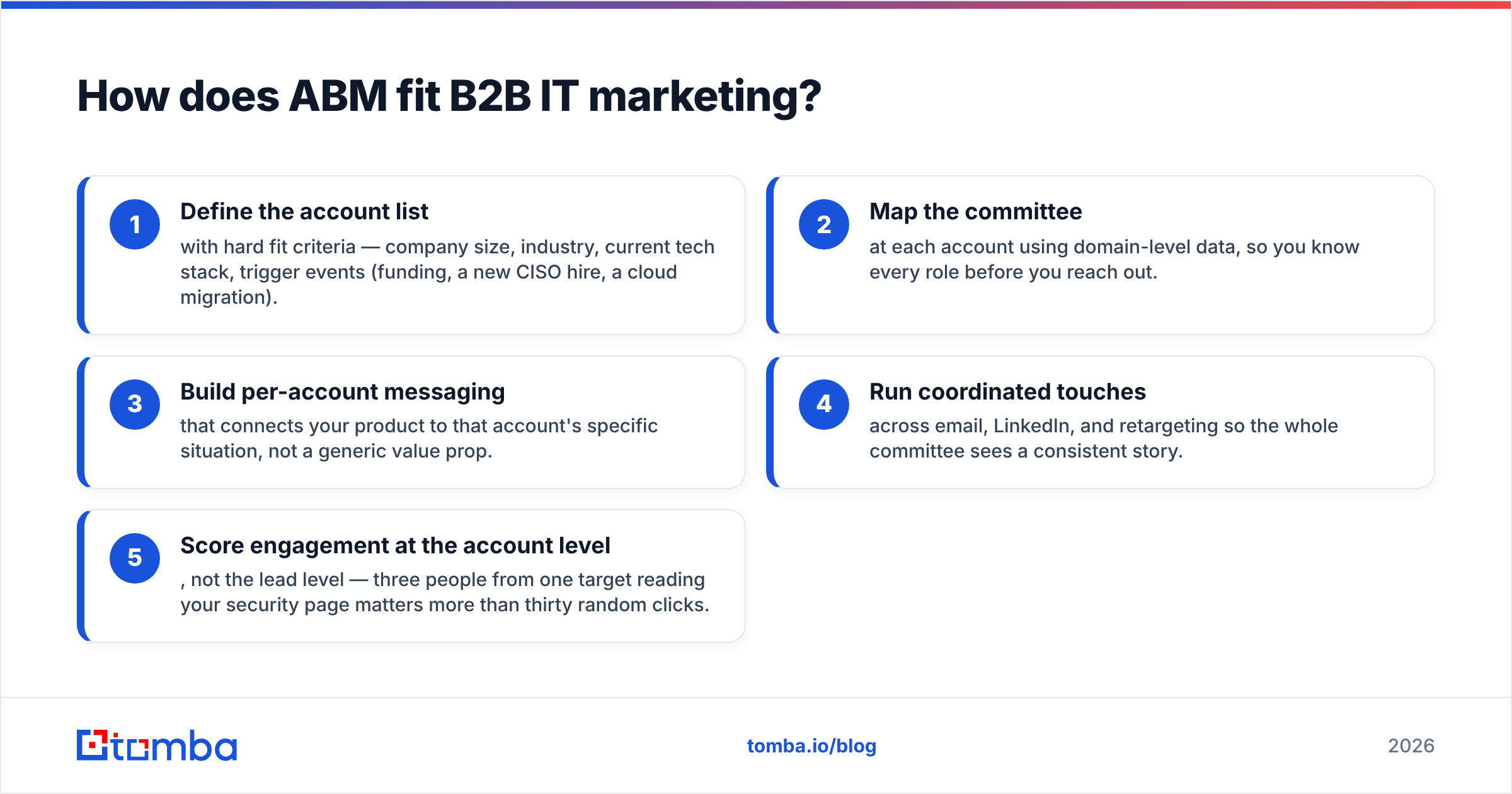
- Define the account list with hard fit criteria — company size, industry, current tech stack, trigger events (funding, a new CISO hire, a cloud migration).
- Map the committee at each account using domain-level data, so you know every role before you reach out.
- Build per-account messaging that connects your product to that account's specific situation, not a generic value prop.
- Run coordinated touches across email, LinkedIn, and retargeting so the whole committee sees a consistent story.
- Score engagement at the account level, not the lead level — three people from one target reading your security page matters more than thirty random clicks.
The discipline is the point. ABM forces you to invest where revenue actually lives, and it only works when your account and contact data is clean enough to trust. This is also where LinkedIn outreach pairs well with email — multi-threading a committee across channels is far more effective than single-threading one champion.
What content actually converts IT buyers?#
Technical buyers convert on evidence, not adjectives. Every asset should answer a skeptic's question and survive fact-checking. The hierarchy that works:
- Documentation and quickstarts — if a buyer can see exactly how your product works in five minutes, you've cleared the highest bar. Good docs are a sales asset.
- Benchmarks and reproducible numbers — show methodology, not just a winning chart. IT buyers trust transparent tests and distrust cherry-picked ones.
- Security and compliance pages — SOC 2, GDPR handling, data residency, sub-processors. The CISO will look; make it easy.
- Honest comparison content — buyers are already comparing you, so do it for them with real criteria. (A neutral Apollo alternative or RocketReach alternative page works because it's specific, not because it's flattering.)
- Peer proof — case studies with real names and numbers, plus presence on review sites like G2.
Notice what's missing: thought-leadership fluff, vague "digital transformation" copy, and superlatives without data. Those actively erode trust with technical readers.
How do you measure B2B IT marketing?#
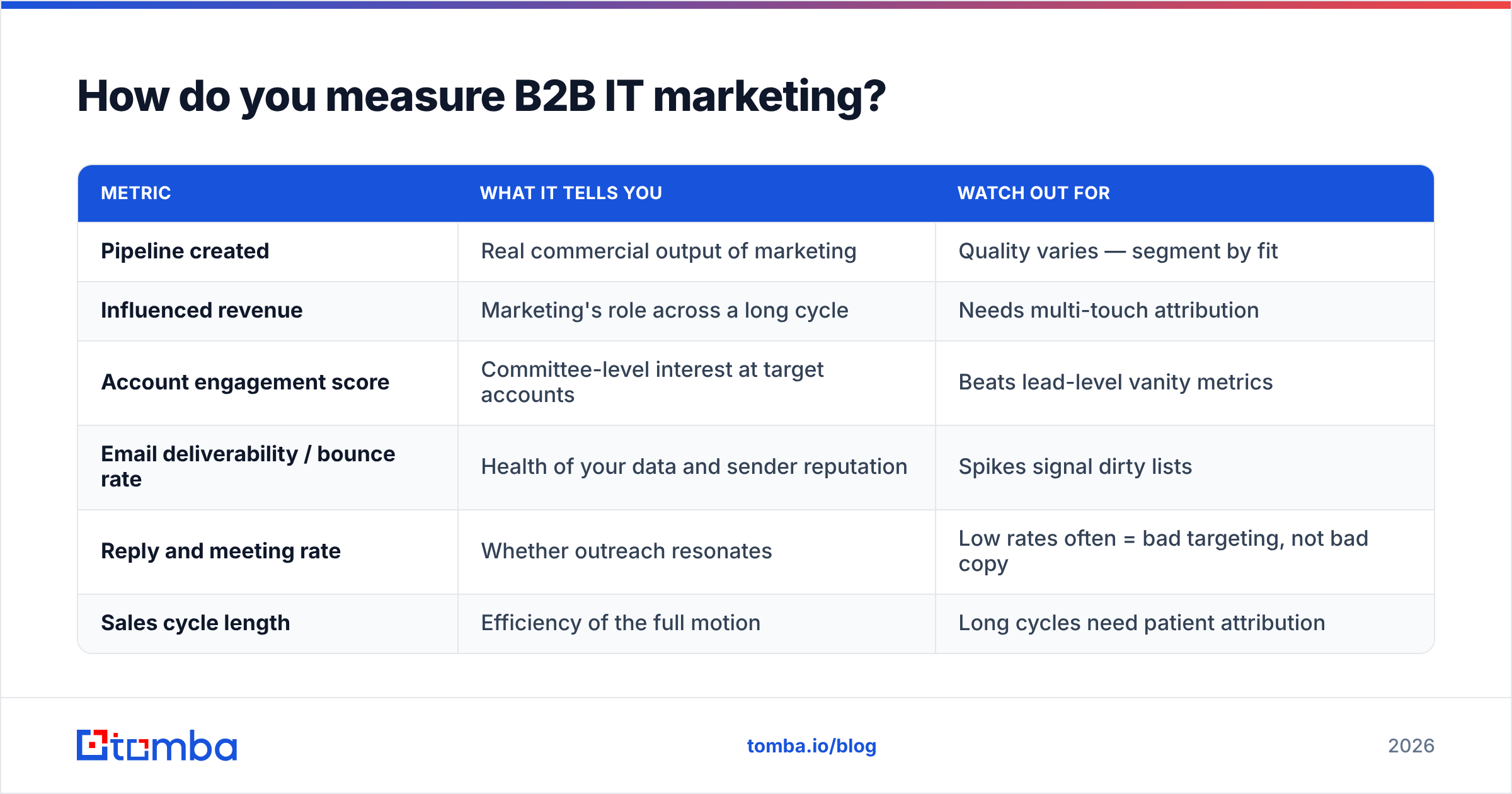
Measure pipeline and influenced revenue, not MQL counts. IT buying cycles run months, committees are large, and first-touch-to-close attribution that ignores the middle will mislead you.
| Metric | What it tells you | Watch out for |
|---|---|---|
| Pipeline created | Real commercial output of marketing | Quality varies — segment by fit |
| Influenced revenue | Marketing's role across a long cycle | Needs multi-touch attribution |
| Account engagement score | Committee-level interest at target accounts | Beats lead-level vanity metrics |
| Email deliverability / bounce rate | Health of your data and sender reputation | Spikes signal dirty lists |
| Reply and meeting rate | Whether outreach resonates | Low rates often = bad targeting, not bad copy |
| Sales cycle length | Efficiency of the full motion | Long cycles need patient attribution |
Two of these are leading indicators most teams ignore: deliverability and reply rate. If your bounce rate climbs, your email deliverability and sender reputation are at risk — which means even perfectly targeted campaigns stop landing. That traces straight back to data hygiene, closing the loop on why verification matters.
What does a 2026 B2B IT marketing stack look like?#
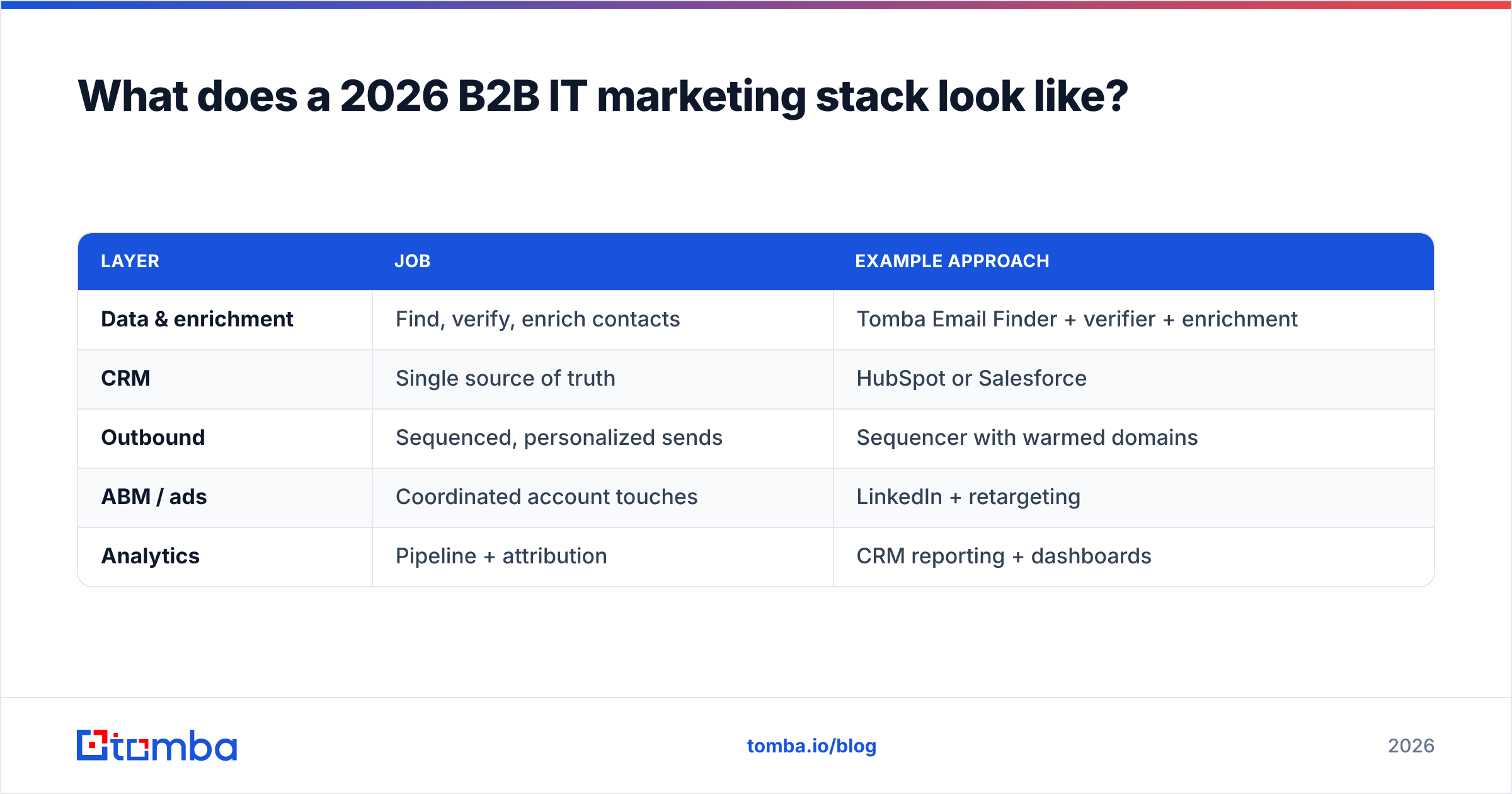
You don't need forty tools. You need a tight stack across five jobs, with clean data flowing between them.
| Layer | Job | Example approach |
|---|---|---|
| Data & enrichment | Find, verify, enrich contacts | Tomba Email Finder + verifier + enrichment |
| CRM | Single source of truth | HubSpot or Salesforce |
| Outbound | Sequenced, personalized sends | Sequencer with warmed domains |
| ABM / ads | Coordinated account touches | LinkedIn + retargeting |
| Analytics | Pipeline + attribution | CRM reporting + dashboards |
The connective tissue is data. If your enrichment feeds clean records into your CRM, your outbound and ABM both improve automatically, and your analytics stop lying to you. Tomba slots into the first layer and pushes into the rest through integrations with HubSpot, Salesforce, Pipedrive, and Zapier, plus a Tomba API for custom pipelines. For teams watching budget, the Tomba pricing starts free (25 searches/mo) and scales from $49/mo, which keeps the foundational layer affordable while you prove the motion.
Common mistakes that kill IT campaigns#
- Treating IT as one persona — the security veto alone justifies committee-level messaging.
- Skipping verification — sending to unverified lists burns domain reputation you can't quickly rebuild.
- Over-relying on broad paid social — technical buyers tune out interruptive ads; reserve paid for retargeting known accounts.
- Selling in developer communities — add value or stay out; a sales pitch on Hacker News backfires publicly.
- Chasing MQL volume — a thousand low-fit leads cost more to process than they ever return.
- Ignoring the champion — without internal enablement, even an interested account stalls at the committee.
Getting started: a 30-day plan#
If you're rebuilding an IT marketing motion from scratch, sequence it like this:
- Week 1 — Fix the data. Build and verify a target-account contact list. Map committees with domain search before anything else.
- Week 2 — Build role-specific assets. One credible piece each for the evaluator, the economic buyer, and the security reviewer.
- Week 3 — Launch focused outbound + ABM to a tight account list, multi-threaded across email and LinkedIn.
- Week 4 — Instrument measurement. Track pipeline, account engagement, deliverability, and reply rate. Cut what isn't working.
Small, accurate, and well-measured beats big, sloppy, and unattributed every time in this market.
Where Tomba fits#
B2B IT marketing lives or dies on data accuracy, and that's exactly the layer Tomba owns. Before you spend a dollar on ABM, ads, or outbound, you need real emails for real decision-makers across each target account — verified, enriched, and ready to route into your CRM. The Tomba Email Finder finds professional emails by domain, name, or company, the verifier keeps your sender reputation intact, and enrichment turns raw contacts into committee-ready leads. Start on the free tier, map a handful of target accounts, and see how much further your campaigns go when the foundation is clean. Build the data layer first — everything else in your IT marketing stack gets cheaper and sharper once you do.
// get started
Find, verify and enrich your first contacts today
Start on the free plan with 25 searches a month, then scale when your team is ready.
Free plan · No credit card required · GDPR & CCPA
// about the author