B2B Lead Generation Platform: The 2026 Buyer's Guide
A B2B lead generation platform should fill your pipeline with contactable, accurate leads — not vanity counts. Here's how the categories compare and how to pick one in 2026.
TL;DR
- A B2B lead generation platform is software that finds, enriches, verifies, and routes prospect data into your outreach and CRM — the engine behind a repeatable pipeline.
- No single product wins every category. Data providers, prospecting tools, outreach sequencers, and visitor-reveal tools solve different jobs; most teams combine two or three.
- The metric that actually moves revenue is deliverable accuracy (verified emails and phones), not raw database size.
- Budget realistically: usable stacks start around $49–$99/mo per tool and scale with seats and credits.
- Use the 6-step selection framework at the end to avoid paying for inflated record counts you can't email.
What is a B2B lead generation platform?#
A B2B lead generation platform is the system that turns "we need more pipeline" into a list of real people you can actually contact. Think of it like a water system for sales: a reservoir (the database), pipes (enrichment and verification), and taps (outreach and CRM sync). If any stage leaks, the water never reaches the field — and most teams have leaks they can't see.
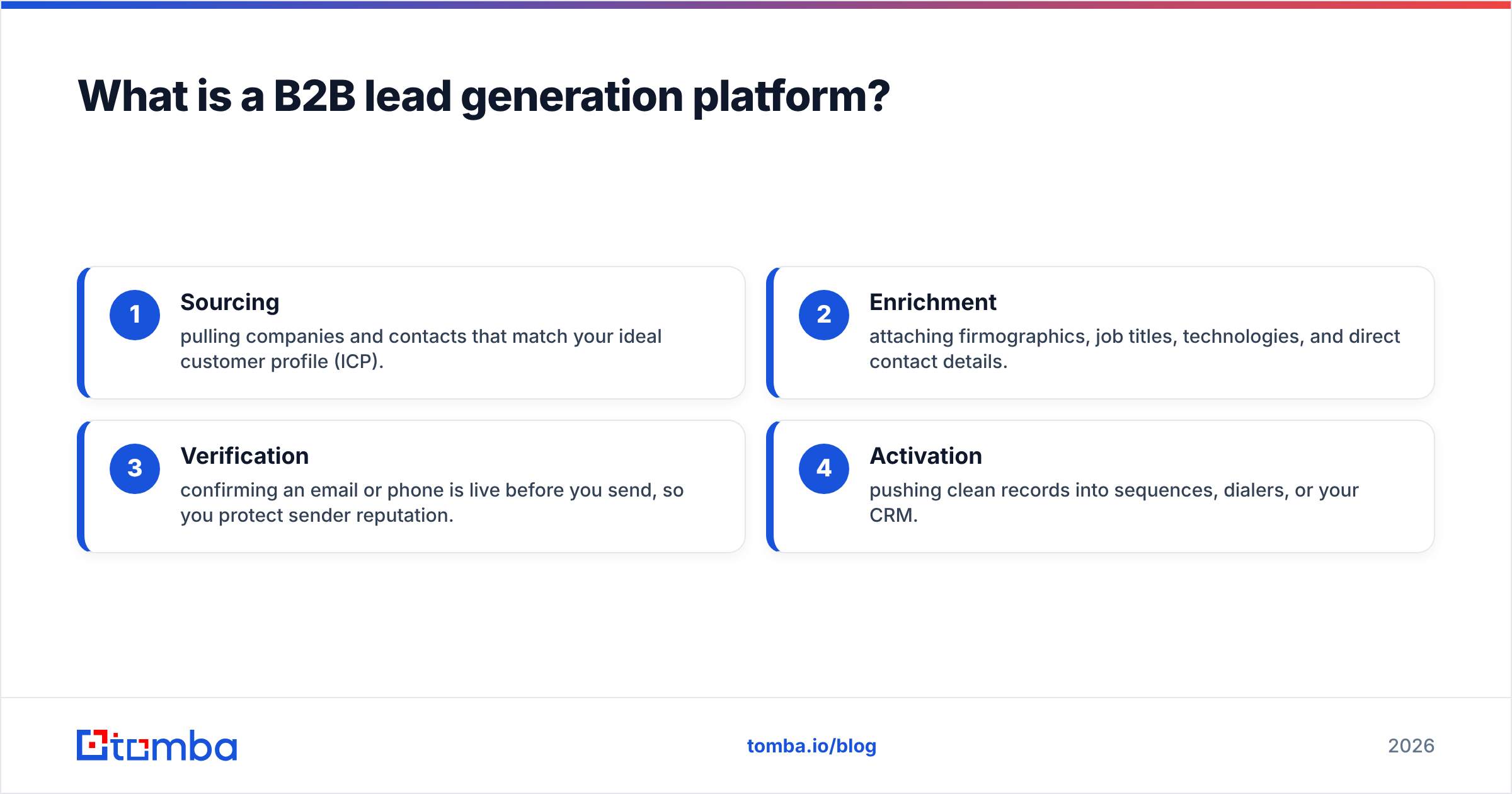
Technically, these platforms cluster into four jobs:
- Sourcing — pulling companies and contacts that match your ideal customer profile (ICP).
- Enrichment — attaching firmographics, job titles, technologies, and direct contact details.
- Verification — confirming an email or phone is live before you send, so you protect sender reputation.
- Activation — pushing clean records into sequences, dialers, or your CRM.
The mistake buyers make is assuming one logo does all four equally well. It rarely does. A tool with 200M contacts can still hand you a 30% bounce rate if its verification is weak. Conversely, a precise email finder paired with a separate sequencer often beats an all-in-one suite on cost-per-meeting.
)
What are the main types of B2B lead generation platforms?#
Before comparing brands, sort the market by the job each category does. You'll likely need more than one, and knowing the categories keeps you from overpaying for overlap.
- Sales intelligence databases — Apollo, ZoomInfo, Cognism. Huge contact graphs with filters, intent signals, and built-in sequencing. Strong for volume; pricing and data freshness vary widely.
- Email finders and verifiers — tools that resolve a name + domain into a verified work email, or check a list before you send. This is where deliverability is won or lost. Tomba's email finder and email verifier sit here.
- Outreach and sequencing — Instantly, Smartlead, Salesloft, Outreach. They send and track multi-step campaigns but assume you bring clean data.
- Website visitor reveal — tools that de-anonymize traffic so you can reach warm accounts. See Tomba's website visitor reveal.
- Enrichment and routing — Clearbit-style services and APIs that fill gaps in records you already own.
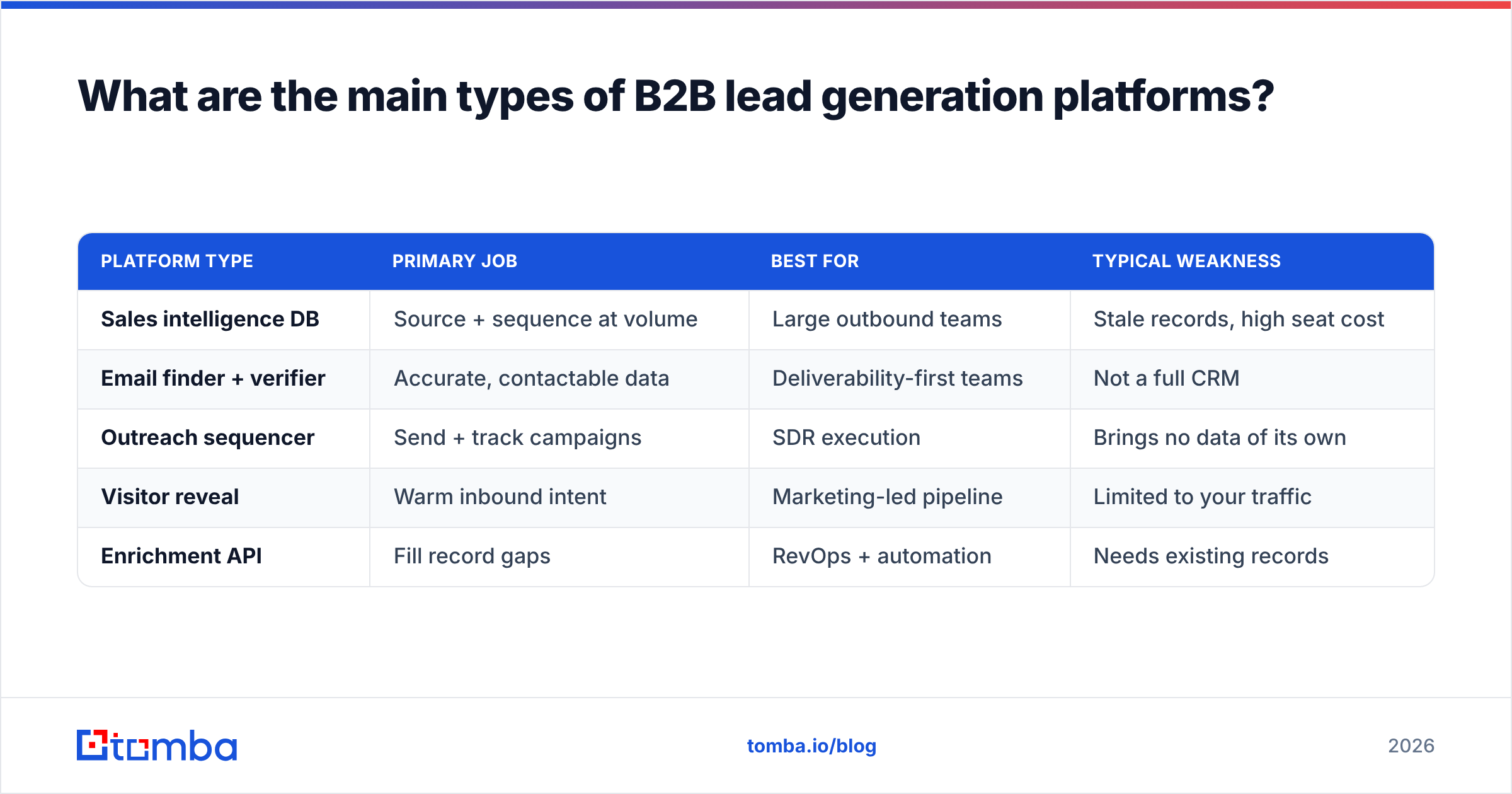
Here's how the categories stack up on the dimensions that decide fit.
| Platform type | Primary job | Best for | Typical weakness |
|---|---|---|---|
| Sales intelligence DB | Source + sequence at volume | Large outbound teams | Stale records, high seat cost |
| Email finder + verifier | Accurate, contactable data | Deliverability-first teams | Not a full CRM |
| Outreach sequencer | Send + track campaigns | SDR execution | Brings no data of its own |
| Visitor reveal | Warm inbound intent | Marketing-led pipeline | Limited to your traffic |
| Enrichment API | Fill record gaps | RevOps + automation | Needs existing records |
Read this table as a shopping list, not a leaderboard. A marketing-led team with strong inbound buys visitor reveal plus enrichment; an outbound-heavy team buys a finder plus a sequencer. Few teams need all five.
Why does data accuracy matter more than database size?#
Accuracy is the whole game, because an email you can't deliver is worth exactly zero — and a bad one costs you more than zero. Every hard bounce chips away at your sender reputation, and once mailbox providers flag you, even your good emails land in spam. A database of 250M contacts means nothing if a third of them bounce.
Vendors love to advertise total record counts because it's the easiest number to grow and the hardest to audit. What you should ask instead:
- What's the verified-deliverable rate on a sample of my actual ICP, not a vendor demo?
- How is data refreshed — continuous re-verification, or a one-time scrape from years ago?
- Are catch-all domains flagged rather than guessed? A catch-all verifier tells you when a domain accepts everything, so you don't treat a guess as a confirmation.
- Where does the data come from? Transparency about data sources is a proxy for quality and compliance.
The practical test is cheap: pull 100 contacts from any platform's free tier, run them through an independent email verifier, and measure the real bounce risk before you sign an annual contract. Most "200M contact" pitches don't survive that test.
According to G2's category data, buyers consistently rank data accuracy and contact-level coverage above raw volume — yet pricing pages keep selling volume. Don't be anchored by it.
How do the leading B2B lead generation platforms compare on price?#
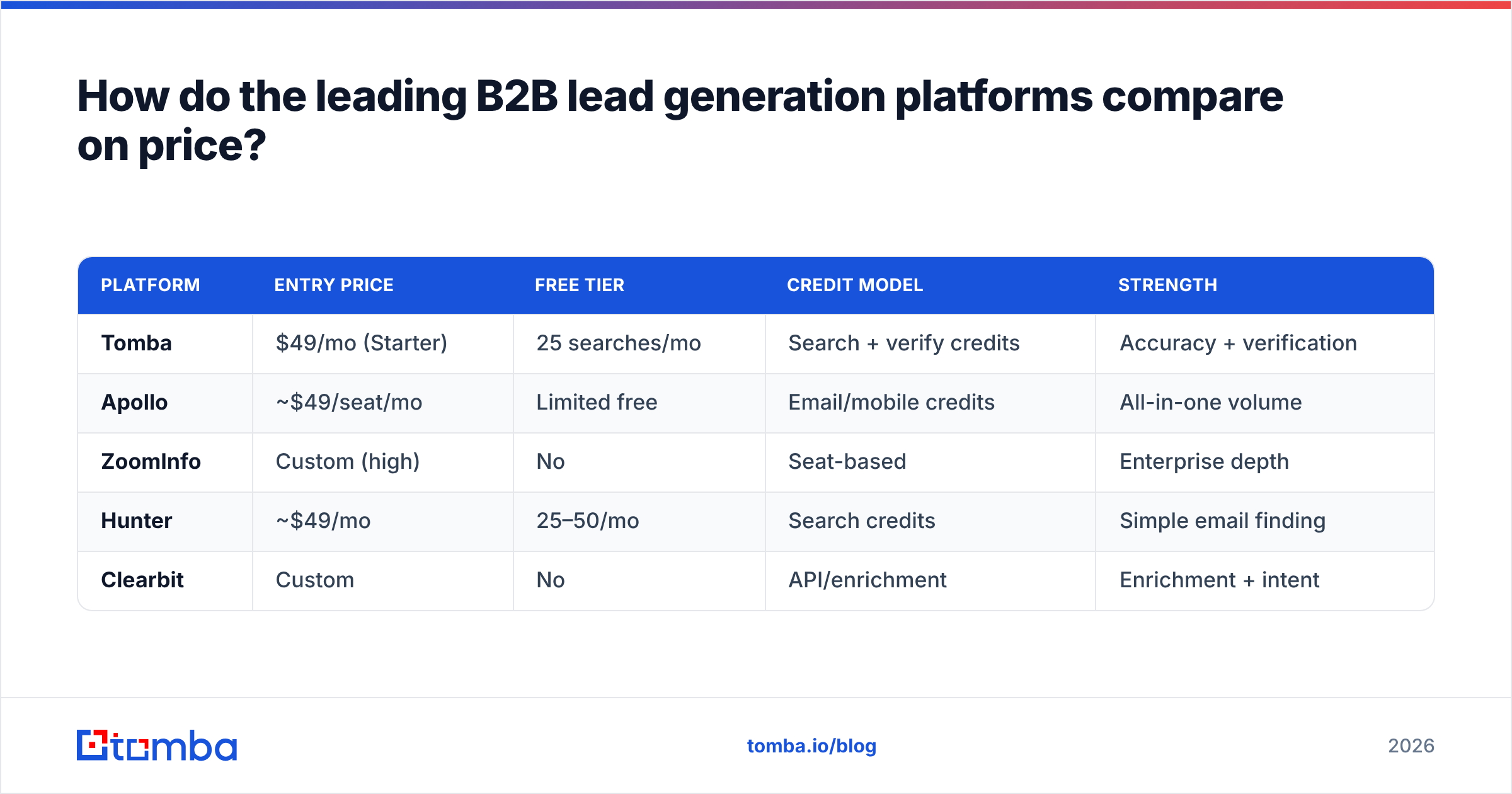
Pricing models are deliberately hard to compare: some charge per seat, some per credit, some per verified record. The table below normalizes the entry points so you can see what an honest starting budget looks like in 2026. Always confirm current numbers on each vendor's own pricing page, since tiers change.
| Platform | Entry price | Free tier | Credit model | Strength |
|---|---|---|---|---|
| Tomba | $49/mo (Starter) | 25 searches/mo | Search + verify credits | Accuracy + verification |
| Apollo | ~$49/seat/mo | Limited free | Email/mobile credits | All-in-one volume |
| ZoomInfo | Custom (high) | No | Seat-based | Enterprise depth |
| Hunter | ~$49/mo | 25–50/mo | Search credits | Simple email finding |
| Clearbit | Custom | No | API/enrichment | Enrichment + intent |
A few honest takeaways. Tomba's pricing runs Free (25 searches/mo), Starter $49/mo, Growth $99/mo, Pro $249/mo, and Enterprise custom — credit-based so you pay for finding and verifying, not for seats you don't use. Apollo bundles sequencing, which is convenient but means you're partly paying for outreach you may already run elsewhere. ZoomInfo is powerful and expensive enough that mid-market teams often can't justify it. Hunter is close to Tomba in simplicity; the differentiator is verification depth and API breadth.
If you're replacing a specific incumbent, Tomba publishes side-by-side breakdowns like its Apollo alternative and Clearbit alternative pages — useful for matching feature-to-feature before you migrate.
)
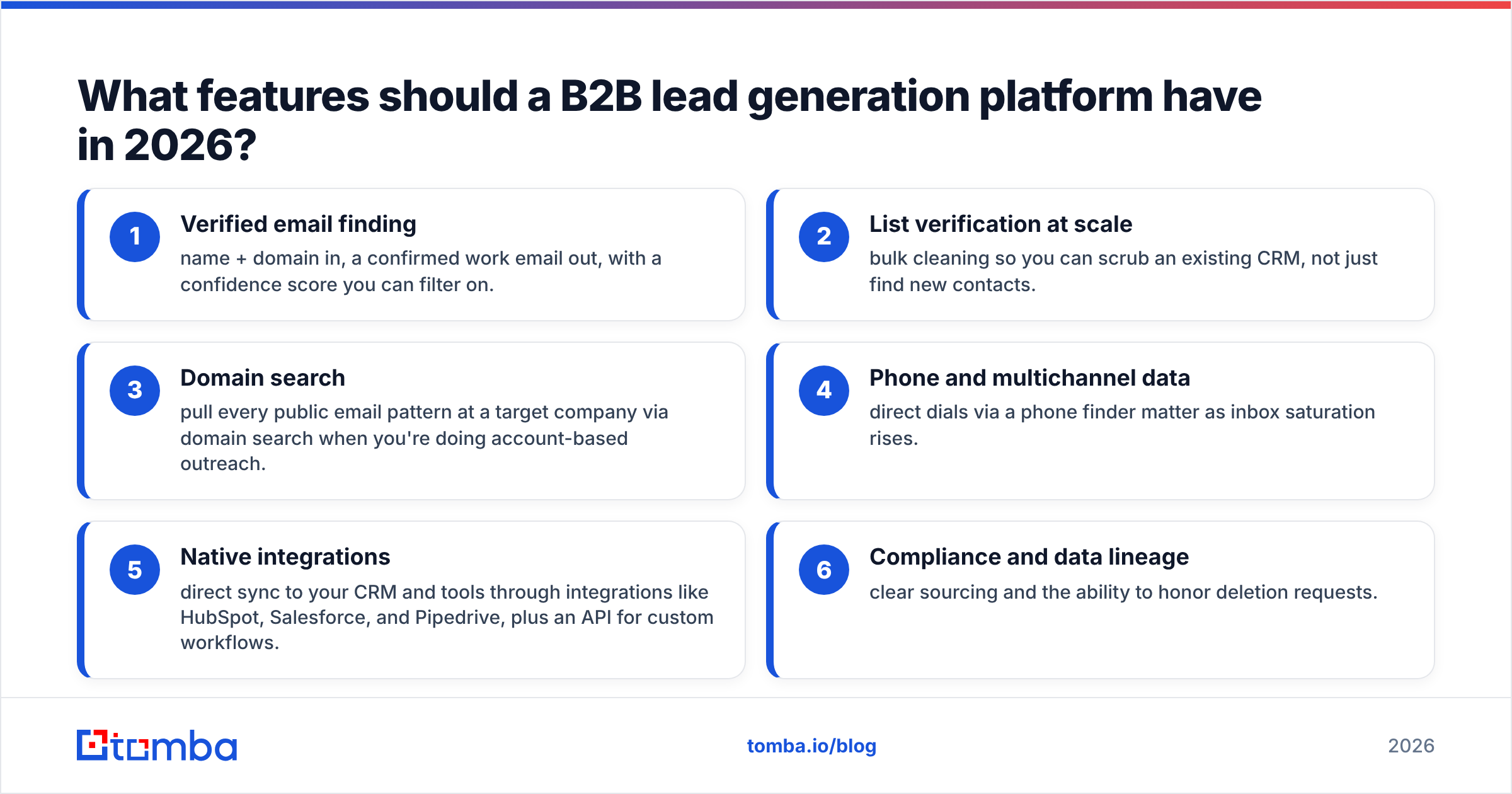
What features should a B2B lead generation platform have in 2026?#
The feature list below is the difference between a tool that looks good in a demo and one that survives a quarter of real sending. Use it as a checklist when you trial.
- Verified email finding — name + domain in, a confirmed work email out, with a confidence score you can filter on.
- List verification at scale — bulk cleaning so you can scrub an existing CRM, not just find new contacts.
- Domain search — pull every public email pattern at a target company via domain search when you're doing account-based outreach.
- Phone and multichannel data — direct dials via a phone finder matter as inbox saturation rises.
- Native integrations — direct sync to your CRM and tools through integrations like HubSpot, Salesforce, and Pipedrive, plus an API for custom workflows.
- Compliance and data lineage — clear sourcing and the ability to honor deletion requests.
If a platform nails 1, 2, and 6, it will outperform a flashier suite that's weak on verification. Deliverability compounds: clean data this month protects every campaign next quarter.
Is an all-in-one suite or a best-of-breed stack better?#
It depends on your team's size and where your pipeline comes from — but for most teams under ~50 reps, a focused best-of-breed stack wins on cost and accuracy. An all-in-one suite is like a hotel buffet: convenient, everything in one place, but rarely the best version of any single dish. A best-of-breed stack is like assembling a meal from specialists — more setup, better results.
The decision usually comes down to three questions:
- Do you already own a sequencer or CRM you like? If yes, you don't need a suite to bundle one. Buy a strong data layer (finder + verifier) and connect it.
- How outbound-heavy are you? Heavy outbound rewards a dedicated finder/verifier because deliverability is existential. Lighter, inbound-led teams lean on visitor reveal and enrichment.
- What's your tolerance for vendor lock-in? Suites make migration painful; modular stacks let you swap one component without ripping out the whole pipeline.
A common, durable 2026 stack: a verification-first data tool (find and clean contacts), a sequencer you already trust, and your existing CRM, glued with an API or Zapier. It costs less than one enterprise seat of a major suite and gives you better control over the one thing that matters most — whether your emails actually arrive.
How do you choose: a 6-step selection framework#
Run every candidate through these six steps in order. Stop at any step a vendor fails — the later steps don't matter if the data is bad.
- Define your ICP precisely. Industries, titles, company sizes, regions. A platform's value is only its coverage of your segment, not the world.
- Test accuracy on a real sample. Pull 100 of your ICP contacts on a free tier and verify them independently. Demand a deliverable rate, not a record count.
- Check the activation path. Confirm native sync to your CRM and sequencer. If it needs a fragile workaround, factor that cost in.
- Model true cost. Multiply credits or seats by realistic monthly volume. Cheap-per-credit tools get expensive at scale, and vice versa.
- Audit compliance. Confirm data sourcing and deletion handling so you're not buying future legal risk.
- Pilot for 30 days, measure cost-per-meeting. Not opens, not "leads" — booked meetings. That single number ends most debates.
The teams that follow this rarely overpay, because step 2 quietly disqualifies the inflated-database vendors before procurement ever sees a contract.
Frequently asked questions#
What is the difference between a lead generation platform and a CRM? A lead generation platform creates and verifies contacts; a CRM stores and manages the relationship after contact. They're complements — the platform feeds the CRM. Many teams wrongly expect one to do the other's job.
Can I generate B2B leads for free? Partially. Most quality platforms, including Tomba, offer a free tier (25 searches/mo) so you can validate fit before paying. Free tools are great for spot-checks and small tests, but sustained pipeline needs paid credits.
How many leads do I actually need? Fewer, more accurate leads beat large, unverified lists every time. A reply-driven funnel with a healthy response rate on 500 verified contacts outperforms 5,000 guesses that wreck your deliverability.
Does buying email lists work? Almost never. Purchased lists are stale, shared across buyers, and bounce-prone. Finding and verifying contacts on demand is both more accurate and more compliant.
The bottom line#
A B2B lead generation platform is only as good as the leads it can actually deliver to a real inbox. Database size is marketing; verified, contactable data is revenue. Sort the market by job, test accuracy on your own ICP, and build a modular stack you can adjust as you scale.
If accuracy is your priority — and it should be — start with the data layer. The Tomba Email Finder turns a name and domain into a verified work email, backs it with a confidence score, and connects to your CRM through native integrations and an open API. Spin up the free tier (25 searches/mo), run the 100-contact accuracy test from step 2, and let the deliverable rate make the decision for you. Clean data first; everything else in your pipeline gets easier from there.
Ready to find emails that actually work?
Join 150,000+ professionals who stopped guessing and started sending. Free credits on signup — no credit card required.
Get the Tomba newsletter
Practical outbound tactics and product updates — once every two weeks.
About the author