The B2B Lead Generation Process: A 7-Step Framework for 2026
A repeatable, 7-step B2B lead generation process beats random prospecting every time. Here is the framework that fills pipeline in 2026.
TL;DR
- A b2b lead generation process is a repeatable, stage-by-stage system for turning strangers into qualified pipeline — not a one-off campaign.
- The seven stages: define your ICP, source raw contacts, enrich and verify data, score and prioritize, run multichannel outreach, hand off to sales, and measure to improve.
- Bad data sinks the whole process. Verifying emails before you send protects sender reputation and keeps bounce rates low.
- Tools matter at specific steps, not everywhere. Match the tool to the stage instead of buying one bloated platform.
- Track conversion at each handoff (lead → MQL → SQL → opportunity) so you can fix the leakiest stage first.
What is the B2B lead generation process?#
The b2b lead generation process is the repeatable workflow a revenue team uses to find, qualify, and convert business buyers into sales-ready opportunities. Think of it like a water treatment plant: raw water (cold contacts) enters one end, passes through a series of filters (enrichment, verification, scoring), and clean, drinkable water (qualified leads) comes out the other. Skip a filter and you ship contaminated leads straight to your sales team — who then waste hours on people who will never buy.
The difference between "lead generation" as a vague activity and a process is repeatability. A process has defined inputs, named stages, owners for each stage, and metrics at every handoff. That structure is what lets you forecast pipeline instead of hoping for it.
Most teams that struggle with lead gen do not have a creativity problem. They have a process problem: they buy a list, blast it, get a 0.4% reply rate, blame the channel, and start over. The framework below fixes that by treating each stage as a control point you can measure and optimize independently.
What are the stages of the B2B lead generation process?#
Here is the end-to-end flow. Each stage feeds the next, and each one has a clear "definition of done" before a lead moves forward.
- Define the Ideal Customer Profile (ICP). Firmographics (industry, headcount, revenue, geography), technographics (tools they run), and trigger events (funding, hiring, leadership change). Without this, every later stage compounds the wrong targeting.
- Source raw contacts. Pull companies and people matching the ICP from databases, domain search, LinkedIn, events, and inbound forms.
- Enrich and verify. Append missing fields (role, email, phone, company size) and validate every email before it touches your sending domain.
- Score and prioritize. Rank leads by fit and intent so reps work the hottest accounts first instead of the alphabetical top of the list.
- Engage across channels. Run coordinated email, phone, and LinkedIn sequences tailored to the persona and trigger.
- Qualify and hand off. Apply a framework (BANT, MEDDIC) so only sales-ready leads reach an AE, with full context attached.
- Measure and refine. Track stage-to-stage conversion, attribute closed revenue back to source, and reinvest in what works.
That ordered list is your operating manual. The rest of this article unpacks the stages where teams most often leak pipeline.

How do you define an ICP that actually filters?#
Start narrow, then widen. The most common ICP mistake is defining a profile so broad ("B2B SaaS companies in North America") that it filters nothing. A useful ICP is specific enough that you can disqualify a company in under ten seconds.
Build it from your existing best customers, not your aspirations. Pull your closed-won deals from the last 12 months, find what the top 20% by retention and contract value have in common, and write that down. You are reverse-engineering the pattern of buyers who already proved they get value.
A workable ICP has three layers:
- Firmographic: "Series B–C B2B SaaS, 50–500 employees, US/UK/Canada." These are the hard filters.
- Technographic: "Runs HubSpot or Salesforce, uses a dedicated SDR tool." Use a website tech stack check to confirm.
- Behavioral / trigger: "Hired a VP of Sales in the last 90 days" or "just raised a round." Triggers tell you when to reach out, which beats who almost every time.
Document the disqualifiers too. Knowing who is not your buyer (free-tier-only users, companies under 10 people, certain regions you can't service) saves more time than any sourcing tool.
Where do you source raw B2B contacts?#
Once the ICP is locked, sourcing becomes a search problem. The five reliable channels, ranked by control:
- Contact databases — query by firmographic filters and export matching companies and people. Best for repeatable, ICP-driven volume.
- Domain search — give a company domain, get the people and email patterns behind it. Ideal once you have a target account list. Tomba's find email addresses tools cover this directly.
- LinkedIn / Sales Navigator — strongest for role-level targeting and trigger events; pair it with a LinkedIn finder to resolve business emails.
- Inbound + website visitors — capture form fills and de-anonymize traffic to catch buyers already researching you.
- Events, communities, referrals — lower volume, higher intent, almost no data-cleaning overhead.
The trap here is volume worship. A list of 10,000 loosely-matched contacts performs worse than 500 tightly-matched ones, because the loose list trains spam filters to distrust your domain and burns rep hours on dead ends. Source for fit, then enrich for accuracy.
Why does data enrichment and verification make or break the process?#
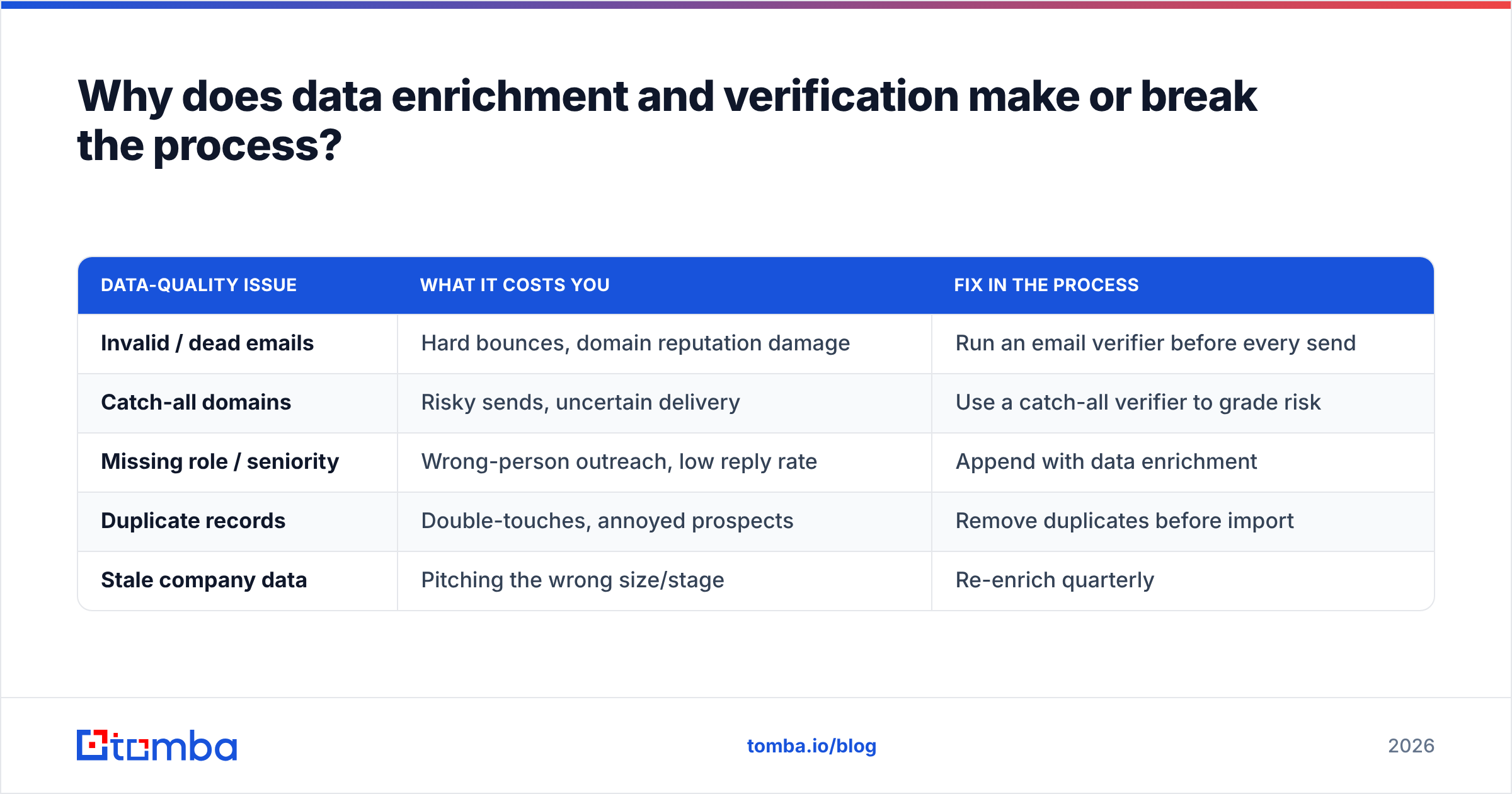
Because everything downstream runs on this data, and dirty data fails silently. A 25% bounce rate doesn't just waste a quarter of your sends — it tells inbox providers your domain is careless, which then suppresses delivery of the valid 75%. One bad stage poisons the rest of the funnel.
Enrichment fills the gaps your sourcing left: missing titles, company size, direct dials, social profiles. Verification confirms the contact is real and reachable before you send. Run both, in that order, on every batch.
| Data-quality issue | What it costs you | Fix in the process |
|---|---|---|
| Invalid / dead emails | Hard bounces, domain reputation damage | Run an email verifier before every send |
| Catch-all domains | Risky sends, uncertain delivery | Use a catch-all verifier to grade risk |
| Missing role / seniority | Wrong-person outreach, low reply rate | Append with data enrichment |
| Duplicate records | Double-touches, annoyed prospects | Remove duplicates before import |
| Stale company data | Pitching the wrong size/stage | Re-enrich quarterly |
For large lists, do this in batches rather than one record at a time — a bulk email finder and bulk verifier turn a multi-day chore into a coffee break. The rule of thumb: never let an unverified email reach your sequencing tool. Verification is the cheapest insurance in the entire b2b lead generation process.
How should you score and prioritize leads?#
Score on two axes: fit (how well they match the ICP) and intent (how actively they're showing buying signals). A simple 1–10 score on each, multiplied or charted on a 2x2, tells a rep exactly where to spend the next hour.
- High fit + high intent: call today. These are your SQLs in waiting.
- High fit + low intent: nurture with relevant content until a trigger fires.
- Low fit + high intent: be polite but don't over-invest; they often churn fast.
- Low fit + low intent: disqualify and remove. Don't let them clog the pipeline.
Intent signals worth scoring: pricing-page visits, repeat website sessions, content downloads, job-posting changes, and funding events. The point of scoring isn't precision — it's sequencing. You will never have time to work every lead equally, so the process decides order for you.

What does effective multichannel outreach look like?#
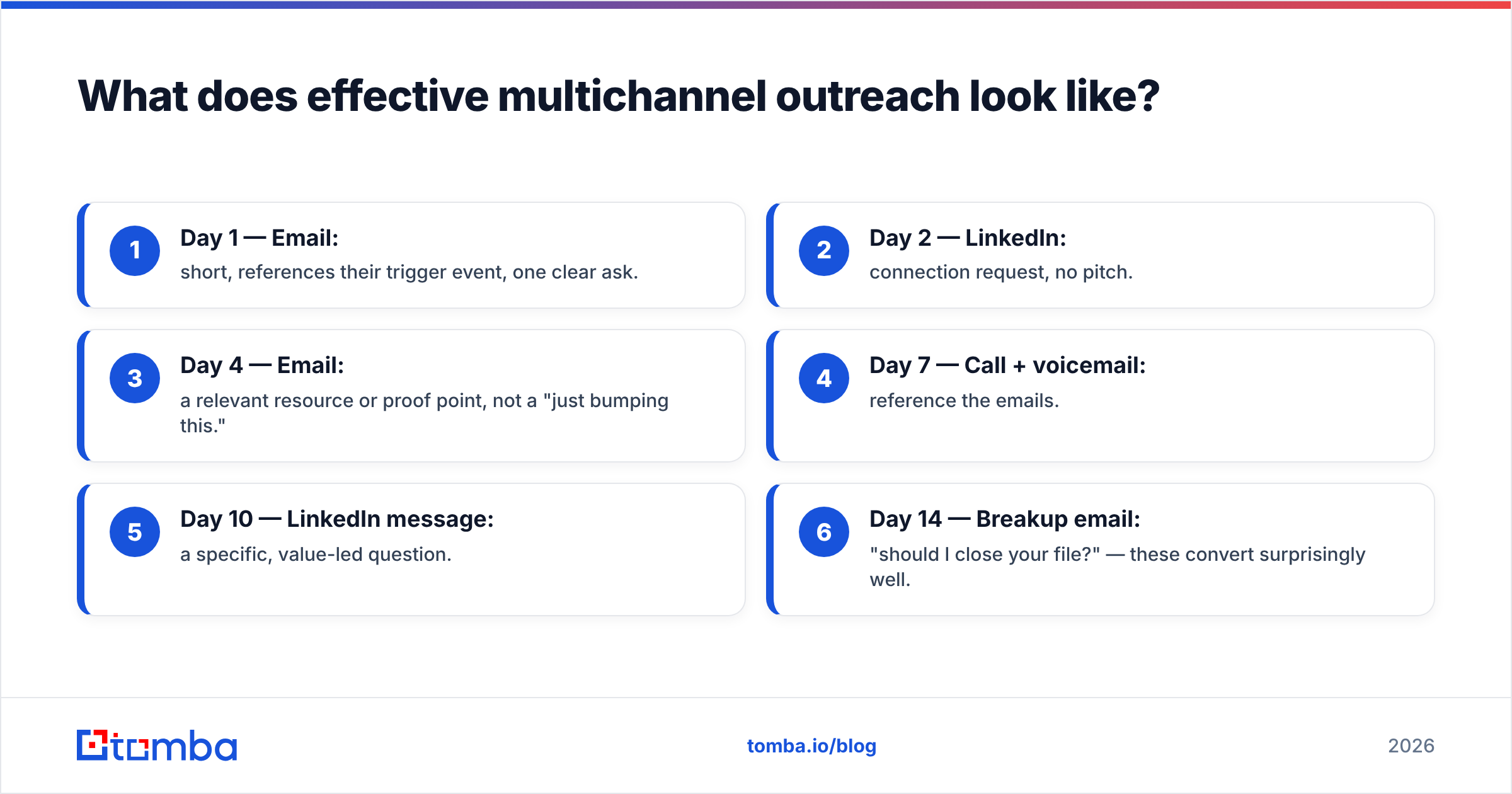
Coordinated, not scattered. A buyer who sees a relevant email, then a connection request that references the same trigger, then a well-timed call, experiences one coherent message across three touchpoints — not three interruptions. According to HubSpot's sales research, persistence across channels and touches dramatically outperforms single-channel one-shots.
A clean B2B sequence over ~14 business days:
- Day 1 — Email: short, references their trigger event, one clear ask.
- Day 2 — LinkedIn: connection request, no pitch.
- Day 4 — Email: a relevant resource or proof point, not a "just bumping this."
- Day 7 — Call + voicemail: reference the emails.
- Day 10 — LinkedIn message: a specific, value-led question.
- Day 14 — Breakup email: "should I close your file?" — these convert surprisingly well.
Personalization is what separates this from spam. Use the enriched fields you already collected — role, company stage, tech stack — to make the first line obviously human. If you're sending cold email at any volume, protect deliverability first: warm the domain, authenticate with SPF, and keep your email deliverability healthy. Even perfect copy fails from the spam folder.
How do you qualify leads and hand them to sales?#
Use a shared qualification framework so "qualified" means the same thing to marketing and sales. BANT (Budget, Authority, Need, Timeline) is the simplest; MEDDIC is heavier and better for complex deals. Pick one, write the definition down, and make it the gate between marketing and sales.
The handoff itself is where deals die quietly. A lead that reaches an AE without context — no notes on why they're a fit, what trigger surfaced them, or what's been said — gets treated as cold again, and the prospect feels it. Attach the full record: source, enriched fields, score, every touch, and the qualification notes. A tight handoff is the difference between a win rate that compounds and one that stalls.
How do you measure and improve the process?#
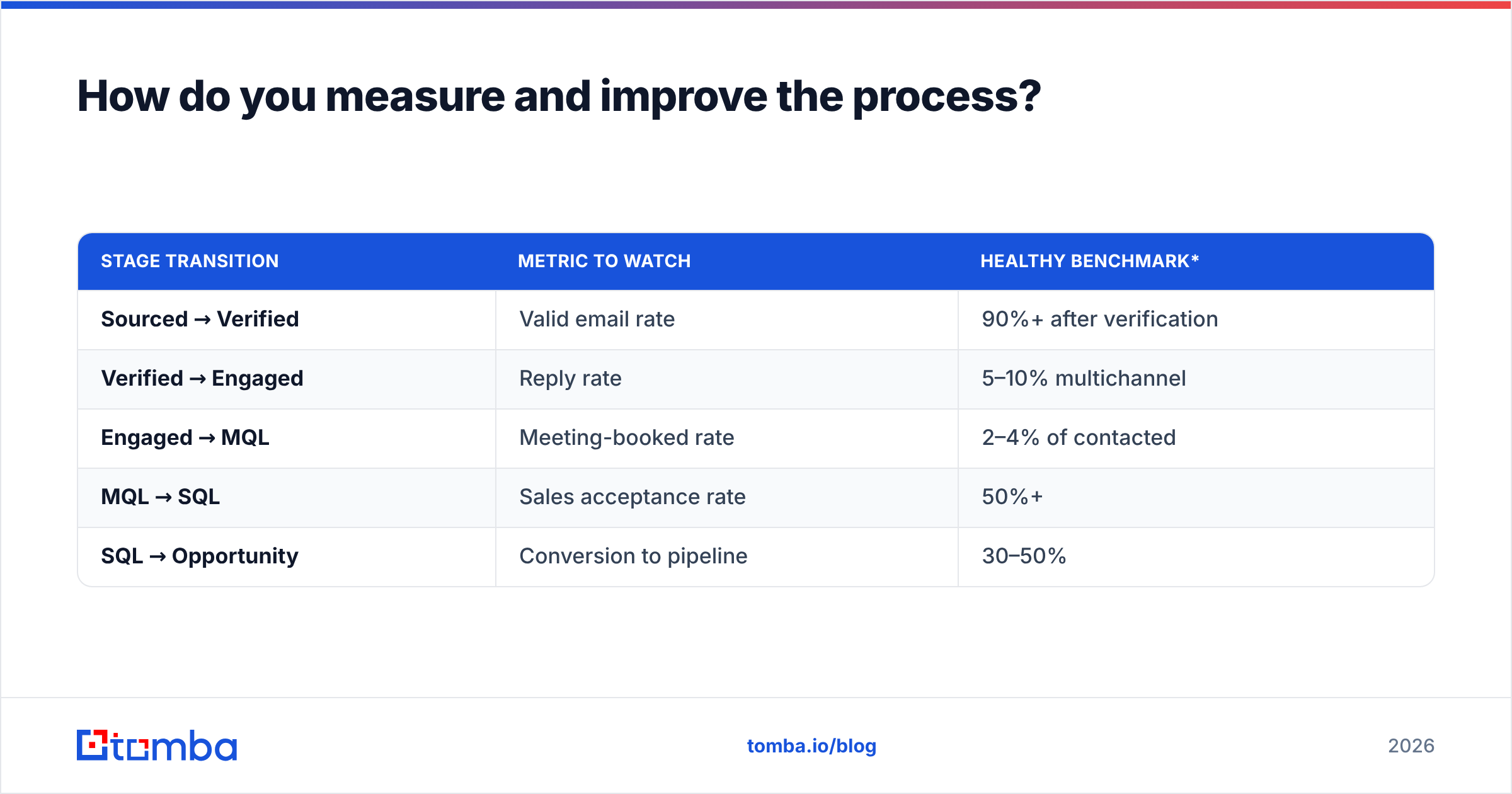
Measure conversion at every handoff, not just the final close. The funnel has predictable choke points, and you can only fix the one you can see.
| Stage transition | Metric to watch | Healthy benchmark* |
|---|---|---|
| Sourced → Verified | Valid email rate | 90%+ after verification |
| Verified → Engaged | Reply rate | 5–10% multichannel |
| Engaged → MQL | Meeting-booked rate | 2–4% of contacted |
| MQL → SQL | Sales acceptance rate | 50%+ |
| SQL → Opportunity | Conversion to pipeline | 30–50% |
*Benchmarks vary by industry and deal size; track your own baseline and improve against it.
Find your leakiest transition and fix that one first. If reply rates are fine but acceptance is low, your scoring or ICP is off. If valid email rate is low, your sourcing or verification step needs work. Attribute closed revenue back to its original source so you know which channels to fund. Tools like G2 can help you benchmark the tooling at each stage as you scale. The process is never "done" — it's a loop you tighten every quarter.
Which tools fit which stage?#
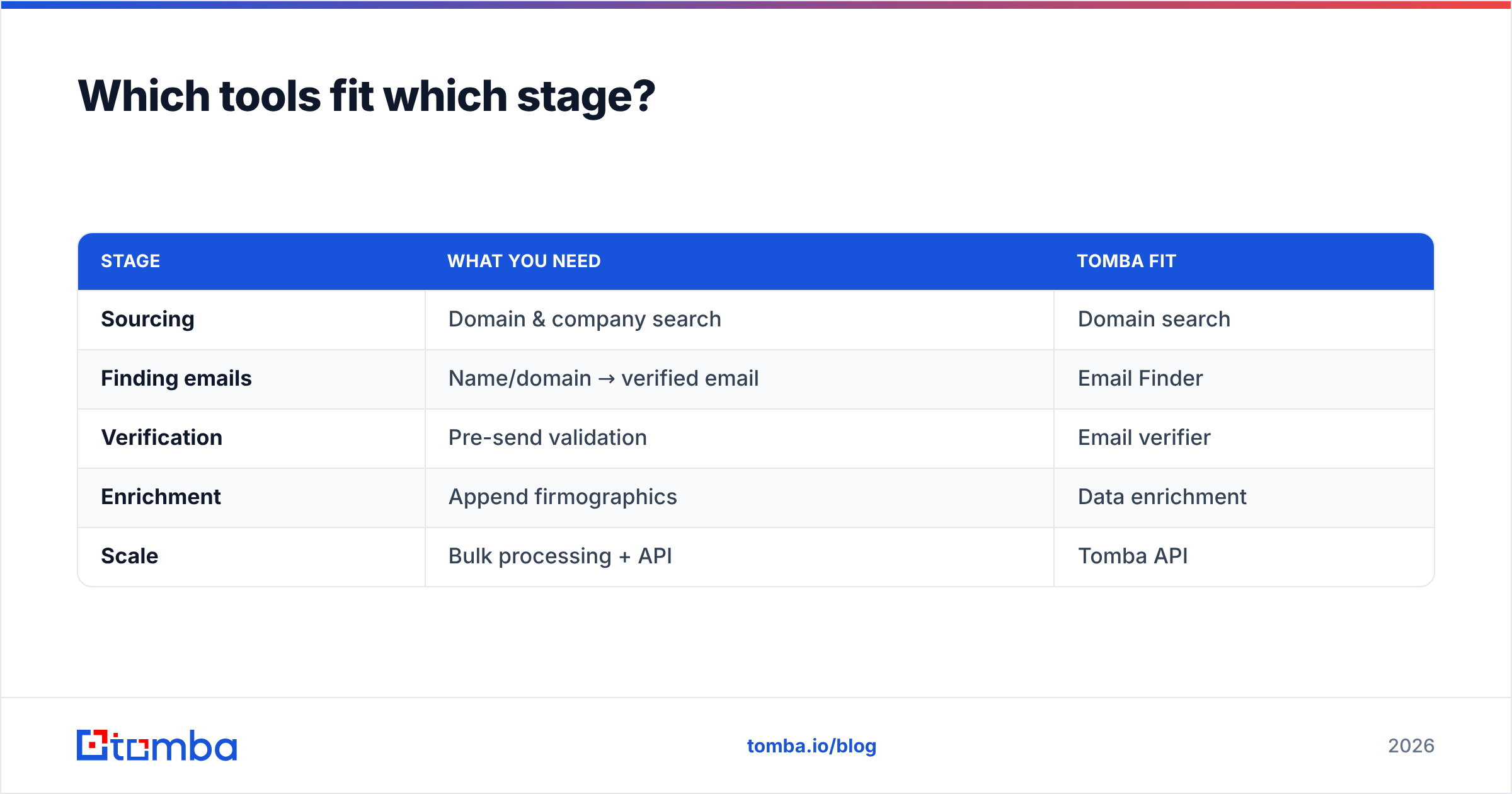
You don't need one mega-platform. Match the tool to the stage and you'll spend less and get cleaner data. For sourcing and enrichment, compare options the same way you'd compare any vendor — and if you're evaluating an all-in-one, check honest breakdowns like an Apollo alternative comparison before committing.
| Stage | What you need | Tomba fit |
|---|---|---|
| Sourcing | Domain & company search | Domain search |
| Finding emails | Name/domain → verified email | Email Finder |
| Verification | Pre-send validation | Email verifier |
| Enrichment | Append firmographics | Data enrichment |
| Scale | Bulk processing + API | Tomba API |
On cost: Tomba runs a free tier (25 searches/month), with paid plans starting at $49/mo (Starter), $99/mo (Growth), and $249/mo (Pro). Full Tomba pricing scales with search and verification volume, so you pay for the stages you actually use rather than a seat-based platform fee.
Build your process on data you can trust#
A b2b lead generation process is only as strong as the data flowing through it. The smartest framework in the world still fails if a quarter of your emails bounce and your domain lands in spam. Start at the foundation: source contacts that match a tight ICP, then verify and enrich every one before it enters a sequence.
That's exactly where the Tomba Email Finder fits. Find verified professional emails by name, domain, or company, append the firmographics your scoring needs, and feed your outreach clean, deliverable contacts from day one. Spin up a free account, run your first ICP-matched list through the finder and verifier, and watch your bounce rate — and your sales team's trust in the pipeline — climb. Build the process once, fuel it with accurate data, and the leads stop being a gamble.
// get started
Find, verify and enrich your first contacts today
Start on the free plan with 25 searches a month, then scale when your team is ready.
Free plan · No credit card required · GDPR & CCPA
// about the author